D/A (Documents against Acceptance)
Automatically translated from Korean.
One-line definition — D/A (Documents against Acceptance) is a payment term under which the bank releases the shipping documents when the importer accepts the bill of exchange, while payment is made at maturity.
Other names: DA · Documents against Acceptance
In simple terms
D/A means “sign, receive the documents first, and pay at maturity.” The exporter presents the shipping documents and a usance bill of exchange through the bank. Once the importer accepts the bill of exchange (signing a promise to pay at maturity), the importer receives the documents. Payment is made on the maturity date specified in the bill. At the destination, the B/L included in the shipping documents must be surrendered to claim delivery of the cargo. Therefore, the importer can take delivery of the cargo before making payment.
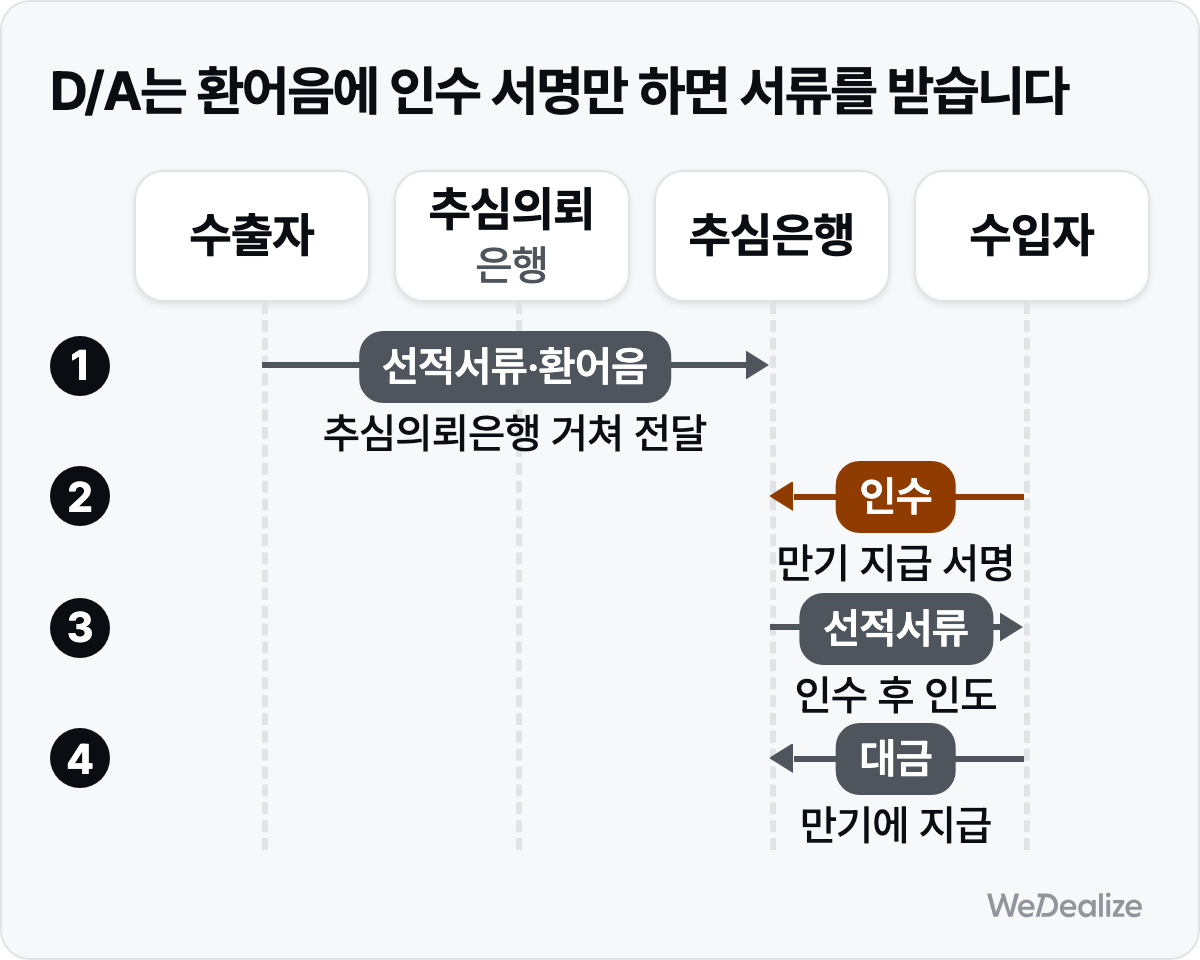
When is it needed?
When a long-standing business relationship has built mutual trust — The exporter accepts terms that are close to a credit sale.
When the importer wants to pay using the sales proceeds — The importer receives and sells the goods first, then pays at maturity.
When managing the maturity of an accepted bill — The importer prepares the payment according to the maturity date.
Example
Representative Kim imports 3,000 tumblers from a Chinese factory with which he has been doing business for three years, under “D/A 60 days” terms. When the documents arrive at the bank handling the transaction, Representative Kim signs an acceptance on the bill of exchange and receives the B/L. He takes delivery of the cargo, sells it over the next two months, and pays USD 20,000 to the bank on the maturity date. The bank remits the payment to the Chinese factory’s bank.
The quantity, amount, and period in this example are assumed values for explanatory purposes.
Common points of confusion
“With D/A, the bank guarantees payment at maturity.” — No. The obligation to pay at maturity lies with the importer who accepted the bill. The bank presents and delivers the documents according to the collection instructions.
“Once I accept the bill, I can delay payment.” — No. An accepted bill must be paid at maturity.
Related terms
D/P (Documents against Payment) — A collection-based payment term under which the bank releases the shipping documents only after the importer makes payment.
Payment terms — An agreement made with the trading partner specifying when and how payment for the goods will be made.
Bill of exchange — The bill accepted by the importer in a D/A transaction.
Sight and usance letters of credit — Sight and usance letters of credit are categorized according to whether payment is made immediately when the documents are presented (sight) or after an agreed period (usance).
Export credit insurance — Trade insurance that compensates the exporter for losses when the importer fails to pay or payment cannot be received due to circumstances in the importing country.
Compare — Differences between D/P and D/A