Adjustment Tariff
Automatically translated from Korean.
One-line definition — An adjustment tariff is a tariff imposed at a rate higher than the basic tariff rate when it is necessary to correct an imbalance in tariff rates or protect the domestic market.
Other names: Adjustment Tariff · Adjustment Tariff
In simple terms
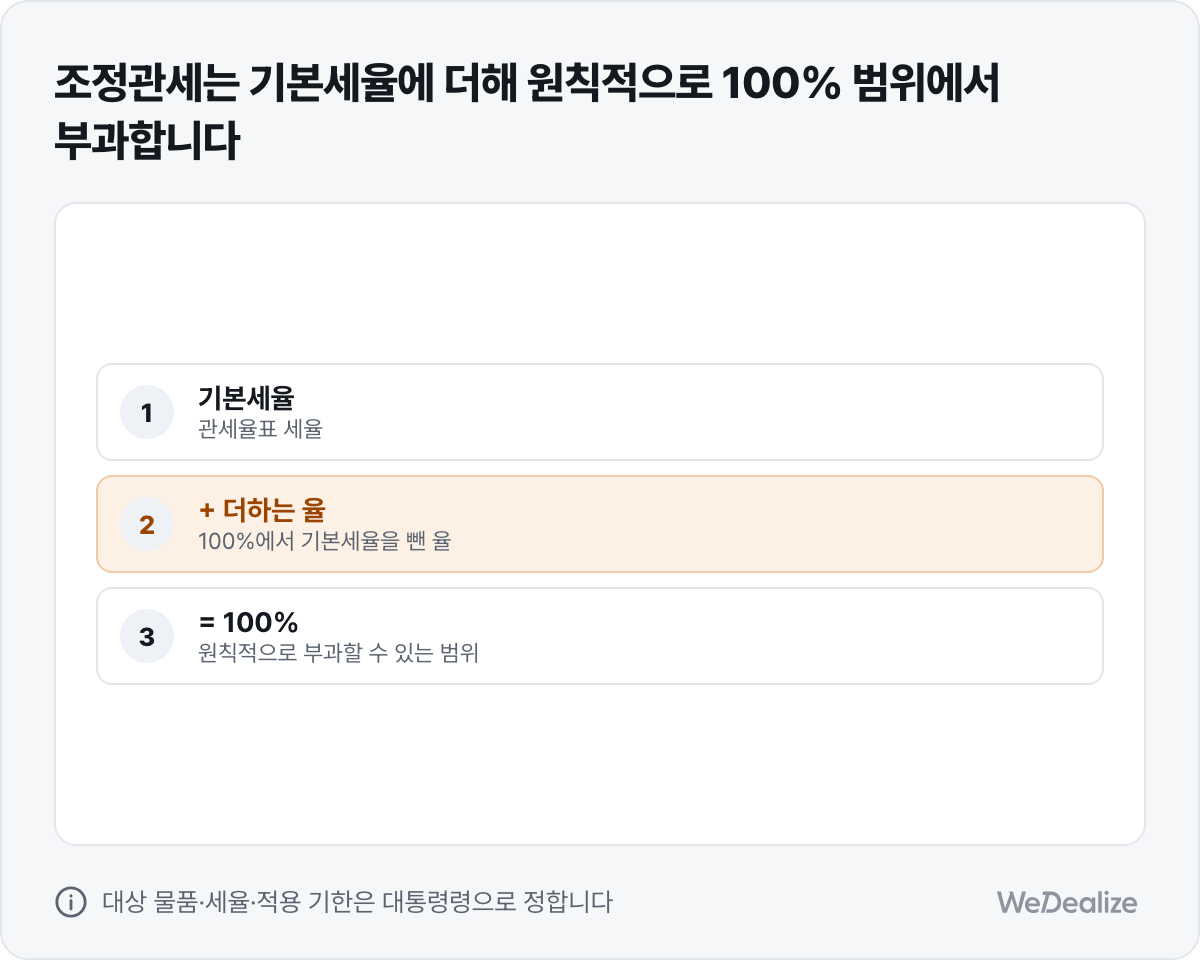
An adjustment tariff is a “temporarily increased tariff.” Under the Customs Act, an adjustment tariff may be imposed when tariff rates between goods become significantly misaligned due to changes in the industrial structure, or when it is necessary to protect public health or the environment. It may also be imposed to protect domestically developed goods for a certain period. The same applies when increased imports of goods with weak competitiveness, such as agricultural, forestry, livestock, and fishery products, disrupt the domestic market. In principle, the rate may be added to the basic tariff rate up to the rate obtained by subtracting the basic tariff rate from 100%, and is set so that the combined rate does not exceed 100%. However, for agricultural, forestry, livestock, and fishery products or goods made from them as raw materials, an adjustment tariff may be imposed within the range of the rate corresponding to the price difference when the difference between domestic and overseas prices exceeds the dutiable value. The goods subject to the tariff, the rate, and the period of application are prescribed by Presidential Decree. For example, adjustment tariffs are imposed on certain agricultural and fishery products.
When is it needed?
When importing agricultural, forestry, livestock, or fishery products or processed goods — First check whether they are subject to an adjustment tariff.
When calculating import costs — If you consider only the basic tariff rate, you may estimate the actual tariff rate too low.
When regulations are revised — Check again because the goods subject to the tariff and the rates may change.
Example
Mr. Kim plans to import dried shiitake mushrooms to sell in gift sets bundled with tumblers. When he calculates the cost based only on the basic tariff rate, a customs broker tells him that dried shiitake mushrooms are subject to an adjustment tariff in 2026 and therefore have a higher tariff rate. Mr. Kim recalculates the cost to reflect the adjustment tariff and adjusts the price of the bundled product.
The circumstances and figures in this example are assumed for explanatory purposes.
Commonly confused point
“The basic tariff rate in the tariff schedule is the actual tariff rate.” — No. Rates such as adjustment tariffs and tariff quotas may be applied with priority over the rates in the tariff schedule. Confirm the actual tariff rate with a customs broker based on the order of application.
Related terms
Types of tariff rates and order of application — Rules prescribed by the Customs Act determining which rates are applied first depending on the type of tariff rate.
Tariff quota — A tariff that may be imposed by deducting a certain range from the basic tariff rate or by adding a tariff to quantities exceeding a specified amount.
Tariff rate — The rate of customs duty imposed on imported goods, including the basic tariff rate and the provisional tariff rate.
Customs duty — A tax imposed on imported goods.
Compare — Difference between adjustment tariffs and tariff quotas