Advance Manifest Filing (AMS·ENS)
Automatically translated from Korean.
One-line definition — Advance manifest filing is the procedure of transmitting cargo information in advance to the customs authorities of the destination country before the cargo is loaded onto the vessel.
Also known as: AMS · ENS · Advance Manifest Filing (AMS·ENS)
In simple terms
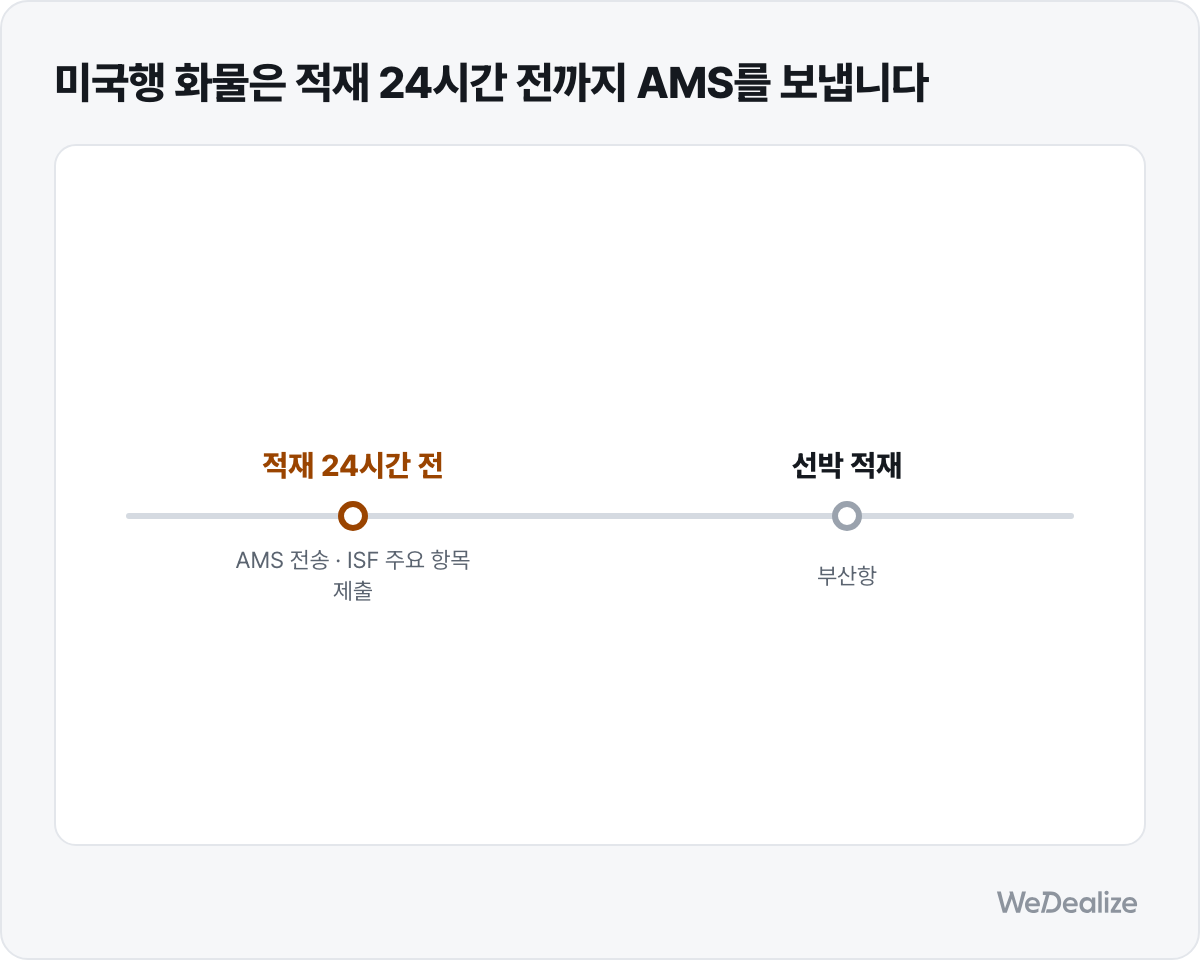
Advance filing is similar to obtaining an electronic entry permit in advance before traveling abroad. Many countries require customs authorities to receive information on who is transporting what cargo to whom before the cargo is loaded onto the vessel at the port of departure. The name varies by country. In the United States, it is called AMS, along with the ISF filed by the importer; in the EU, it is called the Entry Summary Declaration (ENS). Canada requires container cargo information up to 24 hours before the cargo is loaded onto the vessel, while Japan requires it before the vessel departs the port of loading. For cargo bound for the United States, AMS must be transmitted at least 24 hours before loading at a foreign port, excluding bulk cargo. The carrier submits it. An NVOCC (freight forwarder) licensed or registered with the U.S. Federal Maritime Commission (FMC) and holding an International Carrier Bond may transmit it directly. Korea also requires the cargo manifest for import cargo to be submitted at least 24 hours before loading at the port of loading. As an exception, for nearby regions such as China, Japan, Taiwan, Hong Kong, and the Russian Far East, it is required before departure from the port of loading; for bulk cargo, it is required four hours before the vessel enters the port. For example, an exporter shipping from Busan to the United States provides the cargo information by the forwarder’s documentation cut-off.
When is it required?
When exporting to the United States, the EU, Canada, or Japan — The carrier or freight forwarder files the advance declaration for the country, so provide accurate cargo information before the documentation cut-off.
When exporting to the United States — Because the U.S. importer must file the ISF separately, share information such as the seller’s details and HS code in advance.
When AMS·ENS appears as an item on a quotation — Confirm with the freight forwarder what is included in the advance filing fee.
Example
Representative Kim exports cosmetics from Busan to Los Angeles, United States. The registered and bonded freight forwarder organizes the house B/L details based on the S/R received from Representative Kim and transmits the AMS, while the carrier transmits the master B/L details. The U.S. importer files the ISF. Representative Kim initially enters the product description only as “cosmetics,” but revises it at the forwarder’s request to a specific description such as “skin-care cream.”
The item and route in this example are hypothetical values used for explanatory purposes.
Common points of confusion
“Advance filing is done after the cargo arrives in the importing country.” — No. It is generally transmitted before the cargo is loaded onto the vessel at the port of departure, not after arrival in the importing country. Since the deadline varies by country and cargo, confirm it with the freight forwarder before the documentation cut-off.
“The product description can be entered roughly.” — No. Under U.S. regulations, broad descriptions such as “general cargo” or “FAK” are not accepted. Enter a specific description that allows the cargo to be identified.
Related terms
Cargo manifest (loading manifest) — A list of cargo details from the B/Ls and AWBs for cargo loaded onto a vessel or aircraft, compiled and submitted to customs.
Shipping Request (S/R) — A document through which the shipper provides the information about the cargo to be loaded onto the booked vessel and the details to be included on the B/L.
Cut-off (deadline) — The final time by which documents must be submitted and cargo must be delivered to be loaded onto the booked vessel.
House B/L · Master B/L — The house B/L is issued by the freight forwarder to the shipper, while the master B/L is issued by the carrier to the freight forwarder.
Freight forwarder — A company that arranges the entire import and export transportation process on behalf of the shipper by securing vessels, aircraft, or trucks.