Advance Payment and Balance (T/T in Advance)
Automatically translated from Korean.
One-line definition — Advance Payment and Balance (T/T in Advance) is a payment method in which part of the payment (the deposit) is remitted first, before receiving the goods, and the remainder (the balance) is remitted later.
Also known as: T/T in Advance · Advance Payment · Deposit · Balance · Deposit · T/T in Advance · Advance Remittance · Advance Payment / Balance
In simple terms
Advance payment is like paying a deposit when ordering custom furniture and paying the balance when it is completed. In international transactions, terms such as 「Deposit 30%, Balance 70% before shipment」 may be agreed upon. The payment is usually made by bank telegraphic transfer (T/T).
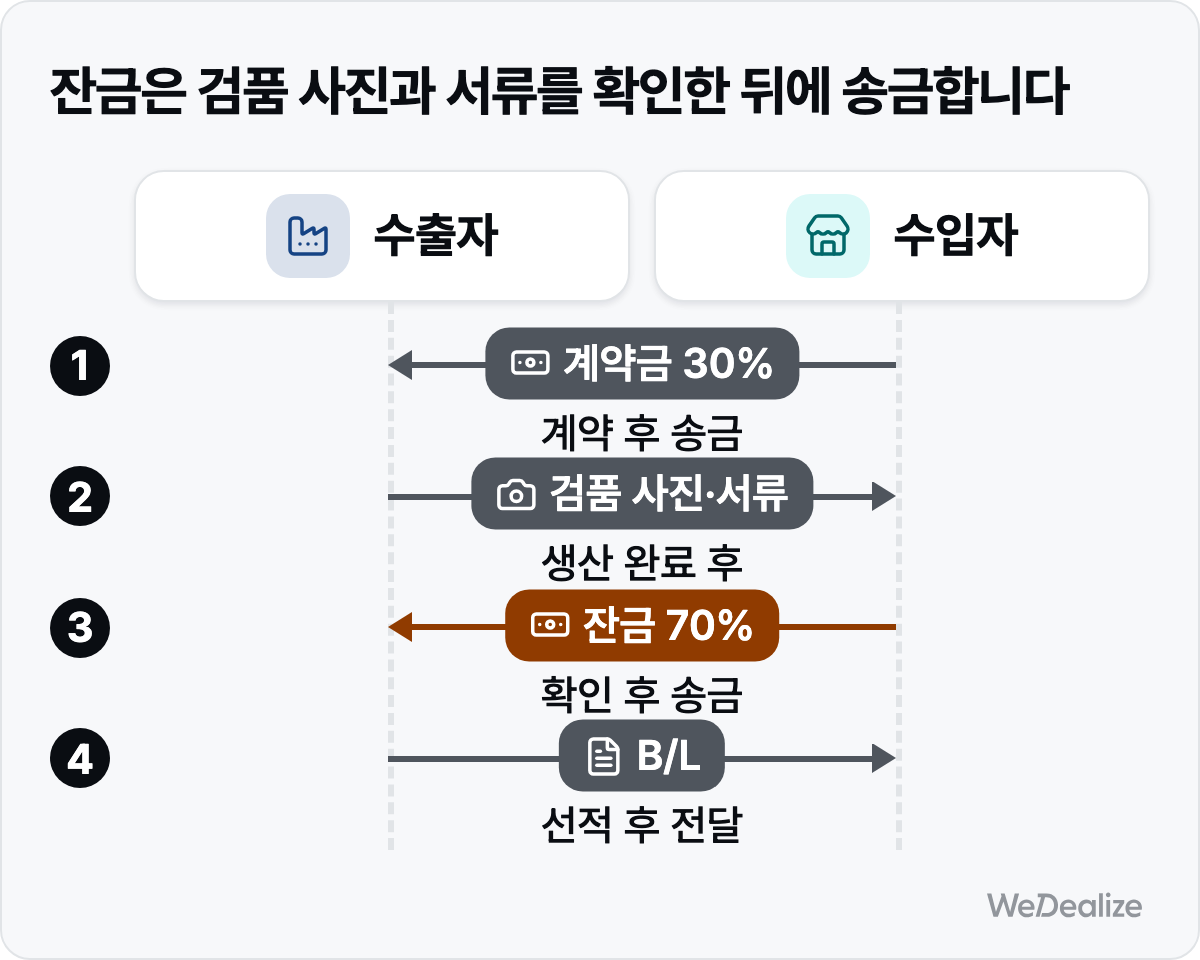
When is it needed?
When signing a contract with a factory for the first transaction — The factory may require a deposit upfront.
When part of the payment must be made before production for a made-to-order product — The payment is divided into a deposit and a balance.
When the amount is too small for opening a letter of credit (L/C) to be worth the cost and procedures — Payment is divided and remitted by T/T.
Example
Mr. Kim contracts with a Vietnamese factory for USD 20,000 worth of clothing. The day after signing the contract, he remits a 30% deposit (USD 6,000) by T/T, and the factory purchases fabric and begins production. One month later, the factory contacts him, saying, 「Production is complete, and we will ship once you remit the balance.」 Mr. Kim first receives and reviews inspection photos and the packing list, then remits the remaining USD 14,000. The factory ships the goods and provides the bill of lading (B/L).
The amount and percentage in this example are assumptions for illustrative purposes.
Common points of confusion
「There is no difference whether the balance is paid before or after shipment」 — That is incorrect. The timing of the balance payment varies by transaction, so the contract must clearly specify whether it will be paid before shipment or after reviewing a copy of the B/L.
「100% advance payment does not pose a significant risk to the importer」 — That is incorrect. Advance payment is the payment method that places the greatest burden on the importer. Whether to divide the payment should be negotiated with the trading partner.
「No documents are required when making a remittance」 — This is not always the case. Depending on the amount and type of transaction, certain documents may be exempted, so check with the remitting bank regarding the documentary requirements and types of documents needed.
Related terms
Telegraphic Transfer (T/T) — A method of remitting payment to an overseas trading partner's account through a bank's electronic network.
Payment terms — An agreement made with a trading partner specifying when and how payment for the goods will be made.
Proforma Invoice — A quotation invoice issued by the seller before actual shipment, listing the items, prices, and terms in advance.
Supporting documents for an overseas remittance — Documents such as contracts and invoices submitted to the bank to substantiate the reason for and amount of an overseas payment.
Bank Guarantee — A certificate in which a bank promises to pay a specified amount if the counterparty fails to perform its obligations.