Import Guide for Folding Camping Chairs
Automatically translated from Korean.
One-line summary — Check whether folding camping chairs are subject to furniture safety standards in light of the exclusion for outdoor furniture; 9401.79-9000 has a 0% WTO concessionary tariff rate, so there is no customs duty.
Product covered in this guide — Folding camping chairs
What to check first
Is the frame made of metal or wood? — The subheading (six-digit HS code) differs depending on the frame material.
Does the seat have cushioning, springs, or a cover? — The six-digit code differs between a seat with only fabric covering and one with padding inside.
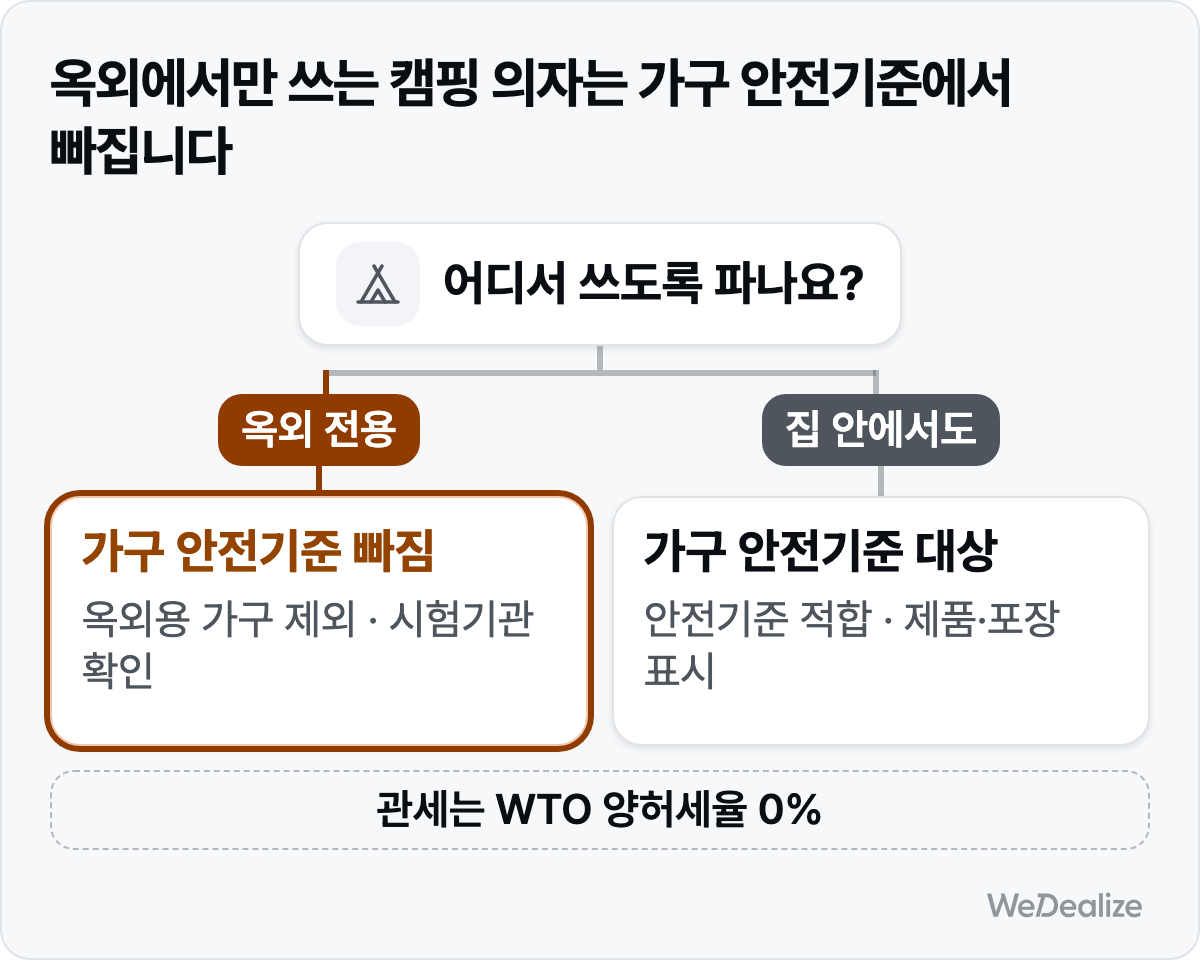
Is it used only outdoors, or is it sold for use indoors as well? — Furniture safety standards apply to folding chairs used in homes, offices, and schools, while outdoor furniture is excluded from the scope.
Are there sizes for children? — A size used by children aged 13 or under is a children's product, so determine separately whether it is subject to safety management requirements in addition to adult products.
Order of tasks
Obtain the frame material, seat construction (padding, springs, and cover), and folded configuration from the factory → What to check first
Determine the code between 9401.79 and 9401.71 based on the seat construction, and apply for an advance ruling if the chair can be unfolded into a bed → HS code
Check with a testing institution whether the product is subject to furniture safety standards in light of the exclusion for outdoor furniture → Certification & requirements
Mark the country of origin and file the import declaration — Since the WTO concessionary tariff rate is 0%, there is no customs duty even without a certificate of origin → Certification & requirements · Taxes
HS code
Chairs with metal frames fall under heading 9401.7 of the tariff schedule (other seats, with metal frames). Within this heading, chairs with padding, springs, covers, or similar materials on the seat are classified under 9401.71, while those without them are classified under 9401.79. A typical camping chair with only a fabric seat covering is represented by 9401.79-9000 (Other).
Even if a chair can be unfolded into a bed, the tariff schedule excludes camping models from “convertible seats” (heading 9401.4). If you are uncertain, apply for an advance ruling on tariff classification before filing the import declaration.
If the product is | Tariff item number (description) | General duty rate |
|---|---|---|
Camping chair — metal frame, seat with fabric covering only | 9401.79-9000 (Other) | 8% |
Camping chair — metal frame, seat with padding, springs, or a cover | 9401.71-9000 (Other) | 8% |
The tariff item numbers in this guide are representative examples for explanatory purposes and do not constitute definitive classifications. The Korea Customs Service and testing institutions make the final determinations on tariff classification and whether safety management requirements apply.
Certification & requirements
Must be obtained — The importer applies
Task | When | Differences by case |
|---|---|---|
Check with a testing institution whether the product is subject to furniture safety standards | Before import | Outdoor furniture is excluded from the scope |
If covered, comply with safety standards and provide product and packaging labeling | Before sale | Import for sale is not permitted without the required labeling |
Country-of-origin marking on the product and packaging | At import | Same in all cases |
What customs checks — Customs checks this during clearance
Tariff item number | Children's product check |
|---|---|
9401.79-9000 | None |
9401.71-9000 | Check with the certification body |
The children's product requirement under item 9401.71 applies to infant chairs with a seat height of at least 450 mm, so it may not apply to adult camping chairs. Even if the product is not on the customs list or does not meet the conditions, the certification and other legal requirements must still be satisfied (Customs Chief Confirmation).
Depending on the case — The importer must handle this separately if applicable
If intended for children aged 13 or under — “Children's furniture” is a children's product subject to supplier conformity verification. If you import children's sizes as well, check with a testing or inspection institution.
Taxes
This is an example of importing goods from China with a dutiable value of KRW 4 million.
Declared number · tariff rate | Customs duty | Value-added tax (10% of dutiable value + customs duty) |
|---|---|---|
9401.79 · 9401.71 · No certificate of origin (WTO concession) 0% | KRW 0 | KRW 400,000 |
The amounts in this example are assumed for explanatory purposes.
For both numbers, the WTO concessionary tariff rate (the maximum rate committed under the WTO agreement) is lower than the general duty rate and therefore applies first (Types of tariff rates and order of application).
9401.79-9000 Other — General duty rate 8% · WTO concessionary tariff rate 0%
9401.71-9000 Other — General duty rate 8% · WTO concessionary tariff rate 0%
Transport and customs clearance tips
Calculate CBM using the box dimensions when folded — Because this cargo is light but bulky, freight charges are often determined by volume rather than weight.
Decide the sales purpose first — The result of checking the furniture safety standards may differ depending on whether the chair is sold for indoor use as well or exclusively for outdoor use. Contact a testing institution with wording that matches the product detail page.
Recheck the code if importing parts separately — If you import only replacement fabric seats or frames, compare them with parts (heading 9401.9) rather than chairs. Parts made of metal (9401.99-1000) have a WTO concessionary tariff rate of 13%, which is higher than the general duty rate of 8%; without a certificate of origin, the 8% rate applies.
Common mistakes
Misconception: “A camping chair is camping equipment, so it is not furniture.” — Not necessarily. Folding chairs are included in the scope of the furniture safety standards, while outdoor furniture is excluded. Check with a testing institution which category your product falls into.
Misconception: “If the customs duty is 0%, there are no taxes.” — Incorrect. Even when customs duty is KRW 0, you must pay 10% value-added tax on the dutiable value.
Misconception: “The code stays the same even if padding is added.” — Incorrect. A chair with padding, springs, or a cover on the seat is classified under 9401.71 and has a different code.
Related terms
Preferential tariff (FTA rate) — A tariff that has been eliminated or reduced and applies to goods originating in a country that has an FTA.
HS code — A number used to classify goods by type under a globally common system and serve as the basis for determining tariff rates.
Advance ruling on tariff classification — A system under which the Korea Customs Service reviews and determines a product's tariff classification (HS code) in advance of an import or export declaration.
Dutiable value — The value used as the basis for assessing customs duty.