Alkaline Battery Import Guide
Automatically translated from Korean.
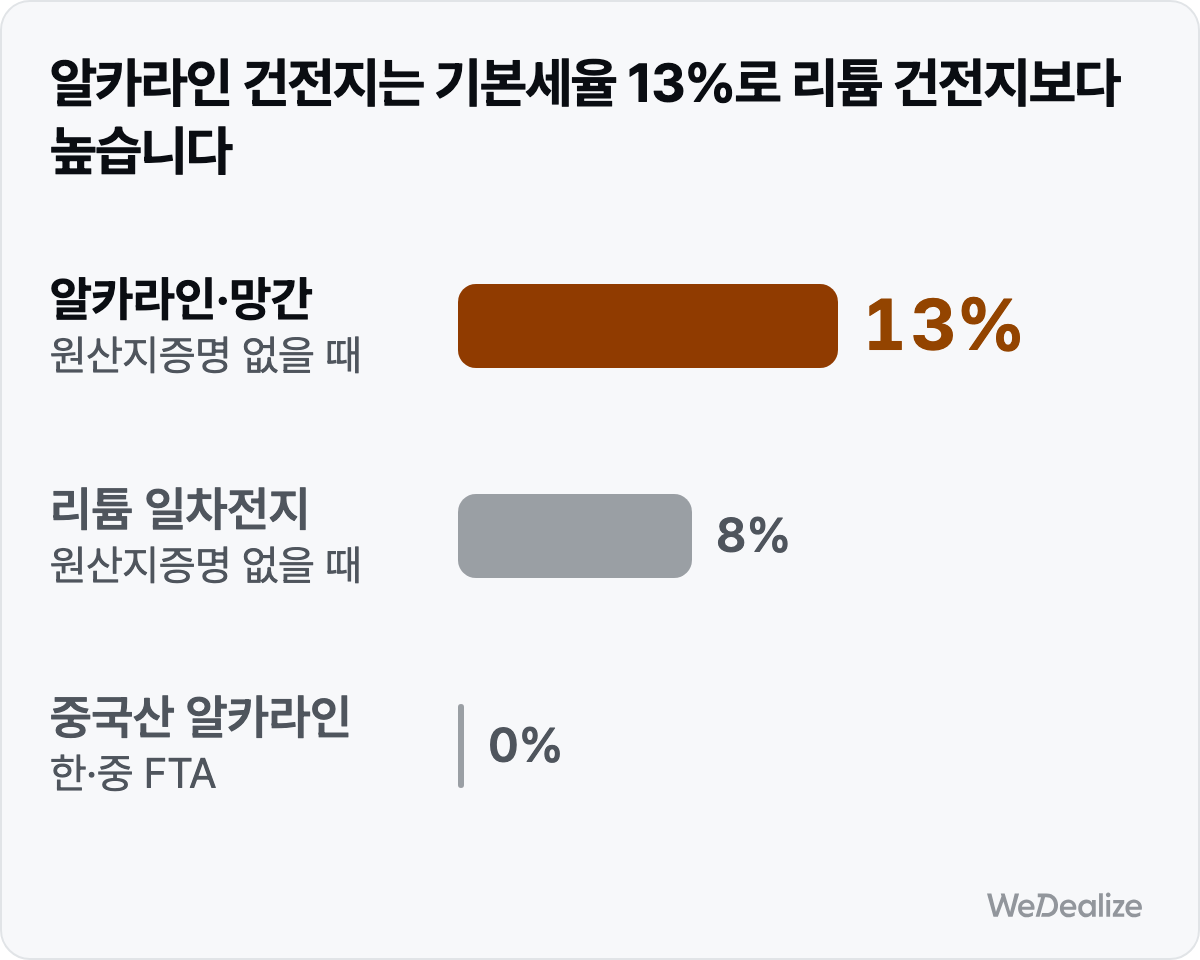
In one line — Alkaline batteries are primary batteries subject to the Household Goods Safety Confirmation requirements for “Batteries” and to mandatory recycling, and 8506.10-2000 is subject to both the basic duty rate and the WTO bound duty rate of 13%. Products from China are subject to 0% under the Korea–China FTA.
Products covered in this guide — Alkaline batteries (AA·AAA primary batteries)
Related guides — Power Bank·Rechargeable Battery Import Guide · Uninterruptible Power Supply (UPS) Import Guide · Camping Power Bank (Power Station) Import Guide
What to check first
Is the battery chemistry alkaline-manganese, manganese, or lithium? — Within the same heading 8506, the basic duty rate is divided between 13% and 8%.
Is the product rechargeable and intended for repeated use? — Rechargeable batteries are a separate detailed category under the Electrical Appliances “Batteries” safety confirmation requirements, so check the Power Bank·Rechargeable Battery guide.
Can you obtain a certificate of origin from the first shipment? — If the exporting country is a treaty partner, you can apply for a preferential duty rate lower than 13% with a certificate of origin; rates vary by country from 0% to 6.5% (see “Taxes” below).
Order of tasks
Obtain the battery chemistry (alkaline-manganese·manganese·lithium), specifications, and labeling samples from the factory → What to check first
Determine the code among 8506.10-2000, -1000, and 8506.50 based on the battery chemistry → HS Code
Conduct safety confirmation testing and file a declaration for Household Goods “Batteries” for each model → Certifications·Requirements
Prepare to report the previous year’s import volume every year, as manganese·alkaline-manganese·lithium primary batteries are subject to mandatory recycling → Certifications·Requirements
Apply the safety confirmation mark and country-of-origin marking, and request a certificate of origin from the first shipment — the difference between 13% and the preferential duty rate is significant → Certifications·Requirements · Taxes
Apply for requirements verification through the customs clearance portal and apply for the preferential duty rate when filing the import declaration → Certifications·Requirements · Taxes
HS Code
Because these are primary batteries that are used once and discarded, they fall under heading 8506. In the tariff schedule, within heading 8506.10 (those made with manganese dioxide), only “manganese batteries or alkaline-manganese batteries” are separately set at 13%.
If the product is | Item number (description) | Basic duty rate |
|---|---|---|
Alkaline batteries (AA·AAA) | 8506.10-2000 (alkaline-manganese batteries) | 13% |
Manganese batteries | 8506.10-1000 (manganese batteries) | 13% |
Primary batteries made with lithium | 8506.50-0000 (those made with lithium) | 8% |
If the battery chemistry cannot be confirmed from the specifications, determine the code through a prior tariff classification ruling.
The item numbers in this guide are representative examples for explanatory purposes and do not constitute definitive classifications. The Korea Customs Service and testing·certification bodies make the final determinations regarding tariff classification and whether certification·requirements apply.
Certifications·Requirements
Required — the importer applies
Task | When | Differences by battery type |
|---|---|---|
File a declaration after safety confirmation testing for Household Goods “Batteries” for each model | Before importation | Rechargeable batteries are separately classified as Electrical Appliances “Batteries” |
Mandatory recycling — collection·recycling and submission of previous year’s import volume data | By April 15 every year | Manganese·alkaline-manganese·primary lithium batteries |
Country-of-origin marking on the product·packaging | At importation | The same for all battery types |
Check with the Ministry of Climate, Energy and Environmental Affairs on how to fulfill the mandatory recycling obligations.
What customs checks — Customs checks these items during clearance
Item number | Electrical appliance verification |
|---|---|
8506.10-2000 | Safety confirmation |
8506.10-1000 | Safety confirmation |
8506.50-0000 | None |
Even if the item is not listed by Customs or does not meet the conditions, the certifications·requirements prescribed by law must still be fulfilled (confirmation by the head of the customs office).
Taxes
This is an example of importing goods from China with a customs value of KRW 5 million.
Declared number·duty rate | Customs duty | Value-added tax (10% of customs value + customs duty) |
|---|---|---|
8506.10 · No certificate of origin, 13% | KRW 650,000 | KRW 565,000 |
8506.10 · Korea–China FTA, 0% | KRW 0 | KRW 500,000 |
The amounts in this example are assumed values for explanatory purposes.
8506.10-2000 Alkaline-manganese batteries — Basic duty rate: 13%
Preferential duty rates by country of origin.
Country of origin | Applicable rate | Applicable agreement |
|---|---|---|
China | 0% | Korea–China FTA |
China | 6.5% | RCEP |
Indonesia | 5% | Korea–ASEAN FTA |
Indonesia | 0% | Korea–Indonesia CEPA · RCEP |
Singapore | 0% | Korea–Singapore FTA · RCEP |
Singapore | 5% | Korea–ASEAN FTA |
Malaysia | 5% | Korea–ASEAN FTA |
Malaysia | 0% | RCEP |
Thailand | 5% | Korea–ASEAN FTA |
Thailand | 0% | RCEP |
United States·United Kingdom·Germany | 0% | FTA with each country |
Japan | 6.5% | RCEP |
8506.10-1000 Manganese batteries — Basic duty rate: 13%
Preferential duty rates by country of origin.
Country of origin | Applicable rate | Applicable agreement |
|---|---|---|
China | 0% | Korea–China FTA |
China | 6.5% | RCEP |
Indonesia | 5% | Korea–ASEAN FTA |
Indonesia | 0% | Korea–Indonesia CEPA · RCEP |
Spain·United States·Germany | 0% | FTA with each country |
Japan | 6.5% | RCEP |
When declaring under another number
8506.50-0000 Those made with lithium — Basic duty rate: 8%
Preferential duty rates by country of origin.
Country of origin | Applicable rate | Applicable agreement |
|---|---|---|
China | 0% | Korea–China FTA · RCEP |
Indonesia·United States·France·Singapore·Switzerland·United Kingdom·Germany | 0% | FTA·RCEP with each country |
Japan | 4% | RCEP |
Check with a customs broker for preferential duty rates under agreements with countries not listed in the table.
Transportation·Customs Clearance Tips
Include the certificate of origin in the document list for the first shipment — This document is required to apply the preferential duty rate instead of the 13% customs duty.
Match the blister packaging units (2-pack·4-pack) and model names with the testing documents — Safety confirmation declarations are filed by model.
Collect the quantities on the import declaration certificates for recycling records — Recycling data must be submitted based on the previous year’s import volume.
Common Mistakes
Misconception: “Batteries are also subject to KC certification as electrical appliances” — No. Non-rechargeable batteries are included in the Household Goods safety confirmation list.
Misconception: “It is 8% because it is a power item” — No. Manganese batteries and alkaline-manganese batteries are subject to 13%.
Misconception: “Lithium batteries are also 13%” — No. The basic duty rate under heading 8506.50 is 8%.
Related Terms
Types of duty rates and order of application — Rules prescribed by the Customs Act for determining which duty rate to apply first when multiple customs duty rates apply to one item.
HS Code — A number classifying goods by type under a globally standardized system and used as the basis for determining customs duty rates.
Import value-added tax — Value-added tax (10%) paid to Customs together with customs duty when goods are imported.
Certificate of Origin (C/O) — A document proving the country of origin of goods, required to receive preferential tariff treatment under an FTA.