Import Guide for Glass Food Storage Containers, Silicone Cooking Utensils, and Stainless Steel Insulated Tumblers
Automatically translated from Korean.
In one line — Glass food storage containers, silicone cooking utensils, and insulated tumblers are food-contact utensils, so in principle an import declaration for imported food products is required each time they are imported for sale (with exceptions prescribed by the Prime Minister’s Office Ordinance), and items such as 7013.49-0000 are subject to the basic duty rate of 8%.
Products covered in this article — Glass food storage containers, cooking utensils such as silicone spatulas, turners, and tongs, and vacuum double-wall stainless steel insulated tumblers — all are food-contact utensils without electrical functions
See also — Electric insulated lunch boxes → Import Guide for Electric Insulated Lunch Boxes and Rice Containers · Formula dispensers and bottle warmers → Import Guide for Egg Cookers, Coffee Makers, Electric Steamers, and More
Check these first
Will you sell them as suitable for microwave or oven use? — Then they will be tested under the standards for glassware used for heating and cooking, including thermal shock strength and stricter lead and cadmium limits.
Does the capacity exceed 600 mL or 3 L? — For glassware not intended for heating and cooking, the lead and cadmium limits differ by capacity range.
Do you have data on the linear expansion coefficient of the glass? — The six-digit classification number is determined by this value.
Is it made entirely of silicone, or does it have a wooden or stainless steel handle or core? — The tariff classification number and material-specific standards may differ by part.
Is the silicone rubber content at least 50% of the basic polymer? — This is the criterion for the definition of “rubber products” in the MFDS notification.
Is it vacuum double-wall or a single-wall cup? — Depending on the structure, it is classified under Heading 9617 (vacuum containers) or Heading 7323 (iron or steel kitchenware).
What material are the lid, gasket, and straw made of? — If plastic or rubber is used on a food-contact surface, the migration standards for that material apply separately.
Does it have an electric heating function powered by USB? — If so, also check whether it is subject to electrical appliance requirements.
Order of tasks
Obtain from the factory the material composition (type of glass, silicone content, inner-wall steel grade), the materials of the lid, gasket, and handle, whether it is intended for microwave or oven use, and whether it has a vacuum structure → Check these first
Classify the glass containers under 7013.49 or 7013.42, the silicone cooking utensils under 3924.10, and the tumblers under 9617.00 or 7323.93. If the materials are mixed and the essential character is unclear, apply for an advance ruling → HS Code
Complete 4 hours of hygiene training and register as an importer and seller of imported food products, etc. → Certifications and requirements
Obtain test results meeting the standards for each material, file an import declaration for food-contact utensils, and undergo MFDS inspection — the first import is in principle subject to detailed inspection → Certifications and requirements
Apply for the preferential tariff rate when filing the import declaration, with the food-contact utensil designation and country-of-origin marking completed and the import declaration certificate prepared → Certifications and requirements · Taxes
HS Code
The three product types have the same food-contact utensil declaration requirements, but their tariff classification numbers vary depending on material and structure. Glass containers for storing food fall under Heading 7013 (glassware for table, kitchen, toilet, office, indoor decoration, or similar purposes), and the six-digit number varies according to the properties of the glass. Heading 7013 excludes goods of Heading 7010 (bottles, jars, and other containers for the conveyance or packing of goods).
For products such as these | Tariff classification number (description) | Basic duty rate |
|---|---|---|
Glass food storage container — glass whose linear expansion coefficient exceeds the standard | 7013.49-0000 (Other) | 8% |
Glass food storage container — glass whose linear expansion coefficient is at or below the standard | 7013.42-0000 (Of glass having a linear coefficient of expansion not exceeding 5 × 10⁻⁶ per Kelvin within a temperature range of 0°C to 300°C) | 8% |
Silicone cooking utensils — spatulas, turners, and tongs | 3924.10-0000 (Tableware and kitchenware) | 8% |
Insulated tumbler or flask — vacuum double-wall | 9617.00-1000 (Vacuum flasks) | 8% |
Single-wall stainless steel cup without a vacuum layer | 7323.93-0000 (Of stainless steel) | 8% |
Commercial bottles and jars such as jam jars | Classified under Heading 7010 | — |
Cooking utensils whose essential character is imparted by the metal body | Compare with other headings — advance ruling | — |
If materials are mixed, such as a glass container with a plastic lid and silicone gasket or a silicone utensil with a metal core, classification is based on the material that gives the product its essential character under General Rule 3(b). If uncertain, obtain an advance ruling on tariff classification.
The tariff schedule includes silicone resins of Heading 3910 within the scope of “plastics.” Confirm the classification number for silicone cooking utensils through an advance ruling.
Heading 9617.00 covers “vacuum flasks and other vacuum vessels, complete,” with the 10-digit classifications divided into vacuum flasks, insulated lunch boxes, and other products.
The classification numbers in this article are representative examples for explanatory purposes and are not definitive classifications. The Korea Customs Service, Ministry of Food and Drug Safety, and testing institutions make the final determination on classification and whether requirements apply.
Certifications and requirements
Must obtain — applied for by the importer
Task | When | Differences by material |
|---|---|---|
Hygiene training — 4 hours before business registration (or after starting business if unavoidable), followed by 3 hours every year | Before business registration · Every year | Same for all materials |
Business registration as an importer and seller of imported food products, etc. | Before the first import | Same for all materials |
Import declaration for food-contact utensils | Each time they are imported | Same for all materials |
MFDS import inspection — the first import is in principle subject to detailed inspection | After import declaration · Before customs clearance | If the country of manufacture, overseas manufacturing facility, material, and base color are the same, re-imports within five years are in principle subject to document inspection |
Meeting material-specific standards — glass, rubber (silicone), and metal (stainless steel) | Prepare before import declaration | Glass is subject to stricter requirements when used for heating and cooking; silicone is subject to rubber-product standards; stainless steel is subject to metal migration standards (below) — if another material is used on a food-contact surface, that material’s standards apply |
Meeting the standards for other food-contact materials such as lids, gaskets, and handles | Prepare before import declaration | Same for all materials |
Food-contact utensil labeling — name and address of the business office of the importer and seller, and the words “for food use” or a food-contact utensil symbol | Prepare before import declaration — checked during import inspection | Plastic and silicone (rubber) parts must also state the material name |
Country-of-origin marking on the product | — | Same for all materials |
The standards for the glass body are divided as follows according to use and capacity under the MFDS notification.
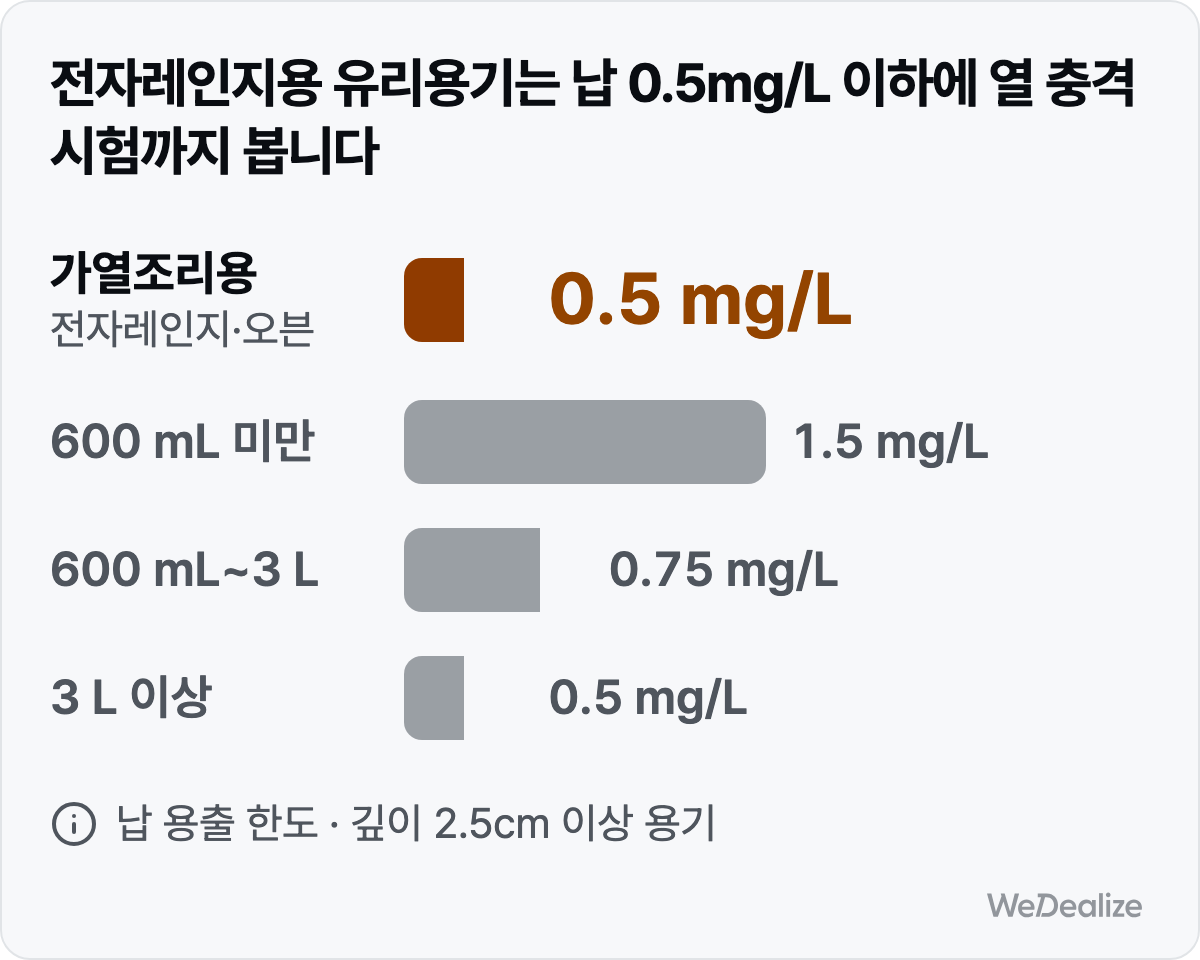
Use · capacity | Lead | Cadmium | Thermal shock strength (heat resistance temperature difference) |
|---|---|---|---|
For heating and cooking (microwave- or oven-safe) | Not more than 0.5 mg/L | Not more than 0.05 mg/L | At least 120°C — must not break or crack |
Other than for heating and cooking, less than 600 mL | Not more than 1.5 mg/L | Not more than 0.5 mg/L | — |
Other than for heating and cooking, 600 mL or more and less than 3 L | Not more than 0.75 mg/L | Not more than 0.25 mg/L | — |
Other than for heating and cooking, 3 L or more | Not more than 0.5 mg/L | Not more than 0.25 mg/L | — |
The table applies to containers with a liquid-filled depth of at least 2.5 cm. Utensils that pose no health concern, such as uncolored glassware, may not be subject to the material-specific standards, but this exception does not apply when they are sold for microwave or oven use.
Silicone parts are subject to the rubber-product standards under the “Standards and Specifications for Utensils, Containers and Packaging.” The limits for rubber products other than those intended for infants and young children are as follows.
Rubber-product standards (other than for infants and young children) | Limit |
|---|---|
Residue — lead | Not more than 100 mg/kg |
Residue — cadmium | Not more than 100 mg/kg |
Migration — lead | Not more than 1 mg/L |
Migration — total migration | Not more than 60 mg/L |
Migration — phenol | Not more than 5 mg/L |
Migration — formaldehyde | Not more than 4 mg/L |
Migration — zinc | Not more than 15 mg/L |
Migration standards set limits for substances such as lead and cadmium that dissolve out of the material when it comes into contact with food. The stainless steel body is subject to metal migration standards. If another material, such as plastic or rubber, is used on a food-contact surface, that material’s migration standards apply separately.
Metal migration standards | Limit |
|---|---|
Lead | Not more than 0.4 mg/L |
Cadmium | Not more than 0.1 mg/L |
Nickel | Not more than 0.1 mg/L |
Hexavalent chromium | Not more than 0.1 mg/L |
Arsenic (as As₂O₃) | Not more than 0.2 mg/L |
MFDS import inspection — After an import declaration is filed, the MFDS inspects the goods before customs clearance is completed. Inspections include document inspection, on-site inspection, and detailed inspection. Utensils imported for the first time are in principle subject to detailed inspection (inspection using physical and chemical methods). However, utensils that pose no health concern, such as uncolored glassware (excluding glassware for heating and cooking and lead-containing crystal glassware), are subject to document inspection. If utensils with the same country of manufacture, overseas manufacturing facility, material, and base color as utensils that underwent detailed inspection are re-imported within five years, they are in principle subject to document inspection. However, even goods subject to document inspection may undergo random sampling inspection (inspection using physical and chemical methods) under the MFDS sampling plan. If detailed inspection was conducted on an import quantity below the minimum inspection quantity, detailed inspection is required again when importing at least the minimum quantity thereafter. If a test report issued by an inspection institution designated by law is submitted, the MFDS may omit all or part of the inspection.
Food-contact utensil labeling — Utensils must bear the name and address of the business office (the importer and seller’s business office) and the words “for food use” or a food-contact utensil symbol. Synthetic resin and rubber parts must also state the material name, such as polypropylene or silicone rubber. The MFDS checks whether the labeling complies with the standards during import inspection. The “for food use” marking must be applied to the minimum sales-unit packaging or product by ink, engraving, or stamping; if this is difficult, a sticker or tag may be used. The material name may be stated only for materials in parts that come into direct contact with food.
Checked by customs — Customs checks these during clearance
Tariff classification number | Food-contact utensil check |
|---|---|
7013.49-0000 | Import declaration |
7013.42-0000 | Import declaration |
3924.10-0000 | Import declaration |
9617.00-1000 | Import declaration |
7323.93-0000 | Import declaration |
Depending on the case — the importer must handle these separately when applicable
If it has an electric heating function — Check with a testing or certification institution whether it falls under “electric warmers and electric warming cabinets” in Appendix 4 of the Enforcement Rule.
If it has a children’s design — Utensils subject to the Food Sanitation Act are excluded from children’s products, so food-related requirements apply instead of children’s product KC requirements.
Taxes
This is an example of importing goods from China with a customs value of KRW 6 million.
Declared number · duty rate | Customs duty | VAT (10% of customs value + customs duty) |
|---|---|---|
7013.49·9617.00 · No certificate of origin, 8% | KRW 480,000 | KRW 648,000 |
7013.49 · Korea-China FTA · RCEP, 0% | KRW 0 | KRW 600,000 |
3924.10 · No certificate of origin (WTO concession), 6.5% | KRW 390,000 | KRW 639,000 |
3924.10·9617.00 · Korea-China FTA, 0% | KRW 0 | KRW 600,000 |
The amounts in this example are assumed values for explanatory purposes.
3924.10 is subject first to the 6.5% WTO bound tariff rate (the tariff ceiling committed under the WTO Agreement), because it is lower than the general rate (Types of Tariff Rates and Order of Application).
The RCEP tariff rates are the annual rates for 2026. For Indonesia and the Philippines, RCEP entered into force between Korea and those countries in 2023, making 2026 the fourth year. Malaysia and the other member countries are in their fifth year.
7013.49-0000 Other — General rate 8%
Country of origin | Applicable tariff rate | Basis of tariff treatment |
|---|---|---|
China | 0% | Korea–China FTA · RCEP |
United States·Thailand·France·Germany·Italy·Türkiye·Finland·Spain | 0% | FTA with each country · RCEP |
Japan | 4% | RCEP |
3924.10-0000 Tableware and kitchenware — General rate 8% · WTO bound tariff rate 6.5%
Country of origin | Applicable tariff rate | Basis of tariff treatment |
|---|---|---|
China | 0% | Korea–China FTA |
China | 3.3% | RCEP |
Japan | 3.3% | RCEP |
Taiwan | 6.5% | No FTA (WTO bound tariff rate) |
United States·Italy·India·the Netherlands·Hungary | 0% | FTA with each country |
Thailand | 0% | Korea–ASEAN FTA |
Thailand | 3.3% | RCEP |
Vietnam | 0% | Korea–ASEAN FTA · Korea–Vietnam FTA |
Vietnam | 3.3% | RCEP |
9617.00-1000 Vacuum flasks — General rate 8%
Country of origin | Applicable tariff rate | Basis of tariff treatment |
|---|---|---|
China | 0% | Korea–China FTA |
China | 4% | RCEP |
Malaysia | 0% | Korea–ASEAN FTA |
Malaysia | 4% | RCEP |
Thailand | 0% | Korea–ASEAN FTA |
Thailand | 4% | RCEP |
Philippines | 0% | Korea–ASEAN FTA · Korea–Philippines FTA |
Philippines | 4.8% | RCEP |
Germany·United States·India | 0% | FTA with each country |
Vietnam | 0% | Korea–ASEAN FTA · Korea–Vietnam FTA |
Vietnam | 4% | RCEP |
Japan | 4% | RCEP |
New Zealand | 0% | Korea–New Zealand FTA |
New Zealand | 4% | RCEP |
When declaring under a different code
7013.42-0000 Glass with a coefficient of linear thermal expansion of not more than 5 parts per million per Kelvin within the range of 0°C to 300°C — General rate 8%
Country of origin | Applicable tariff rate | Basis of tariff treatment |
|---|---|---|
China | 0% | Korea–China FTA · RCEP |
Japan·Czech Republic·France·Germany·Hungary·United Kingdom·Poland·Romania·Italy | 0% | FTA with each country · RCEP |
7323.93-0000 Of stainless steel — General rate 8%
Country of origin | Applicable tariff rate | Basis of tariff treatment |
|---|---|---|
China | 0% | Korea–China FTA |
China | 5.3% | RCEP |
Vietnam | 0% | Korea–ASEAN FTA · Korea–Vietnam FTA |
Vietnam | 5.3% | RCEP |
Germany·United States·France·India·Italy·Belgium | 0% | FTA with each country |
Japan | 5.3% | RCEP |
Thailand | 0% | Korea–ASEAN FTA |
Thailand | 5.3% | RCEP |
Transport and customs clearance tips
After deciding on the sales wording (microwave- and oven-safe), select the inspection criteria — A thermal shock test is added if the product is intended for cooking by heating.
Determine the dividers and cushioning materials inside the box, as well as cargo insurance, when concluding the contract — Glass is prone to breaking from impacts during transport.
Match the model list by capacity with the import declaration documents — The lead and cadmium limits differ by capacity range.
Obtain a list of the materials used for the silicone parts, handles, and cores from the factory — It is used for both tariff classification and material-specific standard inspections.
For sets with different sizes and shapes, group them by base color and make an inspection plan (excluding glass products) — The notice provides that when the base color is the same, inspections may be conducted by material and the applicable standards applied.
Obtain a list of the materials used for the body, lid, gasket, and straw, along with migration test reports for each material — The standard for each material applies to every material on a surface that comes into contact with food.
Because the cargo is light and bulky, calculate the CBM based on the carton dimensions first — Freight charges are more likely to be determined by volume than by weight.
Common mistakes
Misconception: “Empty containers, cooking utensils, and tumblers have nothing to do with food.” — Incorrect. Items that hold or come into contact with food or beverages are “utensils” and, in principle, are subject to declaration when intended for sale, subject to the exceptions prescribed by the Prime Minister’s Decree.
Misconception: “Glass products are not subject to standard inspections.” — Incorrect. The exception is limited to colorless glass that is not intended for cooking by heating, and even then the provision states that an inspection “may” be conducted.
Misconception: “There is a bound tariff rate, so the rate is 0%.” — Incorrect. Heading 7013 has no corresponding number in the tariff schedule, so the rate is 8% without a certificate.
Misconception: “Silicone is inspected under the standards for plastics.” — Incorrect. The Ministry of Food and Drug Safety notice defines silicone rubber as a rubber product.
Misconception: “The rate is 8% if there is no certificate of origin.” — It depends on the code. For 3924.10, the 6.5% bound tariff rate applies first; for the remaining codes, the rate is 8% without a certificate.
Misconception: “If it is stainless steel, only the standards for metal apply to the gasket.” — Incorrect. The standards for the material concerned apply to rubber and plastic that come into contact with food.
Misconception: “There is no MFDS inspection if the factory has a test report.” — Incorrect. Utensils imported for the first time are, in principle, subject to detailed inspection. If a test report from an inspection institution designated by law is submitted, the MFDS may omit all or part of the inspection.
Related terms
Post-importation application for preferential tariff treatment — A procedure for applying for preferential tariff treatment after the import declaration has been accepted and receiving a refund of the difference in duties already paid.
Goods subject to customs chief confirmation — Goods for which the customs chief confirms at the customs clearance stage whether requirements such as permits, approvals, or certifications under other laws have been met.
HS code — A number used to classify goods by type under a globally common standard and serve as the basis for determining tariff rates.
Certificate of Origin (C/O) — A document certifying the origin of goods and a required document when receiving preferential tariff treatment under an FTA.
Customs value — The base amount for calculating customs duties, consisting of the price of the goods plus freight and insurance costs to a Korean port.
Import value-added tax — Value-added tax (10%) paid to customs together with customs duties when goods are imported.