Import Guide to Air Compressors and Air Inflators
Automatically translated from Korean.
In one line — 220V air compressors require checks for KC safety confirmation, pressure relief devices, and energy efficiency management equipment requirements, while small air compressors under 8414.80-9219 carry a general duty rate of 8%. Products of Chinese origin are 0% under the Korea–China FTA.
Products covered in this guide — Air compressors and automotive air inflators
From other guides — Import Guide to Grinders, Corded Electric Drills, Circular Saws, and More · Import Guide to Soldering Irons and Heat Guns · Import Guide to Small Electric Welders · Import Guide to Submersible Pumps
Check these first
Is a safety valve (pressure relief device) installed on the tank? — If not, the product cannot be transferred or displayed.
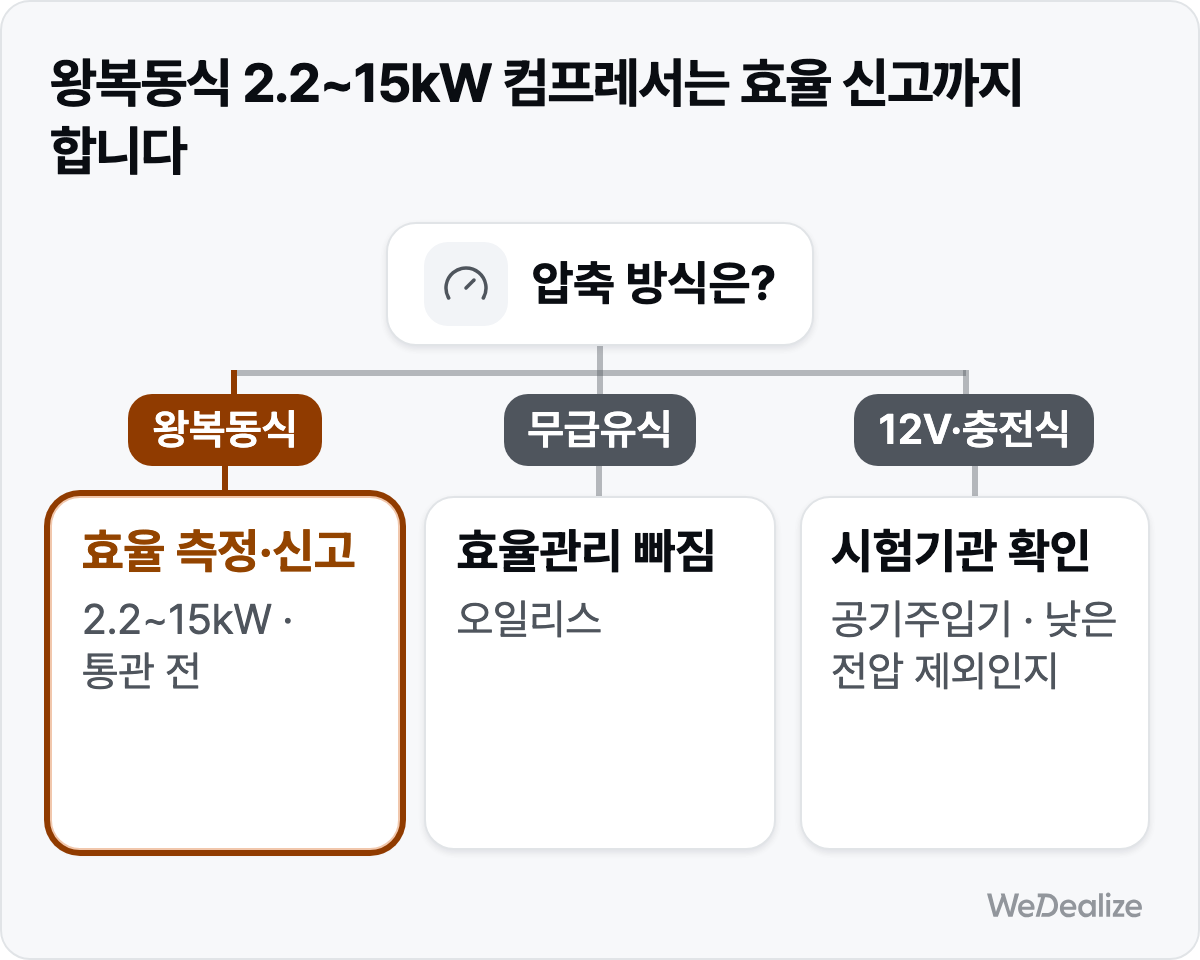
Is it a reciprocating type with a motor output of 2.2–15 kW, or is it oil-free? — Whether it is subject to energy efficiency management equipment requirements is determined by these values and the lubrication method.
Is it a 12V cigarette-lighter or rechargeable vehicle air inflator? — Also check whether it falls under the exclusions for low voltage, vehicle-only construction, or battery-only construction (conditions added below the statutory table).
Order of tasks
Obtain the compression method, motor output, lubrication method, discharge pressure, safety valve specifications, and power supply (220V·12V) from the factory → Check these first
Classify it as 8414.80-9219 if it is a compressor, or 8414.80-9190 if it is a pump type; if unclear, apply for an advance ruling → HS code
For a 220V main unit, check KC safety confirmation; for 12V·rechargeable products, confirm with a testing institution whether they are excluded as low-voltage or vehicle-only products → Certifications and requirements
Confirm that a safety valve (pressure relief device) is installed — without one, the product cannot be transferred or displayed → Certifications and requirements
If it falls within the efficiency coverage (such as reciprocating types rated 2.2–15 kW), have its efficiency measured and report each model before customs clearance → Certifications and requirements
Complete EMC self-confirmation, mark the KC mark and country of origin, then apply for requirements verification through the customs clearance portal and file the import declaration → Certifications and requirements
HS code
Among heading 8414 (gas pumps, gas compressors, and fans), products other than those for refrigeration or freezing equipment (8414.30) and chassis-mounted traction types (8414.40) are classified under 8414.80. The Schedule of Concessions (WTO tariff schedule) divides this subheading into gas pumps and gas compressors according to power consumption ranges.
If the product is | Item number (description) | General duty rate |
|---|---|---|
Air compressor — small tank-type air compressor (under 74.6 kW) | 8414.80-9219 (Other) | 8% |
Air inflator — pump type that inflates air without a compression tank | 8414.80-9190 (Other) | 8% |
Gas pump for aircraft | 8414.80-9110 (For aircraft) | 8% |
The Korea Customs Service has classified a rechargeable tire inflator with a maximum pressure of 150 psi as a “gas pump” under 8414.80-9190 (April 15, 2025). If it is unclear whether the product is a compressor or a pump, determine the number through an advance ruling on tariff classification.
The item numbers in this guide are representative examples for explanatory purposes and are not definitive classifications. The Korea Customs Service and testing and certification institutions make the final determinations regarding tariff classification and whether certification or other requirements apply.
Certifications and requirements
Must obtain — The importer applies
Task | When | Differences by power supply |
|---|---|---|
220V main unit — KC safety confirmation (compressor) | Before importation | For 12V·rechargeable products, confirm with a testing institution whether they are excluded as low-voltage or vehicle-only products |
Install a pressure relief device (safety valve) on the tank — protective measure | Before transfer or display | Same for all power supplies |
Efficiency measurement and reporting (energy efficiency management equipment) | Before customs clearance, by model | Only when within the scope, such as reciprocating types rated 2.2–15 kW; oil-free types are excluded |
EMC self-confirmation | Before importation | Same for all power supplies |
Country-of-origin marking on the product and packaging | At the time of importation | Same for all power supplies |
What customs checks — Customs checks this during clearance
Item number | Efficiency confirmation |
|---|---|
8414.80-9219 | Efficiency report |
8414.80-9190 | None |
8414.80-9110 | None |
Even if the product is not listed in the customs system or does not meet the conditions, the certifications and requirements prescribed by law must still be satisfied (customs chief verification).
Taxes
This is an example of importing goods valued at KRW 5 million for customs purposes from China and Germany.
Declared number·tariff rate | Customs duty | VAT (10% of customs value + customs duty) |
|---|---|---|
8414.80 China · No certificate of origin 8% | KRW 400,000 | KRW 540,000 |
8414.80 China · Korea–China FTA 0% | KRW 0 | KRW 500,000 |
8414.80 Germany · No certificate of origin 8% | KRW 400,000 | KRW 540,000 |
8414.80 Germany · Korea–EU FTA 0% | KRW 0 | KRW 500,000 |
The amounts in this example are assumed values for explanatory purposes.
In the table, “→ apply …” means that the preferential tariff rate is equal to or higher than the rate applicable without a certificate of origin, so that rate is applied first. The RCEP rates are the annual rates for 2026. For Indonesia and the Philippines, RCEP entered into force with Korea in 2023, making 2026 the fourth year. For Malaysia and the other member states, it is the fifth year.
8414.80-9219 Other — General duty rate 8%
Origin | Applicable rate | Agreement basis |
|---|---|---|
China | 0% | Korea–China FTA |
China | 4% | RCEP |
Japan | 8% (same as without a certificate of origin) | RCEP |
Germany·United States·Italy·Sweden·India·Romania | 0% | FTA with each country |
Philippines | 0% | Korea–ASEAN FTA · Korea–Philippines FTA |
Philippines | 4.8% | RCEP |
8414.80-9190 Other — General duty rate 8%
Origin | Applicable rate | Agreement basis |
|---|---|---|
Germany | 0% | Korea–EU FTA |
China | 0% | Korea–China FTA |
China | 4% | RCEP |
Poland·United States·Switzerland·France | 0% | FTA with each country |
Japan | 6% | RCEP |
Philippines | 0% | Korea–ASEAN FTA · Korea–Philippines FTA |
Philippines | 4.8% | RCEP |
Vietnam | 0% | Korea–ASEAN FTA · Korea–Vietnam FTA |
Vietnam | 4% | RCEP |
When declaring under a different number
8414.80-9110 For aircraft — General duty rate 8%
Origin | Applicable rate | Agreement basis |
|---|---|---|
United States | 0% | Korea–US FTA |
Canada·Luxembourg | 0% | FTA with each country |
China | 1.6% | Korea–China FTA |
China | 4% | RCEP |
Transport and customs tips
Obtain photos showing the safety valve’s set pressure and attachment location — These serve as documentation confirming the pressure relief device.
Obtain the compression method, motor output, lubrication method, and discharge pressure on a single specification sheet — These values determine whether the product is subject to energy efficiency management requirements.
List air hoses, nozzles, and tire adapter sets as separate items on the invoice — They are not classified under the number for the compressor main unit.
Common mistakes
Misconception: “You can sell it once you obtain KC certification” — No. If there is no pressure relief device, the product cannot be transferred or displayed under the Occupational Safety and Health Act.
Misconception: “Because it is for vehicles, it is unrelated to electrical appliance regulations” — No. If it is designed for household use, it is subject to the regulations, so confirm with a testing institution.
Misconception: “The 13% concessionary tariff rate applies” — No. A concessionary tariff rate higher than the general duty rate is not applied, so the rate is 8%.
Related terms
Preferential tariff (FTA rate) — A tariff that is eliminated or reduced and applied to goods originating in a country with which an FTA has been concluded.
Post-import application of a preferential tariff — A procedure for applying for preferential tariff treatment after the import declaration has been accepted and receiving a refund of the difference in customs duty already paid.
Types of tariff rates and order of application — Rules prescribed by the Customs Act for determining which rate to apply first when multiple tariff rates apply to one product.
HS code — A number used to classify goods by type under a worldwide standard and a basis for determining tariff rates.
Customs value — The amount used as the basis for calculating customs duty, consisting of the product price plus freight and insurance costs to a Korean port.
Import VAT — Value-added tax (10%) paid to customs together with customs duty when goods are imported.