Reading a Notice of the Results of a Prior Ruling on Tariff Classification
Automatically translated from Korean.
In one line — A Notice of the Results of a Prior Ruling on Tariff Classification (prior ruling) is a document in which the Korea Customs Service determines and informs you in advance, before an import or export declaration, that “this goods is classified under this tariff item number.” Both the importer and exporter should first check the tariff item number, product name, model and specifications, and notes, and the goods actually declared must be the same as the goods described in the notice.
The document shown is a simplified sample based on the fields in the response form for a prior ruling on tariff classification. The company name, number and date are fictional values adapted to the tumbler transaction in another document article. The tariff item number is also only a sample and is not a classification determination for an actual product.
When is it received, and who issues it?
A person seeking to import or export goods, a manufacturer of goods to be exported, or a customs broker may apply to the Commissioner of the Korea Customs Service for a prior ruling on tariff classification before filing an import or export declaration. The application must state the product name, specifications, manufacturing process, country of origin, intended use, customs office of intended clearance, and reason for the application, and must be submitted together with a sample and explanatory materials.
The result is received as a response issued in the name of the Director of the Customs Valuation and Classification Institute. As a rule, the notice is provided through the electronic customs clearance system (UNI-PASS). The processing period is 30 days from the date of receipt of the application. If there is a prescribed reason, you may submit a request for expedited review and ask for the application to be processed within 15 days. Such reasons include when an import or export declaration is imminent due to shipment or similar circumstances, or when it is necessary to respond to an FTA origin verification by a foreign customs authority. The notified result remains valid until the Korea Customs Service changes the tariff classification.
If the materials are insufficient, the Korea Customs Service may set a period of up to 20 days and request supplementation (additional materials). The time required for committee deliberation, supplementation and testing or analysis is not included in the processing period. If processing is delayed, the Korea Customs Service informs the applicant of the reason for the delay and the expected processing period. If physical or chemical analysis of the component materials is necessary, the applicant may be required to pay a fee.
Using the sample
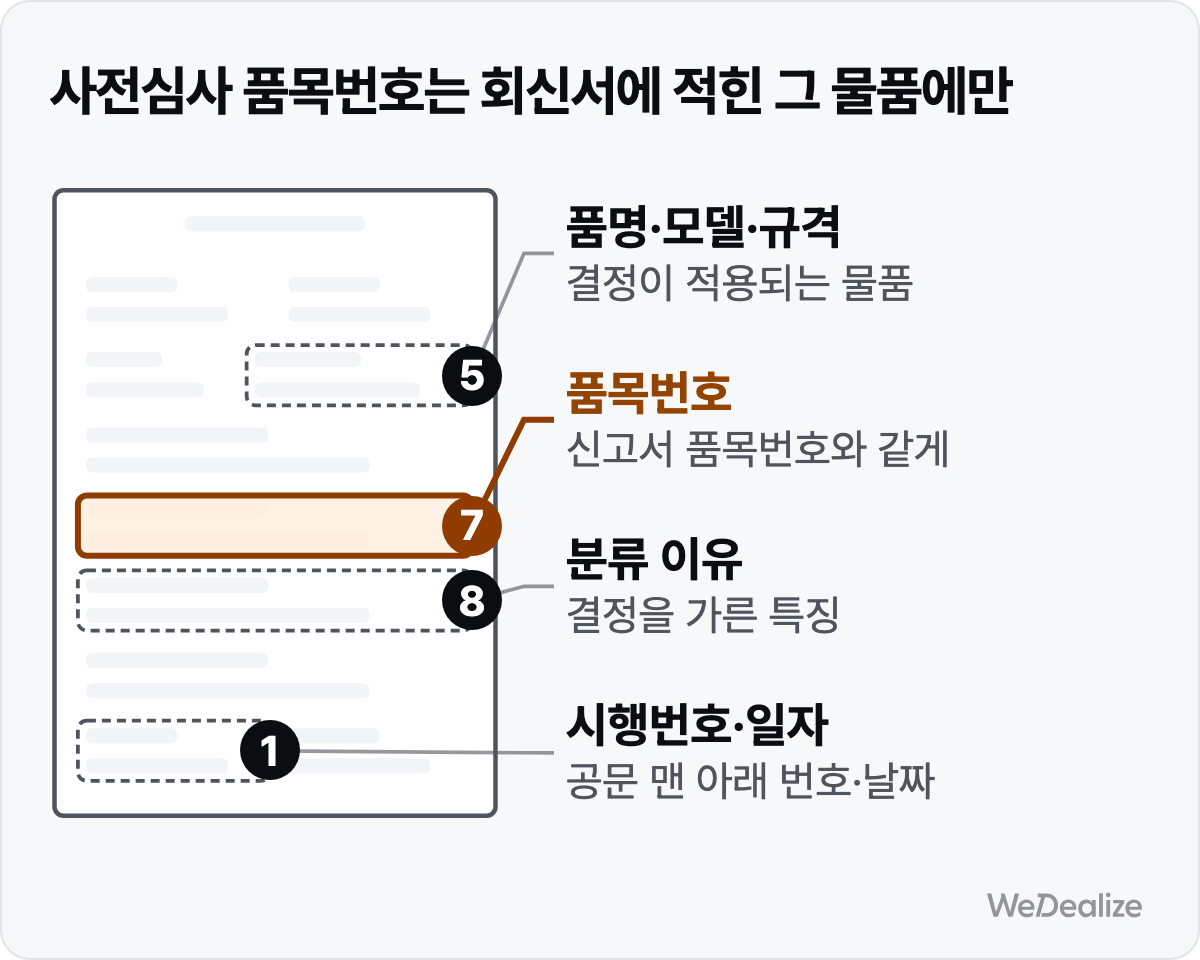
The response is arranged in the order of “application details → description of the goods → decision → notes.” The document number and date are at the bottom of the official letter. The numbers in the illustration indicate the order of explanation in this article; the actual form does not contain numbers.
Reading each field
① Document number and date — The number and date of the response document shown at the bottom of the official letter. The 30-day deadline for applying for a re-examination is calculated from the date the response is received, not this date.
② Applicant — The person or company that applied for the prior ruling. This is a separate field and may differ from ③, the importer or exporter.
③ Importer/exporter name — The company that will actually import or export the goods.
④ Customs office of intended clearance — The customs office where the declaration is expected to be filed. It may be changed for reasons such as a change in the place of arrival or bonded transportation.
⑤ Product name, model and specifications — The goods subject to the decision. The decision applies only to goods that are the same as those described in this field.
⑥ Description of the goods — The field describing the goods subject to the decision.
⑦ Tariff item number — The tariff item number under the determined Customs Tariff Schedule. Enter the same tariff item number as this field on the import declaration or export declaration.
⑧ Grounds for classification — The field explaining why the goods were classified under that number. When determining whether the goods are the same, check this field to identify which characteristics formed the basis of the decision.
⑨ Notes — This field states that a decision obtained using false materials is invalid, that it applies only to the same goods, that import and export requirements must be checked separately, and the deadline for applying for re-examination.
The date in the sample is based on the case of receiving a prior ruling after ordering the tumbler described in another document article and before the first import declaration (October 2026). A prior ruling must be applied for before filing the first import or export declaration for the same goods; otherwise, the application may be rejected. It may also be rejected while an objection or other appeal or litigation is pending. Since ⑤ in the notice is the 500ML model, consult a customs broker first to confirm whether a model with a different capacity or structure will be recognized as the same goods when importing it.
If you are the exporter
The manufacturer of the goods to be exported may also apply — The manufacturer may apply directly, in addition to the exporter.
It applies to export declarations as well — If the goods declared for import or export are the same as the goods stated in the notice, Customs applies the tariff classification according to the notice. Enter the same tariff schedule code as ⑦ of the notice on the export declaration.
You may request review only up to the 6-digit subheading for export goods — A request for classification of export goods at the 6-digit subheading level qualifies as a reason for expedited review (15 days).
If you are the importer
Declare only goods that are the same as those in the notice — Customs applies the tariff classification according to the notice only when the declared goods are the same as the goods stated in the notice. Confirm that they are the same goods when the declaration is accepted as well. A change in the model, material or specifications may mean that they are not the same goods.
Check import requirements separately — Even if the tariff item number has been determined, import and export clearance requirements must be checked under the relevant laws and regulations.
Apply for re-examination within 30 days if you object to the result — The processing period for re-examination is 60 days.
The submitted sample will be returned — A sample submitted with the application is returned to the applicant when the prior ruling is notified. Goods submitted for analysis are returned by the head of the analysis laboratory. If the goods have lost their commercial value through analysis and the applicant does not want them returned, they may be discarded.
Submit application materials truthfully — The decision is based on the materials submitted. If there is a defect, such as the submission of false materials, the decision becomes invalid. Customs may also request testing or analysis to confirm whether the goods are the same.
Do not miss a notice of change — If the Korea Customs Service changes the tariff classification, the changed number applies from the earlier of the date on which the change is notified and the date of notification or publication. As an exception, for goods shipped to Korea before 30 days have passed from the date of the change, the pre-change number applies if it is more favorable to the importer filing the import declaration.
You may request non-disclosure if it is a trade secret — Decisions are generally notified and published. As an exception, goods for which notification or publication is inappropriate, such as goods containing trade secrets, may not be notified or published.
Fields to cross-check against other documents
With the draft import declaration — ⑦ = tariff schedule code, ⑤ = product name, model and specifications, ④ = customs office of declaration.
With the import declaration certificate — After acceptance, check again whether the tariff schedule code on the certificate is the same as ⑦.
With the commercial invoice and specification sheet — ⑤ and ⑥ = the product name and product specifications on the invoice.
With the certificate of origin (for exports) — The first six digits of ⑦ = the HS code on the certificate of origin.
Related articles
Prior ruling on tariff classification — A system under which the Korea Customs Service determines in advance the tariff classification (HS code) of goods before an import or export declaration.
Tariff classification — The process of determining which number in the tariff classification table (HS code table) applies to goods being imported or exported.
HS code — A number classifying goods by type under a globally common standard and serving as the basis for determining tariff rates.
Import requirements — Conditions such as permits, certifications and declarations that must be met under other laws before goods can be imported.
Import declaration — The procedure for declaring to Customs the product name, quantity, price and other details of goods imported from abroad.
Certificate of origin — A document certifying the origin of goods, which is required to receive preferential tariff treatment under an FTA.