Reading a Bill of Exchange
Automatically translated from Korean.
One-line summary — A bill of exchange is a negotiable instrument by which the exporter (drawer) instructs the drawee to “pay this amount on the specified date to the person entitled to receive it.” The drawer guarantees acceptance and payment of the bill, while the drawee becomes obligated to pay at maturity upon acceptance.
The document shown is a simplified sample of the fields commonly used on a bill of exchange in export transactions. The figures are hypothetical and assume a transaction for 500 tumblers converted to payment by letter of credit, and follow the sample text of the letter of credit. The meaning of each field is explained based on Korea’s Bills of Exchange and Promissory Notes Act.
When is it received, and who prepares it?
The exporter prepares it directly after completing shipment when claiming payment. Check the letter of credit, collection terms, or guidance from the handling bank to confirm whom to designate as the drawee and the procedure for submitting shipping documents to the bank. A letter of credit cannot require a bill drawn on the applicant (importer) as the drawee.
Under the Bills of Exchange and Promissory Notes Act, a bill of exchange must contain eight items: the words “bill of exchange,” an unconditional order to pay a fixed amount, the drawee, maturity, place of payment, payee, date and place of issue, and the drawer’s name and seal or signature. If any one of these is omitted, the bill has no legal effect as a bill of exchange. As exceptions, if the maturity, place of payment, or place of issue is omitted, it is supplemented in the manner prescribed by law.
Reading the sample
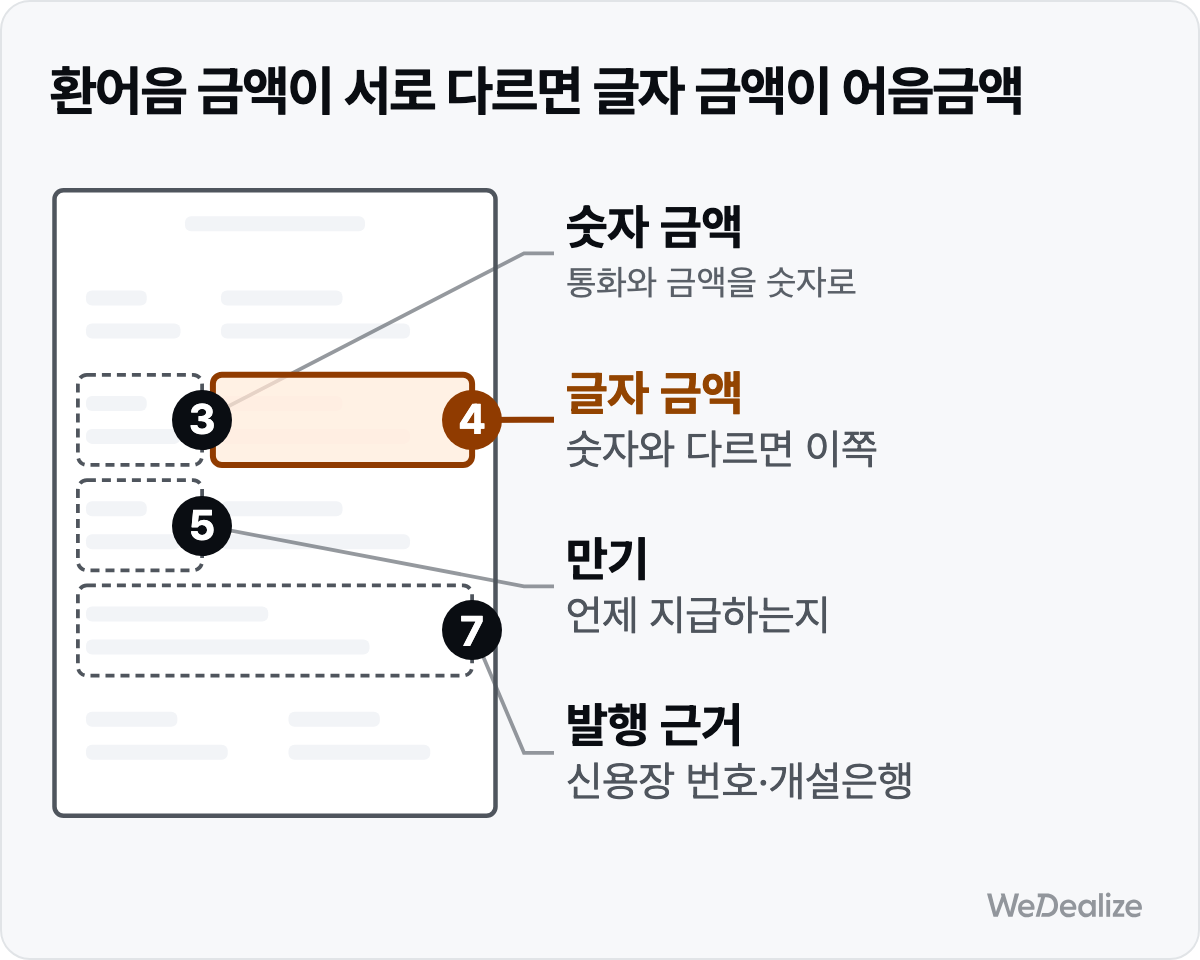
Read the bill in the order of “number and issue → amount → maturity and payee → underlying letter of credit → drawee and drawer.” The numbers in the illustration indicate the order of explanation in this article; actual bills do not have field numbers.
Reading each field
① No. (Bill Number) — This is the control number assigned by the drawer. At the top, wording such as “BILL OF EXCHANGE” appears to indicate that the document is a bill of exchange.
② Date · Place of Issue — The date and place where the bill was issued. If the place of issue is omitted, the place indicated next to the drawer’s name is deemed to be the place of issue.
③ Amount (in figures) — Enter the currency and amount in figures.
④ Amount in Words — Enter the same amount in words. If it differs from the amount in figures, the amount in words becomes the amount of the bill.
⑤ Tenor (Maturity) — This indicates when payment is due. Under the Bills of Exchange and Promissory Notes Act, there are four types of maturity: at sight, at a fixed period after sight, at a fixed period after date, and on a fixed date. AT SIGHT means that the bill matures when it is presented. For a usance bill, enter the maturity details completely.
⑥ Pay to the Order of (Payee) — The person who is to receive payment. Enter the name of the payee or the person to whose order payment is to be made.
⑦ Drawn under (Underlying transaction) — The field for entering the letter of credit number and issuing bank under which the bill is drawn.
⑧ Drawee — The party instructed to make payment. If no separate place of payment is specified, the place indicated next to the drawee’s name becomes the place of payment.
⑨ Drawer (Drawer’s Signature) — The name and seal or signature of the exporter that issued the bill. The drawer guarantees acceptance and payment of the bill.
The sample is payable at sight, so the bill matures when it is presented to the issuing bank. If the same transaction is changed to a usance transaction and “AT 60 DAYS AFTER SIGHT” is entered in ⑤, it becomes a bill payable at a fixed period after sight. In this case, maturity is determined based on the date of acceptance (or the date of the protest for non-acceptance). The wording in ⑤ must match the text of the letter of credit exactly. Change ③ and ④ together. If you change only the figures and leave the amount in words unchanged, the amount in words remains the amount of the bill.
If you are the exporter
Enter the details according to the letter of credit — Copy the maturity in ⑤, drawee in ⑧, and letter of credit number in ⑦ exactly as stated in the letter of credit. Under UCP 600 (Uniform Customs and Practice for Documentary Credits), a letter of credit cannot require a bill drawn on the applicant (importer) as the drawee.
Enter the same amount in ③ and ④ — If the amount in words is incorrect, that amount becomes the amount of the bill. Confirm whether it matches the letter of credit amount and invoice amount according to the handling bank’s document examination standards.
You remain liable as the drawer — If the drawee fails to pay after the bank has purchased the bill, the exporter, as drawer, remains liable for guaranteeing payment. Receiving the purchase proceeds does not mean the transaction is over.
It can be transferred by endorsement — A bill of exchange can be transferred by endorsement, which means signing the back of the bill to transfer the rights.
If you are the importer
For a letter of credit transaction, check the shipping documents rather than the bill — A letter of credit cannot require a bill drawn on the applicant (importer) as the drawee. Follow the issuing bank’s guidance to verify whether the shipping documents comply with the letter of credit terms.
For a collection transaction, check the bill’s acceptance terms — Once the drawee accepts the bill, the drawee becomes obligated to pay the amount at maturity. Confirm the conditions for receiving the shipping documents in the collection instruction and the bank’s guidance. Compare the amounts in ③ and ④ and the maturity in ⑤ with the contractual terms before accepting the bill.
Check the maturity date — For a bill payable at a fixed period after sight, maturity is determined based on the date of acceptance (or the date of the protest for non-acceptance). Confirm the date based on the maturity wording on the bill and include it in your cash-flow plan.
Fields to compare with other documents
With the letter of credit — ⑦ letter of credit number and issuing bank, ⑤ maturity (the Available by·Drafts at fields), and ⑧ drawee.
With the commercial invoice — Confirm whether the bill amount matches the invoice amount according to the handling bank’s document examination standards.
With the collection instruction (D/P·D/A) — Compare the drawee in ⑧ and maturity in ⑤ with the conditions stated in the instruction.
Related articles
Bill of Exchange — A negotiable instrument by which the drawer instructs the drawee to pay a specified amount at maturity to the payee.
Negotiation (Purchase) — A method in which the exporter presents the shipping documents and bill of exchange to the bank and receives payment in advance as the bank purchases them.
Letter of Credit (L/C) — An instrument by which the importer’s bank undertakes to make payment when complying documents are presented.
D/P (Documents against Payment) — A collection payment term under which the bank releases the shipping documents only after the importer makes payment.
D/A (Documents against Acceptance) — A payment term under which the bank releases the shipping documents first when the importer accepts the bill of exchange, with payment due at maturity.
Sight and Usance Letters of Credit — Letters of credit are classified as sight or usance depending on whether payment is made immediately when the documents are presented or after the agreed period.
View Documents — Reading a Letter of Credit (by L/C Term)