Reading a Cargo Arrival Notice (Arrival Notice) by Section
Automatically translated from Korean.
One-line summary — A Cargo Arrival Notice (A/N) is a notice from a freight forwarder or carrier informing you when and at which port the cargo will arrive, and what needs to be settled, and in what amount, to take delivery. The exporter should check the B/L notify party and freight terms before shipment to ensure the notice is sent properly, while the importer should first check whether the B/L number, cargo details, and charges match the B/L and quotation upon receipt.
An A/N is a notice document sent by a freight forwarder or carrier. The document shown is a simplified sample of the typical field arrangement of a forwarder’s A/N, and all company names, numbers, and amounts are fictitious.
Who receives it, and what happens after the vessel arrives?
The A/N is sent to the Notify Party or consignee shown on the B/L. Under the Commercial Act, if the carrier gives notice to the notify party stated on the B/L, the notice is deemed to have been given to the shipper, B/L holder, and consignee as well.
When the vessel arrives at the port, the master submits an arrival report to customs with a cargo manifest attached. The cargo is managed using the Cargo Management Number assigned in this manifest. As a rule, the import declaration is filed after arrival. As an exception, if expedited customs clearance is necessary, the declaration may also be filed before arrival.
A sample view
An A/N is generally arranged in the order of “recipient and B/L number → vessel, route, and ETA → Cargo Management Number and cargo details → place of delivery → charges to be settled.” Even when the format differs by forwarder, these items are generally included.
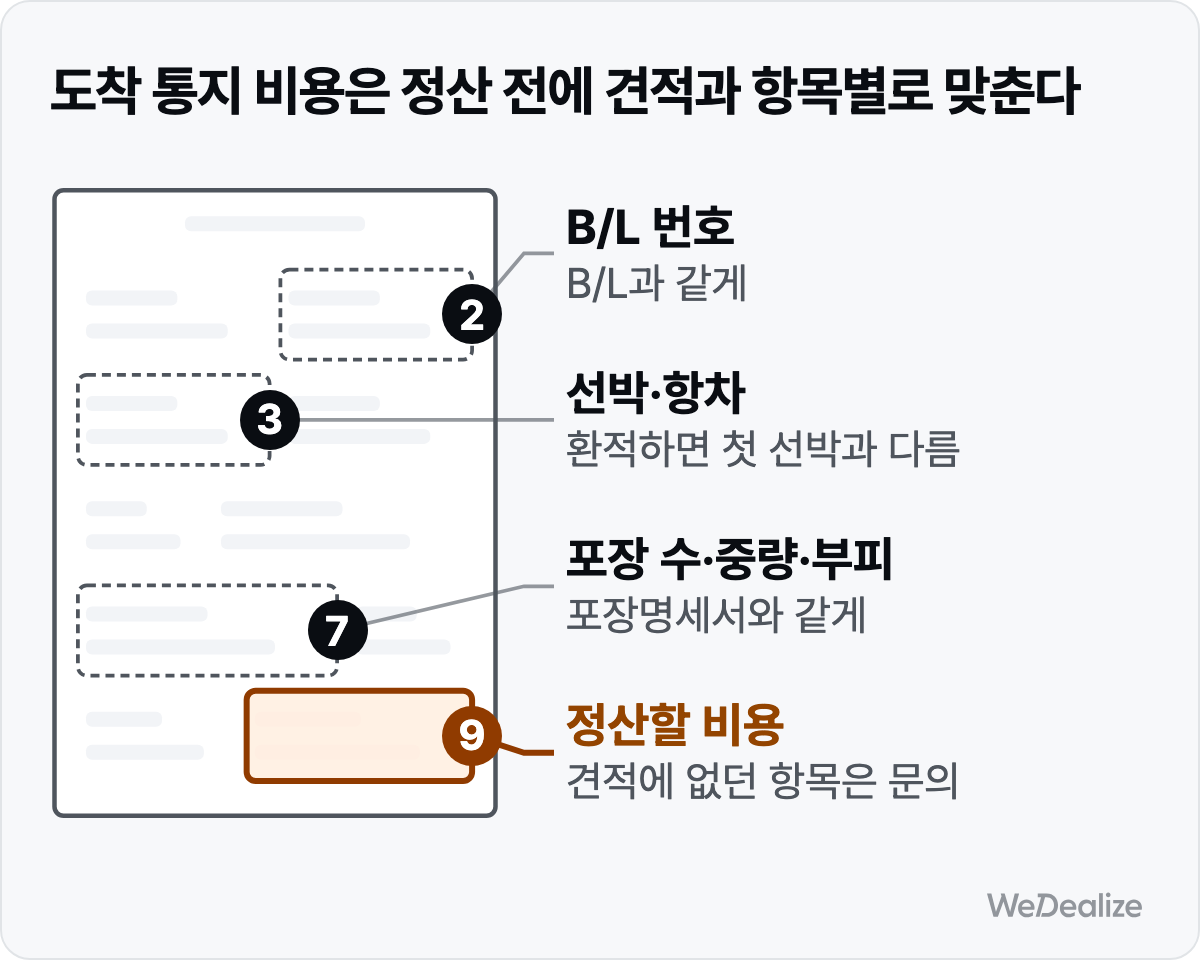
Reading it by section
① Notify Party — The person receiving the A/N. It is sent to the company listed in the Notify Party field on the B/L.
② B/L No. — The B/L number for this cargo. A forwarder’s A/N may include both the House B/L number and the carrier’s Master B/L number.
③ Vessel / Voy. — The name and voyage number of the arriving vessel. For transshipped cargo, they may differ from those of the first vessel shown on the B/L.
④ POL → POD — The port of departure and the port of arrival.
⑤ ETA — The estimated date of arrival. It is not a confirmed date and may change due to weather or port conditions.
⑥ MRN · MSN · HSN — The number used by customs to manage the cargo. It combines the Manifest Reference Number (MRN), the Master B/L sequence number (MSN), and the House B/L sequence number (HSN).
⑦ Pkgs / G.W. / CBM — The number of packages, gross weight, and volume.
⑧ Warehouse — The bonded area (CY, CFS, or bonded warehouse) where cargo unloaded from the vessel is brought in. This is where a truck should be sent to pick up the cargo.
⑨ Charges — The charges to be settled before taking delivery of the cargo. Compare the items and amounts with the forwarder’s quotation.
If you are the exporter
The A/N goes to the B/L notify party — The B/L states the company name of the consignee or notify party. Check before shipment that the notify party’s company name and contact details match those of the importer.
Check the freight terms on the draft B/L — Before shipment, check that the freight terms on the draft B/L match the contractual terms.
Send the shipping documents before arrival — The importer may file an import declaration before arrival. Sending the invoice, packing list, and a copy of the B/L before the ETA allows the importer to prepare for customs clearance in advance.
Confirm the original/surrender schedule with the forwarder — Determine when the original document will be released or surrendered in line with the payment collection schedule, and confirm it with the forwarder before arrival.
If the terms include responsibility for destination charges — In transactions such as DAP and DDP, where the exporter is responsible through to the destination, the exporter’s local agent may receive the A/N. Decide who will receive it when concluding the contract.
If you are the importer
Confirm that ① is correct — If this field is incorrect, you may not receive the notice.
Forward ② to the customs broker — Upon receiving the A/N, provide the B/L number and prepare to have the import declaration handled by a customs broker.
Use ⑤ only as an estimated date — Allow sufficient time when scheduling inland transportation and receiving the cargo, and check again using the cargo status after arrival. If the port of discharge in ④ differs from expectations, revise the inland transportation plan.
Check ⑥ — Confirm the cargo progress and release schedule with the customs broker and carrier.
Compare ⑦ with the B/L — If the number of packages or weight differs, the cargo manifest may need to be corrected. For packaged goods, the correction may be omitted if the weight difference is within 10% and there is no abnormality in the packaging.
File the declaration within 30 days from the date of receipt — If the cargo has been brought into a bonded warehouse or other facility, the import declaration must be filed within 30 days from the date of receipt.
Compare ⑨ item by item with the quotation — The amount may differ due to factors such as the exchange-rate reference date, the volume remeasured at the CFS, or the storage period. If there is a discrepancy, request the supporting basis.
The cargo cannot be released before the import declaration is accepted — Before the declaration is accepted, the declared goods cannot be released from the place of storage. Confirm the settlement of charges and the D/O procedure with the forwarder.
Fields to compare with other documents
With the B/L — ① Notify Party, ② B/L number, ④ route, and ⑦ number of packages and gross weight.
With the forwarder’s quotation — The items and amounts for ⑨ freight and destination charges. If there is an item not included in the quotation, inquire about it before settlement.
With the packing list — ⑦ number of packages, gross weight, and volume.
Related articles
Delivery Order (D/O) — An instruction issued by a carrier or freight forwarder to the terminal or warehouse stating, “Deliver this cargo to this person.”
Consignee and Notify Party — The consignee is the party designated on the B/L to receive delivery of the cargo, while the Notify Party is the party to receive the cargo arrival notice.
Cargo Management Number — A customs number assigned to each shipment by appending the B/L serial number (AWB for air cargo) to the Manifest Reference Number (MRN).
ETD·ETA — ETD is the estimated date of departure of a vessel or aircraft, and ETA is the estimated date of arrival.
Local charges — Various charges incurred around the port of origin or destination separately from the ocean freight.
Cargo manifest — A list of cargo submitted to customs, compiled from the B/L and AWB details of cargo loaded on vessels or aircraft.