Reading an Air Waybill (AWB)
Automatically translated from Korean.
One-line summary — Upon receiving an air waybill (AWB), the exporter is responsible for ensuring that the stated particulars are accurate, while the importer should first check the consignee, number of pieces, weight, and chargeable weight.
The document shown is a sample with a simplified layout, not a form from any specific airline or forwarder, and all company names, numbers, and dates are fictional. It assumes that 500 tumblers (20 cartons), as described in the other document, are being shipped by air.
When is it received, and who issues it?
Under the Commercial Act, when requested by the carrier, the shipper must prepare and deliver three original copies of the AWB. If the carrier prepares it at the shipper’s request, it is presumed to have been prepared on behalf of the shipper. The originals are divided into “for the carrier,” “for the consignee,” and “for the shipper.” After receiving the cargo, the carrier delivers the shipper’s copy to the shipper.
The importer receives a copy from the exporter or forwarder and submits it with the import declaration if it is subject to document submission. The carrier may also store the AWB details electronically instead of issuing a paper copy (electronic AWB).
Using the sample
An AWB is generally arranged in the order of “number (top) → parties → departure and destination airports and flight → cargo particulars and weight → charges.” When a forwarder consolidates cargo from multiple shippers, the airline issues a master AWB to the forwarder, and the forwarder issues a house AWB to the shipper.
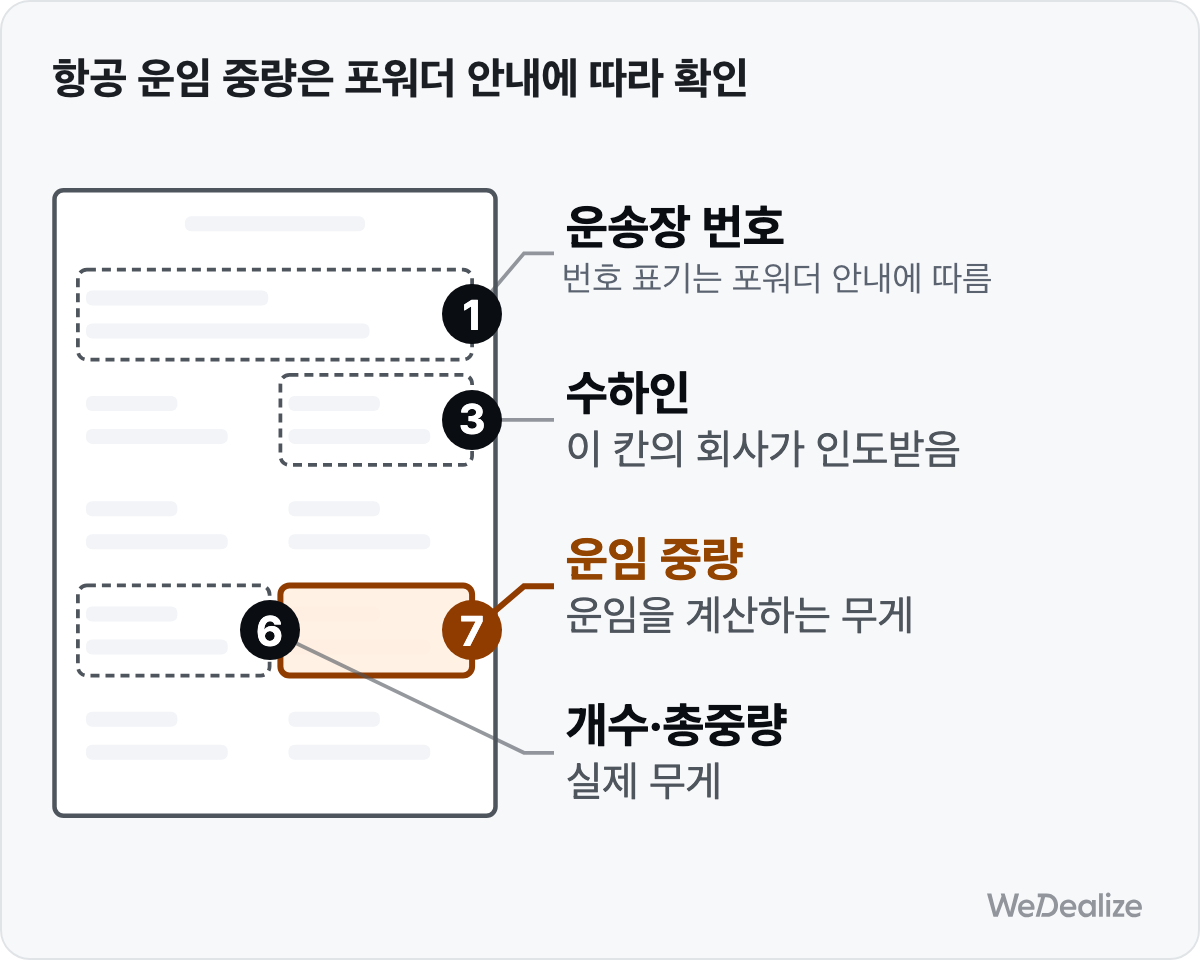
Reading it field by field
① AWB No. — The AWB number. The numbering of a house AWB follows the forwarder’s instructions.
② Shipper — The exporter entrusting the cargo for transportation.
③ Consignee — The field for entering the consignee’s name or company name.
④ From → To (departure and destination airports) — The departure and destination airports, usually entered using airport codes (e.g., PVG·ICN).
⑤ Flight / Date — The flight used for transportation and its departure date. If the flight changes after departure, the forwarder will provide updated information.
⑥ Pieces / G.W. (number of pieces and gross weight) — The number of packages and the actual weight. The carrier is presumed to have received the cargo according to the weight and number of pieces stated on the AWB.
⑦ Chargeable Weight — The weight used to calculate freight. How the actual weight and the volumetric weight calculated from the carton dimensions are reflected may vary by carrier, so confirm with the forwarder. In the sample, the actual weight of 220 kg is entered as the chargeable weight.
⑧ Charges — The field indicating where the air freight is to be paid. Confirm the notation and who bears the charges based on the terms of delivery and the forwarder’s instructions.
⑨ Nature of Goods — The type of goods being transported.
If you are the exporter
The shipper is responsible for the accuracy of the particulars — The shipper is deemed to warrant that the particulars stated on the AWB or provided to the carrier are accurate and sufficient. If the particulars are incorrect or insufficient and the carrier suffers a loss as a result, the shipper is liable for compensation. Even if the forwarder prepares it on the shipper’s behalf, compare ⑥ and ⑨ against the packing list and invoice.
Enter ⑨ to match the description on the invoice — Avoid vague expressions such as “SAMPLE” or “GIFT,” and describe the goods so that their material and use are clear. For goods subject to air transport restrictions, such as lithium batteries, confirm the requirements with the forwarder before dispatch. This is a practical matter governed by the airline’s and forwarder’s regulations.
Provide the requested documents — If necessary for procedures by customs or other administrative authorities, the shipper must, upon the carrier’s request, provide documents specifying the nature of the goods.
File the export declaration by AWB — Export declarations are filed for each aircraft loading unit (AWB). Since the time from cargo acceptance to departure is short for air shipments, the timing of export declaration acceptance is coordinated with the flight schedule. This is standard practice.
Report the carton dimensions accurately — Chargeable weight may be affected by carton dimensions. If the packaging changes, report the dimensions and weight to the forwarder again.
Receive the original for the shipper — Send this original or a copy to the importer so that they can prepare for customs clearance.
If you are the importer
Confirm that ③ is the company that will actually take delivery — Since the delivery procedure follows the airline’s and forwarder’s instructions, confirm that the consignee’s company name matches the company that will actually take delivery.
Confirm the number to use for the declaration in ① — For forwarder cargo, obtain the house number and master number separately. Confirm with the customs broker or forwarder which number to enter in the B/L (AWB) No. field of the import declaration.
Distinguish ⑦ from the actual weight — Confirm with the forwarder how carton dimensions are reflected in the chargeable weight. When requesting a quotation, provide the carton dimensions as well so that the billed amount matches your estimate.
Compare ⑥ with the packing list — If the numbers differ, notify the forwarder before arrival.
If the flight in ⑤ changes, reschedule accordingly — If the flight changes after departure, the arrival time will also change. Adjust the customs clearance and delivery schedules based on the forwarder’s information.
Compare ⑧ with the terms of delivery — Confirm with the forwarder that the freight payment terms match the terms of delivery. If payment is due at destination, also check whether the air freight is included in the amount to be settled.
Fields to compare with other documents
With the packing list — ⑥ number of pieces and gross weight, carton dimensions, and ⑦ chargeable weight.
With the forwarder’s quotation — ⑦ chargeable weight × freight rate per kg, and ⑧ freight payment terms.
With the commercial invoice — ② Shipper and Seller, and ⑨ description of goods.
With the import declaration — ① AWB number, ② Shipper and overseas supplier, and ⑥ number of pieces and gross weight.
Related articles
Chargeable Weight (Air) — The weight used as the basis for calculating air freight.
Air Freight (A/F) — The basic freight charge for transporting cargo by air from the departure airport to the destination airport.
House B/L · Master B/L — A house B/L is issued by the forwarder to the shipper, while a master B/L is issued by the carrier to the forwarder.
Consignee · Notify Party — The consignee is the party designated on the B/L to receive delivery of the cargo, while the notify party is the party to receive notice of the cargo’s arrival.
Freight Prepaid · Collect — With freight prepaid (Prepaid), the shipper pays the ocean freight at the place of departure; with freight collect (Collect), the consignee pays it at the destination.
Export Declaration — The procedure for declaring to customs the description, quantity, value, and other details of goods to be exported overseas.