Taiwan BSMI Inspection Mark
Automatically translated from Korean.
One-line definition — The Taiwan BSMI Inspection Mark is a commodity inspection mark displayed on products to indicate that goods designated by Taiwan’s Bureau of Standards, Metrology and Inspection have passed inspection.
Also known as: BSMI · 商品檢驗標識 · Taiwan commodity inspection · Taiwan BSMI certification · Bureau of Standards, Metrology and Inspection · BSMI Commodity Inspection Mark
In simple terms
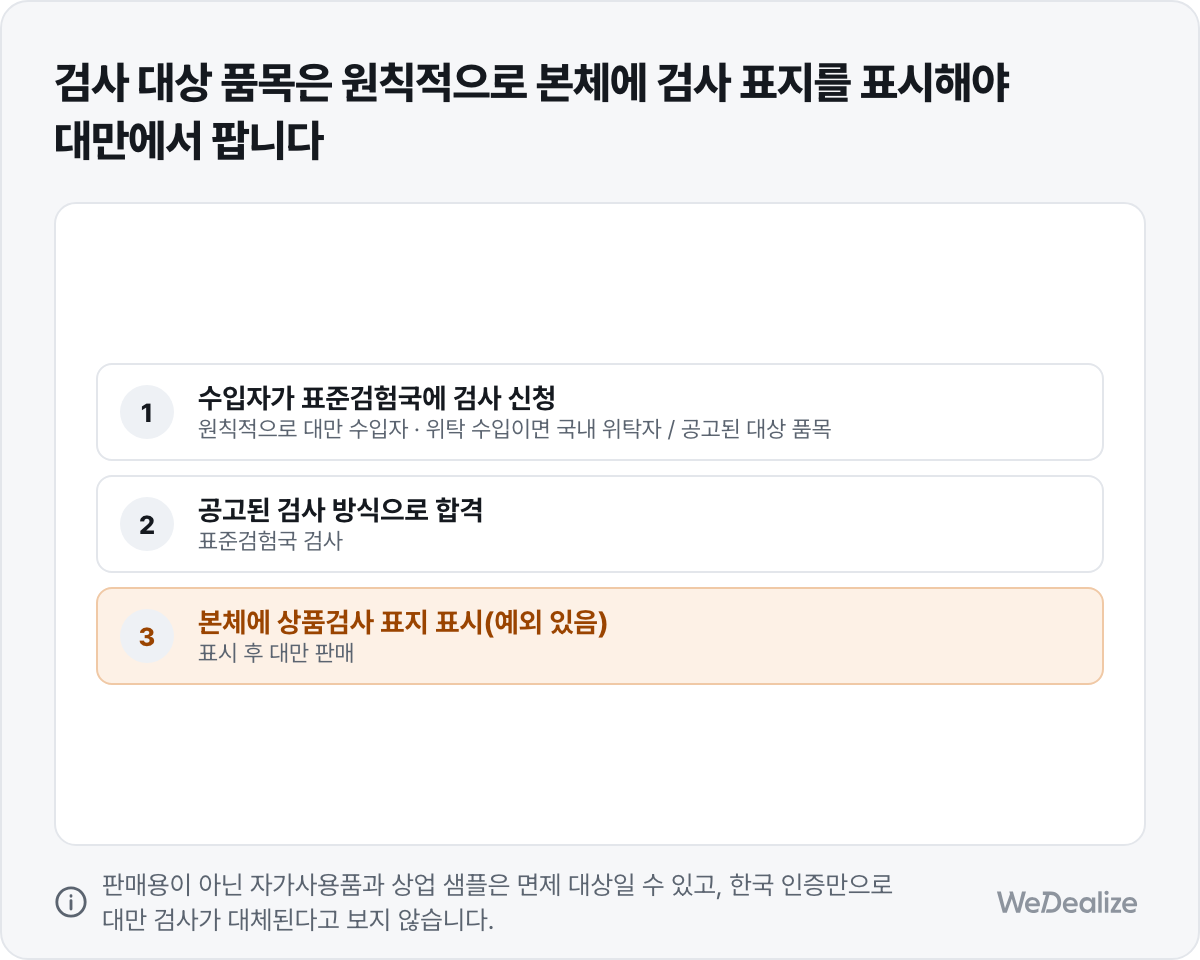
The BSMI Inspection Mark is Taiwan’s version of a “safety inspection passed” seal. Under Taiwan’s Commodity Inspection Act, products whose types and categories are designated and publicly announced by the Bureau of Standards, Metrology and Inspection (BSMI) under the Ministry of Economic Affairs must undergo inspection. Products that do not meet the inspection requirements generally cannot be imported. Products recognized by BSMI as posing a low risk of harm are exempt, but they must still meet the inspection requirements before entering the market. For products manufactured overseas, the importer generally applies for inspection. If the products are sold in Taiwan under the name of a principal that has an address or business establishment in Taiwan, the principal applies. Products subject to inspection must generally display the commodity inspection mark on the product itself. If the product is too small, the mark may be displayed in another manner, and products designated and approved by BSMI are exempt from displaying it. For example, if an electrical product made in Korea is a designated product category, you must confirm that it meets the inspection requirements and displays the mark before importing and selling it in Taiwan.
When is it needed?
When importing and selling products in Taiwan — First, check whether the product is a category subject to inspection as designated and publicly announced by BSMI.
When deciding on the inspection method — There are four inspection methods: lot-by-lot inspection (inspection for each imported lot), monitoring inspection, registration of certification, and declaration of conformity. BSMI publicly announces the applicable method for each product category.
When confirming who is required to apply for inspection — For products manufactured overseas, the party required to apply for inspection is the importer. For consignment imports sold in Taiwan under the name of a principal that has an address or business establishment in Taiwan, it is the principal. Therefore, first confirm who will be the importer.
Example
Mr. Jin plans to sell small home appliances made in Korea through a Taiwan-based online mall. First, he checks BSMI’s public announcements to confirm whether the products are subject to inspection and which inspection method applies. If they are subject to inspection, the importer applies for inspection, and the products are received into a warehouse in Taiwan after displaying the commodity inspection mark on the product itself. For several samples that are not intended for sale, he considers applying for an exemption.
The product and sales scenario in this example are hypothetical and provided for illustrative purposes.
Common points of confusion
“If a product has obtained Korean KC certification, it can also be sold in Taiwan” — That is not necessarily the case. Do not assume that KC certification alone replaces Taiwan’s inspection; check the public announcement for the relevant product category. Also check whether a certificate of inspection passed from a country granted preferential treatment for mutual inspection exemption, or a test report under a mutual recognition agreement, is accepted.
“Even products intended for sale are exempt from inspection if they are sent to an individual” — This is not necessarily true. Only products imported by the recipient for the recipient’s own use qualify for an exemption. If the total value under the same declaration and for the same model exceeds USD 1,000, the shipment must undergo review. If the recipient resells the products in Taiwan, they must undergo inspection.
Related terms
Taiwan NCC certification — See the article for this term for a detailed explanation.
PSE Mark (Japan) — See the article for this term for a detailed explanation.
KC certification — See the article for this term for a detailed explanation.
IOR (Importer of Record) — The party declared as the importer to the customs authorities of the country of sale, which assumes responsibility for paying duties and taxes and for legal compliance.