Domestic Administrator (Japan)
Automatically translated from Korean.
One-line definition — A Domestic Administrator is a person appointed by an importing business operator located overseas to take measures in Japan to prevent the expansion of product-related risks.
Other names: 国内管理人 · Japanese Domestic Administrator · Administrator for a Specified Importing Business Operator · Domestic Administrator
In simple terms
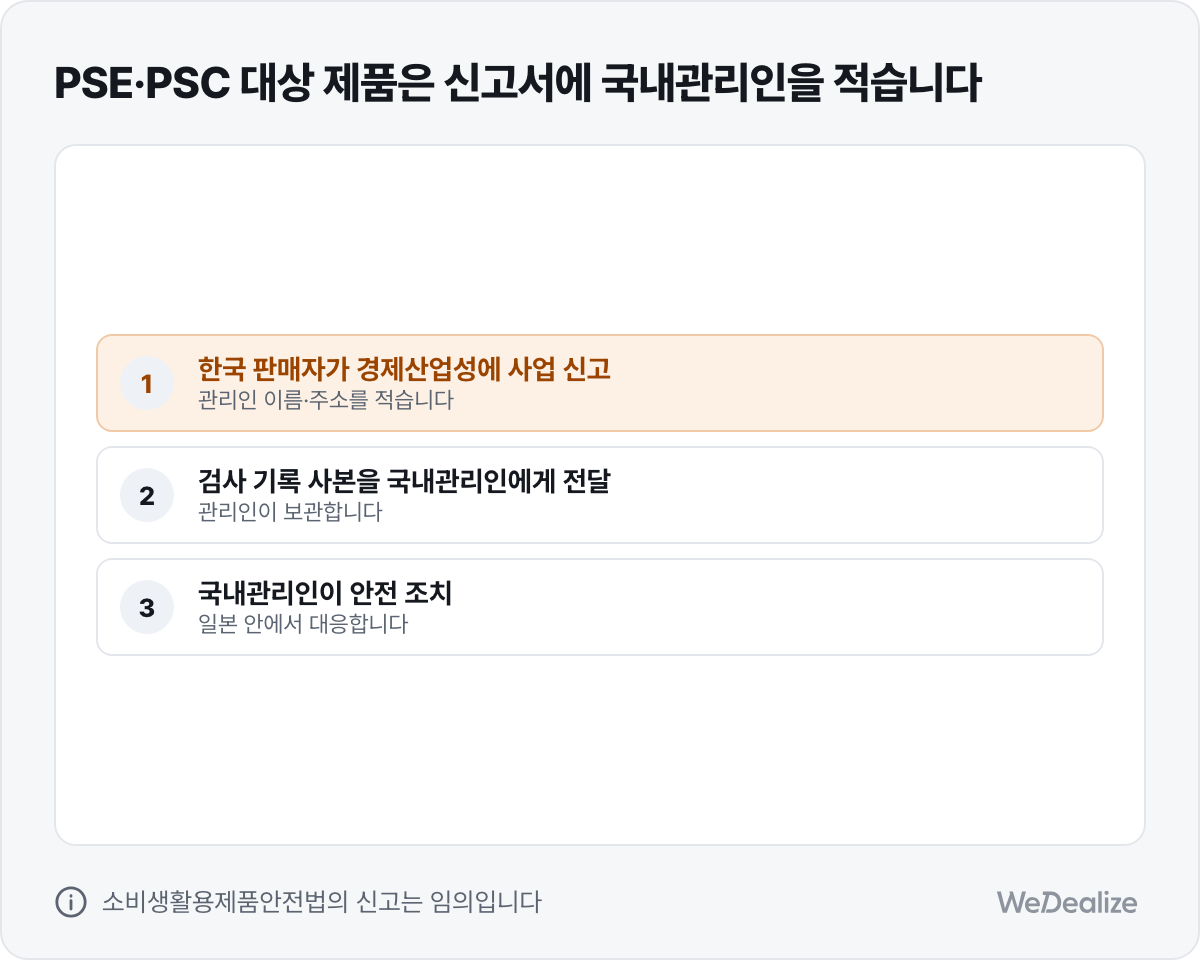
A Domestic Administrator is the overseas seller’s “safety contact in Japan.” Japan amended its four Product Safety Acts and put the amendments into effect on December 25, 2025. An overseas business that directly sells products subject to PSE or PSC requirements to Japanese consumers becomes a Specified Importing Business Operator. Under the Electrical Appliances and Materials Safety Act, such businesses must list a Domestic Administrator in their notification. The Domestic Administrator handles the measures required in Japan to prevent risks from increasing due to those products. They also retain copies of the inspection records provided by the seller. For example, if a business in South Korea directly ships electrical appliances subject to PSE marking to Japanese consumers, it must list the Domestic Administrator’s name and address when notifying the Ministry of Economy, Trade and Industry of its business.
When is it required?
When directly selling products subject to PSE or PSC marking from overseas to Japanese consumers — Under Japanese law, a foreign-based seller’s causing goods to be brought into Japan for Japanese consumers is also deemed an import. In this case, the seller becomes a Specified Importing Business Operator.
When notifying the business — The Electrical Appliances and Materials Safety Act requires businesses to submit a notification, and a Specified Importing Business Operator must list the Domestic Administrator’s name and address in the notification. This notification must be submitted within 30 days from the date the business begins. Notification under the Consumer Product Safety Act is optional, and a Domestic Administrator is listed if a notification is submitted.
When managing inspection records — The seller must provide copies of its own inspection records to the Domestic Administrator, who must retain them. The seller may affix the PSE mark only after confirming that the Domestic Administrator is complying with this retention obligation.
Example
A representative, Mr. Han, sells electric grills made in South Korea on a Japanese marketplace and ships each order from South Korea by express courier. Since Mr. Han’s company has no office in Japan, it appoints a business partner with an address in Japan as its Domestic Administrator. When notifying the Ministry of Economy, Trade and Industry of the business, it lists the Domestic Administrator’s name and address and provides copies of the inspection records to the partner. It then affixes the PSE mark and begins sales.
The product and sales circumstances in this example are hypothetical and provided for explanatory purposes.
Common point of confusion
“The marketplace acts as the Domestic Administrator because we have joined the marketplace.” — Under the law, it is the seller, as the Specified Importing Business Operator, that designates the Domestic Administrator and lists it in the notification.
Related terms
PSE mark (Japan) — A mark affixed to electrical appliances and materials for which conformity with technical standards has been confirmed under Japan’s Electrical Appliances and Materials Safety Act.
Customs Affairs Administrator (Japan) — A person or entity in Japan appointed by an importer without an address in Japan to handle customs procedures.
IOR (Importer of Record) — The party declared as the importer to the customs authorities in the country of sale, bearing responsibility for paying duties and taxes and for legal compliance.
Reverse direct purchase — A transaction in which an overseas consumer purchases a domestic seller’s product online and it is shipped overseas.