IOR (Importer of Record)
Automatically translated from Korean.
One-line definition — An IOR (Importer of Record) is the party that imports goods into the country of sale and bears primary responsibility for paying customs duties.
Also known as: importer of record · Importer of Record
In simple terms
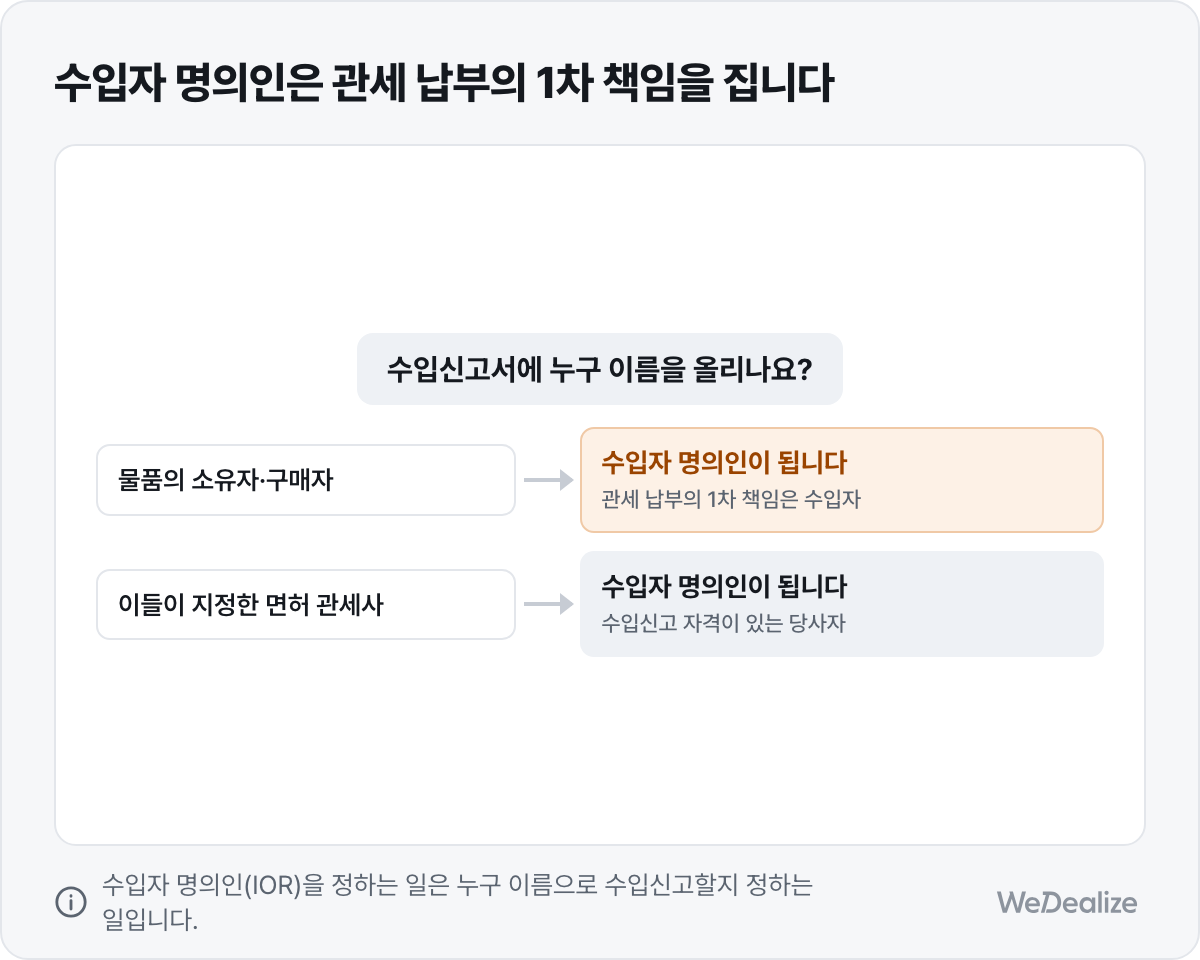
The IOR is the party whose name appears on the import declaration as “the person importing these goods.” Under U.S. law, the importer is the person or their agent primarily responsible for paying customs duties on the goods. The importer of record must be the owner or purchaser of the goods, or a party qualified to make an import declaration, such as a licensed customs broker designated by them. For example, when a Korean seller imports inventory into a U.S. warehouse, deciding whose name will appear on the import declaration means determining the IOR.
When is it needed?
When exporting to Taiwan — Under Taiwan’s customs law, the persons liable for customs duties are the consignee (收貨人, the person receiving the cargo), the holder of the delivery document (提貨單, the document presented to take delivery of the cargo), and the holder of the cargo.
When there is no address or office in the country of sale — Japan requires such a declarant to appoint a customs procedure administrator domiciled in Japan when the declarant needs to handle customs procedures.
Example
Representative Jung sells skincare products made in Korea through a U.S. marketplace. At first, the products are shipped by express courier with each order, but as sales increase, Representative Jung decides to stock 1,000 units in a local U.S. warehouse. If Representative Jung’s company is designated as the importer of record on the import declaration, the company can appoint a U.S. customs broker to handle the declaration. In this case, primary responsibility for paying customs duties lies with Representative Jung’s company as the importer.
The circumstances and quantity in this example are hypothetical and provided for explanatory purposes.
Common points of confusion
“The seller receiving the payment is always the IOR.” — No. The IOR is the importer primarily responsible for paying customs duties. Confirm separately who the importer is for each transaction, and consult a customs broker if the determination is difficult.
“If there is no legal entity in the country of sale, customs procedures cannot be handled.” — It depends on the country. Japan requires a declarant without an address or office in Japan to appoint a customs procedure administrator in Japan when the declarant needs to handle customs procedures. Check country-specific requirements with a customs broker.
Related terms
De minimis threshold in the country of sale
Customs procedure administrator (Japan) — An administrator in Japan appointed by a declarant without an address or office in Japan to handle customs procedures.
Dispatch from a local warehouse
DDP (Delivered Duty Paid)
Person liable for customs duties — The person obligated to pay customs duties; in principle, for goods covered by an import declaration, this is the cargo owner at the time the import declaration is made.