Japan Cosmetics Export Guide
Automatically translated from Korean.
One-line summary — To sell cosmetics in Japan, a Japanese cosmetics marketing authorization holder must file a notification in advance for each product and labeling must be in Japanese. For Korean products, the RCEP Korea tariff rate is 0% for most items. Tariffs remain only for bath preparations (1.8%) and certain other cosmetics (2.5%).
Products covered in this article — Perfumes, makeup, creams·sunscreens·sheet masks, shampoos·hair products, toothpaste·mouthwash, deodorants, bath preparations, cosmetic soaps·cleansing foams·body washes.
Covered in another article — Quasi-drugs and pharmaceuticals claiming to prevent body odor, prevent hair loss·promote hair growth·remove hair are not covered. Dental floss and indoor air fresheners are also not covered in this article. Requirements for selling in China are covered in the China Cosmetics Export Guide.
Have your interpretation checked by a local Japanese regulatory expert before selling.
What to check first
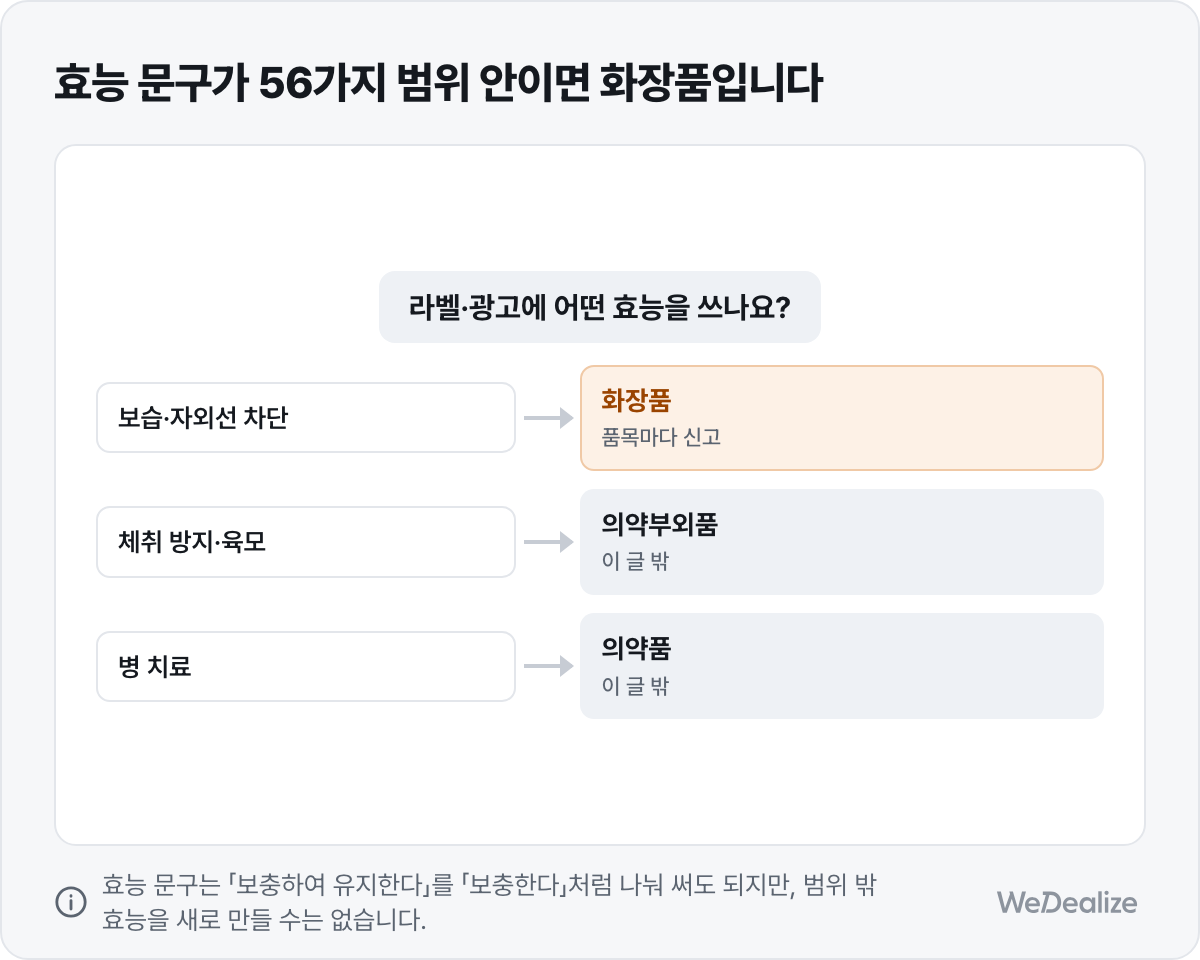
Does the claim fall within the scope of cosmetics? — Under Japan’s Pharmaceuticals and Medical Devices Act (薬機法), cosmetics are mild products applied to clean and beautify the body and maintain healthy skin and hair. The claims that cosmetics may make fall within the 56 categories prescribed by the Ministry of Health, Labour and Welfare. If making a claim outside this scope, check whether the product is classified as a quasi-drug or pharmaceutical.
「人の身体を清潔にし、美化し、魅力を増し、容貌を変え、又は皮膚若しくは毛髪を健やかに保つ」 — Definition of cosmetics in Japan
If the product claims this | In Japan |
|---|---|
Improving skin texture, moisturizing, protecting the skin, preventing prickly heat (other categories) | Cosmetic |
Protection from UV rays (日やけを防ぐ), preventing spots·freckles caused by sunlight | Cosmetic |
Making fine lines caused by dryness less noticeable | Cosmetic |
Preventing cavities·bad breath while brushing (toothpaste) | Cosmetic |
Preventing body odor, preventing hair loss·promoting hair growth·removing hair | Quasi-drug |
Treating·preventing disease | Pharmaceutical |
Who is the seller in Japan? — To manufacture and market cosmetics as a business in Japan, a cosmetics marketing authorization license is required. To sell in Japan, you need a Japanese marketing authorization holder with this license, and its name and address must also be stated on the container labeling. The license is issued by the governor of the prefecture where the office of the responsible marketing supervisor is located, so the office must be in Japan.
Who handles each sales method? — The Ministry of Health, Labour and Welfare states that licenses and other requirements under the Pharmaceuticals and Medical Devices Act are necessary to import cosmetics and other products for commercial purposes. When a licensed marketing authorization holder imports for commercial purposes, it submits a copy of its marketing authorization license and other documents to customs at the time of the import declaration for verification. For customs clearance, a corporation without an office in Japan must appoint a customs procedure administrator (税関事務管理人) located in Japan. When a Korean seller sells under its own name or trademark, the arrangements differ as follows depending on the four sales methods.
Sales method | Who handles the license·product notification | Importer at customs clearance |
|---|---|---|
Sell directly to Japanese consumers through cross-border e-commerce | The Ministry of Health, Labour and Welfare treats products brought in from overseas by consumers through the internet or other means for their own use as personal imports. A Ministry notice states that when an overseas seller sends the product directly to the consumer, the consumer is regarded as the importer. Since the license is required for those importing as a business, under this standard the overseas seller is not the importer in Japan. Cosmetics imported personally may only be used by the importer and may not be sold or given away. Standard-size products clear customs without separate confirmation up to 24 units per item; small products of 60 g·60 mL or less may be imported up to 120 units (excluding foundation·lip products·perfume and similar items). | The Japanese consumer receiving the goods (personal import). |
Sell to a Japanese company (distributor·importer) | That Japanese company, which holds the license, files the product notification as the marketing authorization holder. | That Japanese company. It submits a copy of its license and other documents to customs when filing the import declaration. |
Our company becomes the importer of record (IOR) without establishing a corporation | Commercial imports require a license and other requirements. The special approval for overseas manufacturers (Article 19-2) also requires appointing a Japanese marketing authorization holder and having that company conduct the marketing. Since the license is issued by the governor of the prefecture where the office of the responsible marketing supervisor is located, our company, which has no office in Japan, cannot obtain the license directly. Appoint a licensed Japanese marketing authorization holder and have that company conduct the marketing. | Our company. If it has no office in Japan, it appoints a customs procedure administrator located in Japan. |
Borrow the importer-of-record name of a Japanese company through an IOR service | Confirm that the company lending its name holds a cosmetics marketing authorization license. Without the license, the products cannot be imported for commercial purposes. | The Japanese company lending its name. It submits a copy of its license and other documents to customs when filing the import declaration. |
If we borrow an importer-of-record name through an IOR service, is that company the marketing authorization holder? — Not merely because its name is borrowed. Marketing cosmetics as a business requires a marketing authorization license, and commercial imports require a license and other requirements. Confirm by contract whether the company holds the license and will also handle the product notification, and have a local Japanese expert check the interpretation before selling.
For tariffs and consumption tax on cross-border e-commerce parcels, see the continuation in the “Japan Sales Guide.”
Action sequence
Review efficacy claims — Confirm that they fall within the 56 categories (“What to check first”).
Choose the sales method·Japanese marketing authorization holder — Choose one of the four sales methods and appoint a licensed marketing authorization holder (“What to check first”·“Licenses and notifications”).
Compare ingredients — Compare them against the prohibited·restricted·permitted ingredient lists in the Standards for Cosmetics (“Standards for Cosmetics — Ingredients”).
Japanese labeling — State the marketing authorization holder’s name·address, manufacturing lot number, and ingredients in Japanese (“Japanese labeling”).
Product notification — File a notification for each product before selling (“Licenses and notifications”).
Shipment·customs clearance — Prove RCEP origin (“Tariffs·FTA”).
Post-sale management — Manage adverse-event reports and advertising claims (“Advertising and adverse-event reporting”).
Japanese cosmetics requirements (薬機法)
Licenses and notifications
Marketing authorization license — To manufacture and market cosmetics as a business in Japan, a “Cosmetics Manufacturing and Marketing Authorization License” (化粧品製造販売業許可) is required.
Manufacturing license — To manufacture cosmetics as a business, each manufacturing site must have a manufacturing license. Cosmetics manufacturing is divided into “all or part of manufacturing” and “packaging·labeling·storage only.” Confirm with the Japanese marketing authorization holder·local expert whether a manufacturing license is required for attaching labels and storing products in a Japanese warehouse.
Overseas manufacturing site — A company manufacturing cosmetics for export to Japan overseas may obtain accreditation (認定) from the Minister of Health, Labour and Welfare. Confirm with the Japanese marketing authorization holder whether this is required for a Korean factory.
Product notification — Cosmetics that are not subject to approval require a notification (届出) for each product before sale. If the contents of the notification change, file another notification within 30 days.
Products subject to approval — Cosmetics containing ingredients designated by the Minister of Health, Labour and Welfare require approval for each product.
Manufacturing records — The person responsible at the manufacturing site must retain manufacturing·testing records for three years. For products required to display an expiration date, the retention period is the stated period plus one year.
Standards for Cosmetics — Ingredients
The Standards for Cosmetics (化粧品基準) are a notification issued by the Ministry of Health, Labour and Welfare.
Do not formulate pharmaceutical ingredients (excluding ingredients used only as additives and ingredients listed in Appendices 2–4) or substances listed in Appendix 1.
Ingredients in Appendix 2 may be formulated only within the specified amounts per 100 g.
Use only preservatives listed in Appendix 3 and UV absorbers listed in Appendix 4. Check the UV-protection ingredients in sunscreen against this list.
Tar colors must comply with the ministerial ordinance specifying tar colors that may be used in pharmaceuticals and other products. Red No. 219 and Yellow No. 204 may be formulated only in products used on hair·fingernails and toenails.
Japanese labeling
Required items — Directly state on the container the marketing authorization holder’s name·address, product name, manufacturing lot number (manufacturing symbol), names of designated ingredients, and, for designated cosmetics, the expiration date.
Outer box — If the container labeling cannot be seen from outside the outer box, state the same information on the outer box as well.
Omission of ingredient names — Ingredient names may be omitted from the immediate container if they are stated on the outer box or on a tag attached to the container, or if a document is enclosed with a small container of 50 g·50 mL or less.
Japanese — Legally required labeling information must be written in Japanese (邦文). Confirm with the Japanese marketing authorization holder·local expert whether a license is required for the location where Japanese labeling is attached over a Korean label.
Advertising and adverse-event reporting
Ban on exaggerated advertising — No one may make false or exaggerated advertising claims about a cosmetic’s name, manufacturing method, or efficacy. Directly translating the wording on a Korean product detail page can easily go beyond the 56 categories.
Adverse-event reporting — If a marketing authorization holder becomes aware of a disease·disability·death suspected to be an adverse event or similar, it must report it to the Minister of Health, Labour and Welfare.
Product table
The product numbers in this article are representative examples for explanatory purposes. The Japanese statistical number (9 digits) is determined by the declarant at the time of the import declaration, so confirm the final classification with the importer and customs broker.
The general rate is the WTO agreement rate in Japan’s current tariff schedule (or the basic rate if no WTO rate exists), and the rate in parentheses is the RCEP Korea rate · As of 2026-10-18.
Perfume·makeup
Product name | Japanese statistical number | General rate | Key classification point |
|---|---|---|---|
Perfume·eau de cologne | 3303.00-000 | Duty 0% (RCEP Korea duty 0%) | The claim of adding fragrance (芳香を与える) falls within the scope of cosmetics. |
Lipstick·lip balm | 3304.10-000 | Duty 0% (RCEP Korea duty 0%) | Preventing chapped lips·moisturizing fall within the scope of cosmetics. |
Eye shadow·mascara | 3304.20-000 | Duty 0% (RCEP Korea duty 0%) | Use only tar colors permitted by the ministerial ordinance. |
Nail polish | 3304.30-000 | Duty 0% (RCEP Korea duty 0%) | Red No. 219 and Yellow No. 204 may be formulated only in products used on hair·fingernails and toenails. |
Powder·pressed powder | 3304.91-000 | Duty 0% (RCEP Korea duty 0%) | Use only UV absorbers listed in Appendix 4. |
Skincare·sunscreen
Product name | Japanese statistical number | General rate | Key classification point |
|---|---|---|---|
Oil·fat·wax-based products such as creams | 3304.99-010 | Duty 0% (RCEP Korea duty 0%) | The statistical number varies depending on whether the product is based on oil·fat·wax. |
Lotions·essences·sunscreens·cushion products, etc. | 3304.99-090 | Duty 0% (RCEP Korea duty 0%) | Making fine lines caused by dryness less noticeable is within the scope; confirm whether claims such as whitening·improving wrinkles appear on the list of 56 categories. |
Hair·oral care
Product name | Japanese statistical number | General rate | Key classification point |
|---|---|---|---|
Shampoo | 3305.10-000 | Duty 0% (RCEP Korea duty 0%) | Claims to control dandruff·itching fall within the scope, while preventing hair loss is a quasi-drug. |
Treatment·hair essence | 3305.90-000 | Duty 0% (RCEP Korea duty 0%) | Claiming to promote hair growth·prevent hair loss makes it a quasi-drug. |
Toothpaste | 3306.10-000 | Duty 0% (RCEP Korea duty 0%) | Preventing cavities·whitening while brushing fall within the scope of cosmetics. |
Mouthwash, etc. | 3306.90-000 | Duty 0% (RCEP Korea duty 0%) | Since the classification between cosmetics and quasi-drugs depends on the efficacy claims, confirm with the importer. |
Deodorants·bath products·other products·cleansing products
Item name | Japan statistical code | General tariff rate | Key point |
|---|---|---|---|
Deodorants·antiperspirants | 3307.20-000 | 3.9% (RCEP Korea tariff: 0%) | If the product claims to prevent body odor, it is a quasi-drug. |
Bath preparations | 3307.30-000 | 3.9% (RCEP Korea: 1.8%) | Even with RCEP origin, a 1.8% tariff remains. |
Sheet masks and other cosmetics | 3307.90-000 | 4% (RCEP Korea: 0% for oil, fat, or wax-based products; 2.5% for other products) | Even within the same code, the RCEP tariff rate varies depending on the base ingredients. |
Toilet soap | 3401.11-000 | 0% tariff (RCEP Korea tariff: 0%) | The claim that the product washes away dirt and cleans the skin falls within the scope of cosmetics. |
Facial cleansing foam·body wash | 3401.30-000 | 0% tariff (RCEP Korea tariff: 0%) | Claims that the product prevents acne or prickly heat by washing are within scope only for facial cleansers. |
Tariffs·FTAs
Under the RCEP Korea tariff rates, most products are subject to a 0% tariff, but bath preparations are subject to 1.8%, and other cosmetics that are not oil, fat, or wax-based are subject to 2.5%.
Reading the Customs Tariff Schedule — Japan’s Customs Tariff Schedule has separate columns for general, temporary, and WTO agreement rates, as well as columns for individual agreements. Preferential rates for Korean products are listed in the RCEP Korea column.
RCEP — Tariff preferences between Korea and Japan are granted under the RCEP (Regional Comprehensive Economic Partnership). To receive preferential treatment, you must prove RCEP origin.
Lines where tariffs remain — The WTO rate of 3.9% for deodorants can be reduced to 0% under RCEP. For bath preparations, 1.8% remains even when RCEP is applied.
Import-stage indirect taxes — The total is 10%, consisting of 7.8% consumption tax and 2.2% local consumption tax. The taxable base (the amount used to calculate tax) is the customs value plus the customs duty, meaning that it includes the customs duty. For goods subject to other consumption taxes, such as liquor tax, that tax amount is also added (Consumption Tax Act).
Calculation example — The taxable value of 1 million yen in this example is an assumed value for explanatory purposes.
Item | WTO agreement rate | RCEP Korea rate |
|---|---|---|
Bath preparations (3307.30) | 39,000 yen (3.9%) | 18,000 yen (1.8%) |
Deodorants (3307.20) | 39,000 yen (3.9%) | 0 yen |
Cream (3304.99-010) | 0 yen | 0 yen |
Shipping·customs clearance tips
Confirm the importer’s authorization — Before filing the import declaration, confirm that the importer has a cosmetics manufacturing and marketing business license and has notified the relevant products. Cosmetics may not be manufactured and marketed as a business without authorization.
Location for applying Japanese labeling — Confirm with a Japanese cosmetics marketing authorization holder or local expert whether a manufacturing business license is required for the warehouse in Japan where labels are applied and the products are stored. Also confirm in advance whether the logistics provider has the required authorization.
Match the item code — For products such as sheet masks whose RCEP tariff rate varies depending on the base ingredients, send the ingredient list to the importer and customs broker in advance to confirm the code and tariff rate.
Common mistakes
Misconception: 「Use the Korean functional claims as they are」 — No. First check whether claims such as whitening and wrinkle improvement are included in the list of 56 permitted effects; if not, consult a local expert in Japan.
Misconception: 「Sunscreen requires pharmaceutical procedures」 — No. In Japan, “prevents sunburn” falls within the scope of cosmetic effects. Separately, check only whether the UV absorber is included in the list in Appendix 4.
Misconception: 「Everything is 0% under RCEP」 — No. The RCEP Korea rate is not 0% for bath preparations or other cosmetics that are not oil, fat, or wax-based.
Misconception: 「Sell products with only Korean labels」 — No. Legally required labeling particulars must be written in Japanese.
Related terms
Tasks to complete in Korea — Export declaration · Certificate of origin · Duty drawback · Strategic goods
RCEP — The Regional Comprehensive Economic Partnership; in this article, it is used for Korean cosmetics to receive the RCEP Korea rate listed in Japan’s Customs Tariff Schedule.
Customs broker — A nationally licensed professional who files import and export declarations and calculates tax amounts on behalf of cargo owners.