China Cosmetics Export Guide
Automatically translated from Korean.
In a nutshell — To export cosmetics to China, ordinary cosmetics must complete NMPA filing before import, while special cosmetics such as whitening products and sunscreens must complete NMPA registration. The MFN tariff on Korean creams is 1%, lower than the 5.2% Korea–China FTA rate.
Products covered in this guide — Perfumes, makeup, creams·lotions·sunscreens·sheet masks, shampoos·perm·hair-coloring·hair products, toothpaste, bath products, cleansing foam·body wash. Special cosmetics are also covered.
In another guide — Pharmaceuticals are not covered. Cosmetic soap that does not claim special-cosmetic efficacy, mouthwash, dental floss, and indoor air fresheners are also not covered here. Japanese sales requirements are covered in the Japan Cosmetics Export Guide.
Confirm the interpretation with a local Chinese regulatory specialist before selling.
First things to check
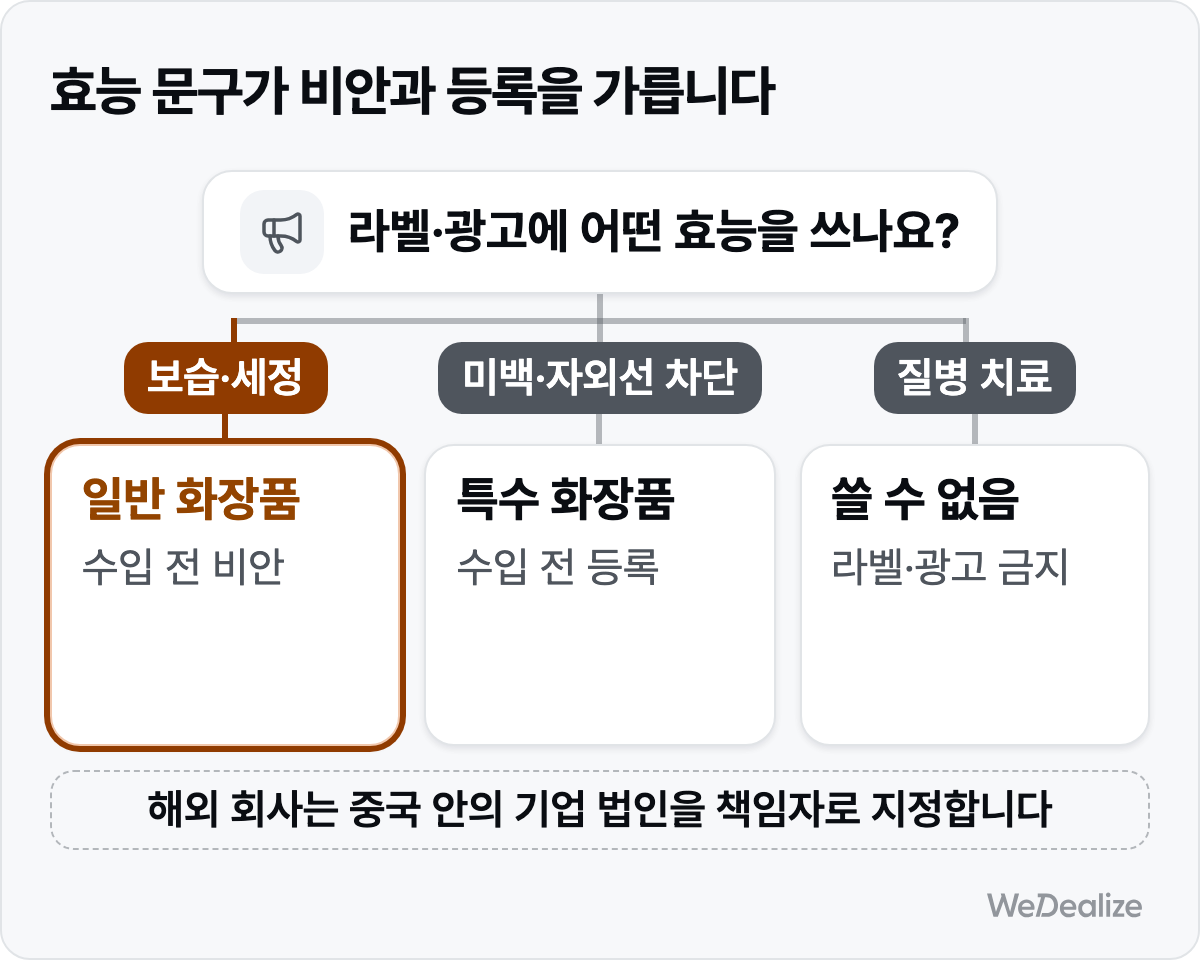
What does the product claim? — Under China’s Cosmetics Supervision and Administration Regulation, cosmetics are products applied to the outer surfaces of the body, such as the skin, hair, fingernails, toenails, and lips, to clean, protect, or beautify them. Products used for hair coloring, perming, whitening (including spot correction), sun protection, or hair-loss prevention, as well as products claiming new efficacy, are special cosmetics. The rest are ordinary cosmetics. Special cosmetics must be registered before import, while ordinary cosmetics must be filed before import.
「用于染发、烫发、祛斑美白、防晒、防脱发的化妆品以及宣称新功效的化妆品为特殊化妆品。」 — Definition of special cosmetics in China
If you claim this | In China |
|---|---|
Moisturizing, cleansing, skin protection, makeup | Ordinary cosmetics — filing before import |
Whitening, correction of spots and freckles | Special cosmetics — registration before import |
Sun protection (including an SPF indication) | Special cosmetics — registration before import |
Hair coloring, perming·straightening | Special cosmetics — registration before import |
Hair-loss prevention | Special cosmetics — registration before import |
New efficacy not currently listed | Special cosmetics — registration before import |
Medical effects such as disease treatment | Cannot be used on labels or in advertising |
Who applies? — The applicant is the registrant (for special cosmetics) or filing applicant (for ordinary cosmetics). If a Korean company becomes the registrant or filing applicant, it must designate an enterprise legal entity in China to handle the registration or filing. The designated company is called the “domestic responsible person in China (境内责任人)” and also assists with adverse-reaction monitoring and product recalls.
What about toothpaste and soap? — Under the regulation, toothpaste is managed under the rules for ordinary cosmetics. Cosmetic soap is outside the scope of the regulation, but if it claims the efficacy of special cosmetics, it must comply with the regulation.
Who does what for each sales method? — Retail imports through cross-border e-commerce (selling listed products directly to consumers through an overseas-shopping platform) are supervised as goods imported by individuals for personal use, so the registration and filing requirements applicable to initial imports do not apply. Other imports must complete registration or filing before import, and the importer checks and records whether registration or filing has been completed before bringing the products in. When a Korean seller sells under its own name or trademark, the responsibilities are divided as follows according to the four sales methods.
Sales method | Who handles registration·filing | Importer at customs clearance |
|---|---|---|
Sell directly to Chinese consumers through reverse cross-border sales (retail imports through cross-border e-commerce) | The registration and filing requirements applicable to initial imports do not apply. Instead, the overseas seller entrusts one enterprise registered in China, which assumes responsibility for customs registration and truthful declarations, as well as joint and several civil liability. | The entrusted Chinese enterprise or the customs broker engaged by that enterprise submits the declaration list. The consumer pays the taxes (“China Sales Guide”). |
Sell to a Chinese company (distributor·importer) | If the Korean company is the registrant or filing applicant, it designates and entrusts a domestic responsible person in China. The Chinese company may also be designated as the domestic responsible person in China. | That Chinese company. It checks and records whether registration or filing has been completed before import. |
Our company becomes the importer of record (IOR) without a legal entity in China | If the Korean company is the registrant or filing applicant, it designates and entrusts a domestic responsible person in China. | To register with customs as the consignor or consignee, the company must be a market entity registered in China, such as a company or branch of a foreign company. Registration as a foreign-trade operator is no longer required following the legal amendment of December 2022. Our company, if it has not registered a legal entity or branch in China, cannot register as the consignor or consignee. |
Borrow a Chinese company’s importer name through an IOR service | If the Korean company is the registrant or filing applicant, it designates and entrusts a domestic responsible person in China. The company lending its name must be designated as the domestic responsible person in China to handle that work. | The Chinese company lending its name. It checks and records whether registration or filing has been completed before import. |
If we borrow an importer’s name through an IOR service, is that company the domestic responsible person in China? — Not merely because its name is borrowed. The overseas registrant or filing applicant must designate an enterprise legal entity in China for that company to handle the registration or filing. The contract should specify whether that company will also be designated as the domestic responsible person in China. Confirm the interpretation with a local Chinese regulatory specialist before selling.
Order of tasks
Determine the efficacy category — Determine whether the product is an ordinary or special cosmetic (“First things to check”).
Choose the sales method·designate a domestic responsible person in China — Choose one of the four sales methods and designate the Chinese enterprise legal entity that will handle registration or filing (“First things to check”·“Filing and registration”).
Safety assessment·test report — Conduct a safety assessment and collect the materials before applying (“Filing and registration”).
Filing or registration — File with the NMPA or obtain a registration certificate before import (“Filing and registration”).
Chinese label — Write the 10 required items in standard Chinese characters (“Chinese label”).
Shipment·customs inspection — The importer checks the registration or filing status and undergoes inspection by the entry-exit inspection authority (“Transportation·customs clearance tips”).
Post-sale management — Monitor and report adverse reactions (“What to do after sales”).
China cosmetics requirements (Cosmetics Supervision and Administration Regulation)
The Cosmetics Supervision and Administration Regulation, effective from 2021-01-01, sets out obligations for filing, registration, labeling, and post-sale management. Labeling details are prescribed by the NMPA’s Measures for the Administration of Cosmetic Labels.
Filing and registration — handled by the registrant·filing applicant through a domestic responsible person in China
When — Special cosmetics may be imported only after NMPA registration. Imported ordinary cosmetics must be filed with the NMPA before import.
Eligibility to apply — The applicant must be an enterprise established in accordance with law. It must also have a quality-management system appropriate for the product and the ability to monitor and evaluate adverse reactions.
Documents to submit — Submit the name, address, and contact details of the applicant company and manufacturing enterprise, the product name, formulation or full ingredient list, applicable standard, and label specimen. Also submit the test report and safety-assessment materials.
Additional submissions for imported products — Submit proof that the product is already sold in the country of manufacture and proof of cosmetics GMP compliance for the overseas factory. If the product was made only for export to China and such proof is unavailable, submit research and testing materials for Chinese consumers.
Safety assessment — Conduct it directly or commission a professional institution before applying. The evaluator must have relevant professional knowledge and at least five years of experience.
Processing — For ordinary cosmetics, filing is completed by submitting the materials through the NMPA online system. For special cosmetics, obtain a registration certificate through technical review taking 90 business days and a decision process taking 20 business days.
Publication·validity period — Registration and filing information is published within five business days. A special-cosmetics registration certificate is valid for five years, and renewal must be applied for no later than 30 business days before expiration.
Efficacy substantiation — Efficacy claims must have sufficient scientific substantiation. A summary of supporting literature, research materials, and efficacy-assessment materials is published on a website designated by the NMPA.
Ingredients
New ingredients — Ingredients used in cosmetics for the first time in China are new cosmetic ingredients. New ingredients with preservative, sun-protection, coloring, hair-coloring, or whitening functions may be used only after NMPA registration. Other new ingredients must be filed before use.
Prohibited ingredients — The NMPA establishes and publishes a list of ingredients that may not be used in cosmetics production. Compare the full ingredient list of the Korean formulation against this list.
Chinese label — The registrant·filing applicant is responsible
Imported cosmetics may bear a Chinese label from the outset, or an additional Chinese label may be affixed. The safety and efficacy information on an additionally affixed Chinese label must be the same as on the original label.
Standard Chinese characters — If other characters are used, an explanation in standard Chinese characters must be written on the visible surface of the sales packaging. Web addresses, the names and addresses of overseas companies, and established technical terms are exceptions.
Character size — Except for registered trademarks, no other characters on the same surface may be larger than the corresponding Chinese characters.
10 required items — State the Chinese product name·special-cosmetics registration number, and the name and address of the registrant or filing applicant and the domestic responsible person in China. Also state the manufacturing enterprise’s name and address, applicable standard number, full ingredient list, net content, shelf life, directions for use, and safety warnings.
On the container too — For products with a box, state the Chinese product name and shelf life on the container that comes into contact with the contents as well.
Ingredients — After 「成分」, list the standard Chinese names of the ingredients in descending order by content. Ingredients at 0.1% or below may be listed without order after 「其他微量成分」.
Shelf life — State the production date and shelf life, or the production lot number and expiration date.
15g·15mL or less — For small packages, only the product name·registration number·registrant or filing applicant name·net content·shelf life need to be stated on the package; the rest may be included in the instructions.
Prohibited expressions — Medical terms or words implying medical effects, exaggerated or absolute expressions, and definitive or guaranteed claims about efficacy or safety may not be used.
Free samples — These labeling rules also apply to cosmetics provided for free trials or as gifts.
What to do after sales — Handled by the registrant·filing applicant
Adverse reactions — Monitor and evaluate adverse reactions to cosmetics being sold, and report them to the adverse-reaction monitoring body in accordance with NMPA regulations.
Recalls — If the products may harm health due to quality defects or other reasons, stop production and recall the products already sold. Report the recall and disposal results to the provincial drug administration department.
Amendment registration — If the manufacturing process or efficacy claims of registered special cosmetics change substantially, apply for amendment registration.
Product table
The product numbers in this guide are representative examples for explanatory purposes. Chinese product numbers have eight digits; confirm the final classification with the importer and customs broker.
The general rate is the MFN rate under the 2026 tariff schedule, and the preferential rate for Korean products is in the “Tariffs·FTA” table · as of 2026-10-18.
Perfume·makeup·skincare
Product | Chinese tariff schedule number | General rate | Key point |
|---|---|---|---|
Perfume·toilet water | 3303.0000 | 3% | This product’s rate does not decrease under the Korea–China FTA, so there is no Korea–China FTA rate column. |
Lipstick·lip tint | 3304.1000 | 5% | The lips are a body area for cosmetic use specified by the regulation. |
Eyeshadow·mascara | 3304.2000 | 5% | New ingredients with coloring functions may be used only after NMPA registration. |
Powder·pressed powder | 3304.9100 | 5% | For products with the same name, distinguish them by adding the color number after the product name. |
Cream·lotion·essence·sheet mask | 3304.9900 | 1% | Claims of whitening or spot correction make the product subject to special-cosmetics registration. |
Sunscreen·cushion (sun-protection indication) | 3304.9900 | 1% | It is a special cosmetic; distinguish it by adding the protection index after the product name. |
Hair
Product name | China tariff line | General tariff rate | Key determination |
|---|---|---|---|
Shampoo | 3305.1000 | 3% | If marketed as preventing hair loss, it is subject to registration as a special-use cosmetic. |
Perming and straightening products | 3305.2000 | 3% | Perming products are special-use cosmetics and must be registered before importation. |
Hair spray and styling products | 3305.3000 | 3% | If they have no special efficacy, they are filed as ordinary cosmetics. |
Treatments, hair dyes, etc. | 3305.9000 | 3% | Hair dyes are special-use cosmetics, while treatments are ordinary cosmetics. |
Oral care, bath, other, and cleansing products
Product name | China tariff line | General tariff rate | Key determination |
|---|---|---|---|
Toothpaste | 3306.1010 | 3% | Claims such as cavity prevention should be made only after an efficacy assessment under national and industry standards. |
Bath salts and bath bombs | 3307.3000 | 3% | As products for washing the body, they are ordinary cosmetics if they have no special efficacy. |
Other cosmetics | 3307.9000 | 3% | This tariff line has a single entry in the detailed tariff schedule for “其他 (other)”; confirm the classification with the importer or customs broker. |
Cleansing foam and body wash | 3401.3000 | 6.5% | These are cosmetics for washing the skin; the product excluded from the regulations is toilet soap. |
Tariffs and FTAs
For cosmetics of Korean origin, compare the MFN tariff rate with the preferential agreement rate available for Korea for each line. For creams (3304.9900), the MFN tariff rate of 1% is lower than the Korea–China FTA rate of 5.2%, so the MFN rate applies.
Principle under the detailed tariff schedule — Even for imports using an agreement rate, apply the MFN rate if it is lower and there is no provisional rate. There are no provisional rates for the lines in this article.
Agreements available for Korea — In the agreement-rate column of the detailed tariff schedule, the Korea–China FTA (韩KR) and the Asia-Pacific Trade Agreement (亚太AP) have separate rates for Korea. The Asia-Pacific Trade Agreement is a preferential agreement involving Korea, China, India, and others. The RCEP rate for Korea (韩RKRR) appears only for the toothpaste and cleansing foam lines, at 5%.
Phased reduction under the Korea–China FTA — Creams are partially reduced products for which the rate stops at 5.2%, a 20% reduction from the base rate of 6.5%. Perfume, lip, eye, powder, perming, and hair spray products retain the base rate, so no Korea–China FTA rate is listed for them in the 2026 detailed tariff schedule.
Import-stage indirect tax — Import VAT is 13%. The tax base (the amount used to calculate the tax) is the customs value plus customs duty and consumption tax, and therefore includes customs duty (VAT Law, effective 2026-01-01).
Consumption tax on high-end cosmetics — The covered products are perfume; lip, eye, and nail cosmetics; powder; and other beauty and skincare cosmetics such as creams (HS headings 3303 and 3304). If the import customs value is at least 10 yuan per milliliter (gram) or 15 yuan per sheet, an additional consumption tax of 15% is imposed. The tax base is (customs value + customs duty) ÷ (1 − 15%) (Caishui [2016] No. 48, Interim Regulation on Consumption Tax). Hair, oral-care, bath, and cleansing products (HS headings 3305–3307 and 3401) are not included in the covered list.
Product | Korea–China FTA | Asia-Pacific Trade Agreement |
|---|---|---|
Cream, lotion, sunscreen, and sheet mask (3304.9900) | 5.2% | No rate |
Toothpaste (3306.1010) | 0% | 2% |
Cleansing foam and body wash (3401.3000) | 0% | No rate |
Perfume (3303.0000) | No rate | 2% |
Shampoo (3305.1000) | 4.2% | 2% |
Treatments, hair dyes, etc. (3305.9000) | 6.5% | 2% |
Bath products (3307.3000) | 6.5% | 2% |
Other cosmetics (3307.9000) | 5.8% | 2% |
Lip, eye, powder, perming, and hair spray products | No rate | No rate |
Because the rules of origin and certificates differ by agreement, decide which agreement to use with the importer or customs broker. The procedure for certifying origin in Korea is explained in the article on certificates of origin under Related Terms.
Calculation example — The taxable value of 10,000 yuan in this example is assumed for explanatory purposes.
Product | Customs duty at MFN rate | Customs duty at Korea–China FTA rate |
|---|---|---|
Cream (3304.9900) | 100 yuan (1%) | MFN rate applies because the agreement rate is higher |
Cleansing foam (3401.3000) | 650 yuan (6.5%) | 0 yuan |
Shipping and customs clearance tips
Import inspection — The entry-exit inspection authority inspects imported cosmetics. If they fail inspection, they cannot be imported.
Importer verification — The importer in China must verify that the cosmetics to be imported have completed registration or filing and comply with the regulations and mandatory national standards. If they do not comply, they cannot be imported.
Import records — The importer must record information about imported cosmetics and retain it for at least one year after the expiration date. If the shelf life is less than one year, the records must be retained for at least two years.
Label compliance — The label must match the filing or registration materials. Before shipment, compare the Chinese label to be affixed with the specimen submitted in the application.
Tariff-line matching — For products whose classification is unclear, such as sheet masks, confirm the applicable tariff line with the importer or customs broker before shipment.
Common mistakes
Misconception: “Sunscreen and whitening creams only need filing.” — No. UV protection and whitening products are special-use cosmetics and can be imported only after registration.
Misconception: “The Korean company submits directly to the NMPA.” — No. An overseas registrant or filing applicant must appoint a corporate entity in China to handle the registration or filing.
Misconception: “The Korea–China FTA rate is always lower.” — No. For creams, the MFN rate of 1% is lower than the FTA rate of 5.2%, and there is no FTA rate at all for perfume, lip products, and similar items.
Misconception: “A 15 mL sample does not need a label.” — No. Even small packages must indicate the product name, registration number, expiration date, and other information on the packaging, and labeling rules also apply to free samples.
Related Terms
What to do in Korea — Export declaration · Certificate of origin · Duty drawback · Strategic goods
Korea–China FTA — The Korea–China FTA is a free trade agreement that entered into force on December 20, 2015, eliminating or reducing tariffs between Korea and China.
Customs broker — A nationally certified professional who handles import and export declarations and tax calculations on behalf of cargo owners.