Australia Cosmetics Export Guide
Automatically translated from Korean.
In one line — Anyone who imports (introduces) industrial chemicals must register annually and meet the requirements for an introduction category, and cosmetic labels must list ingredients in English or by their INCI names. Korean-origin goods are subject to a 0% tariff on every line in this article if they qualify as originating goods under the Korea-Australia FTA.
Products covered in this article — Perfumes, makeup, creams·lotions·sheet masks, shampoos·hair products, toothpaste·mouthwash, bath products, and cleansing foam·body wash.
Covered in another article — Therapeutic sunscreens and medicines covered by the Therapeutic Goods Act 1989 are not cosmetics and are not covered here. Dental floss, indoor air fresheners, and laundry soap are also not covered here. New Zealand sales requirements are covered in the New Zealand Cosmetics Export Guide.
Have the interpretation confirmed by an Australian local regulatory specialist before selling.
What to check first
Is it a cosmetic or a therapeutic good? — Under Australia’s industrial chemicals legislation, a cosmetic is a substance used externally on the body, on the mucous membranes of the mouth, or on the teeth. It is used to change body odour or appearance, cleanse, keep in good condition, add fragrance, or protect. However, therapeutic goods under the Therapeutic Goods Act are excluded from cosmetics. For borderline products such as sunscreen, first check whether they are therapeutic goods.
"but does not include: (c) a therapeutic good within the meaning of the Therapeutic Goods Act 1989" — Definition of cosmetics in Australia
Who must register? — Cosmetic regulation in Australia begins with the industrial chemicals used as ingredients. Cosmetic raw materials and ingredients may be industrial chemicals. Importing industrial chemicals or manufacturing them in Australia is called “introducing” them, and the person who introduces them (the introducer) must register. Whether the exporter must register depends on who becomes the importer in Australia. We divide this into four ways for a Korean seller to sell.
Selling directly to consumers through cross-border e-commerce — If an Australian consumer purchases the product for personal use, the consumer does not need to register. AICIS also gives the example that a consumer who buys lipstick online shipped from an overseas warehouse does not register. If the consumer resells it for profit, it is for business purposes and the consumer registers. AICIS advises that an overseas company exporting to sell directly to Australian customers, without an Australian agent or distributor, may be the introducer. Cross-border e-commerce also means selling directly to Australian customers, so the Korean exporter may be the introducer. If it is the introducer, it must register before exporting, even for small quantities. The industrial chemicals legislation defines importation as an act that constitutes an importation under customs legislation, but does not separately specify which of the seller or consumer performs that act in cross-border e-commerce. Confirm with an Australian local specialist whether our company is the introducer.
Selling through an Australian importer — If an Australian agent or distributor imports the goods, that company registers as the introducer and determines the introduction category. Before the first shipment, the exporter confirms that the company has completed its registration for that year and provides ingredient information if the company requests it for its filing. If you do not want to disclose the ingredients to that company, you can submit them directly to AICIS.
When the exporter becomes the importer directly — If a company outside Australia exports to sell directly to Australian customers without an Australian agent or distributor, that company may be the introducer. In that case, it must register before exporting, even for small quantities. To register, it must first have an Australian Registered Body Number (ARBN); if it cannot obtain one, it must use an Australian agent or distributor. The procedure is summarized in “When the exporter becomes the importer directly.”
Using an IOR service to borrow the importer-of-record name of an Australian company — The Australian company lending its name clears the goods as the importer of record on the documents. AICIS advises that when goods are brought in using an Australian agent or distributor, that company is the introducer as the importer. Whether the company lending its name qualifies as this agent and undertakes registration as well should be specified in the contract and confirmed with an Australian local specialist.
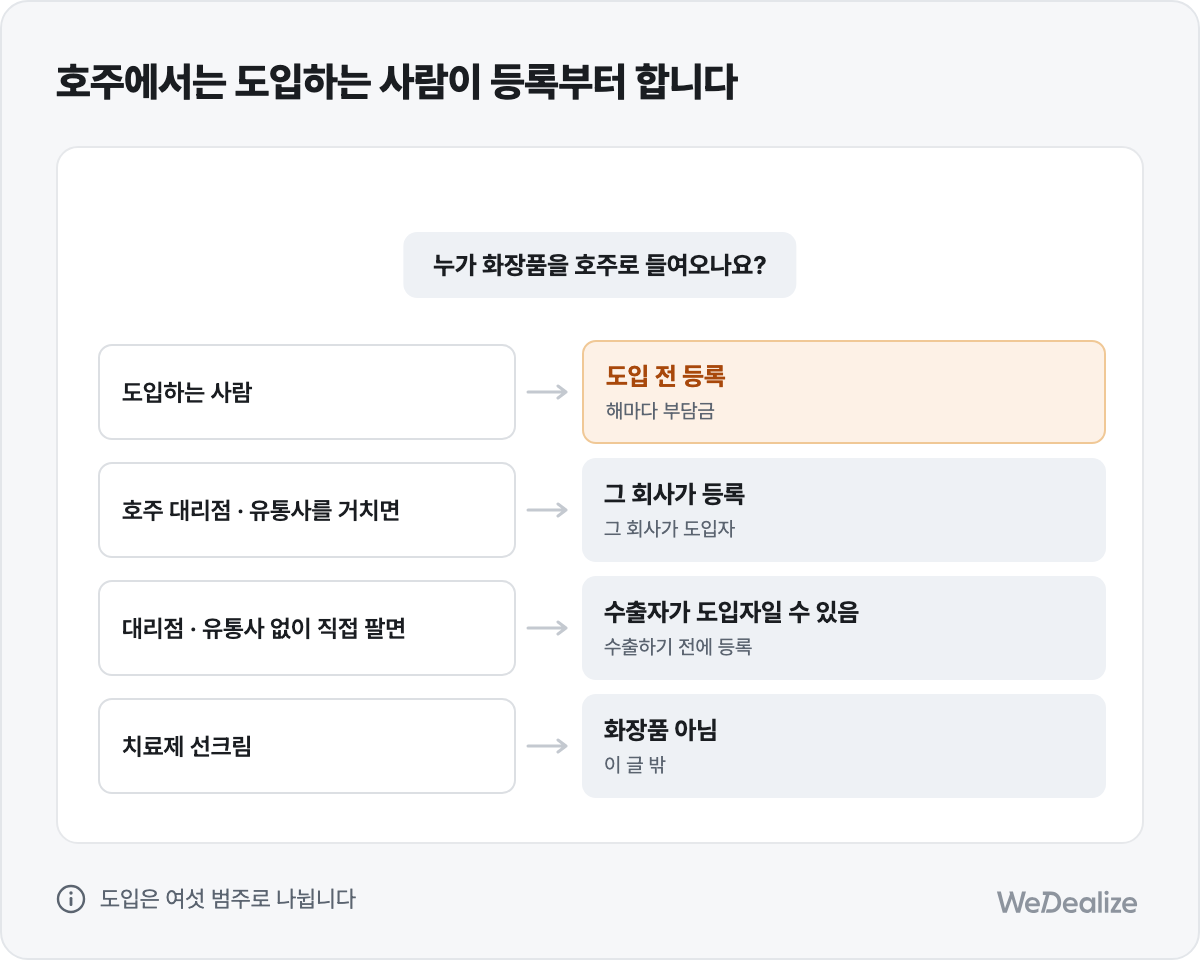
Who is the importer at customs clearance? — Australian customs legislation allows the owner of the goods to make the import declaration, and “owner” includes not only the owner but also a person who controls the goods, such as an importer, consignee, or agent. If an Australian agent or distributor is used, that company declares the goods as the importer; if we import directly, our company does so; and if a name is borrowed, the company lending its name does so. GST on cross-border e-commerce goods valued at AUD 1,000 or less is covered next in the “Australia Sales Guide.”
Order of tasks
Check whether it is therapeutic — Confirm that the product is a cosmetic and not a therapeutic good (“What to check first”).
Sales method·registration of the importing company — Choose one of the four sales methods. If using an Australian importer, that company registers before introducing the goods during that year. If the exporter becomes the importer directly, the exporter may need to register before exporting (“What to check first”).
Check the introduction category — Introductions are divided into six categories. If using an Australian importer, that company determines the category for each ingredient; if the exporter becomes the importer directly, the exporter does so (“Registration and introduction categories”).
Ingredient labels — List ingredients in English or by their INCI names in accordance with the information standard (“Ingredient labels”).
Shipment·customs clearance — Obtain duty-free treatment based on Korean-Australian FTA origin (“Tariffs·FTA”).
Australian cosmetic requirements (industrial chemicals legislation·information standard)
Australian cosmetics are governed jointly by the industrial chemicals legislation, which controls chemical ingredients, and the cosmetics information standard, which sets consumer labeling requirements.
Registration and introduction categories
Registration — The introducer must register on the Register of Industrial Chemical Introducers before introducing industrial chemicals during that year and pay an annual registration charge.
Penalty for non-registration — Introducing chemicals without registration is subject to penalties of up to 500 penalty units. One penalty unit is AUD 364 (for conduct occurring on or after 2026-07-01), so 500 penalty units equals AUD 182,000.
Six categories — Introductions are divided into six categories: listed, exempted, reported, assessed, commercial evaluation, and exceptional circumstances. Introducing chemicals without meeting the requirements of any category is subject to penalties. The introducer determines the category. If using an Australian importer, that company determines it; if becoming the importer directly, the exporter determines it.
Animal test data — For applications for chemicals used only in cosmetics, data obtained through animal testing on or after 2020-07-01 cannot be included in the cases specified by the rules.
When the exporter becomes the importer directly
If the exporter becomes the introducer directly without an Australian agent or distributor, it registers and determines the category for each ingredient in the following order before exporting.
Obtain an Australian Registered Body Number (ARBN) — Apply through the Australian Securities and Investments Commission (ASIC). If you cannot obtain one, you must use an Australian agent or distributor.
Join AICIS business services — Enter the ARBN, select “Introducer” as the type, and “Non-Australian (overseas) business” as the business type.
Apply for registration — Enter in Australian dollars the value of industrial chemicals introduced during the previous financial year (1 July–30 June). If registering for the first time and there were no introductions in the previous year, enter AUD 0.
Pay the registration fee — Pay by card or download the invoice and pay by another method. Registration is valid until 31 August each year.
Determine the category for each ingredient — Check whether the ingredient is on the Inventory and, if not, select one of exempted, reported, or assessed. An exemption is notified once after introduction, a report is submitted once before introduction, and an assessment certificate must be obtained before introduction.
Records·annual declaration — Keep introduction records for five years and submit an annual declaration by 30 November after the registration year ends.
Ingredient labels
The Consumer Goods (Cosmetics) Information Standard 2020 applies to imported cosmetics. It does not apply to therapeutic goods, free samples, or testers.
Where — Put the information on the container, or on the product if there is no container. If it cannot be placed there because of the product’s size or shape, provide it by another method that makes it available to consumers.
Order — List ingredients in descending order by volume or mass. Ingredients present at less than 1% and colorants may be placed at the end in any order.
Names — Use English names or INCI names. A Korean list may also be provided.
Visibility — Make the information conspicuous and easy to read.
Fragrances·colorants — List fragrances as “fragrance,” “parfum,” or by their constituent ingredients. For products available in multiple shades, colorants may be listed using “may contain” or “+/–.”
Product table
The product numbers in this article are representative examples for explanation. Confirm the final classification of Australian tariff items (8 digits) with the importer and customs broker.
The tariff rate applicable to Korean-origin goods on every line is 0% under the Korea-Australia FTA · As of 2026-10-18.
Perfumes·makeup
Product name | Australian tariff item | General rate | Key point |
|---|---|---|---|
Perfume·eau de toilette | 3303.00.00 | 5% | Fragrance may be listed as “fragrance” or “parfum.” |
Lipstick·lip balm | 3304.10.00 | 5% | If there are multiple shades, colorants may be listed using “+/–.” |
Eye shadow·mascara | 3304.20.00 | 5% | Colorants may be placed at the end of the list regardless of order. |
Nail polish | 3304.30.00 | 5% | If the information cannot be placed on the small bottle, provide it by another method that makes it available to consumers. |
Powder·compact | 3304.91.00 | 5% | For products in multiple shades, colorants may be listed using “may contain.” |
Skin care·hair·oral care
Product name | Australian tariff item | General rate | Key point |
|---|---|---|---|
Cream·lotion·sunscreen·cushion foundation | 3304.99.00 | 5% | Sunscreens that qualify as therapeutic goods under the Therapeutic Goods Act are not covered by this article. |
Shampoo | 3305.10.00 | 5% | List ingredients in English or by their INCI names. Other languages may also be included. |
Hair treatment·hair essence | 3305.90.00 | 5% | Confirm that the requirements for the industrial chemicals category have been met for each ingredient. |
Toothpaste | 3306.10.00 | 5% | If it is not a therapeutic good, a product used on the teeth may also fall within the definition of a cosmetic. |
Mouthwash, etc. | 3306.90.00 | 5% | If it is not a therapeutic good, a product used on the mucous membranes of the mouth may also fall within the definition of a cosmetic. |
Bath·other·cleansing
Product name | Australian tariff item | General rate | Key point |
|---|---|---|---|
Bath salts·bath bombs | 3307.30.00 | 5% | If the ingredients cannot be listed because of the product’s shape, provide the information by another method. |
Sheet masks and other cosmetics | 3307.90.00 | 5% | Confirm the final classification with the importer and customs broker. |
Cleansing foam·body wash | 3401.30.00 | 5% | Testers are exempt from the ingredient labeling obligation. |
Tariffs·FTA
No tariff is payable on every line in this article if the goods are Korean-origin goods under the Korea-Australia FTA.
General rate — All lines in this article are 5% under Schedule 3 of the Australian Customs Tariff.
Goods of Korean origin — Under Appendix 10, goods of Korean origin are all duty-free except for the tariff items listed separately in the table. The lines for headings 3303–3307 and 3401 in this article are not included in that table.
Import-stage indirect tax — The goods and services tax (GST) is 10%. The taxable value (the amount used to calculate the tax) is the customs value plus international freight, insurance, and duty, so it includes customs duty (GST Act 1999).
Proof of origin — The procedure for proving origin in Korea is covered in the article on the related term, certificate of origin.
Calculation example — The taxable value of AUD 10,000 in this example is an assumed figure for illustrative purposes.
Item | General rate (5%) | Korea-Australia FTA |
|---|---|---|
Cream (3304.99.00) | AUD 500 | AUD 0 |
Sheet mask (3307.90.00) | AUD 500 | AUD 0 |
Shipping and customs clearance tips
Register first — Registration must be completed before introduction. If you use an Australian importer, confirm whether that company is registered for the relevant year before the first shipment; if you become the direct importer, register before exporting.
Provide ingredient information — If you use an Australian importer, the company may request ingredient information for its categorisation declaration, so prepare it before shipment.
Match the tariff item — Confirm the Australian tariff item with the importer and customs broker before shipment.
Common mistakes
Misconception: “Sunscreen is sold under the same procedure.” — No. Sunscreen that is a therapeutic good under the Therapeutic Goods Act is excluded from the definition of a cosmetic, so the procedure in this article is not sufficient.
Check: “Who must register?” — The person required to register is the person who introduces industrial chemicals (by importing them or manufacturing them in Australia). If you use an Australian importer, it is that company; if you become the direct importer without an agent or distributor, it may be the Korean exporter.
Misconception: “Only a Korean-language ingredient list is required.” — No. Ingredients must be listed using their English or INCI names.
Misconception: “Samples must also have all labels.” — No. The information standard does not apply to free samples and testers.
Related terms
Tasks to complete in Korea — Export declaration · Certificate of origin · Duty drawback · Strategic goods
FTA — An agreement between countries to eliminate or reduce tariffs on each other’s goods.
Customs broker — A nationally certified professional who handles import and export declarations and calculates tax amounts on behalf of the cargo owner.