Canada Cosmetic Export Guide
Automatically translated from Korean.
One-line summary — To sell cosmetics in Canada, the manufacturer or importer must notify Health Canada within 10 days of the first sale, labels must be in English and French, and the tariff rate for Korean goods is 0%.
Products covered in this article — Perfumes, makeup, creams·lotions·sheet masks, shampoos·perming products·hair products, fluoride-free toothpaste, cosmetic soaps·cleansing foams·body washes.
Covered in other articles — Sunscreens are discussed only in terms of classification in “What to Check First”; their sales authorization procedures are not covered. Medicines and natural health products that claim to prevent or treat disease are also not covered. Air fresheners for indoor use are not covered in this article. U.S. sales requirements are covered in the U.S. Cosmetic Export Guide.
Confirm the interpretation before selling with a local Canadian regulatory expert.
What to Check First
Is it a cosmetic or a drug? — Under Canada’s Food and Drugs Act, cosmetics are substances used to cleanse, improve, or alter the appearance of the skin, hair, or teeth. Deodorants and perfumes are also included. If a product claims to diagnose, treat, or prevent a disease or abnormal condition, or to restore or correct bodily functions, it falls under the definition of a drug.
"cleansing, improving or altering the complexion, skin, hair or teeth, and includes deodorants and perfumes" — Definition of cosmetics in Canada
How are borderline products classified? — Health Canada’s guidance explains that products on the border between cosmetics and drugs are regulated under one of the cosmetic, food and drug, or natural health product regulations. Review the claims on the label and in advertising together with the ingredients, but determine the final classification based on the product’s intended use.
Are sunscreens notified as cosmetics? — Health Canada’s sunscreen guidance states that sunscreens in Canada are classified as either non-prescription drugs or natural health products depending on their active ingredients. Chemical sunscreen ingredients such as avobenzone·homosalate·octocrylene·octisalate·octinoxate·oxybenzone are drug ingredients, so products containing any of these ingredients have a Drug Identification Number (DIN) on the label. Physical sunscreen ingredients such as zinc oxide and titanium dioxide are natural substances, so products containing only these ingredients have a Natural Product Number (NPN). If the two types are combined, the product has a DIN. All sunscreens approved for sale in Canada must have either a DIN or an NPN. Companies that manufacture or package·label·import natural health products must obtain product and site licences. However, other Health Canada guidance states that sunscreens may be regulated as natural health products, non-prescription drugs, or cosmetics depending on their use, ingredients, and claims. Confirm the classification of products containing sunscreen ingredients with a local expert first.
Who submits the notification? — The notification is submitted by a manufacturer or importer in Canada. Since 2025-03-05, the notification form must include the Canadian address of the manufacturer or importer, so a Korean seller without a Canadian address cannot submit it alone. When a Korean seller sells under its own name or trademark, the person who submits the notification and the importer at customs are determined according to the four sales methods below.
Sales method | Who submits the cosmetic notification | Importer at customs |
|---|---|---|
Sell directly to Canadian consumers through cross-border e-commerce | Appoint the seller’s representative in Canada, who submits the notification on the seller’s behalf. The regulations treat this representative as the manufacturer. | The seller or the recipient, depending on the payment and delivery terms (see “Canada Sales Guide”). |
Sell to a Canadian company (distributor·importer) | The Canadian company submits the notification as the importer. | The Canadian company. |
Our company becomes the importer of record (IOR) without establishing a corporation | Appoint the seller’s representative in Canada, who submits the notification on the seller’s behalf. The regulations treat this representative as the manufacturer. | Our company, as a non-resident importer. See “When Directly Becoming the Importer Without a Canadian Corporation” for customs preparations. |
Borrow a Canadian company’s importer name through an IOR service | Simply borrowing the company’s name does not mean that the company submits the notification. Appoint a separate Canadian representative, or appoint that company as the representative as well. | The company lending its name, as the importer of record. |
Are cross-border e-commerce sales also subject to notification? — Yes. Health Canada states that anyone who sells cosmetics online to Canadian consumers must comply with Canadian law, regardless of where they are located in the world.
Do cross-border e-commerce sales also require labels in English and French? — Yes. Health Canada states that the Food and Drugs Act and the Cosmetic Regulations apply to anyone selling cosmetics to Canadian consumers. Label information required by the regulations must be provided in both English and French, except for INCI names (see “Labels — English and French”). Health Canada’s import policy does not cover cosmetics brought in by consumers solely for personal use, but quantities exceeding a 90-day supply or shipments received successively within 90 days are considered commercial imports. This scope concerns the import policy and does not contain language exempting products from the labeling requirements under the Cosmetic Regulations.
Is it enough to have someone prepare the notification form? — No. A third party, such as a consulting company, may help prepare the notification form, but if it does not meet the regulatory definition, that company is not the manufacturer or importer. The manufacturer or importer defined by the regulations must be entered in the manufacturer·importer fields of the notification form.
If I borrow an importer’s name through an IOR service, does that company submit the notification? — Not simply because its name was borrowed. Health Canada does not consider the importer of record or non-resident importer shown on the documents to be the importer under the Cosmetic Regulations, and who is the importer is determined on a case-by-case basis. If the company is also appointed as the seller’s Canadian representative, it may submit the notification as the manufacturer under the regulations.
Steps to Take
Confirm the classification — Confirm whether the product is a cosmetic based on its claims (see “What to Check First”).
Determine the Canadian notifying party — Decide whether to sell to a Canadian company or appoint a Canadian representative (see “What to Check First”).
Check the ingredients — Check prohibited ingredients and the Hotlist (see “Ingredients”).
Prepare a bilingual label — Create the label in English and French and list the INCI ingredients (see “Labels — English and French”).
Shipment·customs clearance — Apply the Korean tariff rate based on Korean origin (see “Tariffs·FTA”).
Submit the notification after starting sales — Submit it within 10 days of the first sale (see “Notification — Within 10 Days of Sale”).
Canadian Cosmetic Requirements (Cosmetic Regulations)
Cosmetics in Canada are governed by the Food and Drugs Act and the Cosmetic Regulations.
Notification — Within 10 Days of Sale
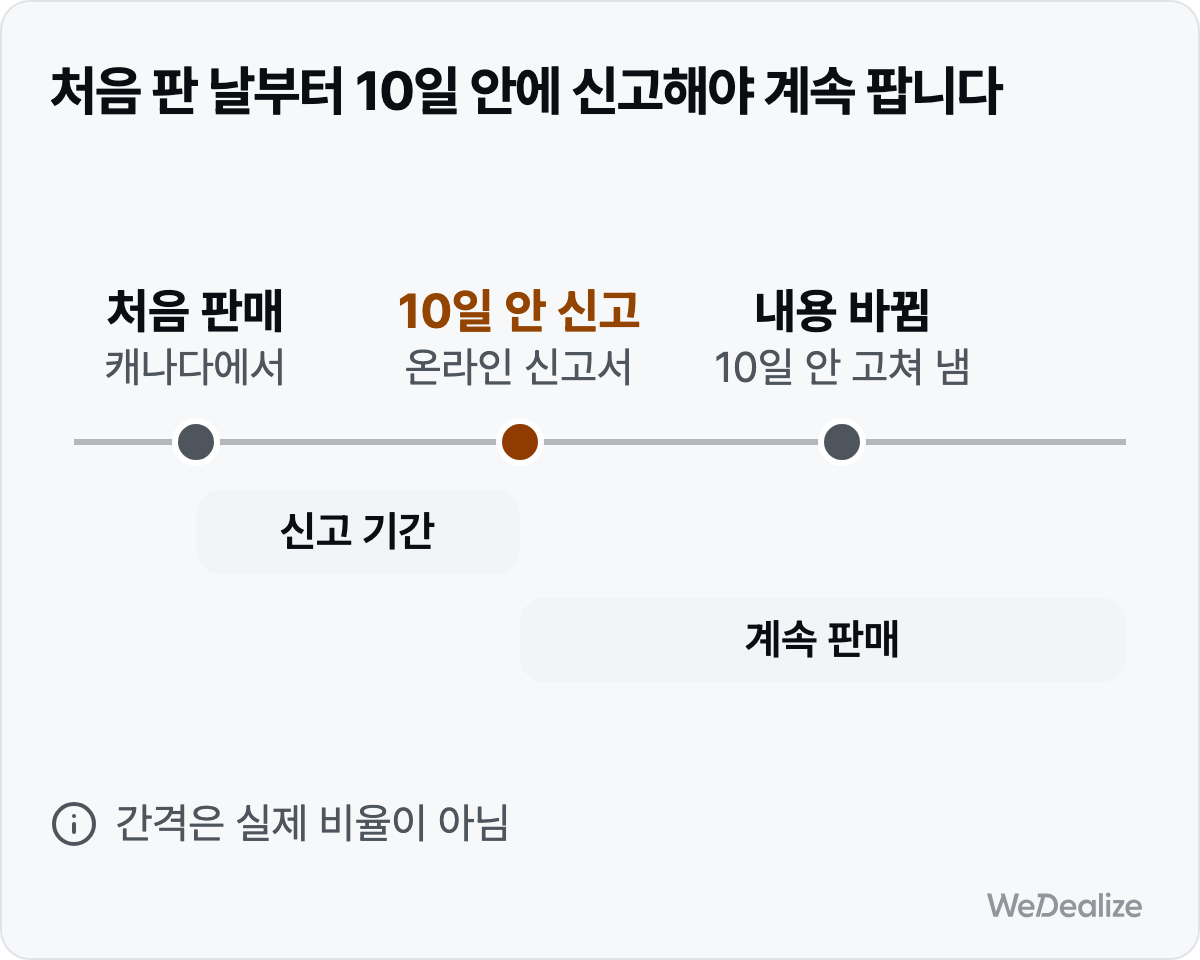
When — The manufacturer and importer must notify Health Canada within 10 days of the date of the first sale in Canada. If the notification is not submitted within 10 days, the product may no longer be sold.
How — Submit it using the online Cosmetic Notification Form.
What — Enter the label contact information, product name, and function, including whether the product is leave-on or rinse-off. Also enter the INCI ingredient names and exact concentrations or concentration ranges, product form, and the Canadian company’s name and address. If the product was not manufactured directly by the notifier, enter the actual manufacturer’s name and address. INCI names are ingredient names listed in the International Cosmetic Ingredient Dictionary and Handbook.
Fragrance allergens — Starting 2026-04-12, fragrance allergens exceeding the applicable thresholds must also be entered on the notification form.
If anything changes — If the notification details change, submit an amendment within 10 days. If Health Canada requests additional information, submit it within 10 days.
Labels — English and French
Two languages — Label information required by the regulations must be provided in both English and French, except for INCI names. It must remain legible throughout use.
Container label — Include one of a telephone number·email·website·address through which consumers can make inquiries, along with the product name or function.
Ingredient list — List ingredients on the outer label in descending order by weight using INCI names. Ingredients at 1% or less and colorants may be placed afterward in any order. Botanical ingredients must include the genus and species names.
Fragrance allergens — Fragrances required to be declared under the EU restricted substances list must be named when they exceed 0.01% in rinse-off products or 0.001% in leave-on products. Fragrances newly added to the EU list do not need to be declared before the later of the EU amendment’s effective date and the date on which declaration becomes mandatory for the EU market.
Small containers — If the container is too small to list all ingredients, list them on a tag or card, or provide the website address on the outer label and list them there.
Net quantity·company — Under the Consumer Packaging and Labelling Act, display the net quantity prominently on the principal display panel, and state the company name and principal place of business of the person for whom the product was manufactured.
Performance claims — Claims suggesting that the product affects the chemistry of the skin·hair·teeth or is harmless must be supported by evidence. Submit the evidence if Health Canada requests it.
Ingredients
Cosmetics containing substances that may harm the health of users cannot be sold.
Cosmetics containing chloroform or estrogenic substances cannot be sold. Coal-tar colors cannot be used in cosmetics for the eye area.
Cosmetics recommended for removing tooth stains cannot be sold if their pH is below 4.
Health Canada’s Cosmetic Ingredient Hotlist is an administrative list identifying substances that may be prohibited or restricted. Compare the formulation against this list.
Product Table
The product numbers in this article are representative examples for explanatory purposes. Canadian tariff item numbers, consisting of 8 tariff digits plus 2 statistical digits, are determined by the declarant at the time of import declaration, so confirm the final classification with the importer and customs broker.
The applicable tariff rate for all lines for Korean-origin goods is 0% under the Korean tariff rate (KRT) · As of 2026-10-18.
Perfumes·makeup
Product name | Canadian tariff item number | General tariff rate | Key classification point |
|---|---|---|---|
Perfume | 3303.00.00.10 | 6.5% | Perfume is a cosmetic by definition and is subject to notification within 10 days. |
Eau de toilette | 3303.00.00.20 | 6.5% | It differs from perfume only in the statistical number. |
Lipstick·lip balm | 3304.10.00.00 | 6.5% | If there are multiple colors, the colorants may be grouped under “may contain/peut contenir.” |
Eye shadow·mascara | 3304.20.00.00 | 6.5% | Coal-tar colors cannot be used in cosmetics for the eye area. |
Nail polish | 3304.30.00.00 | 6.5% | If there are multiple colors, the colorants may be grouped using the “±” symbol. |
Powder·pressed powder | 3304.91.00.00 | 6.5% | Ingredients must be listed only by their INCI names. |
Skincare·hair care
Product name | Canadian tariff item number | General tariff rate | Key classification point |
|---|---|---|---|
Face·hand·body creams·lotions | 3304.99.90.20 | 6.5% | Sunscreens have another statistical number under the same tariff heading, ending in 10, and are not covered by this article. |
Essences·cushions and other skincare·makeup | 3304.99.90.90 | 6.5% | If the product claims to alter skin functions, supporting evidence is required and drug classification must be checked. |
Shampoo | 3305.10.00.00 | 6.5% | Because it is a rinse-off product, the fragrance allergen threshold is 0.01%. |
Perming·straightening products | 3305.20.00.00 | 6.5% | If usage risks can be avoided, include safe-use instructions on the label. |
Treatment · hair dye | 3305.90.00.00 | 6.5% | Hair dyes containing coal-tar ingredients such as PPD must bear the prescribed warnings on both labels. |
Oral care · other · cleansing
Item name | Canadian tariff item number | General tariff rate | Key point |
|---|---|---|---|
Toothpaste | 3306.10.00.10 | 6.5% | Only toothpaste without fluoride may be notified as a cosmetic; toothpaste for preventing tooth decay is subject to pharmaceutical regulations. |
Sheet masks and other cosmetics | 3307.90.00.90 | 6.5% | The Canadian tariff item number is determined by the notifier. |
Castile soap | 3401.11.10.00 | 0% duty | Soap used to wash the body falls within the definition of a cosmetic. |
Other toilet soap | 3401.11.90.00 | 6.5% | If the product is too small to list all ingredients, they may be provided on a tag or card. |
Facial cleansing foam · body wash | 3401.30.00.00 | 6.5% | If it is in a spray-type metal container, warnings about explosion when heated must be provided in both languages. |
Tariffs · FTA
For goods of Korean origin, the tariff on every line in this article is 0% under the Korean Tariff (KRT).
General tariff rate — The most-favoured-nation (MFN) rate in Canada's Customs Tariff (T2026-2) is 6.5% for most lines in this article, while Castile soap alone has a 0% duty.
Korean Tariff — KRT is listed as “Free” in the preferential tariff column. Under Canada's Customs Tariff Act, KRT is the Korean Tariff. Goods of Korean origin are subject to this rate.
Import-stage indirect taxes — The federal goods and services tax (GST) is 5%. The tax base (the amount on which tax is calculated) is the customs value under the Customs Act plus duties and other taxes, and therefore includes customs duty (Excise Tax Act).
HST provinces — Ontario (13%), Nova Scotia (14%), New Brunswick, Newfoundland and Labrador, and Prince Edward Island (15%) use the harmonized sales tax (HST), which adds the provincial portion to the GST. The provincial portion on imports is separately prescribed by section 212.1. Rules requiring collection of the provincial portion based on the importer's province of residence do not apply to goods imported for commercial purposes.
Proof of origin — The procedure for proving origin in Korea is provided in the article on the certificate of origin under the relevant terms.
Calculation example — The customs value of CAD 10,000 in this example is an assumed amount for explanatory purposes.
Item | General tariff rate (MFN) | Korean Tariff (KRT) |
|---|---|---|
Cream (3304.99.90.20, 6.5%) | CAD 650 | CAD 0 |
Sheet mask (3307.90.00.90, 6.5%) | CAD 650 | CAD 0 |
Shipping · customs clearance tips
Import inspection — An inspector may inspect cosmetics intended for import and take samples. Cosmetics that violate a law or regulation may not be imported for sale.
Imports subject to re-labeling — Products that can be legally sold after being re-labeled or corrected may be imported on condition that the inspector is notified in advance and that the re-labeling or correction is carried out under supervision. In that case, they may be sold only after being re-labeled or corrected within three months from the date of importation.
When becoming a direct importer without a corporation
If a Korean company becomes the importer of record (IOR) directly without a Canadian corporation, prepare the following.
Person responsible for cosmetic notification — Appoint a Canadian representative to notify the cosmetics (“What to check first”).
Business number and import account — A non-resident importer obtains a nine-digit business number (BN9) from the Canada Revenue Agency (CRA). It then creates an import-export account (RM) through the Canada Border Services Agency's CARM portal.
Record keeping — Keep import-related records for six years after importation. An agent such as a customs broker or accountant may keep them in Canada. From 2024-05-13 onward, an account will be issued only after an agreement for keeping records outside the business premises (BSF900) has been approved, and a post office box or mail-forwarding address may not be used as the business address.
Security and payment — Security must be posted to use the privilege of receiving goods before paying duties and taxes later (RPP). Without this privilege, the goods must be declared and paid for using a Type C declaration when they are released.
Customs broker — A non-resident importer has the same obligations as a Canadian importer. A customs broker usually handles document preparation, payment of duties, and receipt of the goods on its behalf.
GST registration — If you carry on business in Canada, make taxable supplies, and are not a small supplier (sales of CAD 30,000 or less in one quarter or over the previous four consecutive quarters), register for GST/HST. Once registered, you can claim the GST paid on purchases as an input tax credit (ITC) and collect GST/HST on sales. If you do not register, you cannot claim the GST paid on imports, but if the purchaser is a registered business, it may claim the credit using evidence such as the import declaration (B3-3). Register using the non-resident web form or Form RC1.
Common mistakes
Misconception: “Approval is required before sale” — No. Under Canada's cosmetic regulations, notify within 10 days of the date of first sale.
Misconception: “Notify after 10 days have passed” — No. If the cosmetics have not been notified by the end of the 10-day period, they may no longer be sold.
Misconception: “Attach an English-only label” — No. Required information must also be provided in French, except for INCI names.
Misconception: “Enter only ingredient names on the notification form” — No. The notification form must state the exact concentration or concentration range for each ingredient.
Misconception: “No notification is required when selling directly to consumers through reverse direct purchasing” — No. If the product is sold to Canadian consumers, the regulations apply regardless of where the seller is located, and the Canadian representative appointed by the seller submits the notification.
Related terms
Things to do in Korea — Export declaration · Certificate of origin · Duty drawback · Strategic goods
FTA — An agreement between countries to eliminate or reduce tariffs mutually.
Customs broker — A nationally certified professional who makes import and export declarations and calculates taxes on behalf of the cargo owner.