Malaysia Cosmetics Export Guide
Automatically translated from Korean.
In brief — To export cosmetics to Malaysia, a local entity acting as the Cosmetic Notification Holder must notify the NPRA for each product before import (valid for 2 years). Import duties on Korean products are 0%, while sales tax (SST) of 5–10% is payable separately.
Products covered in this guide — Perfume, makeup, creams·lotions·sunscreen·sheet masks, shampoo·hair products, toothpaste·mouthwash, cosmetic soap·cleansing foam·body wash.
Covered in other guides — Pharmaceuticals and products subject to registration are not covered. Dental floss·indoor air fresheners·laundry soap are also not covered here. Singapore sales requirements are covered in Singapore Cosmetics Export Guide.
Confirm your interpretation with a Malaysian local regulatory expert before selling.
First checks
Does the claim fall within the definition of cosmetics? — Under Malaysia’s Control of Drugs and Cosmetics Regulations, cosmetics are substances intended to come into contact with the external parts of the human body (skin·hair·fingernails·lips·external genital organs), teeth, or the mucous membranes of the oral cavity. They are used solely or mainly to cleanse, perfume, change appearance, correct body odours, or protect. If the product name or efficacy claims appear pharmaceutical in nature or fall outside the scope of cosmetics, notification will be rejected.
"No person shall manufacture, sell, supply, import, possess or administer any cosmetic — (a) unless the cosmetic is a notified cosmetic;" — Malaysian cosmetic import requirement
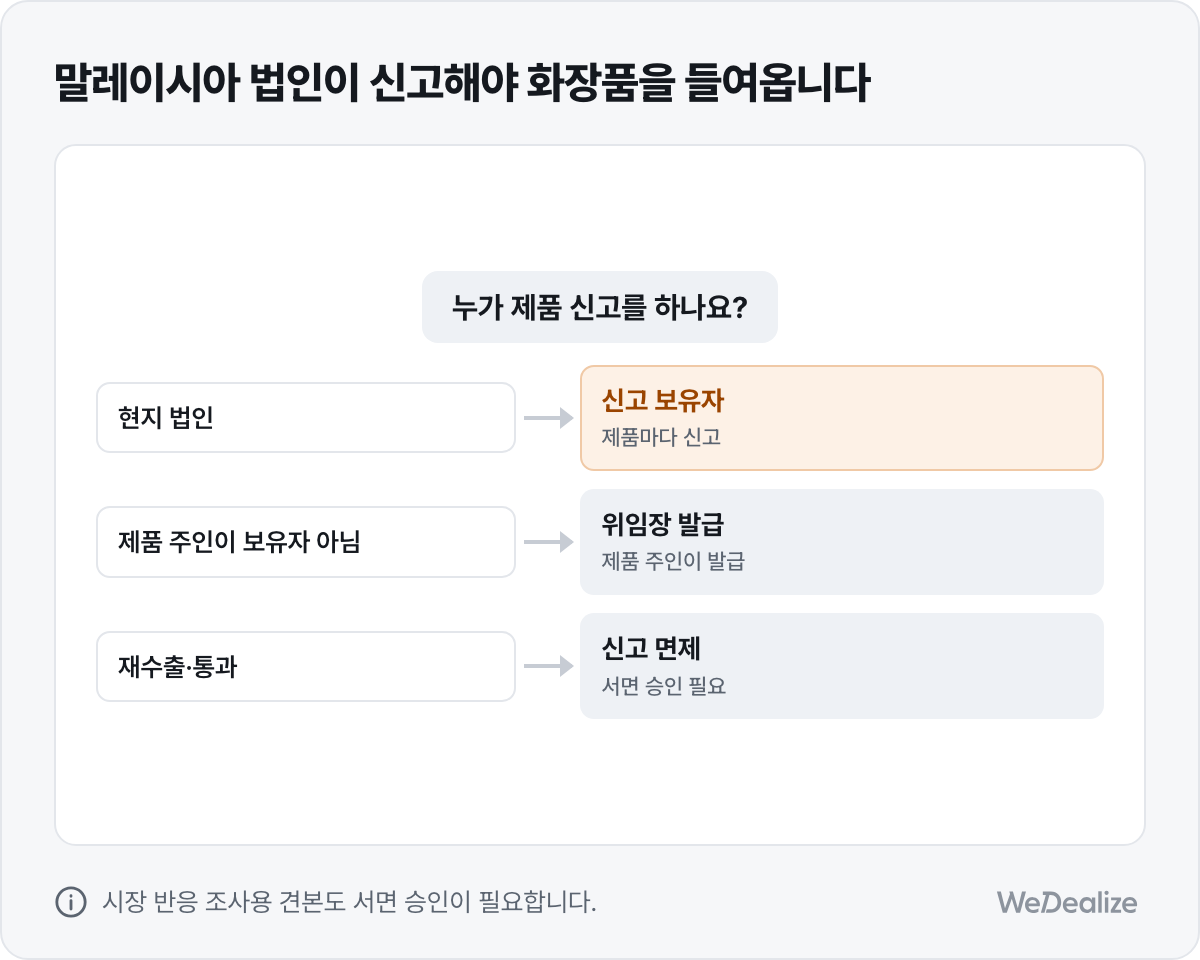
Who submits the notification? — The Cosmetic Notification Holder (CNH) is the responsible company that places the cosmetic on the market. It must be a local entity registered with the Companies Commission of Malaysia (SSM) and have a fixed address. If the CNH is not the product owner, the product owner issues a letter of authorisation (LOA).
Is this the same as the ASEAN Cosmetic Directive? — The NPRA guidelines were developed based on the ASEAN Cosmetic Directive. Cosmetics have been managed under a notification system since 2008-01-01.
Who handles each sales method? — Because the CNH must be a local entity registered in Malaysia, a Korean seller without a Malaysian entity cannot be the CNH. Regulations also allow only the responsible person or a person authorised by the notification to import and sell notified cosmetics. When a Korean seller sells under its own name or trademark, the arrangements differ according to the following four sales methods. Confirm with a local expert which party is regarded as the importer.
Sales method | Who submits the notification | Importer at customs clearance |
|---|---|---|
Sell directly to Malaysian consumers through cross-border e-commerce | Regulations prohibit the import of non-notified cosmetics, and the personal-use exemption covers only one month’s supply carried by a person entering the country as personal effects. Cross-border e-commerce parcels do not qualify for this exemption, so a Malaysian CNH (a local entity) must submit the notification in advance. | Under customs law, the importer is the person possessing the goods or the owner with an interest in them from the time of import through customs clearance. For postal parcels, the recipient or the recipient’s agent submits the declaration. |
Sell to a Malaysian company (distributor·importer) | The Malaysian company submits the notification as the CNH, and our company issues an LOA. | The Malaysian company. |
Our company becomes the importer of record (IOR) without establishing an entity | Our company cannot be the CNH because it is not a local entity. Designate a local entity as the CNH and issue an LOA. | Under the regulations, the persons permitted to import are the responsible person or a person authorised by the notification, and the notification states the importer’s name and address. Malaysian Customs guidance requires import declarations to be made by one of a designated customs agent, an AEO making its own declarations, or a direct user, and requires import records to be retained in Malaysia for 7 years. Confirm with a Malaysian local expert whether the CNH may name our company as the importer and what procedure is required to file the import declaration with Malaysian Customs under our company’s name. |
Use an IOR service to borrow the importer name of a Malaysian company | Designate the company lending its name as the CNH, or designate another local entity as the CNH. | The Malaysian company lending its name (the importer of record on the documents). It may import only if it is the responsible person or a person authorised by the notification. |
If I borrow an importer name through an IOR service, is that company the CNH? — Not merely because it lends its name. The CNH is the local entity that submitted the product notification. The company lending its name must be the CNH or a person authorised by the notification in order to import the cosmetics, so confirm this in the contract and with a Malaysian local regulatory expert before selling.
Import sales tax is covered in 「Tariffs·FTAs」, and taxes on cross-border e-commerce goods are covered in 「Malaysia Sales Guide」.
Action checklist
Check claims — Filter out names and efficacy statements that fall outside the scope of cosmetics (「First checks」).
Choose the sales method and CNH — Choose one of the four sales methods, designate a local entity as the CNH, and issue an LOA (「First checks」·「Product notification」).
Safety assessment·Product Information File — Conduct a safety assessment and prepare a Product Information File (PIF) (「Product notification」).
Ingredient review — Check the lists of prohibited and restricted ingredients, colourants·preservatives·UV filters (「Ingredients」).
Notification before import — Submit a notification for each product through the NPRA Quest system and receive the notification note (「Product notification」).
Labels — State the mandatory information in Malay or English (「Labels」).
Shipment·customs clearance — Import at 0% import duty and pay sales tax (「Tariffs·FTAs」).
Renew every 2 years — Renew by one month before expiry (「Product notification」).
Malaysia cosmetics requirements (Control of Drugs and Cosmetics Regulations 1984)
The Control of Drugs and Cosmetics Regulations 1984 under the Sale of Drugs Act establish cosmetic notification requirements. Detailed notification procedures and labelling requirements are set out in the NPRA’s Guidelines for Control of Cosmetic Products in Malaysia (Second Edition, effective 2022-08-01).
Product notification — submitted by the CNH
When — Notification is required before manufacturing·selling·supplying·importing·possessing. You may import after receiving the Notification Note.
Where — Complete a notification for each product and variant (products differing only in colour·fragrance·flavour) through the NPRA Quest online system and pay the fee. First register as a Quest member.
Fee — The fee is 50 ringgit per product (including variants), and renewal also costs 50 ringgit. Fees paid are non-refundable.
Validity period — A notification is valid for 2 years and must be renewed by one month before expiry. If it is not renewed within the deadline, a new notification number will be issued.
Changes — Submit changes to the notification to the NPRA. Type 1 changes, which only involve corrections, have no fee. Type 2 changes, which require a new notification, incur a fee of 50 ringgit and receive a new number.
Information to submit — Submit the product name·type·intended use·product presentation, the names and addresses of the manufacturing·assembly companies, the CNH’s and contact person’s contact details, and the importer, if any. Also submit the full ingredient list (including concentration % for restricted ingredients), documents such as the LOA, and the label.
Language — Documents submitted to the NPRA must be in Malay or English. Translations into other languages must be certified.
Safety·Good Manufacturing Practice — maintained by the CNH
Safety assessment — Products must not harm health under normal conditions of use. Conduct a safety assessment for each product.
Product Information File (PIF) — Include evidence of quality·safety·efficacy and present it promptly if requested by the NPRA. Prepare it in Malay or English and continuously update it to reflect changes.
Overseas factories — Products must be manufactured in accordance with cosmetic GMP or an equivalent standard. If requested by the NPRA, an overseas manufacturer must submit GMP evidence issued or verified by the authorities of that country.
Ingredients — checked by the CNH
Prohibited ingredients — Ingredients on the Poisons List (except for exemptions) and ingredients in Annex II of the guidelines may not be formulated into products. Technically unavoidable trace amounts are exempt.
Restricted ingredients — Ingredients in Annex III may be used only within the specified limits and conditions.
Colourants·preservatives·UV filters — Use only those listed in Annexes IV·VI·VII, respectively. Colourants in products intended exclusively for hair dyeing are not subject to the colourant list.
Labels — in Malay or English
State the information on the outer packaging, or on the container if there is no outer packaging. Label information must be in Malay or English, or both.
Mandatory information — State the product name and function, directions for use, full ingredients, country of manufacture, and the CNH’s name and address. Also state the net contents (metric units, or metric and imperial units), manufacturing lot number, manufacturing date or expiry date, and precautions. However, the function and directions for use may be omitted if they are clear from the product labelling or name alone.
Ingredients — List ingredients in descending order by weight at the time of formulation. Ingredients below 1% and colourants may be listed afterward in any order. Fragrance may be grouped under 「perfume」, 「fragrance」, 「aroma」, or 「flavour」, and botanical ingredients must be listed by genus and species names.
Expiry date — Products with a shelf life of less than 30 months must state the expiry date. Write the date as month·year or day·month·year, preceded by 「expiry date」 or 「best before」.
Animal-derived ingredients — State that the product contains animal-derived ingredients. For ingredients derived from cattle or pigs, identify the animal.
Small containers·bulk — For small containers, only the product name and lot number need remain on the container; the rest may be provided in an instruction leaflet·tag or similar. For bulk imports, state the product name, manufacturer’s name, and lot number on the container.
Vials·ampoules — State 「for external use only」.
Halal logo — The logo may be used voluntarily only on products certified halal by the Department of Islamic Development Malaysia (JAKIM) or a body recognised by JAKIM.
After-sale obligations — handled by the CNH
Adverse reactions — Report serious or frequent adverse reactions to the NPRA, regardless of their source.
Recalls — Immediately recall products upon learning of a violation of the guidelines. The NPRA may also order a recall.
Samples for market inspection — If requested by the NPRA, submit at least 4 unopened samples from the same lot, with total contents of at least 40g·40mL. At least 1 year must remain before expiry as of the submission date.
Product table
The product numbers in this guide are representative examples for explanatory purposes. Malaysian product numbers (10 digits) are determined by the declarant when filing the import declaration, so confirm the final classification with the importer and customs agent.
0% import duty on all lines · as of 2026-10-18.
Sales tax varies by group and is stated in the subheading.
Perfume·makeup·skincare — 5% sales tax
Product name | Malaysian product number | Key point |
|---|---|---|
Perfume·eau de toilette | 3303.00.0000 | Fragrance may be grouped under 「perfume」 or 「fragrance」. |
Lipstick·lip tint | 3304.10.0000 | For products in multiple shades, all colourants may be listed using 「may contain」 or 「+/-」. |
Eyeshadow·mascara | 3304.20.0000 | Use only colourants listed in Annex IV. |
Powder·compact | 3304.91.0000 | List colourants by colour index number or by their names in Annex IV. |
Acne-care products | 3304.99.2000 | Notification will be rejected if the product is pharmaceutical in nature or makes claims beyond the scope of cosmetics. |
Creams·lotions | 3304.99.3000 | Plant extracts must be listed by genus and species name. |
Other skincare·makeup | 3304.99.9000 | Only UV-filter ingredients listed in Appendix VII may be used. |
Hair·oral care — 10% sales tax
Product name | Malaysian tariff code | Key point |
|---|---|---|
Antifungal shampoo | 3305.10.1000 | Shampoos with antifungal properties have a different tariff code from ordinary shampoos. |
Shampoo | 3305.10.9000 | Variants that differ only in fragrance·color must each be included separately in the notification. |
Perm·straightening products | 3305.20.0000 | Professional products for salons are products that professionals do not sell to consumers. |
Treatments·hair dyes, etc. | 3305.90.0000 | Pigments in products exclusively intended for hair coloring are not subject to the pigment list. |
Toothpaste·powder for dental hygiene | 3306.10.1000 | Products used on teeth also fall under the definition of cosmetics. |
Toothpaste | 3306.10.9000 | If animal-derived ingredients are included, they must be disclosed on the label. |
Mouthwash, etc. | 3306.90.0000 | Products used on the oral mucosa also fall under the definition of cosmetics. |
Other·cleansing — 10% sales tax
Product name | Malaysian tariff code | Key point |
|---|---|---|
Paper·tissues impregnated with cosmetics | 3307.90.3000 | The importer determines the Malaysian tariff code when submitting the import declaration. |
Depilatories and other cosmetics | 3307.90.4000 | For small containers, only the product name and lot number may remain on the label. |
Other 3307.90 products | 3307.90.9000 | Veterinary products·contact lens solutions have different codes and are outside the scope of this article. |
Toilet soap·bath soap | 3401.11.5000 | Nonwoven fabric·paper impregnated with soap falls under a different code subject to a 20% import duty. |
Cleansing foam·body wash | 3401.30.0000 | Because these products are used to wash the body, they must be notified as cosmetics. |
Tariffs·FTA
Korean cosmetics are subject to 0% Malaysian import duty on every line in this article, while sales tax (SST) is payable separately.
Import duty — Under the 2025 Customs Duties Order (PDK 2025), every line in this article is subject to 0% import duty.
Import-stage indirect tax — This is sales tax. In the same lookup, perfumes·makeup·skincare (Chapters 3303·3304) are subject to 5% sales tax, while hair·oral care·other·cleansing (Chapters 3305–3307·3401) are subject to 10%. The taxable base (the amount used to calculate the tax) is the customs value plus import duty and excise duty, and therefore includes import duty (Sales Tax Act 2018).
Korea–ASEAN FTA·RCEP — The certificate of origin procedure is provided in the certificate of origin entry under Related terms.
Calculation example — The taxable base of 10,000 ringgit in this example is an assumed value for explanatory purposes.
Product | Import duty | Sales tax |
|---|---|---|
Cream (3304.99.3000) | 0 ringgit | 500 ringgit (5%) |
Shampoo (3305.10.9000) | 0 ringgit | 1,000 ringgit (10%) |
Shipping·customs clearance tips
Notification first — You can import only after receiving the notification. The notification holder prints the notification before shipment.
Notification exemptions — Personal belongings (one person’s monthly usage quantity) do not require notification. Market research, packaging·labeling for re-export, transit cargo, and sales in free-trade zones do not require notification if written approval is obtained.
Bulk imports — If importing in bulk for repackaging·packaging in Malaysia, send the containers marked with the product name, manufacturer’s name, and lot number.
Matching the tariff code — Confirm the Malaysian tariff code with the importer·customs broker before shipment.
Common mistakes
Misconception: 「The Korean manufacturer·brand automatically becomes the notification holder」 — No. The notification holder must be a locally registered entity in Malaysia, and if the product owner is not the holder, the product owner must issue a power of attorney.
Misconception: 「Once notified, the product can be sold indefinitely」 — No. A notification is valid for only two years, so it must be renewed by one month before expiration.
Misconception: 「If the import duty is 0%, there are no taxes」 — No. Even when import duty is 0%, 5% or 10% sales tax is imposed.
Misconception: 「The halal logo may be displayed freely」 — No. It may be used only on products certified by JAKIM or an institution recognized by JAKIM.
Related terms
Things to do in Korea — Export declaration · Certificate of origin · Duty drawback · Strategic goods
Korea–ASEAN FTA — The Korea–ASEAN FTA is a free trade agreement between Korea and the ASEAN member states.
RCEP — This is a free trade agreement concluded by Korea·China·Japan·Australia·New Zealand and the ASEAN member states.