EU Cosmetics Export Guide
Automatically translated from Korean.
In one line — To sell cosmetics in the EU, you must appoint a responsible person established in the EU, who must have the safety assessment and product information file in place and submit a notification through the CPNP; if the goods qualify as originating products under the Korea–EU FTA, the customs duty is 0%.
Products covered by this article — Perfumes, makeup, creams·lotions·sunscreens, shampoos·hair products, toothpaste·mouthwash, bath products, sheet masks and other cosmetics, as well as toilet soap·cleansing foam·body wash.
From another article — Products claiming to heal or block wounds and products that are eaten or inhaled are not cosmetics and are not covered here. Indoor air fresheners·laundry soap·dental floss are also not covered. Requirements for selling in the UK are covered in the UK Cosmetics Export Guide.
Have your interpretation confirmed by an EU local regulatory expert before selling.
What to check first
Is it a cosmetic under EU regulations? — The EU defines cosmetics by where and how they are used. A substance is a cosmetic if it is used on the skin·hair·fingernails·lips, teeth or inside the mouth to clean, perfume, change appearance, protect or maintain them in good condition. Substances that are eaten, inhaled or injected are not cosmetics.
"with a view exclusively or mainly to cleaning them, perfuming them, changing their appearance, protecting them, keeping them in good condition or correcting body odours" — EU cosmetic definition
Are sunscreens and whitening products also cosmetics? — Yes. The preamble to the EU regulation lists sunscreens·whitening and wrinkle-improvement products, antiperspirants, toilet soap and dental-care products as examples of cosmetics. Medicinal products are not covered by this regulation. Whether a product is a cosmetic is determined separately for each product by reviewing all of its characteristics.
This product is | In the EU |
|---|---|
Sunscreen·SPF cushion | Cosmetic. UV filters may be used only if they are on the permitted list |
Whitening·wrinkle-improvement cream | Cosmetic. Evidence supporting the claimed effects must be kept in the file |
Antiperspirant deodorant | Cosmetic |
Fluoride toothpaste | Cosmetic. Subject to the maximum fluoride content and children’s cautionary wording |
Toilet soap | Cosmetic |
Ingestible collagen, inhaled products | Not cosmetics |
Who becomes the EU responsible person? — A person designated as the responsible person in the EU must be in place before the product can be placed on the market. For imported cosmetics, the importer who first places the product on the EU market is the responsible person. The importer may designate another company in the EU as the responsible person by written mandate. That company must accept the mandate in writing.
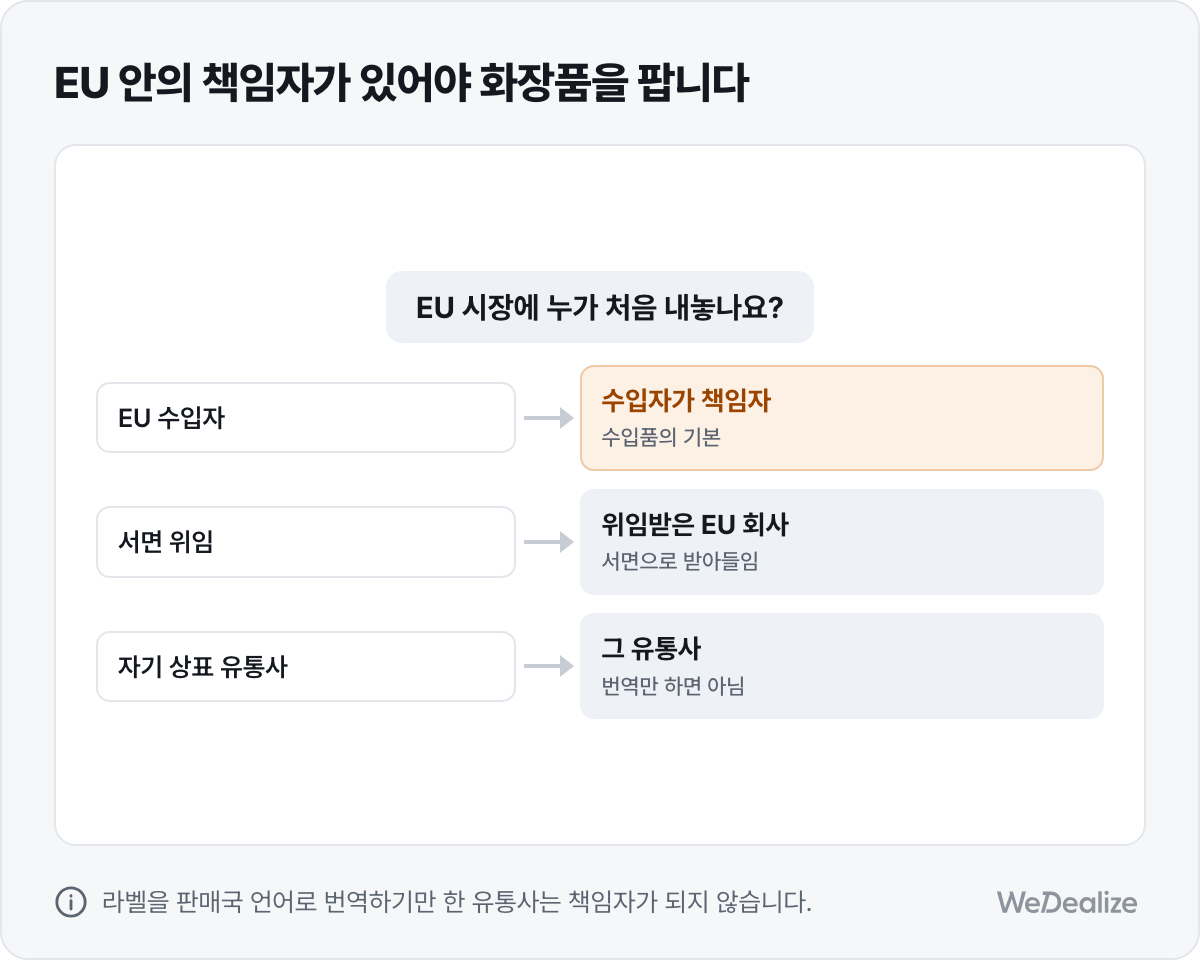
Can a distributor also be the responsible person? — A distributor becomes the responsible person if it places the product on the market under its own name or trademark, or modifies the product in a way that may affect compliance with the requirements. If the distributor only translated the label, it is not designated as the responsible person.
Who handles what for each sales method? — A responsible person must be established in the EU before the product can be placed on the market, and the responsible person is responsible for the CPNP notification and product information file. Under the regulation, an importer is a person established in the EU who first places a cosmetic from a third country on the EU market, so a Korean company cannot become the responsible person as the importer. The customs declarant for customs clearance must also be established in the EU under EU customs law. When a Korean seller sells under its own name or trademark, the roles are divided as follows among the four sales methods.
Sales method | Who is responsible for the responsible person·CPNP notification | Customs declarant |
|---|---|---|
Sell directly to EU consumers through cross-border direct sales | Online sales targeting EU consumers are also regarded as placing products on the EU market. Therefore, a responsible person in the EU must be designated, and that responsible person submits the notification. The regulation requires only manufacturers of cosmetics made in the EU and EU importers to designate a responsible person in writing, and Ireland’s regulator (HPRA) states that a company outside the EU cannot designate a responsible person. Germany’s federal authority (BVL) states that a person selling cosmetics from a third country on a website targeting the German market is regarded as both the importer and the responsible person, and that an EU Member State address must be shown on the product. Therefore, our company, which has no EU address, cannot itself become the responsible person. Confirm with a local regulatory expert whether other Member States take the same view. The European Commission has also been assessing since 2025 whether the cosmetics regulation is sufficient for online sales. | A declarant established in the EU. The Korean seller may appoint a customs representative in the EU. For duties on low-value parcels, see 「Shipping and Customs Tips」. |
Sell to an EU company (distributor·importer) | That EU company is the responsible person as the importer. It may also designate another EU company as the responsible person by written mandate. | That EU company. |
Our company becomes the importer of record (IOR) without an EU legal entity | Our company cannot be the importer under the regulation, and a company outside the EU can neither be the responsible person nor designate one. The EU importer becomes the responsible person, or that importer designates another EU company as the responsible person by written mandate. | Unless an exception applies (such as occasional declarations), the declaration is made through indirect representation, with an EU customs representative filing in its own name on the company’s behalf. This is the same arrangement as the name-lending arrangement below. |
Borrow an EU company’s importer name through an IOR service | Cosmetics brought in from outside the EU and placed on the market constitute imports, and the EU importer is the responsible person. If the company lending its name is the importer, it becomes the responsible person. If it does not want to act as the responsible person, that company must enter into a written mandate agreement with another EU company; an agreement only with our company is not sufficient. | The EU company lending its name. If that company files the declaration in its own name on our behalf, this is indirect representation, and that company and our company are jointly liable for the customs debt. |
If we borrow an importer’s name through an IOR service, is that company the responsible person? — Since the EU importer is the responsible person for cosmetics brought in from outside the EU, the company lending its name is the responsible person if it is the importer. To appoint another EU company as the responsible person, the company lending its name must enter into a written mandate agreement with that company. Decide by contract who will take on the role, and have your interpretation confirmed by an EU local regulatory expert before selling.
Order of tasks
Confirm that it is a cosmetic — Check whether the place and purpose of use fall within the definition (「What to check first」).
Decide the sales method and responsible person — Choose one of the four sales methods and designate the EU importer or an EU company appointed by mandate as the responsible person (「What to check first」·「Responsible person and product information file」).
Cross-check the ingredients — Check the lists of prohibited and restricted substances and the lists of permitted colorants·preservatives·UV filters (「Five ingredient lists」).
Safety assessment — A qualified assessor prepares the safety report (「Safety assessment」).
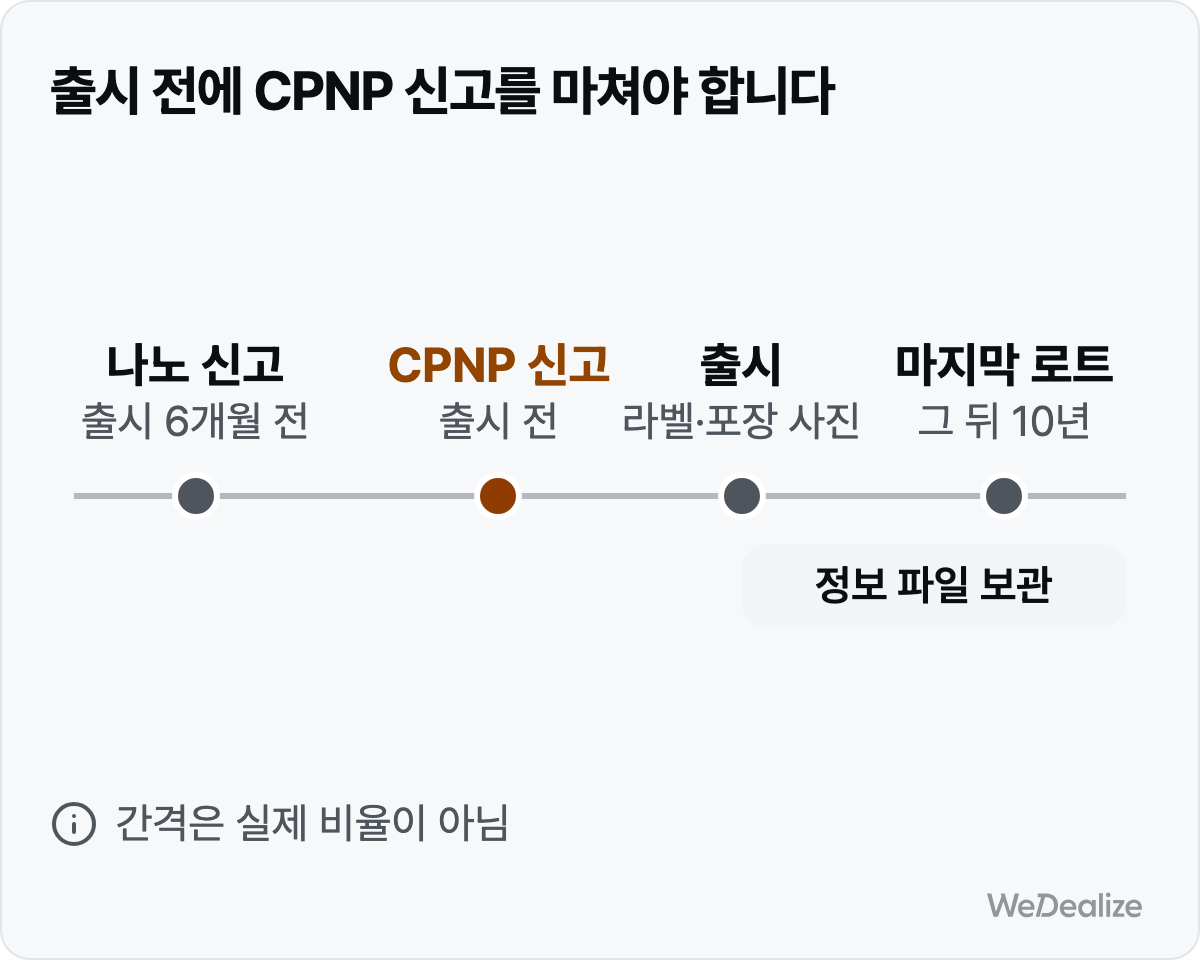
Notify nanomaterials — If nanomaterials are present, submit a notification six months before placing the product on the market (「CPNP notification」).
Prepare the label — State the responsible person’s address·country of origin·ingredients and prepare the label in the language of the country of sale (「Label」).
CPNP notification — Submit the product information electronically before placing the product on the market (「CPNP notification」).
Shipment and customs clearance — The importer files the declaration, and the FTA origin is certified (「Customs duties·FTA」).
Post-market management — Report serious undesirable effects and retain the file for 10 years (「What to do after placing the product on the market」).
EU cosmetics requirements (Regulation 1223/2009)
The 27 EU Member States jointly apply one cosmetics regulation (Regulation (EC) No 1223/2009). Most obligations established by the regulation fall on the responsible person. Safety, good manufacturing practice, safety assessment, the product information file, notification, ingredient restrictions, labelling, efficacy claims and adverse-effect reporting are all the responsibility of the responsible person.
Responsible person and product information file
Safety — The product must be safe for human health when used under normal or reasonably foreseeable conditions of use.
Product information file (PIF) — It contains the product description, safety report, manufacturing method and a statement of compliance with good manufacturing practice (GMP), evidence supporting the claimed effects and animal-testing data.
Where to keep it — Keep it at the responsible person’s address stated on the label so that the authorities of that country can access it immediately. Prepare it in a language that those authorities can easily understand.
How long — Retain it for 10 years from the date the last batch was placed on the market.
Good manufacturing practice — Manufacturing must follow GMP. If the product is made according to a harmonised standard published in the Official Journal of the EU, it is presumed to comply with GMP. GMP materials from the Korean factory are also included in the file.
Safety assessment
The responsible person must have a safety assessment carried out before placing the product on the market. A cosmetic product safety report complying with Annex I must also be prepared.
The report includes the ingredients and their concentrations, physical and chemical characteristics and stability, microbiological quality and preservative-challenge test results, and information on impurities and packaging materials.
The assessment is carried out by a person who has completed a university course in pharmacy·toxicology·medicine or a similar field.
Confirm with the responsible person and assessor what formulation and testing data are required for the assessment.
Five ingredient lists
Compile all ingredients in the formulation using common ingredient names.
Do not include any ingredients listed in Annex II (prohibited substances).
Use substances listed in Annex III (restricted substances) only within the specified concentrations·areas of use·cautionary wording.
Use only colorants listed in Annex IV, preservatives listed in Annex V and UV filters listed in Annex VI, and comply with the conditions for each. Sunscreens fall under this requirement.
Substances classified as carcinogenic·mutagenic·toxic to reproduction (CMR) may not be used. Category 2 substances are exempted only if the EU Scientific Committee considers them safe. Category 1A·1B substances are exempted only when all four conditions are met, including that no suitable alternative substances are available and that the Scientific Committee considers them safe.
Cosmetics made with finished products or ingredients tested on animals may not be placed on the market when an alternative test method exists. Check the testing history of the ingredient supplier as well.
CPNP notification
When — Before placing the product on the market, the responsible person submits an electronic notification to the European Commission. The portal is the Cosmetic Products Notification Portal (CPNP), and there is no fee. Once notified, the product does not need to be notified separately in each Member State.
What — Enter the product category and name, the responsible person’s name·address, the country of origin for imports, the Member States where the product will be placed on the market, a contact person in an emergency, nanomaterials·CMR substances and the broad formulation for emergency treatment (frame formulation).
When placing it on the market — Submit the original label and, where legible, a photograph of the packaging as well.
Nanomaterials — Ingredients measuring 1–100 nm that are insoluble or biopersistent. If present, they must be notified separately six months before placing the product on the market.
If anything changes — Correct the notification immediately if the notified information changes. A distributor that translates the label itself when selling in another Member State must also submit a separate notification.
Label
State the following information on the container and packaging in indelible, easily legible lettering.
Responsible person’s name·address and country of origin — If there is more than one address, make the address where the product information file is kept prominent. For imports, state the country of origin, such as 「Made in Korea」.
Nominal content — The weight or volume at the time of packaging. This may be omitted for products under 5 g·5 mL, free samples and single-use products.
Period of minimum durability — State it after 「best used before the end of」 or the prescribed symbol. For products with a minimum durability of more than 30 months, state the period after opening together with the prescribed symbol instead of the best-before date.
Precautionary statements — Include the wording required by Annexes III–VI and, for professional-use products, the relevant professional-use precautions as well.
Batch number — If the container is too small, it may be stated only on the packaging.
Function — State the function if it is not clear what the product is from its appearance alone.
List of ingredients — After 「ingredients」, list the ingredients in descending order by weight at the time of formulation. Ingredients below 1% may be listed afterward in any order. Fragrance may be grouped under 「parfum」, but ingredients that Annex III requires to be listed separately must also be named. Add 「(nano)」 after the name of a nanomaterial.
Language — The languages for net quantity, period of use, precautions, and functions are determined by the law of the Member State where the product is sold. Use the EU common ingredient names for ingredient names.
Claims about effects — Do not imply, through the label, advertising, name, or images, effects that the product does not have. “Not tested on animals” may be used only when neither the manufacturer nor the raw material suppliers tested or commissioned animal testing on the product and its ingredients.
Actions after launch
Serious undesirable effects — If functional impairment, disability, hospitalization, congenital anomaly, life-threatening condition, or death occurs, the responsible person and distributor must immediately notify the authorities of the relevant Member State.
When non-compliance is discovered — The responsible person immediately takes corrective action, withdraws the product from the market, or recalls it. If there is a health risk, they notify the authorities of the Member State where the product was sold and the Member State where the product information file is kept.
Distribution chain — The responsible person must be able to identify which distributors the product was supplied to for three years.
Product table
The item numbers in this article are representative examples for explanatory purposes. Since the declarant determines the EU commodity code at the time of import declaration, confirm the final classification with the importer and customs broker. The numbers are the 10-digit EU Integrated Tariff (TARIC) codes.
For all rows, the customs duty applicable to Korean-origin goods is 0% if the goods qualify as originating products under the Korea-EU FTA · As of 2026-10-18.
Perfumes and makeup
Item name | EU TARIC | General rate | Key point |
|---|---|---|---|
Perfume | 3303001000 | Customs duty 0% | Ingredients that Annex III requires to be listed by name are listed separately from “parfum.” |
Eau de toilette·cologne | 3303009000 | Customs duty 0% | Only the code differs from perfume; the labeling requirements are the same. |
Lipstick·lip tint | 3304100000 | Customs duty 0% | For multiple shades, colorants may be grouped using “may contain” or “+/-”. |
Eyeshadow·mascara | 3304200000 | Customs duty 0% | Colorants may be used only in accordance with the conditions of use specified in Annex IV. |
Nail polish | 3304300000 | Customs duty 0% | If the container is too small, the batch number may be stated only on the outer packaging. |
Powder·pressed powder | 3304910000 | Customs duty 0% | If nanomaterials are present, add “(nano)” after the ingredient name. |
Skincare and sunscreen
Item name | EU TARIC | General rate | Key point |
|---|---|---|---|
Cream·lotion·essence·cushion | 3304990000 | Customs duty 0% | Even when marketed as whitening or wrinkle-improving products, they are cosmetics, and the substantiation for the claims must be kept in the product information file. |
Sunscreen·SPF products | 3304990000 | Customs duty 0% | UV filters may be used only within the ingredients and concentrations listed in Annex VI. |
Hair and oral care
Item name | EU TARIC | General rate | Key point |
|---|---|---|---|
Shampoo | 3305100000 | Customs duty 0% | If claims are made, the substantiation must be kept in the product information file. |
Hair spray (lacquer) | 3305300000 | Customs duty 0% | State the precautionary wording specified in Annexes III–VI on the label. |
Hair treatments·hair dyes | 3305900000 | Customs duty 0% | Oxidative hair dyes must include a severe allergy warning and wording prohibiting use by persons under 16. |
Toothpaste | 3306100000 | Customs duty 0% | Fluoride must not exceed 0.15%; when it is 0.1–0.15%, a precautionary statement for children under 6 is required. |
Oral rinse | 3306900000 | Customs duty 0% | If it is intended to be swallowed, it is not a cosmetic. |
Bath products·sheet masks·cleansers
Item name | EU TARIC | General rate | Key point |
|---|---|---|---|
Bath salts·bath bombs | 3307300000 | 6.5% | If it is too small to attach a label, like a bath ball, place the ingredients in an information notice next to the display. |
Sheet masks·depilatories and other cosmetics | 3307900000 | 6.5% | The declarant determines the EU code for sheet masks. |
Toilet soap (solid) | 3401110000 | Customs duty 0% | In the EU, toilet soap is also a cosmetic. |
Soap in powder or flakes | 3401201000 | Customs duty 0% | The requirements in this article apply only when it is intended for washing the body. |
Soap in other forms | 3401209000 | Customs duty 0% | If it is too small for labeling, the ingredients may be provided in an information notice next to the display. |
Facial cleanser·body wash | 3401300000 | 4% | The rate changes from 4% to 0% only when the Korea-EU FTA origin is proven. |
Customs duty and FTA
No customs duty is payable on all items in this article if they are originating products under the Korea-EU FTA.
General rate — In the Third country duty line of the monthly TARIC extract published by the European Commission (2026-10), perfumes, makeup, skincare, hair care, oral care, and soap have a 0% rate. Bath products and other cosmetics (heading 3307) are 6.5%, and liquid cleansers (3401300000) are 4%.
Korea-EU FTA — The same extract contains a 0% preferential duty line for Korea, Republic of, for all of Chapters 33 and 34. It has applied since 2011-07-01, based on Decision 0265/11.
Indirect taxes at import — This is import value-added tax (VAT). The rate is determined by the importing Member State, so it varies by country, and the standard rate must be at least 15%. The taxable base (the amount used to calculate the tax) is the customs value plus customs duty and other taxes payable upon import, as well as transport and insurance costs to the first destination in that country; it includes customs duty (VAT Directive and European Commission guidance).
Proof of origin — The procedure for proving origin in Korea is covered in the articles on certificates of origin and approved exporters under the relevant terminology.
Calculation example — The taxable value of EUR 10,000 in this example is an assumed figure for explanatory purposes.
Item | If origin cannot be proven | If the goods are originating products under the Korea-EU FTA |
|---|---|---|
Sheet masks (3307900000, 6.5%) | EUR 650 | EUR 0 |
Facial cleanser (3401300000, 4%) | EUR 400 | EUR 0 |
Cream (3304990000, customs duty 0%) | EUR 0 | EUR 0 |
Shipping and customs clearance tips
Small parcels — From 2026-07-01 to 2028-07-01, a customs duty of EUR 3 per item is imposed on IOSS-registered sales and postal parcels whose contents are each worth no more than EUR 150. The TARIC extract also contains this EUR 3 line for Chapters 33 and 34. Reflect this amount in the cost when sending samples or direct-shipping orders by post.
Distributor checks — Before sale, EU distributors check whether the responsible person’s name and address, batch number, and ingredient list are present and whether the language requirements of the country of sale have been met. If they determine that the requirements are not met, they do not sell the product until the requirements are fulfilled.
Translated labels — If a distributor translates the label into the language of the country of sale itself, that distributor separately submits a notification to the CPNP. Creating the label in the language of the country of sale from the outset reduces this step.
Matching commodity codes — For products such as sheet masks, where the Korean and EU codes may differ, confirm the code with the importer and customs broker before shipment.
Common mistakes
Misconception: “Register the Korean company as the responsible person” — No. The responsible person must be located in the EU. The responsible person is the EU importer or an EU company designated in writing by the importer.
Misconception: “Sell in all 27 countries with one English label” — No. The languages for net quantity, period of use, precautions, and function claims are determined by the law of the Member State where the product is sold.
Misconception: “Sunscreen has a separate pharmaceutical procedure” — No. In the EU, sunscreen is a cosmetic. However, UV filters may be used only if they are included in Annex VI.
Misconception: “A CPNP notification is all that is needed” — No. A safety assessment and product information file must be in place before notification.
Misconception: “Cite the consolidated EUR-Lex version as the original legislation” — No. The consolidated version is a reference document, while the original EU Official Journal has legal effect. At launch, check the ingredient list against the original Official Journal and the latest version.
Related terms
What to do in Korea — Export declaration · Certificate of origin · Duty drawback · Strategic goods
Korea-EU FTA — The Korea-EU FTA is the free trade agreement between Korea and the EU, provisionally applied from July 2011 and formally ratified in December 2015.
Approved exporter — An exporter certified as having the capacity to prove origin, who may self-certify the origin within the scope permitted by the agreement.