Cash on Delivery
Automatically translated from Korean.
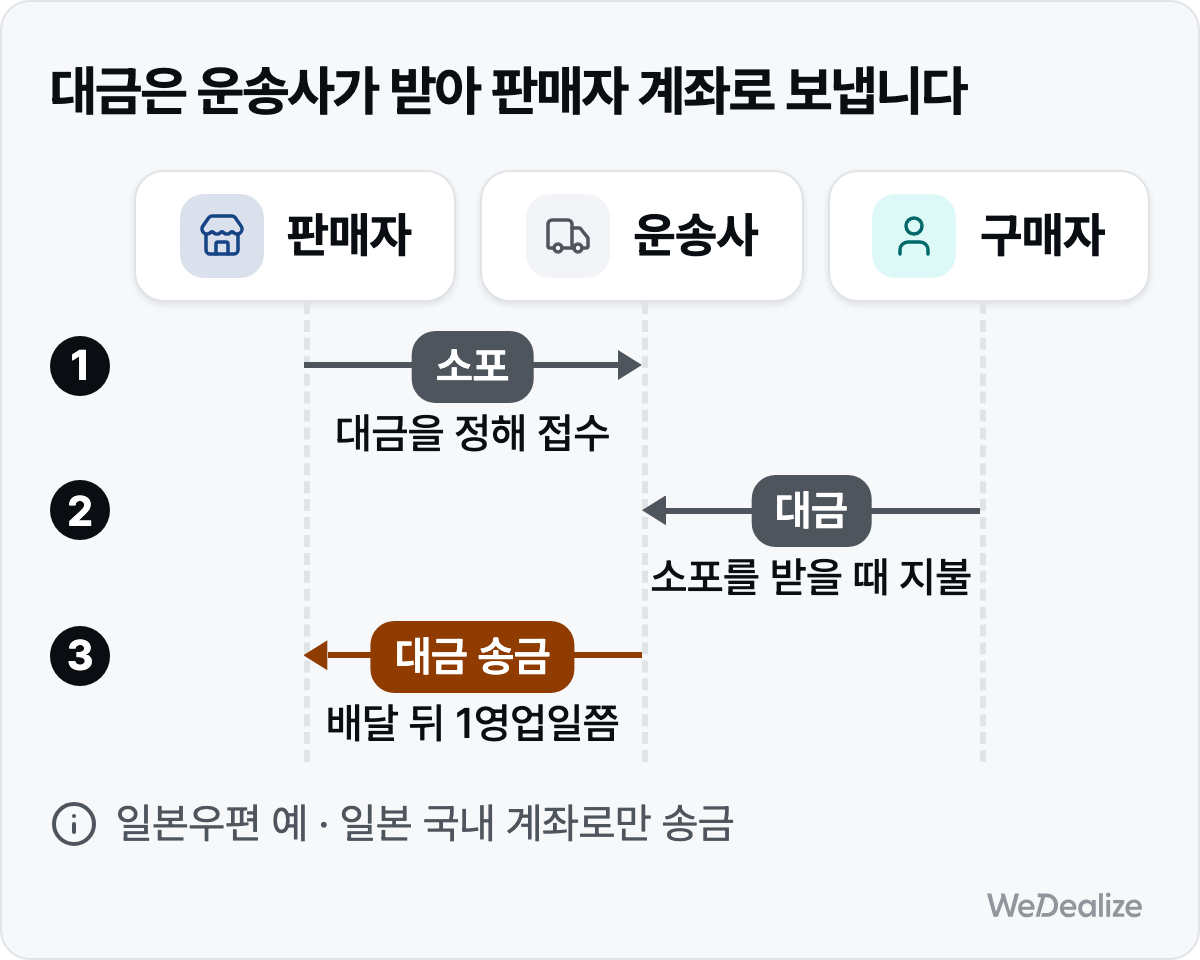
One-line definition — Cash on Delivery is a payment method in which the buyer pays the delivery person when receiving the goods, and the carrier sends the money to the seller.
Other names: COD · 代金引換 · Daibiki · Cash on Delivery
In simple terms
Cash on Delivery is a payment method where you 「pay upon receipt」. Instead of ordering online and paying in advance by card, the buyer pays when receiving the goods. In Japan, it is called 代金引換 (Daibiki). Japan Post (日本郵便) explains that, upon delivery, it collects from the recipient the amount specified by the sender in exchange for the mail item or parcel, and remits the money to a bank account at a financial institution in Japan. In other words, the carrier collects the payment on behalf of the seller.
When is it needed?
When a domestic Japanese bank account is required — Japan Post's 代金引換 service remits the payment to an account at a financial institution in Japan, so a domestic Japanese bank account is required to receive the funds.
When calculating costs — Japan Post adds a 290-yen 代金引換 surcharge to the basic fee and postage, and deducts a separate remittance fee from the payment. For example, sending less than 50,000 yen to a Japan Post Bank account costs 203 yen, and the remittance takes about 1 business day after delivery. The payment amount is limited to 2 million yen, and amounts exceeding 300,000 yen must be sent by registered mail (ゆうパック uses a security service).
When writing a product page — Under Japan's Specified Commercial Transactions Act disclosure requirements, the timing and method of payment are items that must be included in mail-order advertisements. Some items may be omitted if the required conditions are met, such as stating in the advertisement that written information will be provided without delay if requested by the consumer. If the buyer must pay anything in addition to the sale price and shipping fee, the details and amount must also be stated.
Example
CEO Choi added 代金引換 as a payment option when shipping cosmetics from a local warehouse in Japan. When a 10,000-yen order was sent as a parcel, 290 yen was added to the postage, and the amount remaining after deducting the 203-yen remittance fee from the collected payment arrived in the Japan Post Bank account around the next business day after delivery.
The product and amounts in this example are hypothetical and provided for explanatory purposes.
Common points of confusion
「The 290-yen surcharge includes the remittance fee」 — No. Japan Post states that the remittance fee is not included and is charged separately.
「It can be used as is for express shipments sent from Korea」 — Japan Post's 代金引換 service limits the remittance destination to an account at a financial institution in Japan. Check with the carrier whether it can be used for shipments sent from overseas.
Related terms
Japan's Specified Commercial Transactions Act disclosure — The obligation, when conducting mail-order sales in Japan, to display seller information and transaction and return conditions in advertisements.
Convenience store pickup — A delivery method in which the buyer receives the goods at a designated convenience store instead of at home.
Local warehouse fulfillment — A delivery method in which inventory is stocked in advance at a warehouse in the selling country and shipped locally when an order is placed.
Last mile — The final delivery segment in which goods are delivered from a logistics hub or warehouse near the customer to the customer's home.