Marketplace-operated warehouse (marketplace fulfillment) guide
Automatically translated from Korean.
In one line — A marketplace-operated warehouse (marketplace fulfillment) is a model in which, after inventory is received at a marketplace logistics center—such as Coupang Rocket Growth or Amazon FBA—the marketplace handles everything from packaging and shipping to returns. In addition to the selling commission, inbound/outbound handling, shipping, storage, and return fees are charged.
Scope of this guide — The procedures and costs involved when a seller with a high sales share on one marketplace, or whose sales are affected by shipping speed, sends inventory to that marketplace’s warehouse (examples: Coupang Rocket Growth in Korea and Amazon FBA in the United States) See other guides for — Meaning of the term → Marketplace fulfillment · Procedures and costs for 3PL warehouses → U.S. local fulfillment center guide · Coupang onboarding documents and fees → Coupang onboarding guide · Return collection → International returns processing guide
What to check first
Do you have a high sales share on one marketplace? — Orders from that marketplace are processed directly by its warehouse, so you can reduce the staff needed for packaging, shipping, and customer support.
Does shipping speed affect your sales? — Inventory stored at the marketplace warehouse is shipped through the marketplace’s fast delivery service.
Do you sell on multiple marketplaces? — Inventory stored at a marketplace warehouse is generally intended for orders from that marketplace. To ship orders from multiple marketplaces from one warehouse, compare a 3PL warehouse (a warehouse operated by a logistics specialist) with the marketplace’s multichannel fulfillment service.
Are the goods imported? — Check the customs clearance procedures before inbound delivery with your customs broker and the marketplace representative.
Order of tasks
Korea — Coupang Rocket Growth
Start with a Coupang seller account (WING) → How it differs from a 3PL warehouse
For new products, register them by selecting Rocket Growth as the sales method; for products already on sale, switch them to Rocket Growth sales → Cost structure
Pack by sales unit and attach a barcode before sending the goods to the logistics center. There is no minimum inbound quantity requirement → Cost structure
When an order is placed, Coupang handles packaging, shipping, customer support, and returns → Returns
United States — Marketplace-operated warehouse (e.g., Amazon FBA)
Create an inbound shipment according to the marketplace’s procedure (Amazon uses “Send to Amazon”), then prepare, pack, and label the goods according to the marketplace’s requirements → How it differs from a 3PL warehouse
Check the importer and U.S. customs clearance in U.S. Sales Guide — Local Sales → Customs clearance in the country of sale
Orders from that marketplace are fulfilled using the received inventory → Cost structure
How it differs from a 3PL warehouse
Item | Marketplace-operated warehouse | 3PL warehouse |
|---|---|---|
Contracting party | The marketplace (for Coupang, Coupang charges the selling commission, while Coupang Fulfillment Services charges the logistics costs) | The logistics provider selected by the seller |
Orders shipped | Orders from that marketplace (Amazon can also fulfill orders from other channels through multichannel fulfillment) | See the U.S. local fulfillment center guide |
Customer support and returns | Handled by the marketplace | See the U.S. local fulfillment center guide |
Inbound preparation | According to the marketplace’s requirements (packaging by sales unit, barcodes, etc.) | See the U.S. local fulfillment center guide |
Amazon multichannel fulfillment (MCF, Multi-Channel Fulfillment) — Amazon states that orders from other sales channels, such as a seller’s own website, can also be fulfilled using FBA inventory.
Shipping orders from other marketplaces through Coupang Rocket Growth — Check with your Coupang representative.
3PL warehouse operations — For procedures and costs, see the U.S. local fulfillment center guide, which is based on the United States.
Customs clearance in the country of sale
When importing goods into a domestic marketplace warehouse — When importing goods, you must file an import declaration with the head of the customs office, including the product name, specifications, quantity, price, and other details. Check with your customs broker and Coupang representative how customs clearance should be completed before the goods are delivered to the marketplace warehouse.
U.S. marketplace warehouse — Under U.S. federal regulations, the primary responsibility for paying duties lies with the Importer of Record (IOR). For customs clearance and importer designation for inventory in a marketplace warehouse, see U.S. Sales Guide — Local Sales, “Importing and selling as the direct Importer of Record (IOR).”
Cost structure
Marketplace-operated warehouse costs are divided into selling commission + logistics costs. Amounts vary by category, size, and selling price, so only representative criteria are listed here. When checking quotations and settlement statements, compare them against the items below.
Selling commission — Coupang Rocket Growth’s selling commission is the same as that for seller-fulfilled orders.
Inbound/outbound handling fees and shipping fees — Coupang states that these are determined by category, size type, and selling price (the final selling price after applying the seller’s discount coupon). Amazon FBA fulfillment fees include picking (retrieving the product), packing, shipping, and customer support, and are determined by the product’s price, weight, and dimensions.
Storage fees — Amazon FBA charges monthly based on average daily volume (cubic feet). Coupang lists benefits such as a certain period of free storage after each inbound delivery as “on promotion.” Because the public information does not specify a start or end date, this guide does not state a period.
Long-term storage fees — Amazon FBA charges these monthly for inventory stored for more than 181 days.
Return collection and return restocking fees — Coupang charges separately for collecting returned goods and receiving them back into inventory. Coupang states that returns attributable to Coupang are processed without charging the seller.
Removal fees — These are charged when remaining inventory is removed from the marketplace warehouse. Amazon FBA also charges per-unit fees for removal, disposal, and liquidation.
Additional services — Coupang offers barcode labeling, barcode error correction, and removal shipping as additional services (product labeling).
Value-added tax — Coupang’s selling commissions and logistics processing fees are all exclusive of value-added tax.
Returns
The marketplace collects and inspects returns — The marketplace collects and processes customer returns.
What sellers decide in Coupang Rocket Growth — Sellers decide the selling price, inventory quantity, and whether returned products may be resold. Rocket Growth can be discontinued whenever the seller wishes.
Returns at a U.S. marketplace warehouse — Returns are processed within the United States. For the distinction between duty-free reimportation and general importation when bringing goods back to Korea, see the international returns processing guide (reverse logistics).
When connected with WeDealize
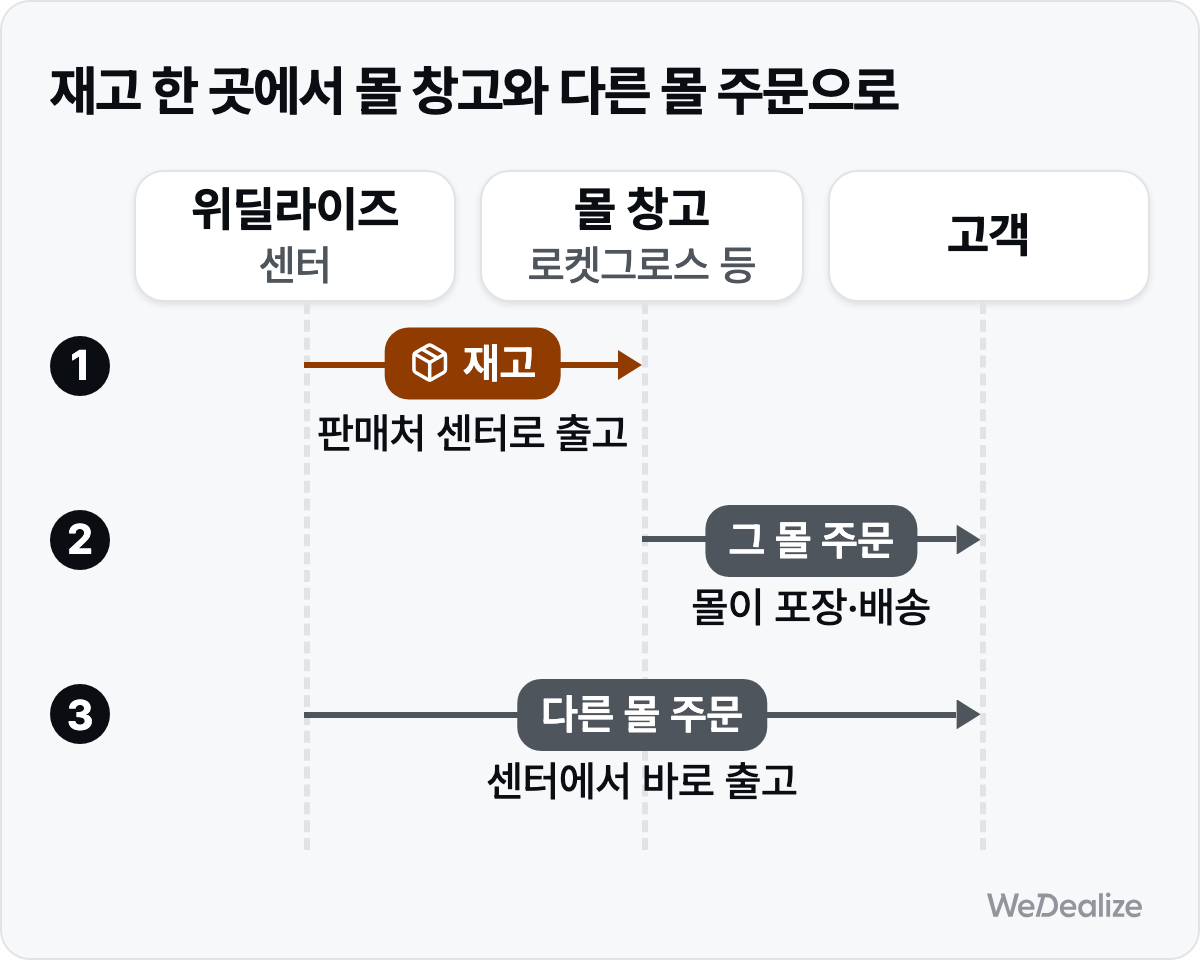
Inventory received once at a WeDealize center can be divided and shipped to the centers of sales channels such as Coupang Rocket Growth. Inventory intended to replenish marketplace warehouses can be stored at a WeDealize center, while orders from other marketplaces can be shipped directly from the WeDealize center. Because inbound delivery is connected to import transportation, you can also check the progress together from pickup at the overseas supplier through receipt at the center.
Common mistakes
Misconception: “Once inventory is received at a marketplace warehouse, the only cost is the selling commission.” — No. Inbound/outbound handling, shipping, storage, and return fees are charged separately. Coupang separately charges the selling commission through Coupang and logistics costs through Coupang Fulfillment Services.
Misconception: “Orders from other marketplaces can also be shipped using inventory stored at a marketplace warehouse.” — Not necessarily. This differs by marketplace, so check the publicly available information and confirm with the representative.
Misconception: “There is always a free storage period.” — Not necessarily. Free benefits in public information are marked as promotions and may change. Check the settlement terms before signing up.
Misconception: “The marketplace warehouse also handles customs clearance.” — The scope of customs clearance services may differ by marketplace, so check with your customs broker and the marketplace representative.
Related terms
FBA — A program in which, when inventory is stored at an Amazon fulfillment center, Amazon handles order picking, packing, and shipping as well as customer support and returns.
Fulfillment — An industry term for entrusting logistics tasks such as product storage and order processing to a fulfillment center.
Seller-fulfilled shipping — A method in which the seller packs and ships orders directly or through its own 3PL without using the marketplace’s logistics center.
Local warehouse fulfillment — A shipping method in which inventory is sent in advance to a warehouse in the country of sale and shipped locally when orders arrive.
Fast-shipping badge — A designation given to products that meet the marketplace’s shipping requirements to inform buyers that they will arrive quickly.
Inventory turnover — An indicator showing how many times inventory was sold and replenished during a certain period.