Guide to Handling International Returns
Automatically translated from Korean.
One-line summary — For international returns, first decide whether to handle them locally or bring them back to Korea. If goods exported from Korea return within 2 years, consider re-import duty exemption. Triangular-trade inventory is not eligible for re-import duty exemption because it was not exported from Korea, and duties paid in the country of sale may be recovered through refund procedures in Japan and the United States.
Scope of this article — Returns of orders sent by express delivery from Korea (Route 1) and orders sold from a local U.S. center (Route 2) — Japan, the United States, and Taiwan 기준 in other articles — Shipping side (Route 1) → Guide to International Direct Shipping · Shipping side (Route 2) → Guide to U.S. Local Centers · Country-specific customs clearance and labeling requirements → Sales guides for Japan·the United States·Taiwan
First, check the following
Where will you receive returns? — If returns are sent back to Korea, international return shipping and Korean import customs clearance costs will arise. Orders sold from a local U.S. center can be returned to the U.S. center. If the product value is low, also compare the option of issuing a refund without retrieving the item.
Did you display the return terms in advance? — In Japan, special mail-order return terms apply only if they were displayed in the advertisement in advance. Taiwanese consumers may cancel the contract within 7 days from the date they received the goods unless the goods fall under a reasonable exception.
Was an export declaration record created when the goods were first shipped? — In principle, proof of export is required to apply for re-import duty exemption. Goods shipped under simplified clearance (a method that omits an export declaration by submitting a customs clearance list) do not have an export declaration certificate.
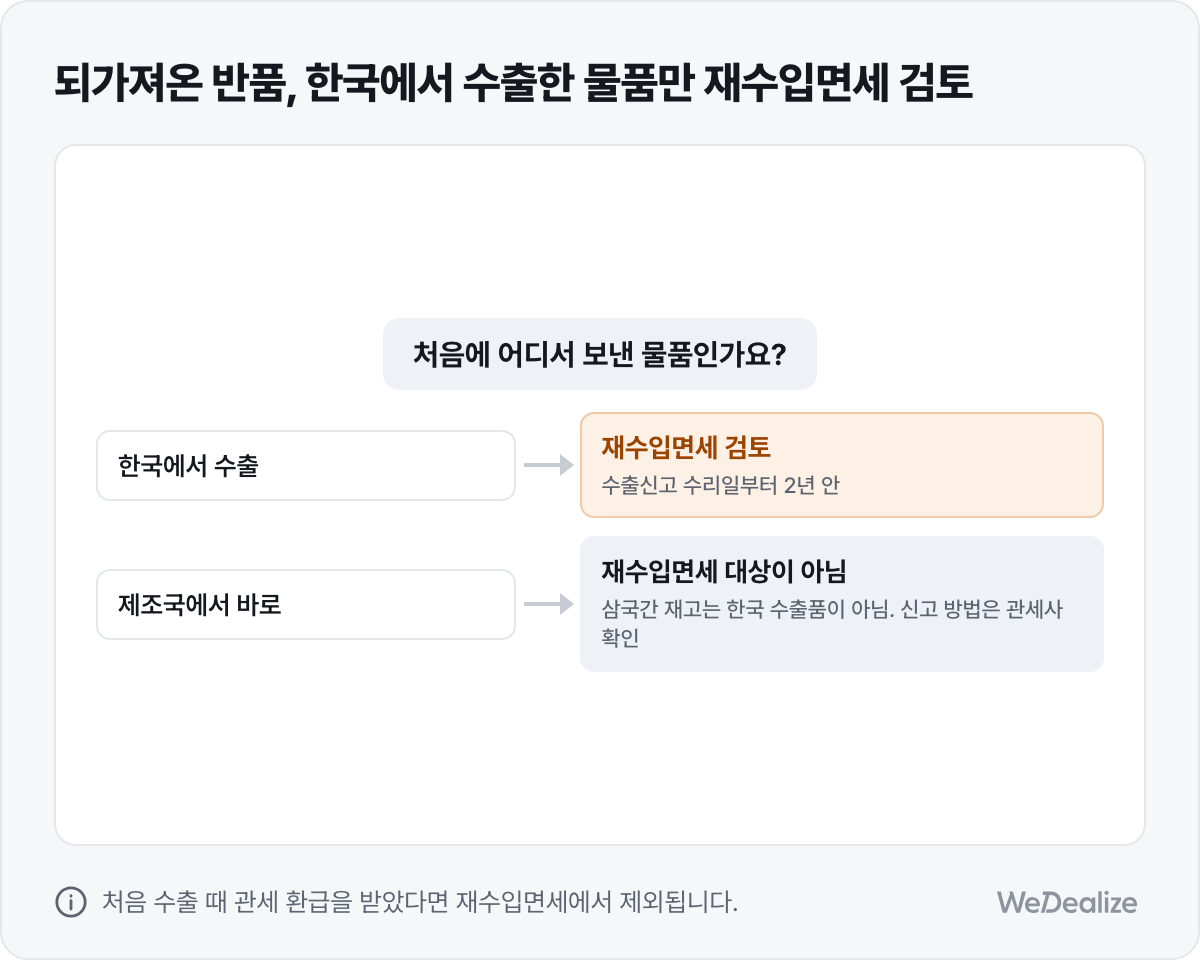
Where did the goods come from? — Eligibility for re-import duty exemption depends on whether the goods were exported from Korea or were triangular-trade inventory shipped directly from the country of manufacture to the country of sale. Confirm the declaration method for triangular-trade inventory with a customs broker.
Order of tasks
Route 1 — Orders sent by express delivery from Korea
Check the reason for return and the condition of the product, then determine who bears the return shipping cost according to the sales terms (return shipping fee) → Cost structure
Check the refund procedure for duties and taxes paid by the consumer in the country of sale → Customs clearance in the country of sale
Send the goods back to Korea and complete import customs clearance → Korean customs clearance and VAT
If the goods can be resold, restock them as Korean inventory; if not, dispose of them → Cost structure
Route 2 — Orders sold from a local U.S. center
Receive returns within the United States at the U.S. center. Because international returns are avoided, shipping costs and processing time are reduced → When connected through WeDealize
If the goods can be resold, restock them as U.S. center inventory; if not, remove, dispose of, or liquidate them → Cost structure
Check the requirements for refunding duties paid when the inventory was imported → Customs clearance in the country of sale
When bringing the goods back to Korea, make the declaration based on the origin of the goods → Korean customs clearance and VAT
Korean customs clearance and VAT
Import customs clearance — Returned goods also undergo import customs clearance in Korea. Under Korea’s Customs Act, bringing foreign goods into Korea constitutes an import.
Re-import duty exemption — Consider this when goods exported from Korea return within 2 years from the date the export declaration was accepted without having been used overseas. If a customs duty refund was received upon the initial export, the goods are excluded from re-import duty exemption.
Defective returns — Exported goods found to be defective are not excluded from re-import duty exemption even if they were used overseas.
VAT — Goods re-imported with reduced or exempt customs duties may also be exempt from VAT.
Export declaration records — In principle, to apply for re-import duty exemption, submit an export declaration certificate, re-export declaration certificate, or substitute document to customs. Submission is not required if the head of the customs office recognizes through other materials that the goods qualify for duty reduction or exemption. Goods sent under simplified clearance (submission of an express-delivery or postal customs clearance list) do not have such certificates. Confirm with a customs broker which documents can substitute for the certificates.
Triangular-trade inventory — Inventory shipped directly from the country of manufacture is not eligible for re-import duty exemption because it was not exported from Korea. Confirm the specific declaration method with a customs broker.
Customs clearance in the country of sale
United States — Customs duty drawback for returned imports
Requirements — The goods must be imported goods that were sold at retail by the importer (or a person who received the goods from the importer) and then accepted as a return. Customs duties may be refunded through drawback if the goods are exported within 5 years of importation or destroyed under CBP (U.S. Customs and Border Protection) supervision.
Matching the documents — You may designate a different import entry instead of the returned goods when claiming the refund. The designated import entry must have been imported within 1 year before the date the returned goods were exported or destroyed. In the import documents, those goods must be recorded with the same 8-digit classification number and product identifier (item number, SKU, etc.) as the returned goods. Manage the SKUs of U.S. center inventory so they match the import documents, and file the claim with a U.S. customs broker.
Japan — 戻し税 (customs duty refund for direct-shipping returns)
Requirements — This applies when goods imported after customs duties were paid are returned without changing their nature or form. Customs duties may be refunded if the goods are brought into a bonded area (a place where goods are held before customs duties are paid) within 6 months from the date of import permission. With the approval of the head of the customs office for unavoidable reasons, the period is extended to 1 year.
Eligible goods — Examples include goods returned because their quality or quantity differs from the contract, and goods purchased for personal use through mail order that are returned because they differ from expectations.
When goods are destroyed — If the goods must be destroyed instead of returned, all or part of the customs duties may be refunded if the goods are brought into a bonded area within 6 months and destroyed with the prior approval of the head of the customs office.
Taiwan
Customs duties when re-exporting returned goods — Confirm with a Taiwanese customs broker whether duties paid in Taiwan can be refunded when consumer returns are re-exported.
Cost structure
Amounts vary by country, carrier, and warehouse. Compare the items below before establishing your return policy.
International return shipping — This arises when overseas customers send goods back to Korea under Route 1.
Duties and taxes already paid in the country of sale — They cannot be recovered unless you follow the refund procedure.
Refund procedure costs — These include bonded-area handling and customs broker fees.
Korean import customs clearance — An import declaration is still required even when re-import duty exemption applies.
Inspection, repackaging, and local storage — These arise when the U.S. center receives returns under Route 2. Marketplace-operated warehouses also charge fees for processing customers’ free returns.
Removal, disposal, and liquidation — These are the costs of handling goods that cannot be resold. Marketplace-operated warehouses charge a per-unit fee for options such as returning inventory, disposing of it, or liquidating it.
Returns
Consumer rights in Japan — For mail-order sales, consumers may withdraw their offer or cancel the contract before 8 days have passed from the date they received the goods. If the seller displayed special return terms in the advertisement in advance, those terms apply (Japan Act on Specified Commercial Transactions disclosures).
Consumer rights in Taiwan — Consumers who purchase through mail order may return the goods or cancel the contract in writing within 7 days from the date they received the goods unless the goods fall under a reasonable exception. They do not need to state a reason and do not bear the costs. The scope of exception goods is determined by Taiwan’s Executive Yuan, so confirm with a local Taiwanese expert whether the goods you sell fall under an exception.
United States — Consumer return regulations vary by state in the United States, so confirm them with a U.S. legal professional.
When connected through WeDealize
When you select a U.S. center in the global multi-center system, you can check receiving, shipping, and return histories as well as remaining inventory. Returns for orders sold from a local U.S. center are received at the U.S. center. Returns for orders shipped under Route 1 to Korea are managed as returns to the Korean center.
Common mistakes
Misconception: “All returned goods qualify for re-import duty exemption.” — No. Goods must have been exported from Korea, must not have been used overseas, and must return within 2 years. Triangular-trade inventory is not eligible for re-import duty exemption.
Misconception: “Re-import duty exemption applies even without proof of export.” — No. In principle, proof-of-export documents must be submitted to customs. The exception is when the head of the customs office recognizes through other materials that the goods qualify for duty reduction or exemption.
Misconception: “Returning goods automatically results in a refund of customs duties in the country of sale.” — No. In Japan, the goods must be brought into a bonded area within 6 months; in the United States, a claim must be filed after export within 5 years or destruction under supervision, together with the required documents.
Misconception: “There is nothing to declare if the goods are destroyed locally.” — No. Local destruction follows the procedures of the country of sale. In Japan, prior approval from the head of the customs office is required to receive a customs duty refund.
Related terms
Reverse logistics — Logistics involving the retrieval of returned or exchanged goods from buyers, inspection, and processing through restocking or disposal.
Return rate — The percentage of sold orders or products that buyers return, used by marketplaces as an indicator for evaluating seller performance.
Right of withdrawal — The right of an online buyer to cancel a contract without giving a reason within a specified period after receiving the goods.
Re-export — The removal of foreign goods that have arrived in the country back to a foreign country without undergoing import customs clearance.
Simplified export declaration — A simplified declaration that reduces the number of declaration items in a formal export declaration, mainly used for low-value e-commerce exports.
International direct shipping — A shipping method in which each order is sent individually from Korea to an overseas buyer by international express delivery or post.