U.S. Sales Guide — Cross-Border E-Commerce
Automatically translated from Korean.
In a nutshell — The U.S. duty-free exemption for cross-border e-commerce parcels valued at $800 or less was suspended in August 2025 and made indefinite under regulations in June 2026, so duties are charged even on low-value orders. If you ship by express and the seller prepays the duties and clears the goods under the seller’s name, you must designate a CTPAT-certified customs broker starting January 5, 2027.
Scope of this article — When sending Korean products to U.S. consumers by express or mail for each order (cross-border e-commerce) See other articles — Korean export declaration and express shipping procedures → International Direct Shipping Guide · Shopify fees and payments → Shopify U.S. Market Entry Guide · When importing into the U.S. for sale → U.S. Sales Guide — Local Sales
Check first
How are you selling? — This article covers cross-border e-commerce shipments sent by express or mail for each order. If you bring inventory into a local U.S. fulfillment center, become the importer of record (IOR), or import into the U.S. for sale under your own or someone else’s importer name, see U.S. Sales Guide — Local Sales. If you sell to a U.S. distributor or importer, that company imports the goods → Export Guide by Product Category
Will the seller be the importer? — If the seller prepays the duties and files the declaration under the seller’s name, the seller becomes the importer. See “Importer” below for the applicable requirements.
Is it a regulated product? — Children’s products, mattresses, button-cell or coin batteries, and products containing those batteries are subject to electronic filing of a certificate with the CPSC (U.S. Consumer Product Safety Commission), and some clothing is also covered. Food requires prior notice to the FDA (U.S. Food and Drug Administration), and devices that emit radio frequencies require FCC (Federal Communications Commission) certification → Certifications and labeling
Is the country of origin marked? — If not, it must be marked in English → Certifications and labeling
Order of tasks
Decide whether the seller will collect duties at checkout or the recipient will pay them, and determine the importer → Duties and taxes · Importer
Check whether the sales amount or number of transactions in each state meets the registration threshold, and register for sales tax in the applicable states → Duties and taxes
Check whether the products are subject to CPSC, FDA, or FCC requirements, and mark the country of origin in English → Certifications and labeling
Check the obligations to submit seller information and the delivery deadlines → Ways to sell in the U.S. · Cancellations and returns
Ways to sell in the U.S.
Own website — Shopify can be used in almost every country. However, according to Shopify’s guidance, features such as payments (Shopify Payments) vary depending on the country where the business is located.
High-volume seller information for online marketplaces (INFORM Consumers Act) — A high-volume seller is a marketplace seller that sold 200 or more new or unused products during any continuous 12-month period in the preceding 24 months and generated more than $5,000 in sales. An online marketplace obtains the seller’s bank account, contact information, and tax identification number from third-party sellers meeting these criteria within 10 days of the date they qualify.
Express and postal customs clearance — Regardless of the sales channel, each order goes through U.S. customs clearance as a separate package. See “Duties and taxes” below for the declaration procedures for express shipments and mail.
Duties and taxes
Current rules
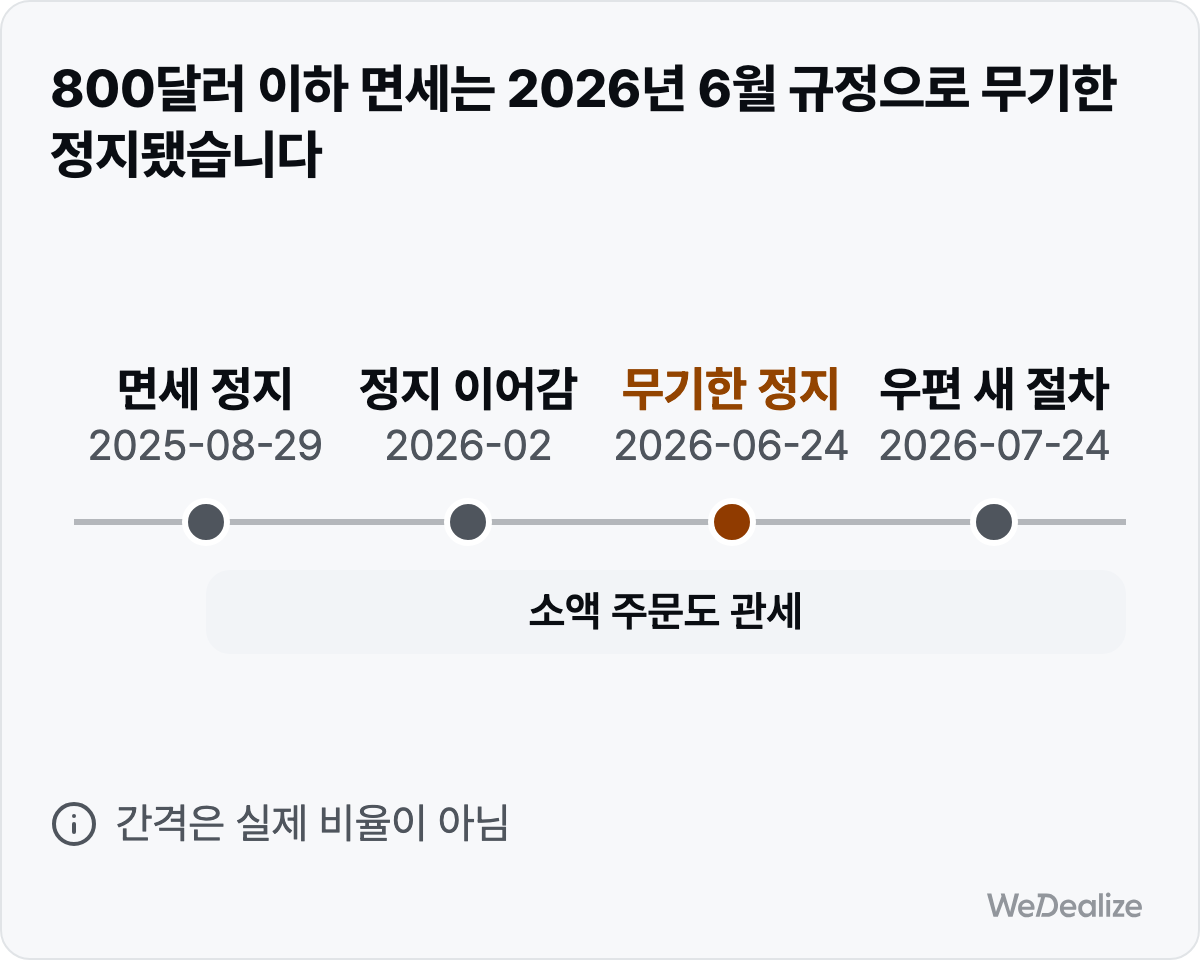
Suspension of the $800 duty-free exemption — As of August 29, 2025, the U.S. suspended the duty exemption for goods valued at $800 or less (de minimis exemption). The suspension was continued under the presidential executive order of February 2026 (Executive Order 14388). On June 24, 2026, CBP (U.S. Customs and Border Protection) amended the regulations to suspend the exemption indefinitely for both non-postal channels such as express shipments and international mail.
Informal entry — Shipments valued at $2,500 or less can generally use informal entry. More expensive goods, as well as certain goods subject to import quotas, antidumping duties, or countervailing duties, must use formal entry. The duty rate is determined based on the HTSUS classification and the duty rate in effect at the time of the import declaration.
International mail — A new informal-entry procedure for international mail took effect on July 24, 2026. The persons eligible to file are the same as those listed under “Importer” below. An import bond guaranteeing payment of duties is also required.
Upcoming changes
International mail subject to formal entry — Starting January 20, 2027, the following goods cannot use the new postal informal-entry procedure: mail subject to requirements of another government agency; goods for which duties are paid under Chapters 98 or 99 of the tariff schedule or for which a Chapter 98 duty exemption is claimed; and goods for which preferential treatment under the U.S.-Korea FTA is claimed. Use formal entry or, if eligible, CBP’s test procedure (Entry Type 13).
Repeal of the $800 duty-free provision — Under legislation enacted in July 2025 (Public Law 119-21), the $800 duty-free provision for commercial shipments will be repealed on July 1, 2027.
Potential changes — On October 8, 2026, CBP announced a proposed rule changing the declaration requirements for informal entries valued at $2,500 or less. The comment period closes on December 7, 2026.
State sales tax
State sales tax — Sales tax varies by state, and some states require marketplaces to collect it instead. See “State sales tax registration for foreign sellers” below for the registration thresholds, and see the U.S. Sales Tax and Marketplace Facilitator Collection articles for terminology.
Sales tax is separate from customs duties — A seller with a sales tax obligation (or a marketplace collecting on the seller’s behalf) collects the tax from the buyer and remits it to the state. Customs duties are taxes paid to CBP during customs clearance. The sales tax obligation is determined separately, regardless of who pays the duties.
Based on the delivery address — Washington determines the sales tax rate based on the location to which the sale is attributed or where the goods are delivered. Texas assesses local use tax based on where the goods are delivered, and out-of-state sellers may choose a single local tax rate instead.
Shopify own website — After entering the states where you are registered for sales tax and the registration numbers you received, you can configure Shopify to collect sales tax in those states. The seller handles state registration and remittance. Shopify’s “Managed Shopify” feature, which remits sales tax on the seller’s behalf, is available only to stores located in the U.S.
State sales tax registration for foreign sellers
Before the 2018 U.S. Supreme Court decision in Wayfair, a seller generally had to have a physical presence in a state to be obligated to collect and remit sales or use tax. After the decision on June 21, 2018, an obligation may arise based solely on the amount of sales or number of transactions shipped to the state, even without a physical presence. The South Dakota threshold considered in the case was more than $100,000 in sales shipped to the state or at least 200 transactions. Thresholds vary by state and change through legislative amendments, so check the state tax authority’s guidance again before registering.
California — If, together with affiliates, you had more than $500,000 in sales shipped to the state in the prior or current year, you collect the use tax payable by consumers and remit it to the state tax agency (CDTFA). Remote sellers selling from outside the state, including through the internet, are also covered. When calculating the $500,000 threshold, include both sales made directly and sales made through marketplaces. If a marketplace that is required to register (a marketplace facilitator) assists with the sale, the marketplace is treated as the seller.
Texas — If your Texas gross revenue for the preceding 12 months is less than $500,000, you do not need to obtain a permit or collect use tax. Gross revenue includes both taxable and nontaxable sales. If you exceed $500,000, obtain a permit and begin collecting by the first day of the fourth month after the month in which you exceeded the threshold. You do not need a permit if you sell only through a marketplace that confirms it will collect and remit tax on your behalf, but keep marketplace sales records for at least four years.
New York — Register if sales shipped to New York exceeded $500,000 and the number of sales also exceeded 100 during the immediately preceding four sales tax quarters. Both conditions must be met. A marketplace provider collects sales tax on New York shipments made by marketplace sellers.
Florida — Under Florida tax law, a person whose total taxable sales from remote sales shipped to Florida exceeded $100,000 in the preceding year is a dealer. A person required to collect and remit sales tax on remote sales must also collect the county surtax when shipping to a location where the surtax applies.
Washington — If Washington gross sales exceeded $100,000 in the prior or current year, register for business and occupation (B&O) tax reporting and collect sales tax. Count direct sales, exempt sales, and sales made through marketplaces. Marketplace sales for which the marketplace collected and remitted the tax may be deducted on the return.
Illinois — Starting January 1, 2026, the threshold is based only on sales. If sales to Illinois purchasers during the preceding 12 months were at least $100,000, collect and remit sales tax (retailers’ occupation tax). The former 200-transaction threshold was eliminated. Marketplaces use the same threshold.
Pennsylvania — If Pennsylvania sales exceeded $100,000 in the preceding calendar year (January–December), register and collect and remit tax for one year beginning April 1 of the following year. There is no transaction threshold. Count both taxable and nontaxable sales. A marketplace seller counts only direct sales and sales through marketplaces that do not collect tax on the seller’s behalf.
Georgia — Collect and remit tax if sales shipped to Georgia exceeded $100,000 or there were at least 200 sales in the prior or current year. A marketplace collects tax if the combined Georgia taxable sales of all marketplace sellers and the marketplace itself are at least $100,000.
New Jersey — Register and collect and remit tax if sales shipped to New Jersey exceeded $100,000 or there were at least 200 sales in the prior or current year. The marketplace collects tax on marketplace sales. If you exceed the threshold but sell only through marketplaces, you still register and may apply to be placed in a non-reporting status.
Nevada — Register and collect and remit tax if Nevada retail sales exceeded $100,000 or there were at least 200 transactions in the prior or current year.
Nebraska — Register and collect and remit tax if Nebraska retail sales exceeded $100,000 or there were at least 200 transactions in the prior or current year. Marketplace sales are also counted.
North Dakota — The threshold is $100,000 in North Dakota taxable sales in the prior or current year. The 200-transaction threshold was eliminated on July 1, 2019.
North Carolina — Register and collect and remit tax if sales to North Carolina exceeded $100,000 in the prior or current year. Marketplace sales are also counted. The 200-transaction threshold was eliminated on July 1, 2024.
New Mexico — Under New Mexico tax law, a person without a physical presence whose gross taxable receipts from sales to New Mexico were at least $100,000 in the prior year is considered to be engaged in business in the state. Exempt and deductible receipts are not counted.
Rhode Island — A remote seller with Rhode Island sales of at least $100,000 or at least 200 transactions in the prior year must register and collect and remit sales tax.
Louisiana — Under Louisiana tax law, a person without a physical presence whose sales shipped to Louisiana exceeded $100,000 in the prior or current year is a dealer.
Massachusetts — Collect and remit tax if Massachusetts sales exceeded $100,000 in the prior or current year. If the threshold is exceeded during the current year, begin collecting on the first day of the month that starts two months after the month in which the threshold was exceeded. For example, if you exceed the threshold in May, begin collecting on August 1.
Maryland — Register and collect and remit tax if sales to Maryland exceeded $100,000 or there were at least 200 transactions in the prior or current year. If you sell only through marketplaces, registration is not required; register if you also make direct sales.
Maine — Register as a seller if sales shipped to Maine exceeded $100,000 in the prior or current year.
Minnesota — An out-of-state retailer soliciting sales to Minnesota customers must determine whether it made at least 200 retail sales shipped to Minnesota or more than $100,000 in sales during the preceding 12 months. If either condition applies, begin collecting by the first day of the month that begins at least 60 days later.
Michigan — If sales shipped to Michigan exceeded $100,000 or there were at least 200 transactions in the previous year, register and remit taxes starting January 1 of the following year. The same applies to foreign sellers.
Mississippi — If sales shipped to Mississippi exceed $250,000 during any 12-month period, register, collect, and remit tax.
Missouri — At the end of each quarter, check Missouri taxable sales for the preceding 12 months. If they exceed $100,000, begin collecting seller’s use tax within three months after the quarter ends. Sellers who sell only through marketplaces do not have to register, but if they have direct sales, those sales are combined with marketplace sales.
Vermont — Collect and remit tax if Vermont sales during the preceding 12 months were at least $100,000 or there were at least 200 transactions. Check the preceding 12 months at the end of each quarter and register within 30 days if the threshold was exceeded. Sellers who sell only through marketplaces do not have to register if the marketplace collects tax on their behalf.
Virginia — Register if direct sales shipped to Virginia exceeded $100,000 or there were at least 200 transactions in either the previous year or the current year. Sales through marketplaces are not counted.
South Dakota — If South Dakota sales exceeded $100,000 in either the previous year or the current year, register and remit tax. The 200-transaction threshold was eliminated on July 1, 2023. Sellers must register if they exceed the threshold even when selling only through marketplaces.
South Carolina — If sales shipped to South Carolina exceeded $100,000 in either the previous year or the current year, obtain a retail license and collect and remit tax.
Idaho — If Idaho sales exceeded $100,000 in either the previous year or the current year, collect and remit tax.
Iowa — If Iowa sales were at least $100,000 in either the previous year or the current year, obtain a permit and collect and remit tax. A permit is not required when selling only through a marketplace and the marketplace collects the tax.
Arkansas — If sales shipped to Arkansas exceeded $100,000 or taxable transactions exceeded 200 in either the previous year or the current year, collect and remit tax.
Alaska — There is no state sales tax, but local governments may impose sales tax. If total sales shipped to Alaska were at least $100,000 in either the previous year or the current year, register with the Alaska Remote Seller Sales Tax Commission (ARSSTC). The 200-transaction threshold was eliminated on January 1, 2025.
Alabama — If direct retail sales shipped to Alabama exceeded $250,000 in the previous year, collect and remit tax. Remote sellers below the threshold may apply to participate in the Simplified Sellers Use Tax (SSUT) program. Sales through SSUT-participating marketplaces that collect Alabama tax on the seller’s behalf are not counted.
Arizona — If sales to Arizona customers that did not go through a marketplace exceeded $100,000 in either the previous year or the current year, pay the transaction privilege tax (TPT).
Oklahoma — If Oklahoma taxable sales exceeded $100,000 in either the previous year or the current year, register and collect and remit tax.
Ohio — If sales shipped to Ohio exceeded $100,000 or there were at least 200 transactions in either the previous year or the current year, obtain a seller’s use tax license starting that month and collect and remit tax.
Wyoming — If sales shipped to Wyoming exceeded $100,000 in either the previous year or the current year, remit tax. The 200-transaction threshold was eliminated on July 1, 2024.
West Virginia — If sales shipped to West Virginia exceeded $100,000 or there were at least 200 transactions in either the previous year or the current year, collect and remit tax. If the threshold is exceeded during the current year, begin collecting tax on sales made the day after the threshold is exceeded. A business registration is required even below the threshold.
Wisconsin — If Wisconsin sales exceeded $100,000 in either the previous year or the current year, register and collect and remit tax. The 200-transaction threshold was eliminated on February 20, 2021.
Utah — If sales shipped to Utah exceeded $100,000 in either the previous year or the current year, collect and remit tax. The 200-transaction threshold was eliminated on July 1, 2025.
Indiana — If sales shipped to Indiana exceeded $100,000 in either the previous year or the current year, register. The 200-transaction threshold was eliminated on January 1, 2024. Sales through marketplaces are not counted.
Kansas — If sales to Kansas customers exceeded $100,000 in either the previous year or the current year, the seller is a retailer doing business in Kansas and must collect tax from buyers.
District of Columbia (Washington, D.C.) — If sales shipped to D.C. exceeded $100,000 or sales exceeded 200 transactions in either the previous year or the current year, obtain a retail license and collect and remit tax.
Kentucky — Starting August 1, 2026, only a sales threshold applies. If sales shipped to Kentucky exceed $100,000 in either the previous year or the current year, obtain a permit by the first day of the month following the 60-day period after the threshold is exceeded, and collect and remit tax. The former 200-transaction threshold has been eliminated.
Connecticut — Under Connecticut tax law, an out-of-state seller is considered a retailer if, during the preceding 12-month period ending September 30, Connecticut sales were at least $100,000 and there were at least 200 sales. Both conditions must be met.
Colorado — If Colorado sales exceed $100,000 during the current year, obtain a license and collect and remit tax by the first day of the month following the 90th day after the threshold is exceeded. If the threshold was exceeded in the previous year, collect tax throughout the current year.
Tennessee — If sales to Tennessee customers exceeded $100,000 during the preceding 12 months, register and collect and remit tax by the first day of the third month after the month in which the threshold was exceeded. Tax-exempt sales are counted, but sales for resale are not. Sales through a marketplace that is registered to collect tax are not counted.
Hawaii — Instead of a sales tax, Hawaii imposes a general excise tax (GET) on businesses. If Hawaii sales were at least $100,000 or there were at least 200 transactions in either the previous year or the current year, obtain a GET license.
States without sales tax — Delaware, Montana, New Hampshire, and Oregon have no state sales tax. Delaware instead imposes a gross receipts tax on people who sell goods within the state.
Importer
Under U.S. law, an import declaration must be filed by the owner or purchaser of the goods, or by a licensed customs broker designated by the owner, purchaser, or consignee.
Decide at checkout whether the seller will collect the tax or the recipient will pay it. If the seller pays in advance, the arrangement is similar to DDP; if the recipient pays upon delivery, it is similar to DAP. If the recipient will be the importer, disclose this in advance on the product page.
The presidential Executive Order 14411 issued in June 2026 directed a ban on informal entry by foreign importers. In an interim final rule dated November 6, 2026, CBP imposed conditions instead of a complete ban. Starting January 5, 2027, a foreign importer that does not meet U.S. importer requirements may clear customs only if it complies with CTPAT (the U.S. Customs Trade Partnership Against Terrorism) requirements. The importer must either obtain CTPAT certification itself or designate a CTPAT-certified customs broker. Among foreign importers, only Canadian importers can currently obtain CTPAT certification, so a Korean seller that wants to clear customs as a foreign importer must designate a CTPAT-certified customs broker. CBP stated that it may completely prohibit informal entry by a foreign importer if it determines that these conditions are insufficient. If a Korean seller plans to ship with duties paid in advance, confirm the processing method with the express carrier.
This restriction applies to all formal entries and informal entry types 11, 12, and 13. Therefore, postal shipments are also subject to the restriction if declared under the Entry Type 13 test procedure.
Under the CBP rules taking effect on January 5, 2027, to qualify as a U.S. importer, a corporation must be located in the United States and incorporated under U.S. law. In addition, at least 51% of its beneficial owners must always be U.S. citizens or lawful permanent residents who control the corporation, or the corporation must directly own a substantial amount of unencumbered U.S. real property. An importer that does not meet these requirements is a foreign importer.
Certifications and labeling
Electronic filing of CPSC certificates — Starting July 8, 2026, when importing consumer products that require certification, the importer must electronically file certificate information with CBP. Because this applies regardless of value, products shipped as parcels also require filing information. For products shipped by mail, the importer is the owner, purchaser, consignee, or customs broker who can clear the shipment. CPSC generally does not consider consumers who purchase or receive products for personal use to be the importer responsible for certification. Covered products include children’s products (primarily intended for children 12 and under), apparel and mattresses, button-cell and coin-cell batteries, and products containing those batteries. For children’s products, the importer issues a Children’s Product Certificate (CPC) based on third-party test results, certifying compliance with applicable safety rules. CPSC has stated that it will not enforce certification requirements for adult apparel exempt from testing. There is no such exception for apparel that qualifies as children’s products.
Food — FDA Prior Notice — All food for humans or animals entering the United States, including gifts and samples, is subject to FDA prior notice. Exceptions include food made at home by an individual and sent as a gift unrelated to a business, among others. See the FDA Registration article for food facility registration.
Wireless and electronic devices — FCC certification — Devices that emit radio frequency energy may not be sold or advertised, or imported for sale, without valid FCC certification. Starting March 1, 2027, a marketplace that sells directly, stores a seller’s devices, or takes ownership of a seller’s devices must display the FCC ID of covered devices on the product page. Other marketplaces must display it starting June 1, 2027. Products sold by sellers who are not bulk sellers under “Ways to sell in the United States” above and used devices are excluded.
Country-of-origin marking — Foreign-made goods imported into the United States (or their containers) must be marked in English with the name of the country of origin. The marking must be placed in a conspicuous location, be indelible, and allow the ultimate purchaser to identify the origin.
Cancellations and returns
Shipping deadlines — Under Federal Trade Commission (FTC) rules, sellers may solicit mail, internet, and telephone orders only when they have a reasonable basis to expect that they can ship within the time stated in the advertisement. If no time is stated, the standard is 30 days from receipt of the order. If the seller cannot ship within the stated time, the buyer must be allowed to choose whether to agree to the delayed shipment or cancel the order and receive an immediate refund. When international shipping takes longer, clearly state the shipping deadline on the product page.
When returned to Korea — Set return terms after considering both international return shipping costs and customs duties already paid in the United States. For goods returned to Korea, consider re-import duty exemption. See the International Returns Processing Guide for the procedure.
Federal cancellation rules — The FTC Cooling-Off Rule does not apply to sales conducted solely online, by mail, or by telephone. The seller sets the return terms and states them on the product page. New York requires online sellers to display their refund policy next to the product or before payment information is entered, or make it available through a link.
Connect with WeDealize
The process for express-shipping orders from an integrated overseas marketplace from the Korean center to the United States is outlined in the International Direct Shipping Guide.
Shipping and customs tips
Information to provide to the express carrier — Before the cargo arrives, the express carrier sends CBP the country of origin, the names and addresses of the sender and ultimate recipient, and the specific description, quantity, weight, and value of the goods. Collect all of these details completely from the order screen and commercial invoice.
Provide the tariff number if the shipment is not duty-free — For cargo that does not clear duty-free, the HTSUS subheading must also be included in this advance information. The $800 duty-free threshold is currently suspended, so virtually all express shipments are covered.
Prohibited and restricted goods are outside express informal entry — Prohibited and restricted goods cannot use the express shipment informal entry procedure even when their value is low.
Common mistakes
Misconception: “Parcels valued at $800 or less are duty-free in the United States” — No. Duty-free treatment is currently suspended for both express and postal shipments. See “Duties & Taxes” above.
Misconception: “Setting up a U.S. corporation makes you a U.S. importer” — Not necessarily. Beginning January 5, 2027, a U.S. corporation owned by a Korean national may also be classified as a foreign importer. See “Importer” above for the requirements.
Misconception: “If you sell through a marketplace, the marketplace files the CPSC report” — No. The importer files it electronically.
Items not confirmed
Whether the foreign importer rules apply to postal shipments — Confirm through a CBP notice whether they also apply to simplified postal customs clearance reported by email.
Obligation to post state-specific refund policies — Check each state’s laws to determine whether New York State regulations also apply to out-of-state and foreign sellers, and whether other states have similar obligations.
Adverse event contact information on cosmetic labels — Confirm through FDA guidance whether the requirement to display adverse event contact information on cosmetic labels also applies to cross-border direct-purchase parcels.
Related Terms
HS Code — An item number used to classify goods by type and the basis for determining applicable duty rates.
Customs Broker — A customs professional who, at the request of a cargo owner or other party, handles import and export declarations, calculates duties, and performs related tasks.
IOR (Importer of Record) — The party that imports goods into the country of sale and bears primary responsibility for paying duties.
Export Declaration — The procedure for declaring to customs the name, quantity, price, and other details of goods to be exported overseas.
Simplified Export Declaration (E-Commerce) — A simplified declaration that reduces the number of required fields from those in a formal export declaration and is primarily used for low-value e-commerce exports.