Guide to Direct International Shipping
Automatically translated from Korean.
In one line — With direct international shipping, each order is sent from Korea by international express or post, and export customs clearance is handled through a simplified method such as a simplified export declaration. In the destination country, each parcel is cleared individually, and the de minimis threshold varies by country.
Scope of this article — When Korean products are sent from Korea to overseas consumers by international express or post for each order (cross-border e-commerce, branch 1 of overseas sales). The same method applies to any country served by express or postal services In another article — Branch 2, in which goods are stocked in advance at a warehouse in the destination country (including triangular trade) → Guide to U.S. Local Centers · Returns collection → Guide to Processing International Returns · Country-specific details → U.S.·Japan·Taiwan sales guides
Things to check first
Is the shipping cost large compared with the product price? — International shipping charges and taxes in the destination country arise for every order. The sale price is calculated based on the landed cost (the total cost incurred until the product reaches the buyer), including the product cost, shipping charges, duties, taxes, and customs clearance fees.
Have you checked the de minimis threshold in the destination country? — Many countries set separate thresholds for customs duties and value-added tax. The basis for determining the threshold also varies by country: some consider only the product value, while others add shipping charges.
Is the item excluded from duty-free treatment or subject to import restrictions? — Even below the threshold, alcohol, tobacco, and items separately designated by the country may be taxed. Some items also require certification or permits.
Is this a country where the seller must collect and report VAT? — You may need to register for tax purposes in that country, as with the EU’s IOSS (Import One-Stop Shop) or point-of-sale taxation in the United Kingdom and Australia.
Are there rules for aggregating parcels sent separately? — Some countries aggregate parcels sent separately to the same person.
Is recipient identity verification required? — Requirements vary by country, including who files the import declaration and pays the taxes (importer of record (IOR)) and whether identity verification or authorization for customs clearance is required.
Order of tasks
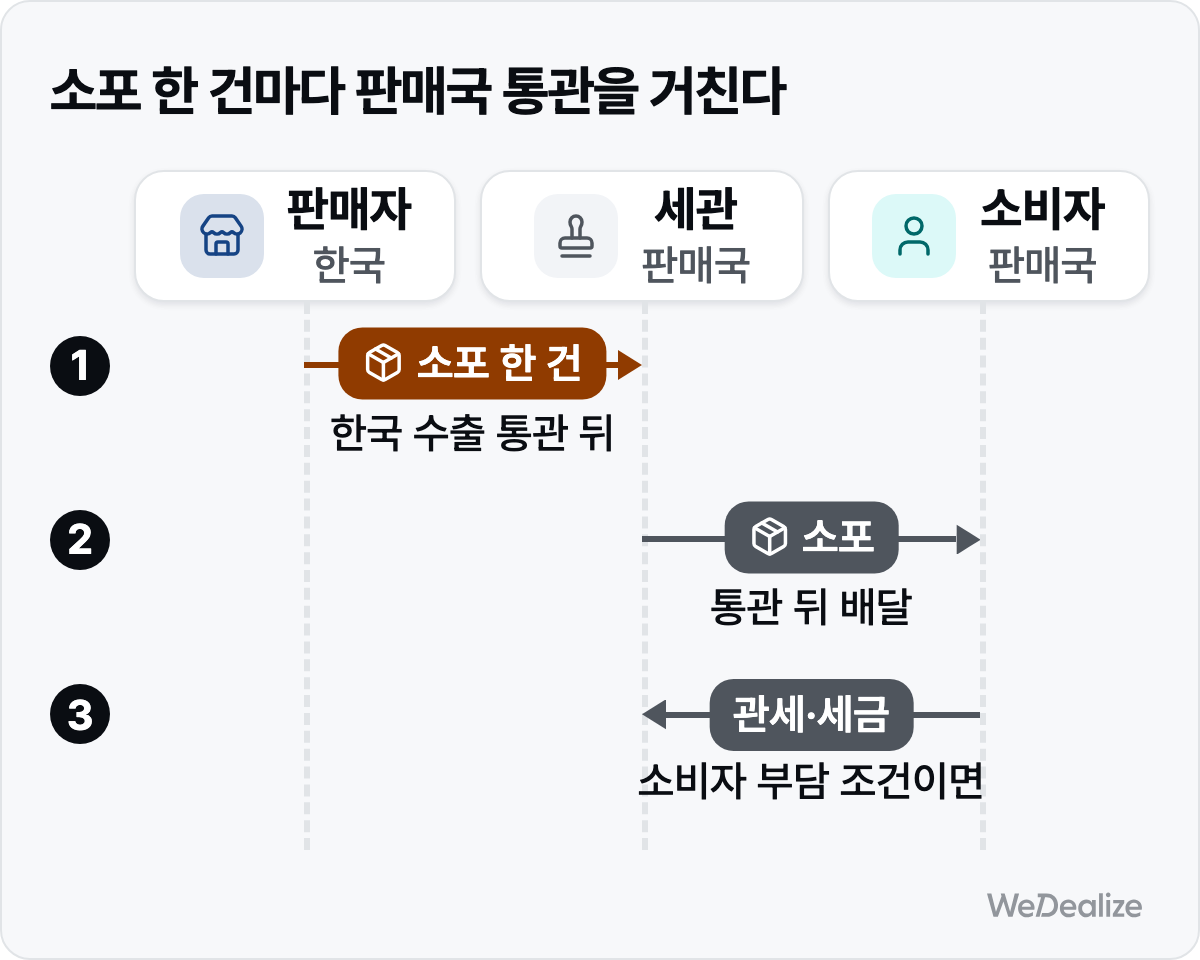
Collect orders from overseas marketplaces and your own online store, then check the destination country, product value, and who bears the taxes → Who pays duties and taxes
Pack each order in one box and attach a commercial invoice (a transaction document stating the product description, quantity, and price) → Customs clearance in the destination country
Complete export customs clearance in Korea → Customs clearance and VAT in Korea
Send the parcel by international express or international post → Customs clearance in the destination country
The parcel is delivered after customs clearance in the destination country, and duties and taxes are paid according to the agreed terms → Who pays duties and taxes
Upload the tracking number to the marketplace and mark the order as shipped → When connected to WeDealize
Customs clearance and VAT in Korea
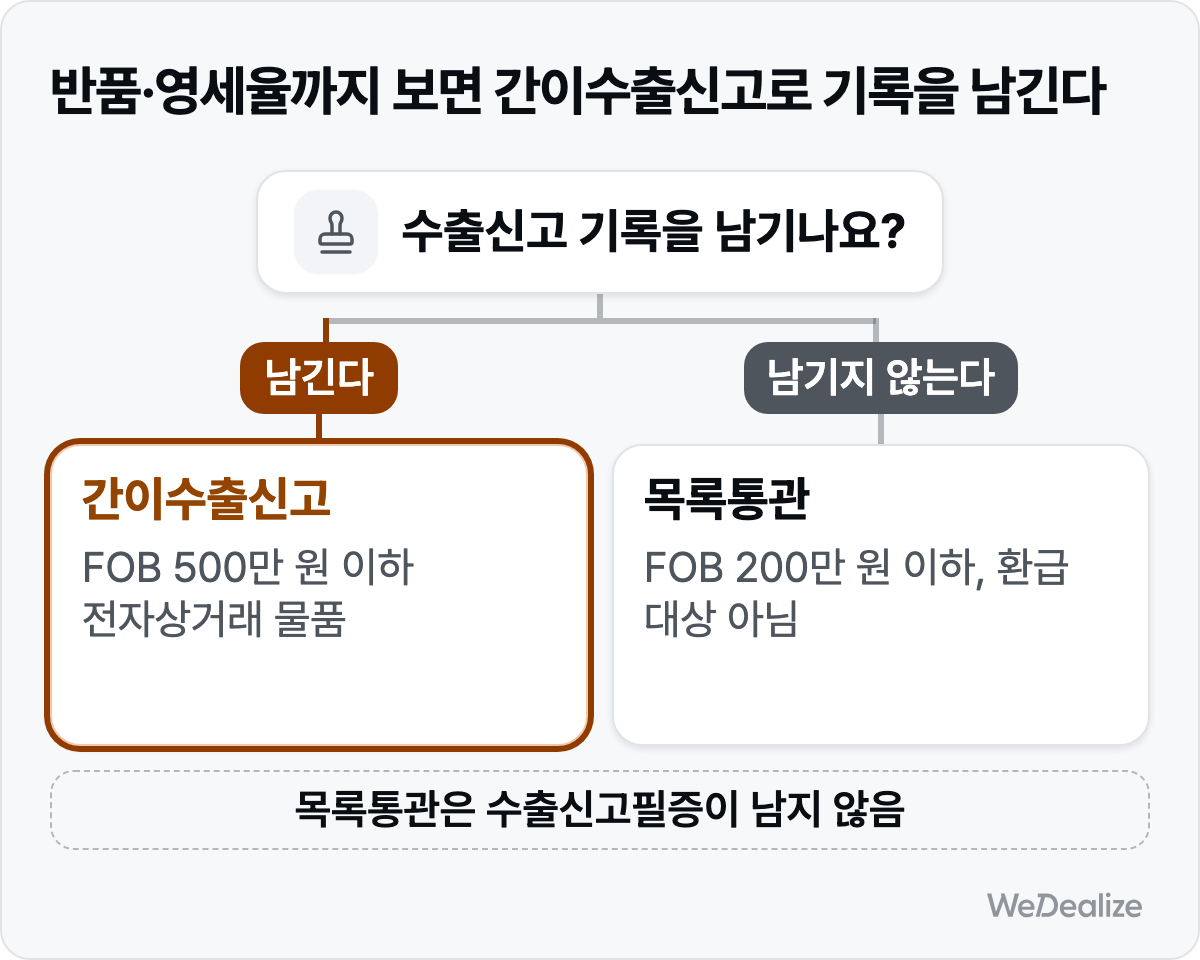
Export declaration — When exporting goods, you must file an export declaration with the head of the customs office, stating the product description, specifications, quantity, price, and other details.
Simplified export declaration — This is a method that reduces the number of declaration items required in a formal export declaration. It applies to goods with an FOB (Free On Board) value of KRW 5 million or less. You can file a simplified export declaration through the simplified e-commerce declaration system or an express carrier’s system for converting export lists into declarations.
Transaction classification — For e-commerce exports, report transaction classification 15 (goods exported through e-commerce) on the export declaration. For fulfillment exports, report 17 (e-commerce fulfillment exports).
List clearance (omission of export declaration) — For goods with an FOB value of KRW 2 million or less that are not eligible for duty refunds, submitting a list may replace an export declaration. Express carriers submit a customs clearance list, while the Korea Post submits a postal item list to customs. Postal items may also have their declarations omitted or simplified under the Customs Act.
Which should you use? — If goods are exported through list clearance, no export declaration certificate remains. Considering export performance records, evidence for the zero VAT rate, and re-import duty exemption when returned goods are imported, it is easier to manage if you keep a record through a simplified export declaration. Decide on the declaration method with the express carrier and customs broker.
Value-added tax zero rate — A 0% VAT rate applies to exported goods. When domestic goods (goods located in Korea) are taken out of the country, they are deemed exports. Confirm with your tax representative which export documents can be used to report the zero rate.
Customs clearance in the destination country
Parcels sent by express or post are cleared individually in the destination country. In Japan, when international express is used, the carrier usually handles the customs clearance procedures. The standard under which a destination country exempts goods below a certain value from duties and taxes is called the de minimis threshold. Some countries have abolished or suspended the threshold.
The official websites of the destination country’s customs and tax authorities are the standard, and guidance from express carriers follows those standards. The table below includes only countries verified through the original text on official customs or government websites (checked on 2026-10-18).
Country | De minimis·taxation threshold | Changes·exceptions |
|---|---|---|
United States | Exemption for shipments of USD 800 or less suspended, regardless of value or origin | Suspended on 2025-08-29; suspended indefinitely for both express and postal shipments from 2026-06-24 |
Japan | Customs duties and import consumption tax exempt when the total customs value is JPY 10,000 or less | Some items excluded; from 2028-04-01, consumption tax applies at the time of sale to mail-order sales of JPY 10,000 or less |
Taiwan | Customs duties and business tax exempt when the customs value is TWD 2,000 or less | Exemption excluded when duty-free clearance exceeds 6 times in six months |
United Kingdom | For goods worth GBP 135 or less, the seller collects VAT at the time of sale | Gifts and excise goods (such as alcohol and tobacco) excluded; above GBP 135, the recipient bears VAT and customs duties |
EU | VAT on imported distance-sale goods worth EUR 150 or less reported and paid through IOSS | Customs duty exemption for goods worth EUR 150 or less abolished on 2026-07-01; until 2028-07-01, a EUR 3 duty per tariff item applies to distance-sale goods worth EUR 150 or less (an item means a tariff classification unit, not the number of pieces) |
Canada | No duties or taxes on goods worth CAD 20 or less received by post | If the value exceeds the threshold, duties, GST/HST, and PST apply to the full amount |
Australia | For goods with a customs value of AUD 1,000 or less, GST may be imposed at the time of sale and collected by the seller | Effective from 2018-07-01 |
Exceptions outside the table — Even countries listed in the table have exceptions depending on the item and shipping route. Check the original source again before shipping.
Items excluded from Japan’s exemption — Leather bags and handbags, knitted apparel, leather footwear, and similar items are excluded from the exemption even when worth JPY 10,000 or less.
Japan’s special provision for personal-use goods — Goods purchased for personal use were exempt up to a sale price of JPY 16,666 under a special rule for calculating the customs value. This provision will disappear at the end of March 2028; thereafter, only the customs value of JPY 10,000 will be used for the determination.
EU — Since 2021-07-01, all imports require an import declaration regardless of value. The EUR 3 duty applies to all distance-sale goods worth EUR 150 or less, regardless of whether the seller is registered for IOSS.
U.S. postal shipments — From 2026-07-24, postal items will undergo new simplified postal clearance. Only the owner or purchaser of the goods, or a licensed customs broker designated by them, may file the declaration, and a basic import bond is required.
Goods excluded from U.S. postal clearance — From 2027-01-20, goods claiming duty-free treatment under an FTA and goods subject to duties under Chapters 98 and 99 of the Harmonized Tariff Schedule of the United States (HTSUS) cannot use the new simplified postal clearance. The same applies to goods subject to requirements of other government agencies. CBP (U.S. Customs and Border Protection) postponed this date from 2026-10-22.
U.S. regulation revision — Under CBP’s interim final rule, customs clearance requirements for foreign importers will change from 2027-01-05. A foreign importer without CTPAT (the Customs Trade Partnership Against Terrorism) certification must designate a CTPAT-certified licensed customs broker to clear goods. Separately, CBP has published a proposed revision changing the declaration requirements for informal entries of USD 2,500 or less. The deadline for submitting comments is 2026-12-07.
Taiwan — If the recipient does not complete real-name authentication (EZ WAY), customs clearance declarations will not be accepted from the second import onward.
Who pays duties and taxes
Terms under which the consumer pays upon receipt — The seller handles transportation, and the consumer pays the destination country’s duties and taxes upon delivery. In international trade terms, this is close to DAP. If the consumer refuses delivery because of unexpected taxes, return shipping costs will arise.
Terms under which the seller pays in advance — Duties and taxes are collected together at checkout and paid to the destination country by the seller (or express carrier). This is close to DDP. Decide in advance with the express carrier under whose name the import declaration will be filed with the destination country’s customs authorities.
Check the United States especially carefully — If the seller becomes the importer in the United States, confirm the foreign importer requirements (under “Customs clearance in the destination country” above) with the express carrier or customs broker.
Cost structure
Amounts vary by express carrier, country, weight, and dimensions. When obtaining a quote, compare the items below.
International shipping charges — See the chargeable weight article for the weight used to calculate shipping charges.
Duties and taxes in the destination country — Calculated using the destination country’s tax rates; under DDP, the seller bears them.
Customs clearance fees — Fees charged by the express carrier or customs broker handling customs clearance in the destination country.
Packaging costs — The cost of packing one box for each order.
Return shipping charges — International shipping charges when an overseas consumer sends the item back (return shipping costs).
Returns
Set the return terms first — International shipping charges to receive the item back in Korea and taxes already paid in the destination country may both arise. State on the product page whether the return will be received in Korea, handled in the destination country, or resolved with a refund only (reverse logistics).
Recovering taxes paid in the destination country — Refund systems vary by country. In Japan, when goods purchased by a consumer through mail order differ from expectations and are returned, a refund of customs duties (戻し税) may be available under the Customs Tariff Act. Procedures must be completed before return shipment, such as bringing the goods into a bonded area (a place where goods are stored before duties are paid) within six months from the date of the import permit.
When re-importing goods into Korea — If goods exported from Korea return unused within two years from the date the export declaration is accepted, consider a re-import duty exemption. In this case, an export declaration certificate or an equivalent document must be submitted to customs. Therefore, consider returns as well when choosing the initial export declaration method.
When connected to WeDealize
When overseas marketplaces are connected through WeDealize marketplace integration, orders can be handled in one place regardless of the sales country or channel. Orders from connected overseas marketplaces are gathered through order collection, and once marketplace products and WeDealize products are linked, the product to be shipped for each order is found automatically. Orders are dispatched from the logistics center in the country designated during setup. If the Korea center is designated, shipments to other countries are sent by air, sea, land express, or freight truck. Once dispatch is complete, the tracking number is registered with the marketplace, and the order is marked as shipped.
Common mistakes
Misconception: “There are no taxes in any country if the amount is small.” — Incorrect. Thresholds vary by country. Some countries, such as the United States, have suspended exemptions, while others, such as the EU, collect VAT from the first amount.
Misconception: “Japan will continue to impose no tax if the value is JPY 10,000 or less.” — Incorrect. From 2028-04-01, consumption tax will also be imposed on mail-order sales of JPY 10,000 or less.
Misconception: “Sending items in several boxes means the exemption will apply.” — Incorrect. Japan aggregates the value of all goods listed on one invoice. In principle, Taiwan does not allow express shipments sent by the same shipper in the same dispatch to the same person to be declared separately. Exceptions apply if the total customs value is within the exemption threshold or, even when it exceeds the threshold, if the importer voluntarily declares and pays the applicable duties and taxes.
Misconception: “Re-import duty exemption is available even without proof of export” — No. Export documentation is required for re-import duty exemption. Since an export declaration certificate is not retained when goods are shipped under simplified customs clearance, products with frequent returns should be documented through a simplified export declaration.
Related terms
Direct international shipping — A shipping method in which each order is sent individually from Korea to an overseas buyer by international express courier or postal service.
Reverse direct purchase — A transaction in which an overseas consumer purchases a domestic seller’s product online and it is shipped overseas.
U.S. Informal Entry — A method of filing an import declaration for shipments valued at $2,500 or less, etc., through a procedure simpler than a formal declaration.
Express cargo customs clearance — A procedure for clearing small shipments brought in by an express carrier registered with customs, through a simplified process based on the value of the goods.
International postal item customs clearance — Customs clearance for goods arriving by mail, such as EMS and international parcels, processed by customs at a designated postal customs office.
EU Import One-Stop Shop (IOSS) — A special scheme under which the seller collects VAT on consignments valued at €150 or less at the time of payment and declares and pays it through a single point.