Japan Sales Guide — Cross-Border Direct Sales
Automatically translated from Korean.
In one line — For parcels sent through cross-border direct sales to Japan, customs duties and consumption tax are exempt if the total customs value for one import declaration is ¥10,000 or less. From April 1, 2028, consumption tax will also be imposed on mail-order sales of ¥10,000 or less, and the overseas seller (or designated platform) will file and pay the tax.
Scope of this article — This article covers cross-border direct sales in which Korean products are sent to Japanese consumers by international express shipment for each order. Covered in other articles — Korean export declarations, simplified export declarations, and zero-rated VAT → International Direct Shipping Guide · Return collection → International Returns Processing Guide · Bringing products into Japan for sale → Japan Sales Guide — Local Sales
What to check first
How are you selling? — This article covers cross-border direct sales sent by international express shipment for each order. If you become the importer of record (IOR) yourself without a Japanese corporation, or bring products into Japan for sale using an IOR service, see Japan Sales Guide — Local Sales. If you sell to a Japanese distributor or importer, that company imports the goods → Export Guide by Product Category
Does it exceed ¥10,000? — The current low-value exemption is based on the total customs value (the value used to calculate tax) for one import declaration. Consumption tax, which will change from April 2028, is based on the price of one item (excluding tax).
Are they electrical appliances, food, or cosmetics? — For electrical appliances, the seller files the PSE notification and affixes the mark. For food and cosmetics, check the standards for personal imports by consumers. First see “Certification and Labeling” below.
Who bears customs duties and consumption tax? — Confirm with a customs broker or express carrier whether the seller or the consumer will be responsible for payment.
Which marketplace are you using? — From April 2028, when payment is received through a platform designated by the National Tax Agency, the platform will file and pay consumption tax.
Steps to take
For electrical appliances, first check the PSE notification and labeling requirements; for food and cosmetics, first check the standards for personal imports → Certification and Labeling
Check whether the total customs value for one import declaration is ¥10,000 or less, and calculate customs duties and consumption tax → Customs Duties and Taxes
Decide whether the seller will pay customs duties and consumption tax in advance or the consumer will pay upon receipt, and confirm the handling method with a customs broker or express carrier → Importer
Display seller information, prices, and return conditions on the product page according to Japanese requirements → Certification and Labeling, Cancellation and Returns
Provide the express carrier with the order information, including the marketplace name → Importer
Prepare a registration and filing plan in line with the consumption tax amendments in April 2028 → Customs Duties and Taxes
Ways to sell in Japan
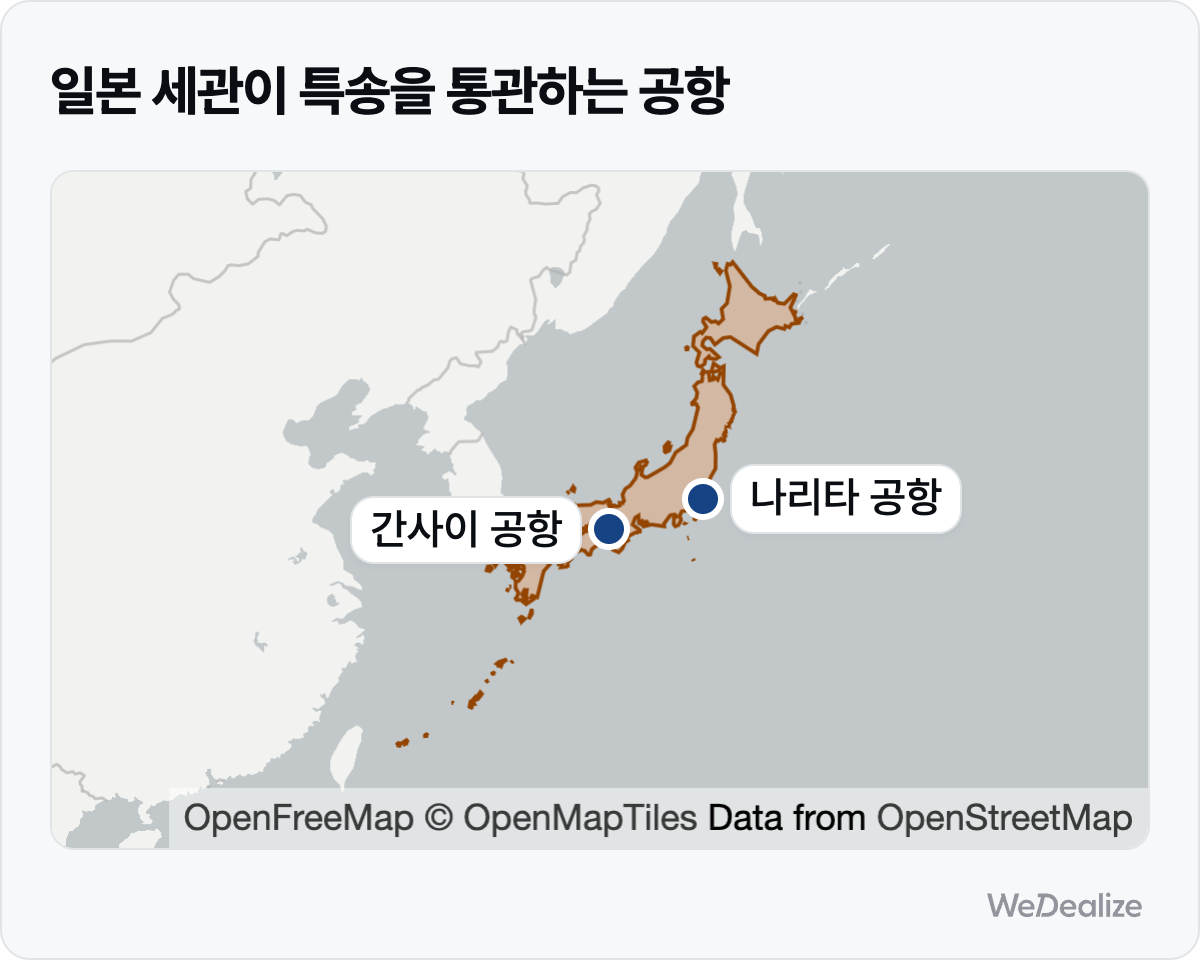
Own online store — Among the overseas marketplaces we cover, Shopify provides guidance on building an independent website on its official Japanese-language page.
Open-marketplace model — An overseas business that sells directly to Japanese consumers through Internet transactions such as marketplaces, without a Japanese importer, becomes the notifying party under the four product safety laws. From April 2028, for transactions in which payment is received through certain platforms designated by the National Tax Agency, the platform will file and pay consumption tax on behalf of the seller under the “platform taxation” system.
Express customs clearance — When international express service is used, the express carrier usually handles the customs clearance procedures.
Customs Duties and Taxes
Current rules
Exemption for ¥10,000 or less — Under the Customs Tariff Act, goods with a total customs value of ¥10,000 or less are exempt from customs duties. Goods exempt from customs duties in this way are also exempt from import consumption tax.
How the ¥10,000 threshold is measured — Customs makes the determination per import declaration. Even if the goods in one invoice shipment are divided into separate declarations, the amounts on that invoice are totaled.
Customs value of goods purchased for personal use — Under the Customs Tariff Act, for goods purchased at retail and imported for personal use, the customs value is generally calculated using the price at the ordinary wholesale stage. Customs determines this value by multiplying the overseas retail price (the amount actually paid) by 0.6, excluding separately stated freight charges. Customs explains that goods purchased by mail order from an overseas shopping site are also calculated this way. For example, if ¥16,000 was paid for the goods, the customs value is ¥9,600, which is ¥10,000 or less.
Goods excluded from the exemption — Goods separately specified by Cabinet Order are not exempt even if they are valued at ¥10,000 or less. Customs gives leather bags and handbags, gloves, knitted clothing (such as T-shirts and sweaters), and leather shoes as examples.
Simplified tariff rates for ¥200,000 or less — In principle, simplified tariff rates apply to imported cargo with a total customs value of ¥200,000 or less. They do not apply if the importer applies to customs not to use them. Travelers’ personal belongings, unaccompanied baggage, and cargo specified by Cabinet Order are also excluded.
Consumption tax rates — Consumption tax is an indirect tax imposed in Japan on almost all sales of goods and services and on imported goods. It is imposed at each transaction stage, with tax paid on purchases credited, and is ultimately borne by the consumer. It has the same structure as Korea’s value-added tax. Under the Consumption Tax Act, the standard rate is 7.8% and the reduced rate is 6.24%. Including local consumption tax, the standard rate is 10% and the reduced rate is 8%. According to guidance from the National Tax Agency, the consumption tax rate on transfers of food and beverages will be reduced for two years, from April 1, 2027, through March 31, 2029.
Changes from April 1, 2028
Under the 2026 (Reiwa 8) amendments to the Consumption Tax Act, goods shipped through mail-order sales from overseas to Japan will be taxable even when the price of one item is ¥10,000 or less (excluding tax). These “transfers of specified low-value assets” will be treated as transactions conducted in Japan and subject to consumption tax.
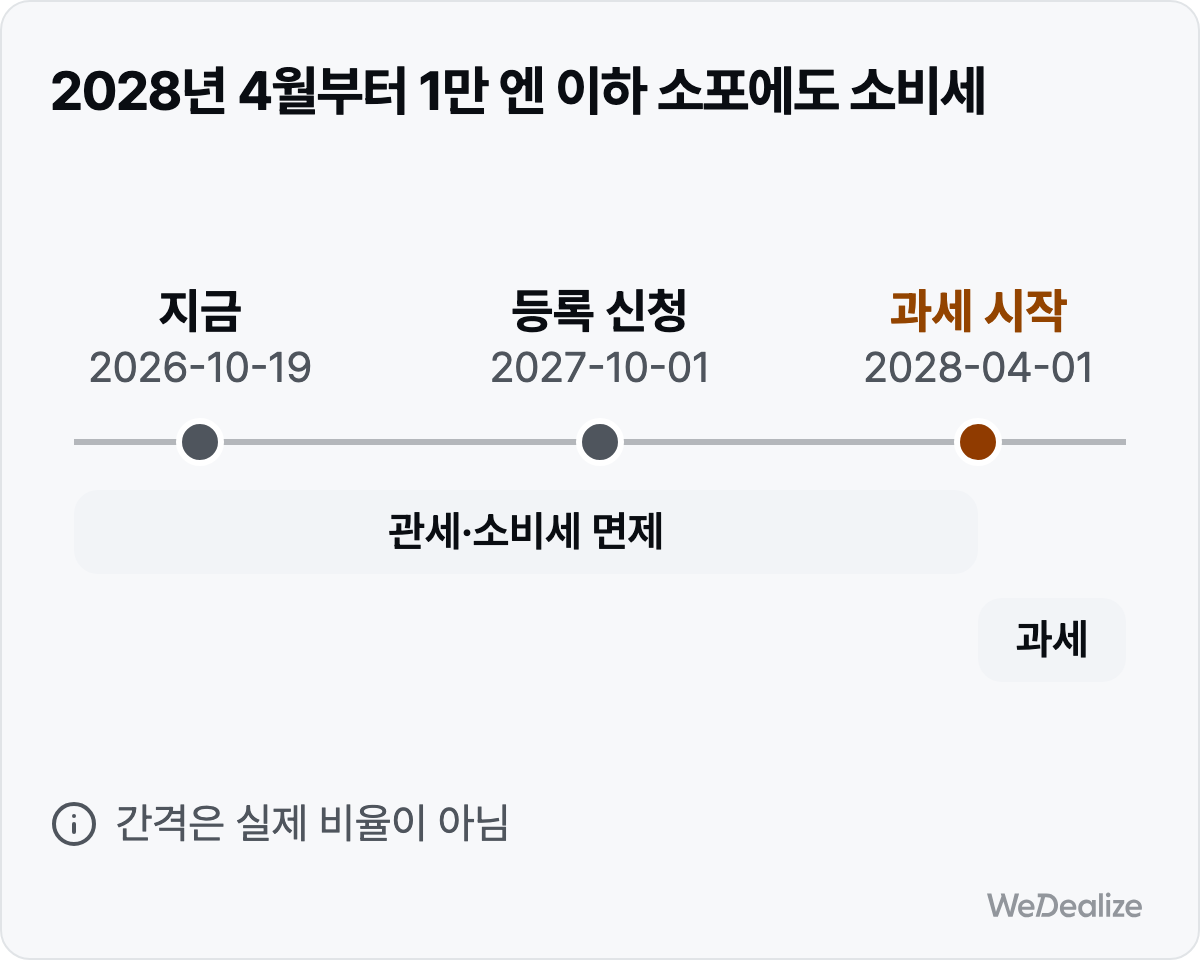
Who files? — Because the transaction is treated as having taken place in Japan, the overseas seller also files and pays consumption tax. Consumption-tax-exempt businesses that are not required to pay consumption tax because of low sales are excluded.
How is the ¥10,000 measured? — The determination is based on the price of one unit at the smallest unit sold. If several ballpoint pens are sold individually, the price of one pen is used; if they are sold as a set, the price of the set is used.
When consumption tax is imposed twice — For the sale, the ¥10,000 threshold is measured using the price of one item; at customs clearance, it is measured using the total customs value for one import declaration. For example, if four items priced at ¥5,000 each are sent in one box, consumption tax applies to the sale because each item is ¥10,000 or less. At customs clearance, the customs value of ¥12,000, calculated as 0.6 of ¥20,000, exceeds ¥10,000, so consumption tax is imposed again. The Ministry of Finance’s explanation states that the same applies when the customs value exceeds ¥10,000 because of exchange-rate fluctuations.
Registration for exemption from import-stage consumption tax — If the seller registers as a “specified low-value asset seller” and enters the registration number and an indication that the goods are transfers of specified low-value assets on the import declaration, import-stage consumption tax is exempt. Consumption tax then remains payable only once, at the time of sale. Registration is optional, and applications will be accepted from October 1, 2027. An overseas business must meet requirements such as notifying a tax agent (a person in Japan who handles tax filings and payments on its behalf).
If you do not register — A seller that is not a tax-exempt business can retain the customs document showing that consumption tax was collected at customs (the import permit document) and deduct that tax on the sale when filing its return.
Platform taxation — When payment is received through a “Class II platform operator” designated by the National Tax Agency, the platform is deemed to have made the sale. The platform therefore files and pays consumption tax. Check the list published by the National Tax Agency to determine whether the marketplace you use is designated.
Importer
Japanese Customs generally refers to a consumer directly purchasing goods from an overseas mail-order company for personal use as a “personal import.” Confirm with a customs broker or express carrier whether the seller or the consumer will bear customs duties and consumption tax.
The import declaration items under the Cabinet Order for the Customs Act include whether the cargo is a mail-order shipment and, if it is, the name of the platform (marketplace) used. Instead of the platform name, the name of the platform operator or seller may also be entered.
Certification and Labeling
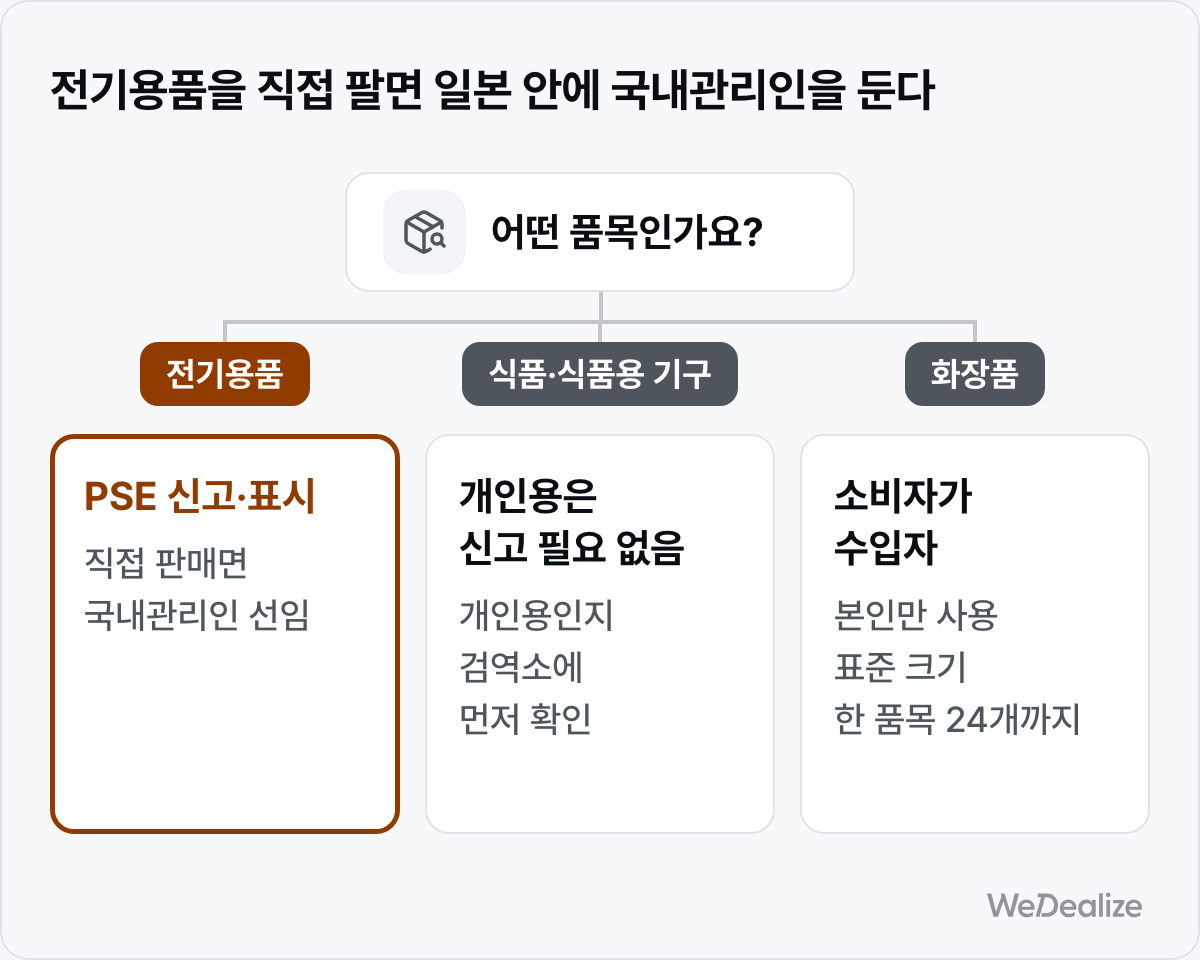
Electrical appliances (PSE) — Handled by the seller who sells directly to consumers
Notification and labeling — Under the Electrical Appliances and Materials Safety Act, a business importing electrical appliances must notify the Minister of Economy, Trade and Industry within 30 days of starting the business. After meeting technical standards and conducting inspections, it affixes the PSE mark. For specified electrical appliances and materials, the business must undergo conformity assessment by a registered body of the Minister of Economy, Trade and Industry and retain the certificate before it can affix the PSE mark. Electrical appliances without the required labeling may not be sold or displayed for the purpose of sale.
Overseas direct sellers — According to guidance from the Ministry of Economy, Trade and Industry, from December 25, 2025, an overseas business that sells directly to Japanese consumers without a Japanese importer also becomes the notifying party under the four product safety laws. Such an overseas business is called a “specified importer.” A specified importer must appoint a domestic manager (国内管理人) responsible in Japan and enter the domestic manager’s name and address when making the notification. The specified importer provides the domestic manager with copies of inspection records for electrical appliances. In cross-border direct sales, the consumer is the importer for customs purposes, but under the Electrical Appliances and Materials Safety Act, the overseas business that sells directly to the consumer is the importing business.
Food and food-contact utensils — Cross-border direct sales are personal imports
Japanese Customs calls goods that a consumer directly purchases from overseas for personal use “personal imports” (→ Importer). Quarantine stations explain that food brought in for personal use does not require an import notification.
First confirm with a quarantine station whether the food being shipped qualifies as personal-use food and whether it can be sent by express service. For notifications required when food is imported into Japan for sale, see Japan Sales Guide — Local Sales.
Cosmetics — Cross-border direct sales are personal imports
A notice from the Ministry of Health, Labour and Welfare treats the consumer as the importer when an overseas seller sends products directly to the consumer. Cosmetics imported for personal use may be used only by the importer and may not be sold or given to another person.
Customs explains that up to 24 units of one standard-size product are cleared without separate confirmation. For detailed quantity standards and the marketing authorization holder’s license required when cosmetics are brought into Japan for sale, see Japan Cosmetics Export Guide · Japan Sales Guide — Local Sales.
Mail-order disclosures — Handled by the seller
When selling online to Japanese consumers, display the sale price and shipping charges, payment timing and method, delivery timing, return conditions, and other information on the product page (Specified Commercial Transactions Act).
The business name, address, and telephone number must also be displayed. If a corporation advertises online, it must also state the name of its representative or the person responsible for mail-order operations. If a foreign corporation has an office in Japan, it must also state the office location and telephone number.
If the consumer must pay any amount in addition to the sale price, display the details and amount. Check whether customs duties and consumption tax paid by the consumer at import fall under this requirement.
Cancellation and Returns
Display return conditions first — Under the Specified Commercial Transactions Act, for mail-order sales, consumers may cancel their application (cancel the order) or rescind the contract until eight days have passed from the day they receive the goods. If they return the goods without a special agreement, the consumer bears the return shipping cost. If the seller displayed return terms in its advertising in advance (whether returns are accepted, the period and other conditions, who bears return costs, etc.), those terms apply. Online sales must also display the return conditions on the final order confirmation screen.
When the consumer sends the goods back to Korea — If goods imported personally through mail order with customs duties paid differ from expectations and are returned without changing their nature or form at the time of import, the refund (戻し税) system under the Customs Tariff Act may be used. Customs duties can be refunded if the goods are brought into a bonded area (a storage location managed by customs) within six months of the import permit date (or, if unavoidable, within a maximum of one year with the approval of the head of customs). Only goods on which customs duties were paid are eligible, so goods exempt because they were valued at ¥10,000 or less have no customs duties to refund.
For goods returned to Korea, consider the re-import duty exemption.
When connected through WeDealize
WeDealize supports integration with 큐텐 재팬(Qoo10 Japan), a leading Japanese marketplace. We are also expanding direct integration with other sales channels.
The process for shipping orders from integrated overseas marketplaces by express service from the Korea center to Japan is summarized in the International Direct Shipping Guide.
Shipping and Customs Tips
Include the marketplace name — Japanese import declaration items include whether the shipment is a mail-order shipment and the name of the platform (marketplace), among other information. When providing order information to the express carrier, include the marketplace name as well.
If you are registered, provide the registration number as well — Starting in April 2028, for goods sold by sellers registered as specified small-value asset sellers, consumption tax will be exempt at import only if the registration number and an indication meaning “transfer of specified small-value assets” are entered on the import declaration. Provide the registration number to the express carrier as well.
Common mistakes
Misconception: “There will be no tax as long as the amount is ¥10,000 or less.” — Incorrect. From April 1, 2028, mail-order sales of ¥10,000 or less will also be subject to consumption tax, which the seller (or designated platform) will report and pay.
Misconception: “If I sell through a marketplace, the marketplace handles PSE and food notifications.” — Incorrect. The marketplace does not handle these procedures on your behalf. The overseas business that sells electrical products (PSE) directly to consumers is responsible for the PSE notification and labeling. For food and cosmetics sold through cross-border e-commerce, the consumer is making a personal import for their own use.
Misconception: “If I file separate declarations for multiple boxes, I can apply the ¥10,000 tax exemption to each one.” — Incorrect. Even if a shipment covered by a single invoice is declared separately, the total invoice value is used for the determination.
Related terms
Importer of Record (IOR) — The party declared as the importer to the customs authorities in the country of sale and responsible for paying duties and taxes and assuming legal responsibility.
Customs broker — A nationally licensed professional who handles import and export declarations and tax calculations on behalf of the cargo owner.
Export declaration — The procedure for declaring to customs the description, quantity, price, and other details of goods to be exported overseas.
Simplified export declaration (e-commerce) — A simplified declaration with fewer required items than a formal export declaration, primarily used for low-value e-commerce exports.
Zero-rated tax — A system under which a 0% value-added tax rate is applied to exported goods, while the value-added tax paid on purchases is refunded.