UK Sales Guide — Local Sales
Automatically translated from Korean.
In brief — For local sales in the UK, our company, which is not established in the UK, either imports through an indirect representative or imports under the name of a UK company acting as the importer. As a rule, the owner of the goods claims the import VAT as input tax, and if taxable sales are made in the UK, the seller must register for VAT regardless of the amount.
Scope of this article — This article covers importing into Great Britain (England, Scotland, and Wales) and selling under our company’s name without a UK entity, and importing and selling under the name of a UK company acting as the importer. Northern Ireland is not covered because its procedures differ. See other articles — Sending each order by express courier or post → UK Sales Guide — Cross-Border Direct Sales · Korean export declarations when shipping inventory → Export Declaration · VAT on exported goods → Zero-Rating · Cosmetics responsible person and notification → UK Cosmetics Export Guide
What to check first
Is this the right article? — If you ship from Korea for each order, see UK Sales Guide — Cross-Border Direct Sales. If you keep inventory in the UK and dispatch it from the UK, someone must act as the importer, so this is the right article. If you sell to a UK distributor or importer, that company imports the goods → Export Guide by Product Category
What do you have in the UK? — If a UK subsidiary purchases and imports the goods, see Export Guide by Product Category. If you have a place of business, such as an office or branch, see the Companies House registration section under “Importing and selling under our company’s name” and the corporation tax section under “Selling in the UK.” If you have nothing in the UK, read this entire article.
How will you import? — Responsibility for customs duties and eligibility to claim import VAT as input tax differ depending on whether you import under our company’s name or under the name of a UK company acting as the importer. See “Ways to sell in the UK” below.
Will you sell through a marketplace or your own website? — The party responsible for reporting sales VAT differs depending on whether you sell UK inventory through a marketplace. See “When selling in the UK” below.
Will you sell electrical and electronic equipment or batteries, or use substantial amounts of packaging? — Check whether you are subject to producer obligations for electrical and electronic equipment, batteries, or packaging. See the product obligations under “When selling in the UK” below.
Order of tasks
Decide whether to import under our company’s name or under the name of an importer → Ways to sell in the UK
If importing under our company’s name, appoint an indirect representative in writing and check whether registration with Companies House is required → Importing and selling under our company’s name
If using another party’s importer name, confirm who can claim the import VAT and which costs will be shared with that company → Importing and selling under the name of an importer
Register for VAT. If you want to use postponed accounting, register before importing → When selling in the UK, When importing
Check product safety and labelling, as well as producer obligations for electrical and electronic equipment, batteries, and packaging → When selling in the UK
Determine the customs value, origin declaration, and payment method, then make the import declaration → When importing
Continue with VAT returns and payments, document retention, and renewal of producer registrations → Ongoing compliance after registration
Ways to sell in the UK
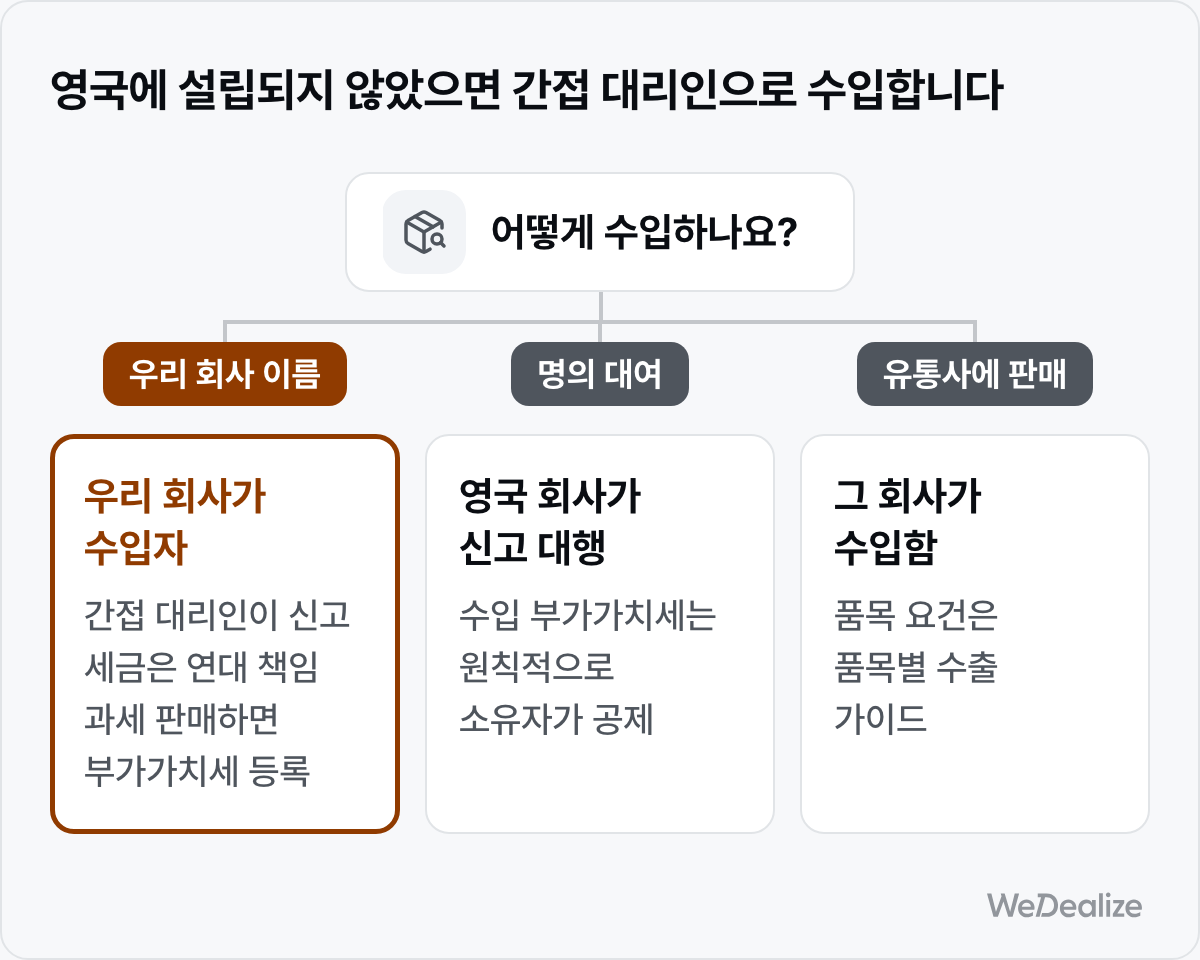
Who does what — The “using another party’s name” column is based on a UK company making the import declaration in its own name on behalf of our company, while our company owns and sells the goods. The explanations are in the sections in the right-hand column.
Task | Under our company’s name | Using another party’s name | Details |
|---|---|---|---|
Import declaration | Customs representative | That company | Under our company’s name · Using another party’s name |
Responsibility for paying customs duty and import VAT | Our company · Customs representative | That company · Our company | Under our company’s name · Using another party’s name |
Claiming import VAT as input tax | Our company | Owner | When importing · Using another party’s name |
VAT registration | Our company | Our company | When selling in the UK › Sales tax |
Importing under our company’s name — Without a UK entity, our company acts as the importer, imports the goods into Great Britain, and then sells them from a UK warehouse or elsewhere. See “Importing and selling under our company’s name.”
Using another party as the importer — A UK company handles the import declaration and imports the goods, while our company or that company sells them in the UK. See “Importing and selling under the name of an importer.”
Choosing a representative — Because a representative handling customs matters must be established in the UK, choose one from among UK freight forwarders, customs agents, and express carriers.
Importing and selling under our company’s name
This applies when our company acts as the importer, imports the goods without a UK entity, and then sells them from a UK warehouse or elsewhere.
Who makes the declaration? — Under UK customs law, customs representatives are divided into direct representatives, who make declarations in the name of the principal, and indirect representatives, who make declarations in their own name. A declaration made by a direct representative is treated as having been made by the principal.
Customs liability — Under the same law, the person named on the declaration is liable to pay the customs duty, and the principal who instructed the representative is also liable. If two or more people are liable, they are jointly and severally liable.
EORI number — To obtain a UK EORI number, a business generally needs to have a registered office, headquarters, or fixed establishment in the UK. If it cannot obtain one directly, it appoints someone to handle customs matters, and that person obtains their own EORI number. Goods can still be moved using an indirect representative even without an EORI number.
Only indirect representation is possible — When a company not established in the UK imports into Great Britain, it can appoint a representative only as an indirect representative. An indirect representative makes the declaration in its own name and is jointly and severally liable with our company for the accuracy of the declaration and for customs duty and import VAT.
Written instructions and duty of care — Set the terms of representation in writing and state in the written instructions whether the representation is direct or indirect. Even when a representative is appointed, our company retains its duty of care regarding the contents of the declaration.
To use postponed accounting — If registered for VAT, tell the representative to select postponed accounting on the import declaration and enter our company as the consignee, meaning the party receiving the goods. See “When importing” below for the conditions for postponed accounting.
Companies House registration — Carrying on business in the UK does not automatically require registration. If you carry on business from a physical base in the UK, such as a place of business or branch, register that UK establishment with Companies House within one month of opening it. Submit form OS IN01 and a copy of the constitutional documents, among other documents. The fee is £124. An independent representative working on behalf of the company is not a UK establishment.
Sales tax registration — The party making the sales registers. See the sales tax section under “When selling in the UK” below.
Importing and selling under the name of an importer
This applies when a UK company handles the import declaration and imports the goods, while our company or that company sells them in the UK.
How using another party’s name works — If a UK company makes an import declaration in its own name on behalf of our company, it is an indirect representative under UK customs law. In this case, that company and our company are jointly and severally liable for the customs duty. See “Importing and selling under our company’s name” above for the liability rules.
Claiming import VAT as input tax — owner only — According to HMRC internal guidance, only the owner of the goods can claim import VAT as input tax. A company that declares itself as the importer and pays the tax on behalf of an overseas owner has no statutory basis for claiming it. “The representative acting as principal” below is an exception.
Importer field on the declaration — Under the same guidance, the party eligible to claim the VAT must be the owner whose EORI number is entered in the importer field of the import declaration. If our company is to claim the VAT as the owner, agree in advance with that company on whose name will appear as the importer on the declaration.
The representative acting as principal — According to HMRC guidance, an overseas business that is not registered for UK VAT can appoint a UK representative to handle imports and sales. If the representative acts as principal under VAT law, it can claim import VAT as input tax.
Sales reporting when acting as principal — Under VAT law, a representative that sells in its own name for a business that is not a taxable person is treated as having imported and sold the goods itself. According to HMRC internal guidance, the representative also reports the VAT on the sale in this case.
VAT on the representative’s fee — Services supplied by the representative to our company are subject to VAT at the standard rate, and our company cannot claim that VAT as input tax.
Resale arrangement — If the UK company purchases the goods from our company before importation, the UK owner claims the import VAT as input tax. This is a buyer sale; see Export Guide by Product Category.
Matters to agree with that company — Set out in the contract who bears the burden if customs duty is assessed retroactively, recall costs, provision of copies of import documents and import VAT evidence, and the transfer of remaining inventory when the contract ends.
Importer for product regulations — When using another party’s name, see the product obligations under “When selling in the UK” below to determine whether that UK company assumes the importer obligations under product regulations.
Sales tax registration — Even when using another party’s name, the party selling to consumers registers. See the sales tax section under “When selling in the UK” below.
When importing
Customs value — According to HMRC guidance, a sale is a transaction between two separate legal entities, and if there is no sale, the transaction value method (Method 1) cannot be used. In that case, use the transaction value of identical goods (Method 2) and the subsequent methods in order. See Customs Value.
Freight and insurance — The customs value includes transport costs and insurance up to the point where the goods arrive at the UK border. For air freight, this means up to the point where the goods first cross the UK border.
Declaration deadline — According to HMRC guidance, goods declared for temporary storage must be entered to free circulation within 90 days of the date they are presented to customs. If the goods arrive at a location without a temporary storage facility, the deadline set by the operator of that location applies.
Customs duty — Duty rates vary by product. If Korean-origin goods meet the rules of origin under the UK–Korea FTA, you can claim the preferential tariff rate. In that case, the goods must be accompanied by an origin declaration.
Origin declaration — The origin declaration is made by an approved exporter. For a consignment with a total value of originating products of no more than EUR 6,000, any exporter may make the declaration.
Improved agreement — The two countries have concluded an improved agreement, and the UK government has stated that it plans to bring it into force after ratification. Until then, UK government guidance is based on the current agreement.
Import VAT — Imported goods are subject to VAT at the same rate that applies when they are supplied within the UK. The standard rate set by the Value Added Tax Act 1994 is 20%.
Taxable amount — The taxable amount for import VAT is the customs value plus incidental expenses and customs duty. Incidental expenses include fees, packaging, freight, and insurance up to the first place of arrival in the UK.
Duty deferment — According to HMRC guidance, if you have a duty deferment account, customs duty and import VAT are paid by direct debit once a month rather than for each consignment. Although a company not established in the UK can apply for an account for Great Britain, it cannot obtain a guarantee waiver.
Postponed VAT accounting — A business registered for UK VAT does not have to pay import VAT at the time of customs clearance. It reports the VAT on its VAT return and claims it as input tax on the same return. The goods must be used in the business and the business must have the right to dispose of them, usually as the owner; the VAT registration number must be entered on the import declaration.
Input tax recovery — If import VAT was paid at customs clearance, it can be claimed as input tax on imported goods that you own, subject to the applicable rules.
Evidence for input tax recovery — According to HMRC guidance, evidence of the import VAT is required to claim it. Transport and forwarding agents generally cannot claim this VAT as input tax.
Obtaining evidence — If you paid through a postponed VAT accounting account, obtain the C79 import VAT certificate; if you used duty deferment, obtain the duty deferment statement.
Goods purchased before registration — According to HMRC guidance, VAT on goods purchased before VAT registration can be reclaimed for goods purchased within the previous four years, provided you still have the goods.
Goods imported before registration — Under the VAT rules, import VAT paid on goods imported for business purposes before registration may also be reclaimed with HMRC approval. The goods must have been imported within the four years before the registration date and must not have been sold or used before registration. Claim it on your first VAT return.
Plastic Packaging Tax — Importing plastic packaging containing goods is also subject to Plastic Packaging Tax. Register if you imported at least 10 tonnes of finished plastic packaging in the previous 12 months, or expect to import at least 10 tonnes within the next 30 days. Register within 30 days of meeting the threshold, and businesses not established in the UK apply using an online form. If the packaging contains less than 30% recycled plastic, pay £228.82 per tonne from 1 April 2026. The liable person is usually the consignee shown on the import documents.
Prohibited and restricted goods — For goods prohibited or restricted at customs, see “Certifications and labelling” in UK Sales Guide — Cross-Border Direct-to-Consumer Sales.
When selling in the UK
Sales tax — VAT
VAT registration — The registration threshold does not apply to a non-established taxable person (NETP) with no place of business in the UK. You must register if you make, or expect to make within 30 days, taxable sales in the UK, and notify HMRC (His Majesty’s Revenue and Customs) within 30 days.
Meaning of a UK establishment — You have a UK establishment if key management decisions and central administration take place in the UK, or if you have a fixed establishment in the UK with the staff or facilities needed to make or receive taxable supplies. A registered office, serviced office or virtual office alone does not constitute an establishment.
Selling through your own website — An overseas seller that owns goods located in the UK at the time of sale must register regardless of the value and account for VAT on sales to customers.
Same registration as cross-border direct-to-consumer sales — This is the same UK VAT registration used when selling goods shipped from Korea to the UK in consignments valued at £135 or less. If you are already registered, you do not register again. See “Ways to sell in the UK” in UK Sales Guide — Cross-Border Direct-to-Consumer Sales.
When selling through a marketplace
Selling through a marketplace — If a seller not established in the UK sells UK stock through a marketplace, the marketplace accounts for VAT on those sales. The seller is treated as making a zero-rated supply to the marketplace. If a business customer provides a UK VAT registration number, the seller accounts for VAT on that sale.
Registration exemption when selling only through a marketplace — If you sell only to non-business customers through a marketplace, you may apply for an exemption from registration. However, to reclaim import VAT, register instead of applying for the exemption. Even after receiving the exemption, you must register if you make taxable sales outside the marketplace.
Product obligations
Whether you import in your company’s name or use another party’s name, check the obligations below when selling UK stock to UK consumers.
Product safety and labelling — Under the General Product Safety Regulations, producers’ safety obligations, producer labelling, UKCA and CE marking, and hazard notifications are the same even if stock is held in the UK. See “Certifications and labelling” in UK Sales Guide — Cross-Border Direct-to-Consumer Sales.
Importer under product regulations — According to UK government guidance, an importer is an individual or company established in the UK that supplies products from outside the UK. The importer must display its name and address on the product and check that the manufacturer has completed the conformity assessment procedures and prepared the technical documentation and markings. If you use another company’s name, confirm before contracting whether that UK company will assume these obligations.
Product liability — Under the Consumer Protection Act 1987, if damage is caused by a defective product, liability lies with the producer and the person who imported it into the UK in the course of a business for supply. If two or more people are liable, they are jointly and severally liable.
Producer responsibility for packaging — Importing packaged goods is also a packaging-producer activity. Even if its head office is outside the UK, a business is treated as established in the UK if it has a postal address in the UK, such as a branch, warehouse or returns address. It must also exceed 25 tonnes of packaging and have worldwide turnover of at least £1 million to be subject to the obligations.
Electrical and electronic equipment producer — If you commercially import electrical and electronic equipment into the UK, you are a producer and must register annually. If you sell to a UK importer or distributor, that UK company registers as the producer. If you supply less than 5 tonnes per year, you may register directly as a small producer; if you supply 5 tonnes or more, join a producer compliance scheme (PCS). A PCS is an approved organisation that assumes the producer’s obligations for waste collection and treatment costs. For obligations and labelling and record-keeping requirements for representatives and PCS arrangements of sellers outside the UK, see “Certifications and labelling” in UK Sales Guide — Cross-Border Direct-to-Consumer Sales.
Batteries — For the definition of a battery producer and the registration thresholds, see “Certifications and labelling” in UK Sales Guide — Cross-Border Direct-to-Consumer Sales.
Corporation tax (permanent establishment)
Treaty standard — Under the UK–Korea tax treaty, the UK may tax our company only when it carries on business in the UK through a permanent establishment, and only on profits attributable to that permanent establishment. A permanent establishment is a fixed place of business and includes a branch or office.
Keeping stock only — Using facilities or maintaining stock solely for the purpose of storing or displaying our company’s goods is not included in a permanent establishment. Delivery is not listed among these exceptions.
Agent — If a person other than an independent agent habitually exercises authority to conclude contracts on behalf of our company, it is treated as having a permanent establishment. The same applies where the person maintains stock and regularly delivers goods on behalf of our company.
Independent agent — The activities of an independent agent, such as a broker or general commission agent, carried out in the ordinary course of business do not by themselves constitute a permanent establishment.
Information for consumers and cancellation and returns
Information displayed on the sales page — The requirements for displaying seller information, the total price including tax, and additional charges are the same even if stock is held in the UK. See “Cancellation and returns” in UK Sales Guide — Cross-Border Direct-to-Consumer Sales.
14-day cancellation — Under the Consumer Contracts Regulations 2013, a consumer buying remotely may cancel the contract without giving a reason. The same applies when selling from UK stock. For the period, exceptions and refund deadline, see “Cancellation and returns” in UK Sales Guide — Cross-Border Direct-to-Consumer Sales.
Satisfactory quality — Under the Consumer Rights Act 2015, a contract for the supply of goods is treated as including a term that the goods must be of satisfactory quality. Quality includes safety, durability and freedom from minor defects, among other things.
30-day right to reject — If goods do not conform to the contract because they fail to meet the quality requirements or other conditions, the consumer may exercise the short-term right to reject. The period is 30 days from the day after both ownership and delivery have taken place. For goods requiring installation, the period starts after the seller notifies the consumer that installation is complete. For perishable goods, the period is shorter.
Ongoing obligations after registration
VAT returns — According to HMRC guidance, you generally submit a VAT return every three months, even if there is no tax to pay. The deadline is usually one month and seven days after the end of the accounting period, and the payment deadline is the same.
If you are late — For accounting periods beginning on or after 1 January 2023, penalty points accrue each time a return is submitted late. Once the penalty threshold is reached, a £200 penalty is charged. If payment is late, penalties and late-payment interest are charged separately.
VAT records — According to HMRC guidance, keep VAT records for at least six years.
Customs declaration records — According to HMRC guidance, keep records of goods declared to customs for four years.
Cancellation of registration — If you are no longer eligible for registration, such as because you stop making taxable sales, cancel your registration within 30 days. A penalty may apply if you are late. If an overseas business continues making supplies in the UK, it cannot apply for cancellation even if its turnover falls below £88,000. Cancelling VAT registration also cancels the EORI number.
Financial statements filed with Companies House — If an overseas company registered with Companies House is required under the law of its home country to prepare, audit and publish financial statements, file them with Companies House within three months of the date on which they must be published. Submit form OS AA01 at the same time.
Small producer of electrical and electronic equipment — According to Environment Agency guidance, a small producer must register by 31 January each year and report the quantity supplied in each category during the previous year. When supplying for the first time, register within 28 days.
Connect through WeDealize
Sales in which express shipments are dispatched from a Korean centre to the UK for each order are set out in UK Sales Guide — Cross-Border Direct-to-Consumer Sales and International Direct Shipping Guide.
Shipping and customs tips
Post imports cannot use postponed accounting — If you receive a consignment worth more than £135 by post through Royal Mail or Parcelforce, you cannot account for import VAT on a VAT return. Import stock by express courier or freight.
Common mistakes
Misconception: “We can make customs declarations directly using our company’s EORI number even without a UK company” — Generally, no. A company not established in the UK usually cannot obtain an EORI number directly and imports through an indirect representative.
Misconception: “If sales are small, we do not need to register for VAT” — No. The registration threshold does not apply to a business with no establishment in the UK. See the sales tax section under “When selling in the UK” above.
Misconception: “If we sell through a marketplace, the marketplace also pays the tax due on import” — No. The marketplace handles VAT on the sale, while the seller pays the customs duty and import VAT on the initial import.
Misconception: “The company lending us its importer name will reclaim the import VAT for us” — No. In principle, import VAT is reclaimed by the owner of the goods. See “Importing and selling using a borrowed importer name” above.
Misconception: “Keeping stock in a UK warehouse immediately makes us liable for UK corporation tax” — Not necessarily. Under the UK–Korea tax treaty, maintaining stock solely for storage or display is not included in a permanent establishment. See the corporation tax section under “When selling in the UK” above.
Items not confirmed
Our company’s EORI number — Confirm with HMRC whether our company, which is not established in the UK, can obtain an EORI number to enter in the importer field of the customs declaration.
FTA origin verification — After claiming UK–Korea FTA preferential treatment, confirm with HMRC what evidence the importer must submit and what responsibilities the importer has if an origin verification takes place.
Warehouse stock and Companies House registration — Confirm with Companies House or a local professional whether holding stock only in a UK logistics warehouse and selling it constitutes a UK establishment that must be registered.
Permanent establishment when delivering from a warehouse — Confirm with HMRC or a tax adviser whether a UK logistics warehouse constitutes a permanent establishment when it stores stock and delivers goods for each order.
Plastic Packaging Tax when using another party’s name — Confirm with HMRC who must pay Plastic Packaging Tax when importing under another party’s name.
Packaging producer obligations when using another party’s name — Confirm with the Environment Agency who must register as the packaging producer when an agent imports the goods.
Related terms
IOR (Importer of Record) — The party that imports goods into the destination country and bears primary responsibility for paying customs duties.
Customs broker — A customs professional who handles import and export declarations and calculates customs duty amounts on behalf of a consignor or other client.
Approved exporter — An exporter certified as capable of proving origin who may self-certify the origin, within the scope permitted by the relevant agreement.
Fulfilment — An industry term for a seller outsourcing logistics operations such as product storage and order processing to a fulfilment centre.
HS code — A commodity code classifying goods by type and serving as the basis for finding the applicable customs duty rate.