Hong Kong Sales Guide — Local Sales
Automatically translated from Korean.
In brief — If you import and sell goods in Hong Kong, there are no customs duties or value-added tax, but the importer must file an import declaration within 14 days, and anyone carrying on business in Hong Kong must register the business. Profits arising in Hong Kong from carrying on business there are subject to profits tax, and the basic corporate tax rate is 16.5%.
Scope of this guide — When importing and selling under our company name without a Hong Kong entity, and when importing and selling under the name of a Hong Kong company as the importer In other guides — Sending each order by express courier or post, and goods requiring an import licence or permit → Hong Kong Sales Guide — Cross-Border Direct Sales · Korean-side declarations when shipping out inventory → Export Declaration · VAT on exported goods → Zero-Rating
Check first
Is this the right guide? — If you send each order from Korea, see Hong Kong Sales Guide — Cross-Border Direct Sales. If you keep inventory in Hong Kong and dispatch it from Hong Kong, someone must file the import declaration, so this is the applicable guide. If you sell to a Hong Kong distributor or importer, that company imports the goods → Export Guide by Product
What do you have in Hong Kong? — If you have a Hong Kong entity (subsidiary), sell to that entity and let it import the goods, so see Export Guide by Product. If you have a place of business such as a branch or office, it must be registered with the Companies Registry. See the corporate tax sections below, “Importing and selling under our company name” and “Selling in Hong Kong.” If you have nothing in Hong Kong, read this entire guide.
Are you entrusting sales to a Hong Kong company? — This guide applies even if a Hong Kong company sells our company’s goods on our behalf. See “Importing and selling under the importer’s name” below.
Are these excise goods or licensed goods? — Excise goods such as alcoholic beverages over 30% alcohol by volume and tobacco, as well as pharmaceuticals, wireless transmitting apparatus, rice and other goods, require a licence or permit for import. See “Importing and selling under our company name” and “When importing” below.
Are these food, toys, or electrical products? — When supplying them in Hong Kong, obtain food importer registration, comply with toy safety standards, and obtain certificates of safety compliance for electrical products. See “Importing and selling under our company name” and “Selling in Hong Kong” below.
Order of tasks
Decide whether to import under our company name or use another importer’s name → How to sell in Hong Kong
Check whether you are carrying on business in Hong Kong and complete business registration and company registration → Importing and selling under our company name
Obtain, before importing, an excise-goods licence, food importer registration, and product-specific import permits → Importing and selling under our company name; When importing
Decide who will submit the import declaration within 14 days from the date of import → When importing
Meet the requirements for electrical products, toys, and packaged food, and state the return and refund terms on the product page → Selling in Hong Kong; Information to provide to consumers and withdrawal and returns
Continue filing and paying profits tax, renewing business registration, filing annual returns, and retaining books and records → Ongoing compliance after registration
How to sell in Hong Kong
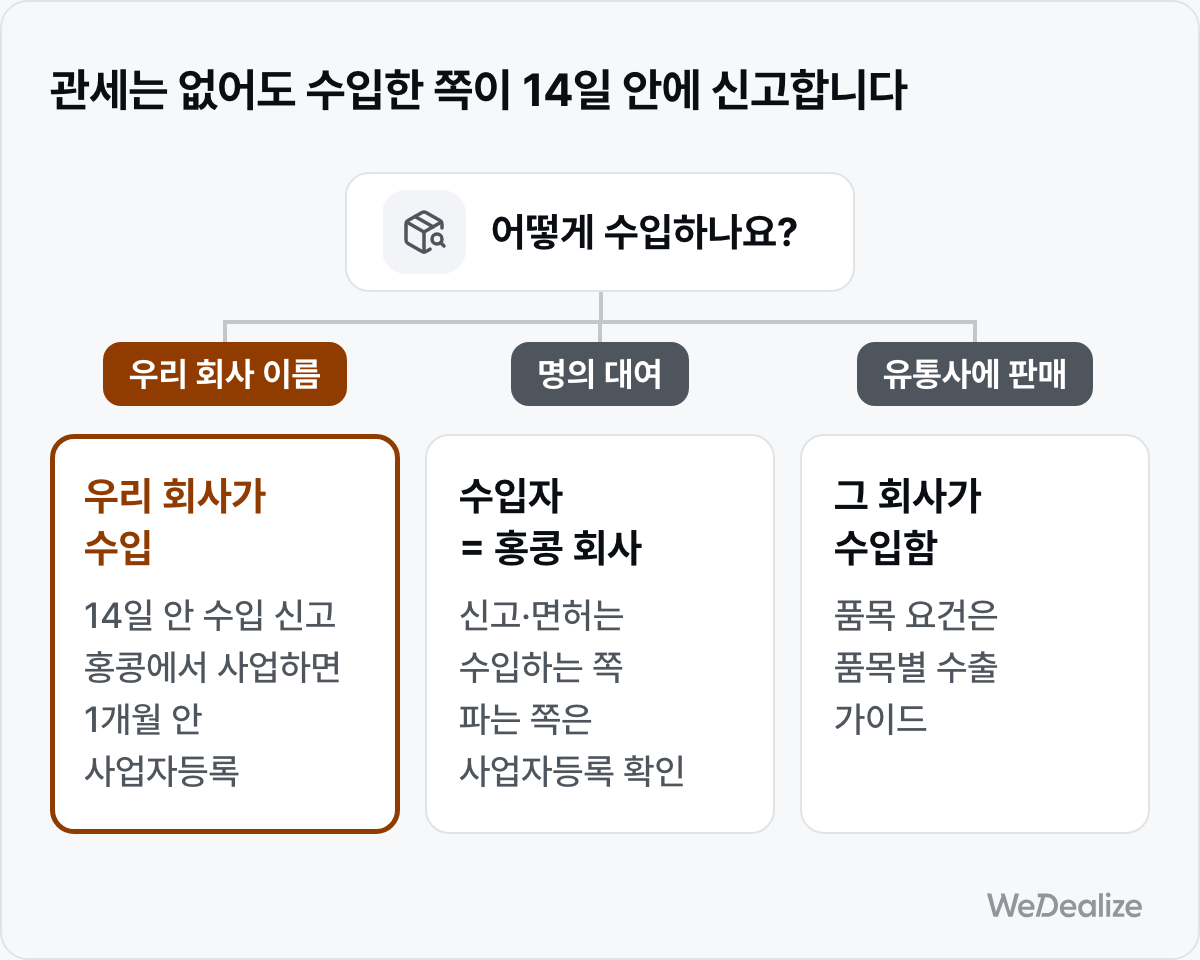
Who does what — Hong Kong has no customs duties, value-added tax, or general sales tax, so there is no import tax payment or credit process and no sales tax registration. The “Using another name” column is based on a consignment-sales arrangement in which a Hong Kong company imports the goods and sells our company’s goods on our behalf. The details are in the sections listed in the right-hand column.
Task | Under our company name | Using another name (consignment sales) | Details |
|---|---|---|---|
Import declaration | Our company | That company | When importing · Using another name |
Import licence for excise goods | Our company | That company | Under our company name · Using another name |
Profits tax filing and payment | Our company | That company | Using another name · Selling in Hong Kong › Corporate tax |
Importing under our company name — Our company imports goods into Hong Kong without a Hong Kong entity and then sells them from a Hong Kong warehouse or elsewhere. See “Importing and selling under our company name.”
Using the importer’s name — A Hong Kong company becomes the importer, imports the goods, and our company or that company sells them in Hong Kong. See “Importing and selling under the importer’s name.”
Importing and selling under our company name
This applies when our company imports goods and then sells them from a Hong Kong warehouse or elsewhere without a Hong Kong entity.
Import declaration — If our company imports the goods, the 14-day import declaration obligation described in “When importing” applies to our company.
Business registration — According to guidance from the Hong Kong Inland Revenue Department, a company incorporated outside Hong Kong that carries on business in Hong Kong must apply for business registration within one month from the date it starts business. Businesses subject to registration include profit-making transactions conducted either through a physical store or online. Failure to apply may result in a fine of HKD 5,000 and imprisonment for one year.
Online sales — If you trade online and the activity is carried out in Hong Kong, you must apply for business registration. According to Hong Kong Inland Revenue Department guidance, whether a business is carried on in Hong Kong is determined by considering together the locations and scale of activities such as sourcing and promotion of goods, soliciting buyers, delivery, and settlement of payments.
Registered name and address — The business name used by an online shop must be the same as the business name on the business registration certificate. The business address for business registration must be a physical address, not a website address or email address.
If you establish a place of business in Hong Kong — Under Hong Kong’s Companies Ordinance, a company incorporated outside Hong Kong that establishes a place of business in Hong Kong must register as a non-Hong Kong company with the Companies Registry within one month. The application must state the address of the principal place of business in Hong Kong, the directors, and an authorised representative (a Hong Kong representative who receives court documents and notices on behalf of the company). The authorised representative must be an individual resident in Hong Kong or a Hong Kong law firm or accounting firm. According to Hong Kong Inland Revenue Department guidance, a non-Hong Kong company that establishes a place of business in Hong Kong is subject to business registration regardless of whether it actually carries on business.
Excise-goods licence — A Hong Kong Customs and Excise Department licence is required to import excise goods such as alcoholic beverages over 30% alcohol by volume and tobacco, or to store them without paying the tax. A permit is required for removal. Wine and alcoholic beverages at or below 30% alcohol by volume do not require a licence or permit for import or movement. Importing or removing goods without a licence or permit may result in a fine of up to HKD 2 million and imprisonment for seven years. If the offence was intended to evade tax, an additional fine of up to 10 times the amount of tax may be imposed.
Food — Registration of importers and distributors — Under the Food Safety Ordinance, anyone who imports food into Hong Kong or operates a business that causes food to be imported must register as a food importer. Anyone whose principal business in Hong Kong is food wholesaling must register as a food distributor. A person who acquires food by electronic means or otherwise and directly conducts the import transaction is also treated as an importer.
Importing and selling under the importer’s name
This applies when a Hong Kong company becomes the importer, imports the goods, and our company or that company sells them in Hong Kong.
Consignment-sales arrangement — According to Hong Kong Inland Revenue Department guidance, a resident consignee (the Hong Kong company that sells the goods on behalf of another party) must report the total sales proceeds collected on behalf of a non-resident consignor (the overseas company that entrusts the sales) to the Inland Revenue Department every quarter. It must pay 1% of that amount, or a smaller amount agreed with the Inland Revenue Department.
Resale arrangement — If the Hong Kong company buys goods from our company and imports them, it is a buyer sale; see Export Guide by Product.
Import declaration — Because the import declaration obligation lies with the person importing the goods, the company that becomes the importer files the declaration. The contract should specify who bears any surcharge imposed for late filing.
Input VAT on imports — Hong Kong has no value-added tax, so even when another company’s name is used, there is no question of deciding who may claim credit for import VAT.
Import licences and permits — Goods such as pharmaceuticals, wireless transmitting apparatus, and rice require a licence or permit for import. Before entering into the contract, confirm that the company lending its name has the required licence or permit. See “When importing” below for product-specific requirements.
Business registration and profits tax of the selling party — If our company is the party selling in Hong Kong, check whether it is subject to the business registration requirements in “Importing and selling under our company name” and the profits tax requirements in “Selling in Hong Kong.”
Responsibilities assumed by that company — Consumer products and toys are also subject to safety obligations for importers. See “Product obligations” under “Selling in Hong Kong” below. The contract should specify the allocation of recall costs and the transfer of remaining inventory when the contract ends.
When importing
No customs duties or value-added tax — Hong Kong is a free port and does not impose customs duties on imports or exports. There are also no tariff quotas or levies, and no value-added tax or general sales tax.
Customs value and origin — Since there are no customs duties, there is no need to calculate customs value or apply for preferential origin treatment under an FTA.
Excise goods — Excise duty is imposed only on alcoholic beverages, tobacco, hydrocarbon oil, and methyl alcohol. For rates and alcoholic beverages subject to a 0% rate, see “Customs duties and taxes” in Hong Kong Sales Guide — Cross-Border Direct Sales.
Time of excise-duty payment — Excise duty is payable when the goods are delivered from the importing conveyance or bonded warehouse (a customs-licensed warehouse that stores goods before excise duty is paid) into the Hong Kong market. Excise goods for which the tax has not been paid in full must be stored in a bonded warehouse.
14-day import declaration — A person importing goods other than exempt goods must submit an accurate and complete import declaration within 14 days from the date of import. The declaration must be submitted electronically through one of three government-designated electronic service providers. Because the Hong Kong commodity code must be entered for each item, confirm it before importing.
Declaration fee — A fee is charged for each declaration, and since August 1, 2018, the fee per declaration has not exceeded HKD 200. For the calculation method, see “Shipping and customs clearance tips” in Hong Kong Sales Guide — Cross-Border Direct Sales.
Late-filing surcharge — If the declaration is not filed within 14 days, a surcharge is imposed for each declaration. For goods valued at HKD 20,000 or less, see “Importer” in Hong Kong Sales Guide — Cross-Border Direct Sales. If the goods covered by a declaration are valued at more than HKD 20,000, the late-filing surcharge is HKD 40, 80, or 200.
Pharmaceuticals, wireless transmitting apparatus, and rice — Pharmaceuticals may be imported only with a Department of Health licence. A person importing wireless transmitting apparatus must obtain an import permit from the Office of the Communications Authority. No import permit is required if the importer holds an Office of the Communications Authority licence to deal in unrestricted radio transmitting apparatus. An import licence for rice for local consumption is issued only to stockholders registered with the Trade and Industry Department.
Other controlled goods — For the full list of goods requiring import licences or permits, see “Certification and labelling” › “Customs clearance” in Hong Kong Sales Guide — Cross-Border Direct Sales.
Selling in Hong Kong
Sales tax
No sales tax — Hong Kong has no value-added tax or general sales tax, so there is no need to register for or file sales tax returns even when selling inventory located in Hong Kong.
Product obligations
If inventory is kept in Hong Kong and the goods are supplied within Hong Kong, the supplier obligations below apply.
Household electrical products — Certificate of safety compliance — Household electrical products supplied in Hong Kong are subject to the Electrical Products (Safety) Regulation. Supply includes sale, display or storage for sale, and delivery in connection with a sale. Before supplying the product, the supplier must confirm that a certificate of safety compliance has been issued.
Types of electrical-product certificates and penalties — For products that are not prescribed products, a manufacturer’s declaration of conformity is also accepted as a certificate of safety compliance. For six types of prescribed products, including plugs and adaptors, only a declaration from a recognised manufacturer or a certificate or test report from a recognised certification body is accepted. Supplying products without a certificate may result in a fine of HKD 10,000. A breach of the regulations may result in a fine of HKD 100,000 and imprisonment for one year for a first offence, and a fine of HKD 500,000 and imprisonment for two years for a subsequent offence. The regulation does not apply to products operating at 50V AC or below, or 120V DC or below.
Plugs — Plugs suitable for Hong Kong sockets are generally BS1363 13A 3-pin plugs or BS546 5A or 15A 3-pin plugs. Before supplying in Hong Kong, Class II insulated products (double-insulated products without an earth connection) fitted with a 2-pin IEC plug must be fitted with a suitable 3-pin plug or an appropriate adaptor.
Difference from reverse direct sales — The Hong Kong Government has stated that household electrical appliances purchased through cross-border e-commerce do not constitute a supply within Hong Kong. Selling Hong Kong inventory in Hong Kong does not qualify for this exception.
Toys and children's products — Toys and children's products manufactured, imported, or supplied for use in Hong Kong must meet both the general safety requirements and additional safety standards. Identification markings, such as the name or trademark of the manufacturer, importer, or supplier, and an address in Hong Kong must be shown in Chinese or English. Warnings and cautionary statements must be provided in both English and Chinese.
General consumer products — Manufacturers, importers, and suppliers must ensure that consumer products supplied in Hong Kong comply with the general safety standards. Warnings and cautionary statements must be provided in both English and Chinese. There is no requirement to have the products tested before sale. Taking all reasonable steps, such as obtaining a certificate from a recognized testing laboratory through the supplier, may serve as a defense.
Food — Labels for prepackaged food — Prepackaged food sold in Hong Kong must show the name of the food, the list of ingredients, the best-before or use-by date, the number or net weight/net volume, and the name and address of the manufacturer or packer. If it contains gluten-containing cereals, crustaceans, eggs, fish, peanuts, soybeans, milk, or tree nuts, the name of the relevant allergen must be stated in the ingredient list. If sulfites are present at 10 ppm or above, the functional class and name of the sulfite must be stated in the ingredient list. Instead of the manufacturer's address, the country of origin and the name and address of the Hong Kong distributor or trademark owner may be shown. In that case, the distributor or trademark owner must notify the authorities of the manufacturer's address in writing. Labels must be in English or Chinese; if both languages are used, the food name and ingredient list must also be provided in both languages. Prepackaged food must also carry a nutrition label stating the amounts of energy, protein, carbohydrates, total fat, saturated fat, trans fat, sodium, and sugars. If the label uses both languages, the nutrition label must also use both languages. Importers and manufacturers may apply for an exemption from nutrition labeling. The authorities may grant an exemption if they recognize that the annual Hong Kong sales volume of the same food is no more than 30,000 units. Even exempt food must carry a nutrition label if its label or advertising makes a nutrition claim, such as a statement emphasizing its energy or nutrient content or function. Selling prepackaged food with non-compliant labeling may result in a fine and imprisonment for six months.
Profits tax (permanent establishment) — Profits tax
Profits tax — A person carrying on a trade or business in Hong Kong must pay profits tax on profits arising in Hong Kong from that business, regardless of whether the person is a resident or non-resident. Profits arising outside Hong Kong are not taxed even if they are remitted to Hong Kong. Whether a business is carried on in Hong Kong and whether profits arise in Hong Kong are determined based on the facts and circumstances.
Tax rates — According to guidance from the Hong Kong Inland Revenue Department, the standard corporate tax rate is 16.5%. Under the two-tiered rates introduced from the 2018/19 year of assessment, corporations are taxed at 8.25% on the first HKD 2 million of assessable profits and 16.5% on the excess. If there are connected entities, meaning entities controlled by one another or jointly controlled by the same company, only one entity selected among them may apply the two-tiered rates.
Non-residents and agents — Non-residents are taxed on Hong Kong-sourced profits, either directly or in the name of an agent. The tax may be recovered from the non-resident's assets or from the agent, and the agent must retain enough money from the non-resident's assets to pay the tax.
Treaty standard — Under the Korea–Hong Kong tax treaty, Hong Kong may tax the profits attributable to a permanent establishment only when our company carries on business in Hong Kong through a permanent establishment there. A branch or office is included in the definition of a permanent establishment.
Keeping inventory only — Using facilities or keeping inventory solely for the purpose of storing, displaying, or delivering our company's goods does not constitute a permanent establishment.
Agent — If an agent in Hong Kong habitually exercises authority to conclude contracts in the name of our company, our company is deemed to have a permanent establishment there. However, the agent is not treated as creating a permanent establishment if the agent's activities are limited to activities excluded from the definition of a permanent establishment, such as storage, display, delivery, or preparatory or auxiliary activities. Using an independent agent, such as a broker or general commission agent acting in the ordinary course of business, does not by itself constitute a permanent establishment.
Information for consumers and withdrawal/returns
Same as the reverse direct sales section — For the return system and the prohibition of unfair trade practices, see Hong Kong Sales Guide — Reverse Direct Sales, “Certification and labeling” › “Sales page” and “Withdrawal and returns.” Clearly state the return and refund terms on the product page.
Violation of the Trade Descriptions Ordinance — Violating the Trade Descriptions Ordinance may result in imprisonment for up to five years and a fine of HKD 500,000.
Returns of dutiable goods — This applies when imported goods on which excise duty has been paid do not conform to the contract or are damaged in transit. If the goods are destroyed in Hong Kong with the written consent of Customs or returned to the supplier outside Hong Kong, an application may be made for a refund of the excise duty.
Ongoing obligations after registration
Profits tax return — According to guidance from the Hong Kong Government, a profits tax return is generally due within one month from the date of issue. A newly registered business will usually receive its first return approximately 18 months after commencing business or incorporation.
Provisional profits tax — Because profits for the year cannot be finalized until the year of assessment ends, profits tax is first assessed on a provisional basis. Once the profits are finalized, the tax amount is determined and the provisional tax paid is applied against that amount.
Filing notices and books — According to guidance from the Hong Kong Inland Revenue Department, a person carrying on business online who is subject to profits tax must notify the department in writing within four months after the end of the basis period if no tax return has been received. The basis period is generally the one-year period ending on March 31 or the company's accounting year-end. Books of income and expenditure must be kept in English or Chinese and retained for at least seven years after the transaction is completed.
Filing and record-keeping violations — According to guidance from the Hong Kong Inland Revenue Department, failure to submit a return by the deadline without a reasonable excuse may result in prosecution. The fine is HKD 10,000, plus three times the amount of tax undercharged. Failure to comply with the obligation to keep business records without a reasonable excuse may also result in prosecution, with a fine of HKD 100,000.
Renewal of business registration — Instead of a one-year business registration certificate, a three-year certificate may be selected. The renewal notice is generally sent around the middle of the month preceding the month in which the new certificate begins, and once payment is made, the receipted notice becomes the registration certificate. If the notice is not received, notify the Inland Revenue Department in writing within one month after the certificate expires.
Change of business address — If the business address changes, notify the Business Registration Office of the Inland Revenue Department in writing within one month.
Notice of cessation — If the Hong Kong business ceases, notify the Business Registration Office of the Inland Revenue Department in writing within one month from the date of cessation. Business registration fees must be paid through the year in which the business ceases. Failure to notify by the deadline may result in a fine of HKD 5,000 and imprisonment for one year.
Annual return for a non-Hong Kong company — A registered non-Hong Kong company must file an annual return (NN3) with the Companies Registry within 42 days after each anniversary of its registration in Hong Kong. The registration fee is HKD 180 if filed on time and HKD 1,200–4,800 if filed late. Failure to meet the deadline is an offense, and the company, its officers, and any company agent who authorized the violation may be prosecuted.
Unsold inventory — Re-exporting inventory outside Hong Kong is also subject to an export declaration, which must be filed within 14 days from the date of export. For goods on which excise duty has been paid, if they are exported with the written consent of Customs, an application may be made for a refund up to the amount of excise duty paid.
Connecting through WeDealize
Sales involving express shipments from the Korea center to Hong Kong for each order are covered in Hong Kong Sales Guide — Reverse Direct Sales and International Direct Shipping Guide.
Common mistakes
Misconception: “There are no taxes, so registration is not required in Hong Kong.” — Incorrect. Although there are no customs duties or VAT, a business operating in Hong Kong must complete business registration, and profits arising in Hong Kong are subject to profits tax.
Misconception: “A certificate for electrical products is not required when selling from a Hong Kong warehouse.” — Incorrect. Selling Hong Kong inventory in Hong Kong makes the products subject to safety compliance certification. See “Product obligations” under “When selling in Hong Kong” above.
Misconception: “If we borrow someone else's name, our company has no obligations in Hong Kong.” — Not necessarily. If our company is the party selling in Hong Kong, we must check whether it is subject to business registration and profits tax.
Items not confirmed
Import declarations by an overseas company without Hong Kong registration — Confirm with the Hong Kong Census and Statistics Department or a designated electronic service provider what identification information and documents are required when an overseas company without business registration declares itself as the importer.
Sales with inventory kept only in a warehouse — Confirm with the Companies Registry, the Inland Revenue Department, or a local professional whether keeping inventory only in a Hong Kong logistics warehouse and selling it constitutes establishing a place of business or carrying on business in Hong Kong.
Food importer registration when lending one's name — For food imported by a Hong Kong company and sold by our company, confirm with the Centre for Food Safety (CFS) who must register as the importer.
Import license or permit applications by an overseas company — Confirm with the Department of Health and the Office of the Communications Authority whether an overseas company without Hong Kong registration can directly obtain an import license for pharmaceuticals or an import permit for radio transmitting devices.
Import declarations by a customs clearance provider — Confirm with the Hong Kong Census and Statistics Department whether a company engaged only to handle customs clearance procedures may make an import declaration in its own name and, in that case, who is the importer.
Business registration for our company in a consignment sale — When a Hong Kong company handles the sale, confirm with the Hong Kong Inland Revenue Department whether our company is also subject to business registration.
Related terms
IOR (Importer of Record) — The party that imports goods in the country of sale and bears primary responsibility for paying customs duties.
Customs broker — A customs professional who handles import and export declarations, customs duty calculations, and related matters on behalf of cargo owners and others.
Consignment export and consignment import — A transaction in which goods are first exported without payment, and payment is made only for the quantity sold locally.
Fulfillment — An industry term for a method in which a seller entrusts logistics operations, such as product storage and order processing, to a logistics center.
HS code — A commodity code classifying goods by type and used as the basis for determining customs duty rates.