Hong Kong Sales Guide — Cross-Border E-Commerce
Automatically translated from Korean.
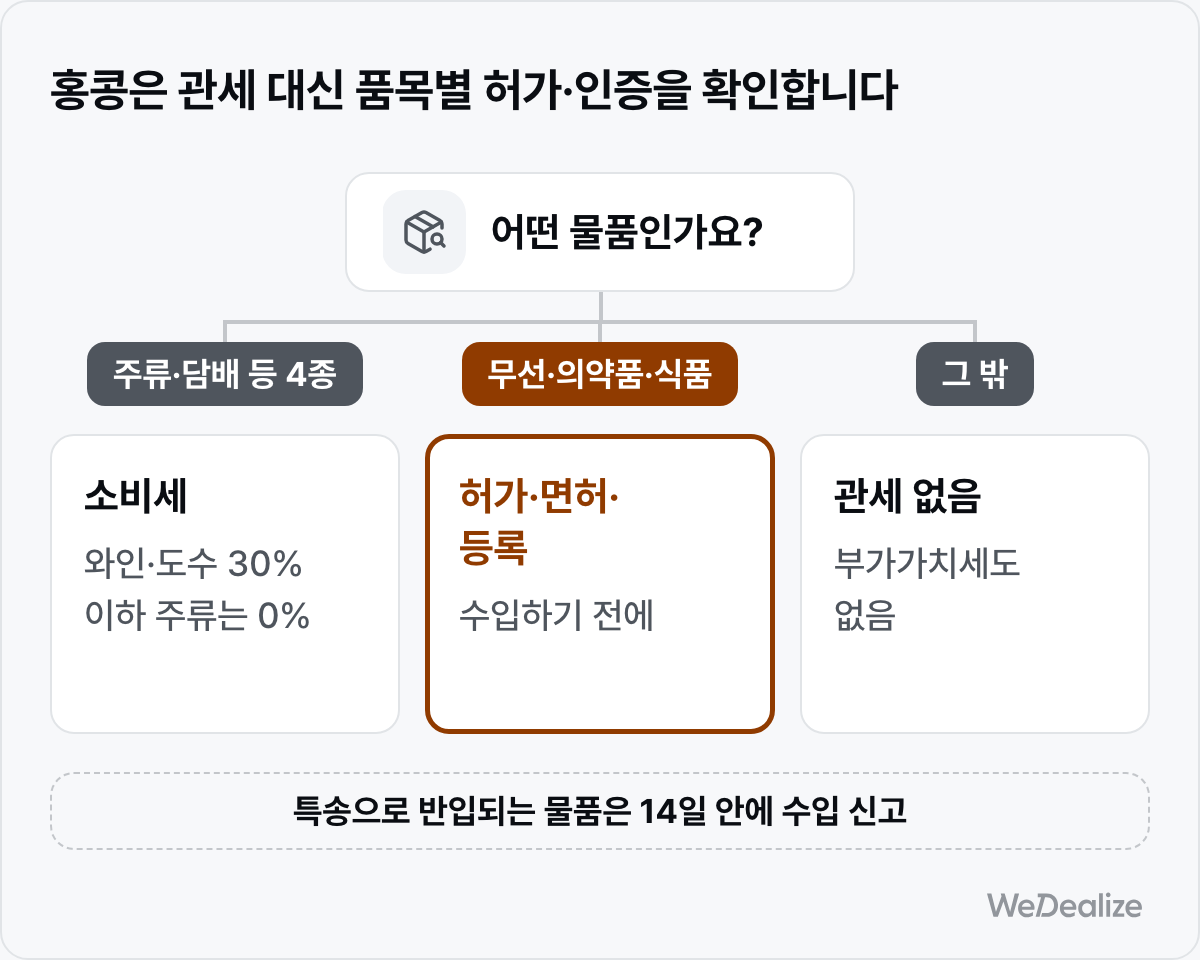
One-line summary — Hong Kong imposes neither customs duties nor value-added tax on cross-border e-commerce goods, while excise duty applies only to four types of goods, including alcoholic beverages and tobacco. Express shipments must be declared for import within 14 days, and wireless devices, pharmaceuticals, and food require permits, licenses, or registration.
Scope of this guide — This guide covers sending Korean products to Hong Kong consumers by international express or post for each order (cross-border e-commerce). Covered in other guides — Korean export declaration, simplified export declaration, and zero-rating → Overseas Direct Shipping Guide · Return pickup → Overseas Returns Processing Guide
What to check first
How are you selling? — This guide covers cross-border e-commerce shipments sent by international express or post for each order. If you sell to a Hong Kong distributor or importer, that company imports the goods → Product-Specific Export Guide
Are the goods subject to excise duty? — Alcoholic beverages, tobacco, some hydrocarbon oils, and methyl alcohol are subject to excise duty. Wine and alcoholic beverages with an alcohol content of 30% or less are subject to a 0% rate and do not require a license. See “Customs Duties and Taxes” below.
Who files the import declaration? — Goods sold and sent by express are subject to an import declaration. See “Importer” below for the deadline and filing party.
Are the goods subject to permits or certification? — Wireless transmitting devices, pharmaceuticals, Chinese medicines, meat, eggs, plants, pesticides, and food require permits, licenses, registration, or certificates. E-cigarettes and heated tobacco products cannot be imported, and cannabidiol (CBD) products are controlled as dangerous drugs. Household electrical products sent by cross-border e-commerce are not subject to Hong Kong safety certification. See “Certification and Labeling” below.
Steps to take
Check whether the goods are subject to excise duty, require permits, or are prohibited from import, and obtain the necessary certificates, licenses, and registrations → Customs Duties and Taxes, Certification and Labeling
Confirm with the express carrier and Hong Kong Customs who must file the import declaration → Importer
Include warning and cautionary statements in both English and Chinese → Certification and Labeling
Describe the products accurately and state the return and refund terms → Certification and Labeling, Cancellation and Returns
Ways to sell into Hong Kong
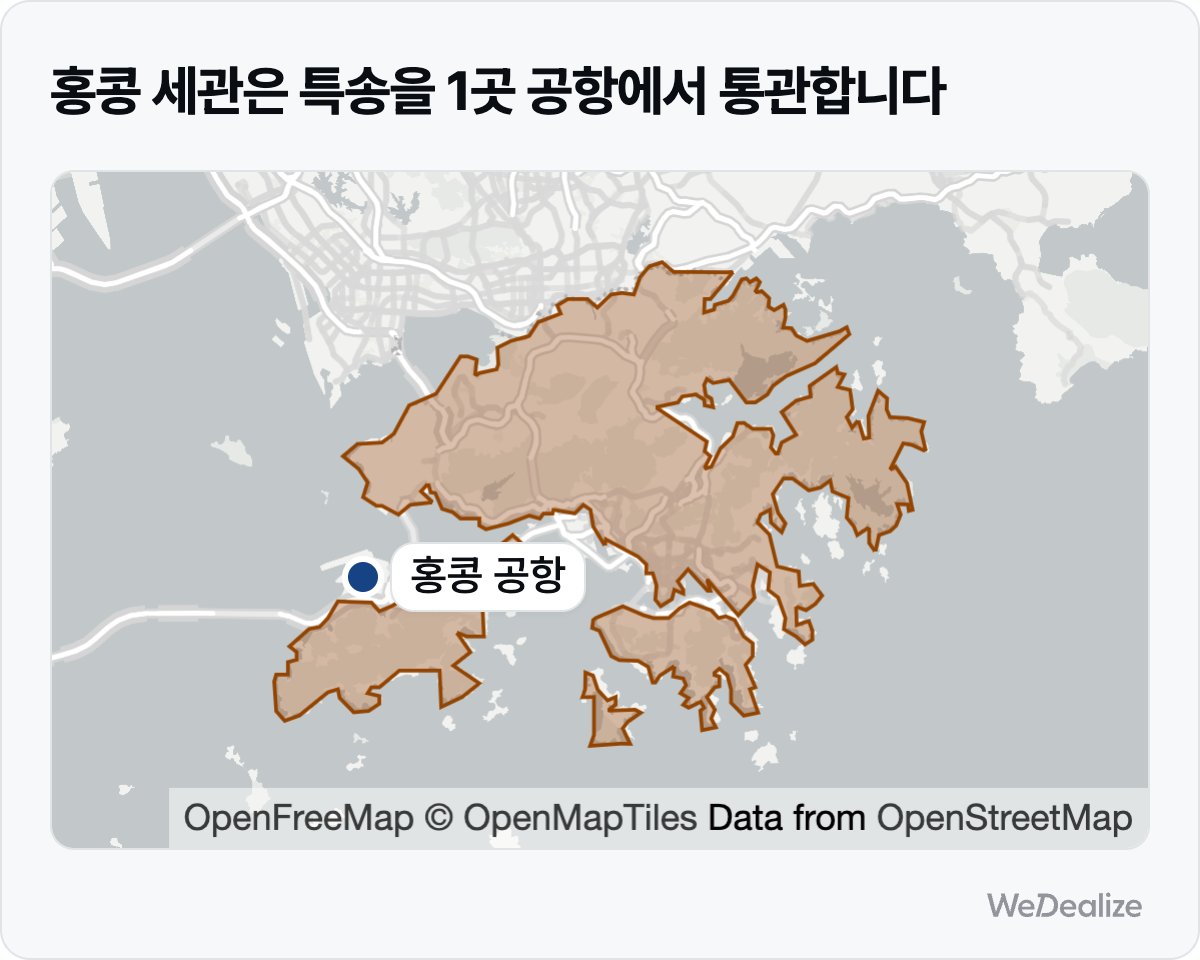
Express — Air cargo entering through Hong Kong International Airport is cleared through Hong Kong Customs’ air cargo clearance system. Goods sold and sent by express are subject to an import declaration. See “Importer” below for the deadline and fees.
Post — Postal parcels with contents valued at less than HKD 4,000 are exempt from import declaration requirements. If the value is HKD 4,000 or more, they are subject to an import declaration like express shipments.
Sales channels — Regardless of which marketplace you use, Hong Kong customs clearance follows the above criteria depending on whether the shipment is sent by express or post. See “Certification and Labeling” below for product-specific certificates and permits.
Customs Duties and Taxes
No customs duties or value-added tax — Hong Kong is a free port and does not impose customs duties on imports or exports. There are also no tariff quotas, levies, value-added tax, or general services tax. Therefore, unlike in other countries, there is no need to consider a low-value tax exemption threshold.
Four types of excise goods — Excise duty applies only to alcoholic beverages, tobacco, hydrocarbon oils, and methyl alcohol.
Excise duty on alcoholic beverages over 30% ABV — If the bottle capacity is 1 liter or less, excise duty is charged at 100% on the first HKD 200 of the value and 10% on the remainder.
Licenses for excise goods — A Hong Kong Customs license is required to import, export, or manufacture excise goods such as alcoholic beverages over 30% ABV and tobacco, or to store them without paying the duty. A permit is required when moving them. Wine and alcoholic beverages with an alcohol content of 30% or less are subject to a 0% rate and do not require a license or permit for import, export, or movement. Check with Hong Kong Customs before sending alcoholic beverages or tobacco for sale by express.
Importer
File within 14 days — When importing goods that are not exempt from declaration, submit the import declaration through the designated electronic system within 14 days from the date of import.
Declaration fees — A fee is charged for each declaration, and since August 1, 2018, the fee per declaration has not exceeded HKD 200. If the declaration is not filed within 14 days, a surcharge based on the delay period is imposed: HKD 20, 40, or 100 for goods valued at HKD 20,000 or less.
Goods exempt from declaration — Postal parcels with contents valued at less than HKD 4,000 and personal gifts for which the recipient pays no consideration are exempt from declaration. Goods sold and sent by express do not qualify for this exemption.
Who files it? — Confirm with the express carrier you use and Hong Kong Customs who must file the import declaration for express cargo.
Certification and Labeling
Household electrical products — cross-border e-commerce shipments are not subject to safety certification — In a response to the Legislative Council, the Hong Kong Government stated that household electrical products purchased through cross-border e-commerce are not considered to be supplied in Hong Kong and therefore are not subject to the Electrical Products (Safety) Regulation. If you keep inventory in Hong Kong and supply the products there, confirm before supply that a certificate of safety compliance has been issued. For reference, plugs for Hong Kong outlets generally use the BS1363 13A three-pin or BS546 5A/15A three-pin standard.
Wireless transmitting devices and pharmaceuticals — prior permits — Importing wireless transmitting devices requires an import license from the Communications Authority. Holders of the Communications Authority’s Radio Dealers Licence (Unrestricted) are exempt. Pharmaceuticals may be imported only with a Department of Health license. Cosmetics that claim to treat or prevent disease or alter bodily functions through pharmacological action are also considered pharmaceuticals. Pharmaceuticals require an import license even when imported by post, express, or through cross-border e-commerce.
E-cigarettes and heated tobacco products — prohibited imports — Alternative smoking products such as e-cigarettes and heated tobacco products, as well as smokeless tobacco, cannot be imported into Hong Kong.
CBD products — dangerous drugs — Goods containing CBD, including food and beverages, cannot be imported from February 1, 2023 unless the requirements of the Dangerous Drugs Ordinance are met. Hong Kong Customs also selects postal items for inspection. Hong Kong’s Narcotics Division states that purchasing drugs online and having them delivered to Hong Kong is treated as drug trafficking, for which the maximum penalty is life imprisonment and a fine of HKD 5 million.
Plants and seeds — import permit and phytosanitary certificate — Importing plants requires both an import permit from the Agriculture, Fisheries and Conservation Department (AFCD) and a phytosanitary certificate from the authorities in the country of origin. Seeds do not require a permit if accompanied by a phytosanitary certificate. Neither is required for edible fruits, vegetables, grains, or spices, cut flowers, or timber products.
Endangered species — CITES documents — Species listed in Appendix II of the Convention on International Trade in Endangered Species of Wild Fauna and Flora (CITES) (the list of species categorized by level of protection) require a valid CITES export permit and are subject to inspection upon arrival in Hong Kong. Species listed in Appendix I require an AFCD license in advance, and specimens obtained from the wild may not be traded commercially. Pharmaceuticals containing endangered animal ingredients also require an import license.
Pesticides — import permit — An AFCD import permit must be obtained in advance for each shipment of pesticides.
Chinese medicines, meat, and eggs — import license and health certificates — Proprietary Chinese medicines and 36 specified Chinese herbal medicines may be imported only with a Department of Health import license. Frozen or chilled meat and poultry require a Food and Environmental Hygiene Department import license for each shipment. Meat and poultry also require prior permission from the Food and Environmental Hygiene Department if they do not have a health certificate from the authority in the country of origin, while eggs require a health certificate or written permission.
Rice — import license — Rice requires an import license, which is issued only to rice stockholders registered with the Trade and Industry Department (TID). No license is required only for quantities of 15 kg or less brought in by travelers for personal use or as gifts.
Pet food — no permit required — An AFCD import permit is not required unless the pet food contains ingredients derived from dogs, cats, or endangered species.
Food — importer registration — Anyone engaged in the business of importing or distributing food must register with the Director of Food and Environmental Hygiene as a food importer or distributor. A person who acquires food electronically and conducts an import transaction is also deemed to be an importer.
False or misleading descriptions prohibited — The Hong Kong Government explains that the Trade Descriptions Ordinance (Cap. 362) covers both goods and services. Unfair trade practices such as false trade descriptions, misleading omissions, aggressive sales practices, and bait advertising are prohibited. The rules apply to both physical stores and online sellers.
General consumer goods — safety obligations — Consumer goods supplied in or imported into Hong Kong must meet general safety standards. Products for which approved safety standards exist must comply with those standards.
Warning statements must be in English and Chinese — Under Hong Kong’s Consumer Goods Safety Regulation, if a product, package, label, or accompanying document contains warnings or cautionary statements regarding storage, use, or disposal, they must be provided in both English and Chinese. Supplying consumer goods that do not meet this requirement is subject to criminal penalties. Food, electrical products, tobacco, pharmaceuticals, Chinese medicines, toys, and children’s products are not consumer goods under this regulation and are governed by separate laws.
Cancellation and Returns
No plans for no-reason returns — In a 2023 response to the Legislative Council, the Hong Kong Government stated that it had no plans to introduce a system allowing consumers in distance transactions to return goods without giving a reason.
Display return terms — The same response states that consumers in distance transactions are also protected by Hong Kong’s existing laws. Confirm the applicable scope with a Hong Kong legal professional and clearly state the return and refund terms on the product page.
When receiving returns back in Korea — If goods were not manufactured, processed, repaired, or used overseas and are re-imported within two years from the date the export declaration was accepted, consider re-import duty exemption. The exemption does not apply if customs duties on the goods or raw materials were reduced or refunded. Confirm applicability with a customs broker.
Connect through WeDealize
The process for dispatching orders from an integrated overseas marketplace by express from the Korean center to Hong Kong is summarized in the Overseas Direct Shipping Guide.
Shipping and Customs Clearance Tips
Import declarations must be filed only through government-designated providers — Import declarations are filed electronically through government-designated electronic service providers (Brio, Global e-Trading, and Tradelink).
Planned transition to the Trade Single Window — Hong Kong Customs has stated only a target of gradually moving import and export declarations to the Trade Single Window (TSW) beginning in mid-2027. The date has not yet been set.
Food and non-food goods use different forms — Non-food goods are declared on Form 1, while food is declared on Form 1A. A declaration submitted on the wrong form is treated as not having been filed, so it must be refiled and any surcharge or fee paid.
Declaration fees vary by value — For non-food goods, the fee is HKD 0.2 on the first HKD 46,000 and HKD 0.125 for every subsequent HKD 1,000. For food, the fee is HKD 0.2 per declaration regardless of value.
Common Mistakes
Misconception: “There is no tax, so there is no declaration.” — Incorrect. Although there are no customs duties or value-added tax, import declaration obligations and declaration fees still apply. The exemption for goods valued at less than HKD 4,000 applies only to postal parcels.
Misconception: “Anything can be freely brought into Hong Kong.” — Incorrect. Excise goods such as alcoholic beverages over 30% ABV and tobacco, as well as wireless transmitting devices, pharmaceuticals, and food, require licenses, permits, or registration, and e-cigarettes and heated tobacco products cannot be imported. CBD products are controlled as dangerous drugs.
Misconception: “Even cross-border e-commerce shipments require Hong Kong electrical product certification.” — Incorrect. The Hong Kong Government has stated that household electrical products purchased through cross-border e-commerce are not subject to the Electrical Products (Safety) Regulation. The regulation applies if inventory is kept and the products are supplied in Hong Kong.
Items not confirmed
Prior registration of general cosmetics — Confirm with Hong Kong Customs whether prior registration or notification is required when selling general cosmetics that do not contain Western medicinal ingredients.
Whether food importer registration applies when shipping directly from Korea — Confirm with the Centre for Food Safety (CFS) whether the seller or the recipient is required to register.
Is the Korean seller the supplier of consumer goods and toys? — Confirm with Hong Kong Customs who is responsible for complying with warning statements and labeling requirements when shipping directly from Korea.
Seller’s business name and address — In Hong Kong, seller’s business name and address (excluding a P.O. box) are considered important information in an invitation to purchase that displays a product’s characteristics and price and enables consumers to buy it immediately. Confirm with Hong Kong Customs whether these requirements also apply to Korean sellers.
Actual submitting party for import declarations for express consignments — Confirm with the express carrier being used and Hong Kong Customs whether the express carrier submits consolidated declarations.
Labels for packaged food — Confirm with the Centre for Food Safety (CFS) whether Hong Kong’s labeling and nutrition labeling requirements apply to packaged food sent directly to consumers from Korea.
Country-of-origin and measurement-unit labeling — Confirm with Hong Kong Customs whether country-of-origin and measurement-unit labeling requirements must also be followed for goods sold cross-border online.
Milk, frozen desserts, and ready-to-eat rice — Confirm with the Centre for Food Safety (CFS) and the Trade and Industry Department (TID) whether approval from the manufacturer is required when sending milk, dairy products, or frozen desserts by express or post, and whether ready-to-eat rice is subject to a rice import licence.
Excise duty on alcoholic beverages and tobacco received by post — Confirm with Hong Kong Customs who is responsible for paying the excise duty on alcoholic beverages and tobacco received by post, and how it must be paid.
Related terms
Importer of Record (IOR) — The party declared as the importer to the customs authorities of the country of sale, bearing responsibility for paying duties and taxes and for legal compliance.
Customs broker — A nationally licensed professional who handles import and export declarations and calculates taxes and duties on behalf of the cargo owner.
Export declaration — The procedure for declaring to customs the name, quantity, price, and other details of goods to be exported overseas.
Simplified export declaration (e-commerce) — A streamlined declaration that reduces the number of declaration items required for a formal export declaration, mainly used for low-value e-commerce exports.
Zero-rating — A system under which a 0% VAT rate is applied to exported goods, while VAT paid on purchases is refunded.