Singapore Sales Guide — Local Sales
Automatically translated from Korean.
One-line summary — For local sales in Singapore, our company, after obtaining a UEN (Singapore Unique Entity Number) and activating a customs account, or a Singapore representative registered for GST, imports the goods in its own name. The importer pays import GST (Goods and Services Tax) at 9%, and sellers whose taxable supplies in Singapore exceed SGD 1 million must register for GST.
Scope of this article — This article covers importing and selling Singapore inventory in our company’s name without a Singapore entity, or importing under the name of a Singapore company and selling the inventory in Singapore. See another article for — Sending each order by express courier or post → Singapore Sales Guide — Cross-Border E-Commerce · Filing an export declaration in Korea when shipping out inventory → Export Declaration · VAT on exported goods → Zero-Rating · Entity responsible for cosmetic notification → Singapore Cosmetics Export Guide
First, check the following
Is this the right article? — If you send each order from Korea, see Singapore Sales Guide — Cross-Border E-Commerce. If you keep inventory in Singapore and dispatch it from Singapore, someone must be the importer, so this is the right article. If you sell to a Singapore distributor or importer, that company imports the goods → Product-Specific Export Guides
What do you have in Singapore? — If you sell to a Singapore entity (subsidiary) and that entity is named as the consignee on the commercial invoice, it is the importer, so see Product-Specific Export Guides. If you have a branch, see the corporate tax sections under “Importing and selling in our company’s name” and “Selling in Singapore.” If you have nothing in Singapore, read this entire article.
Are you entrusting sales to a Singapore company? — This article also applies if a Singapore company registered for GST imports and sells our company’s goods as our agent. See “Importing and selling under another importer’s name” below.
Is this a product that requires a license or registration? — Food requires an import license or registration; electrical appliances and gas appliances require supplier registration; and cosmetics require notification. Only companies registered with ACRA (Accounting and Corporate Regulatory Authority of Singapore) can do these three things. See “Importing and selling in our company’s name” and “Selling in Singapore” below.
Is this a prohibited or controlled product? — Gum and e-cigarettes cannot be imported, and controlled products require approval from the relevant authority before importation. See “When importing” below.
Order of tasks
Decide whether to import in our company’s name or entrust importation and sales to a GST-registered agent → How to sell in Singapore
If importing in our company’s name, obtain a UEN and activate a customs account → Importing and selling in our company’s name
Check whether GST registration is required, and appoint a local agent if registering → Importing and selling in our company’s name; Selling in Singapore
If the goods are food, obtain an import license; if they are electrical appliances, telecommunications equipment, or cosmetics, complete the required registration or notification → Importing and selling in our company’s name; Selling in Singapore
Obtain approval for controlled products and an import permit, and pay import GST. To claim the input tax credit, the importer must be stated as the importer on the import permit → When importing
Display prices inclusive of GST and state the return terms → Selling in Singapore; Information to provide consumers and withdrawal and returns
Continue filing and paying GST and retaining records → Ongoing compliance after registration
How to sell in Singapore
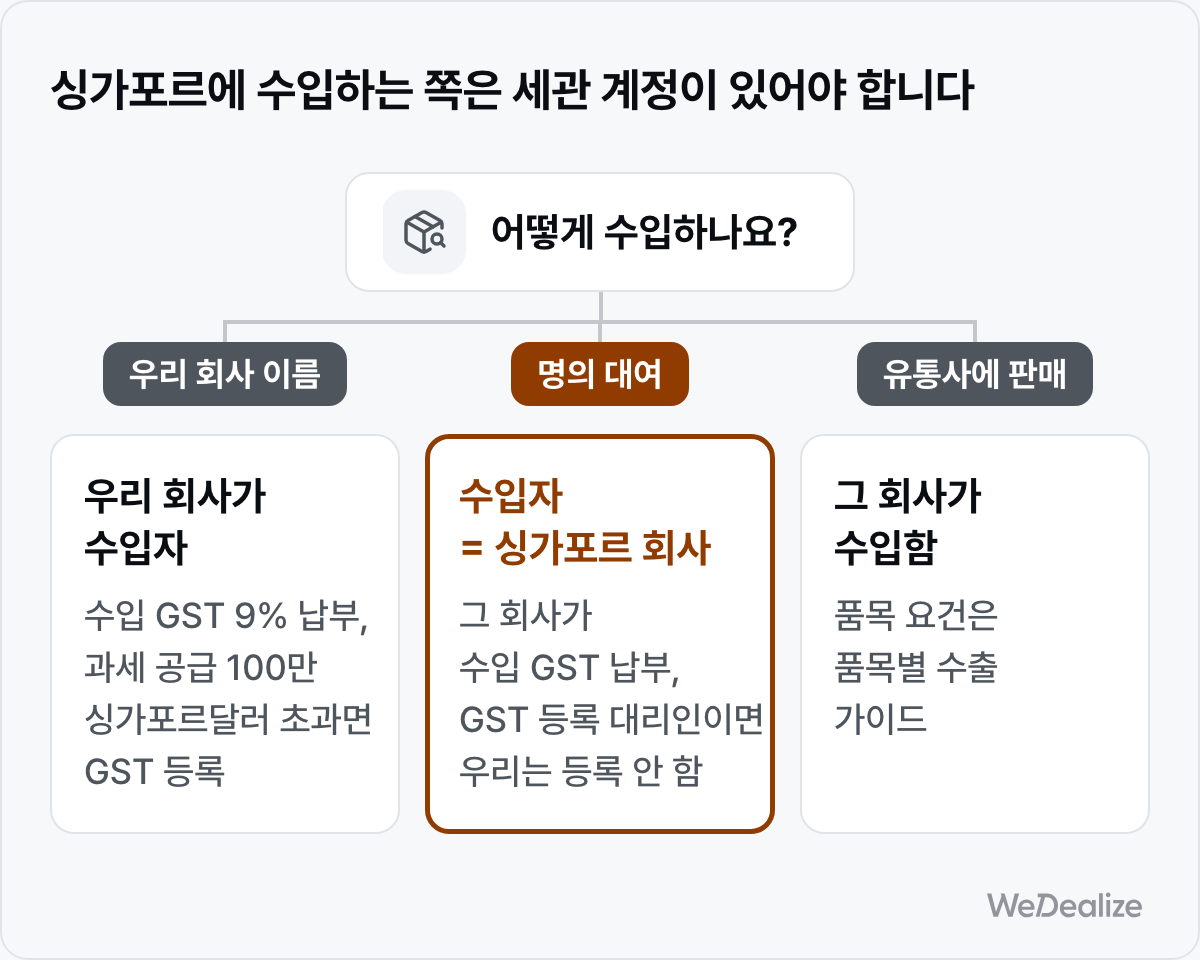
Who does what — The “using another party’s name” column is based on the GST-registered agent model. The details are provided in the sections in the right-hand column.
Task | In our company’s name | Using another party’s name (GST-registered agent) | Details |
|---|---|---|---|
Importer on the import permit | Our company | That company | In our company’s name · Using another party’s name |
Payment of import GST | Our company | That company | When importing |
Claiming import GST | Our company | That company | When importing · Using another party’s name |
GST registration and filing on sales | Our company | That company | Selling in Singapore › Sales tax |
Electrical appliance supplier registration | Our company | That company | Selling in Singapore › Product obligations |
Importing in our company’s name — Our company becomes the importer, imports the goods without a Singapore entity, and then sells them from a Singapore warehouse or other location. See “Importing and selling in our company’s name.”
Using another party’s name as importer — A Singapore company registered for GST imports and sells the goods in its own name as our company’s agent. See “Importing and selling under another importer’s name.”
Selling to a distributor or importer — According to Singapore Customs guidance, if an overseas company sells to a Singapore company and that company is named as the consignee (the person receiving the goods) on the commercial invoice, that company is the importer. See Product-Specific Export Guides for product requirements.
Importing and selling in our company’s name
This applies when our company becomes the importer, imports the goods without a Singapore entity, and then sells them from a Singapore warehouse or other location.
Who is the importer? — According to Singapore Customs guidance, an importer is a person who brings goods into Singapore on their own account or on another person’s account. According to IRAS (Inland Revenue Authority of Singapore) guidance, the person who owns the goods at the time of importation generally must be the importer. If our company owns the inventory, our company is the importer.
UEN and customs account — According to Singapore Customs guidance, a business intending to import or export must register with ACRA or the relevant UEN-issuing agency, obtain a UEN, and activate a customs account. An import permit can be applied for only after the customs account is activated.
Applying for an import permit — To import goods, apply for an import permit through the customs electronic declaration system, TradeNet. You may appoint a Declaring Agent to handle the application, or register as a Declaring Agent yourself and apply after obtaining a TradeNet user ID.
Local GST agent — According to IRAS guidance, when a foreign entity registers for GST, it must appoint a Singapore local agent to handle all GST matters. This agent is responsible for GST accounting and payment.
Food import license — An SFA (Singapore Food Agency) license or registration is required to import food regulated by the SFA. According to SFA guidance, an importing business must register with ACRA, activate a customs account, and submit the original GIRO (bank direct debit) application form to the SFA.
Telecommunication equipment dealer’s license — According to IMDA (Infocomm Media Development Authority) guidance, a company registering telecommunication equipment must hold a dealer’s license. The name of the license is Telecommunication Dealer's Licence. See “Product obligations” under “Selling in Singapore” below for equipment registration.
Singapore business registration — According to ACRA guidance, a foreign company can establish a business presence in Singapore by registering a Singapore branch or incorporating a local entity (subsidiary). In either form, the registration application must be handled by a Corporate Service Provider (CSP). A branch must appoint one Singapore-resident agent and comply with Singapore Companies Act obligations, such as annual filings. Once branch registration is approved, it receives a UEN.
Sales GST — The seller registers for GST. See “Sales tax — GST” under “Selling in Singapore” below.
Importing and selling under another importer’s name
This applies when a Singapore company imports the goods in its own name and sells our company’s goods in Singapore.
If it only handles customs clearance — According to Singapore Customs guidance, a company must not import goods that do not belong to it using its own UEN. An exception applies when it consolidates and imports goods belonging to customers without UENs, but the company remains responsible even in that case. According to IRAS guidance, only the rightful importer may claim import GST under its own name on the import permit. Therefore, if the goods are imported under the name of a company that only handles customs clearance, neither that company nor our company can claim the import GST under that import permit. For our company to claim it, a replacement permit must be obtained in our company’s name. See “When importing.”
If entrusted to a GST-registered agent — According to IRAS guidance, a foreign entity may appoint a Singapore agent registered for GST to handle importation and supply. The agent imports the goods in its own name, claims the import GST, and reports the sale of the goods as its own taxable supply. In this case, the foreign entity does not need to register for GST. This method can be used when our company is not registered for GST or is registered only for remittance purposes under the Overseas Vendor Registration (OVR) regime.
Claiming import GST — According to IRAS guidance, goods that this agent imports and supplies on behalf of our company are treated as having been imported and supplied by the agent. Therefore, the agent claims the import GST as its own input tax and charges and reports GST on sales in Singapore. See “When importing” for the requirements for claiming the credit.
Agent’s responsibilities — According to IRAS guidance, the agent is treated as the owner of the goods and is responsible for all goods imported. The agent must issue tax invoices for goods sold to customers in Singapore. The agent must keep records of the importation and supply of our company’s goods separately from its own transactions.
Electrical appliance supplier registration — According to CPSO (Consumer Product Safety Office) guidance, an importer bringing in controlled products for sale must apply for CPSO registration. Therefore, the company lending its name as importer registers. See “Product obligations” under “Selling in Singapore” for the obligations of a registered supplier.
When changing agents — According to IRAS guidance, if the remaining inventory is transferred to a new agent when changing agents, the new agent takes over the GST responsibilities. If the new agent is GST-registered and the conditions are met, including that ownership remains with our company, the claimed import GST does not need to be repaid. The original self-review form must be submitted to IRAS before transferring the inventory. If the conditions are not met, the previous agent must repay the import GST it claimed.
What to specify in the contract — The contract should specify responsibility for customs duty and GST assessments, recall costs, and the transfer of remaining inventory when the contract ends.
Resale method — If a Singapore company buys the goods from our company and imports them as the consignee, this is a buyer sale. It is the same as selling to a distributor or importer under “How to sell in Singapore” above; see Product-Specific Export Guides.
Sales GST — The party selling to consumers registers. Under the agent model, the sale is the agent’s taxable supply. See “Sales tax — GST” under “Selling in Singapore.”
When importing
Four types are subject to customs duty or excise duty — According to Singapore Customs guidance, goods subject to customs duty or excise duty fall into four categories: liquor, tobacco products, motor vehicles, and petroleum products and biodiesel blends. Other goods are not subject to customs duty or excise duty; unless exempt, they are subject only to GST.
9% import GST — Under Singapore’s Goods and Services Tax Act, the GST rate has been 9% since January 1, 2024, and applies to both domestic supplies and imports. According to IRAS guidance, import GST is imposed regardless of whether the importer is registered for GST. The importer must obtain an import permit and pay GST at the time of importation.
Taxable value — According to IRAS guidance, import GST is imposed on the CIF (cost, insurance, and freight) value plus customs duty, fees, and other incidental costs.
Obtain the import permit before importing — According to Singapore Customs guidance, the importer must obtain a permit before importing goods. Importing without a permit may, upon a first conviction, result in a fine, imprisonment for up to two years, or both. The maximum fine is the higher of SGD 100,000 and three times the value of the goods.
Declared value — According to Singapore Customs guidance, the declared value must include freight and insurance, and samples and free-of-charge goods must also be declared.
Gum and e-cigarettes — Import prohibited — According to Singapore Customs guidance, gum and e-cigarettes, vaporisers, and their parts cannot be imported into Singapore. The only exception for gum is dental and medicinal gum approved by the Health Sciences Authority (HSA).
Controlled goods — Approval before import — According to Singapore Customs guidance, controlled goods require prior notification and approval of licences and certificates from the relevant authorities before import. Check whether goods are controlled goods by their description or item number (HS code).
Food — Cargo clearance permit for each consignment — According to SFA guidance, a cargo clearance permit (CCP) is required for each consignment when importing food. For licences and registration, see “When importing and selling in our company’s name” above.
Payment method — According to Singapore Customs guidance, the importer or declaring agent must maintain an Inter-Bank GIRO (IBG) arrangement with Customs and a bank to pay duties and taxes. If the importer does not have an IBG arrangement, duties and GST are deducted from the declaring agent’s IBG account.
Import GST Deferment Scheme (IGDS) — According to IRAS guidance, an approved GST-registered business may pay import GST by the monthly GST return deadline instead of at the time of import. Deferred import GST must be reported in the same return and, if the conditions for claiming input tax are met, claimed as input tax.
Free trade zones and licensed warehouses — According to Singapore Customs guidance, duties and GST are suspended while goods are in a free trade zone (FTZ), and become payable when the goods are released directly for local circulation. They are also suspended while stored at a Customs-licensed premises, such as a Zero-GST Warehouse or licensed warehouse.
Conditions for claiming import GST — According to IRAS guidance, all conditions for claiming input tax must be met to claim import GST. The goods must be used for business purposes and supported by an import permit naming our company as the importer. For goods imported by express courier through TNT, FedEx, UPS, or DHL, the tax invoices issued by these four companies may be used in place of the import permit.
If the importer’s name is incorrect — Even if it is the legitimate importer, a company cannot claim input tax using an import permit that does not name it. In that case, notify Customs together with the importer declared on the permit and obtain a replacement permit in our company’s name before claiming the tax.
Cannot claim input tax under a payment-only registration — According to IRAS guidance, a foreign seller’s payment-only registration under the Overseas Vendor Registration (OVR) regime for cross-border sales does not allow the seller to claim input GST paid in Singapore.
Imports made before registration — According to IRAS guidance, goods purchased within six months before GST registration may qualify for an input tax claim only if they are still held on the registration date. Goods purchased more than six months earlier must not have been used or supplied before the registration date. Imported goods must have an import permit naming our company as the importer, and GST on inventory already sold before registration cannot be claimed.
Selling in Singapore
Sales tax — GST
Foreign entities can also sell in their own name — According to IRAS guidance, a foreign entity is an entity with no place of business, fixed establishment, or usual place of residence in Singapore. A foreign entity may also import goods and make supplies in its own name, and must register for GST if its taxable supplies in Singapore exceed SGD 1 million.
GST registration threshold — According to IRAS guidance, GST registration is required if taxable turnover exceeded SGD 1 million in a calendar year (January to December), or is expected to exceed SGD 1 million in the next 12 months. Taxable turnover is the total value of taxable supplies made in Singapore, excluding exempt supplies and disposals of capital assets.
Application deadline — If turnover exceeded the threshold in a calendar year, apply between 1 January and 30 January of the following year, and registration will take effect on 1 March. If turnover is expected to exceed the threshold in the next 12 months, apply within 30 days from the date of the forecast. If this obligation arose on or after 1 July 2025, registration will take effect two months after the date of the forecast.
If the application is late — According to IRAS guidance, if a compulsory GST registration application is submitted late, the registration date is backdated to the date on which registration should originally have taken effect.
Voluntary registration — Even if GST registration is not compulsory, a business may voluntarily register and claim import GST if it can comply with the obligations of a GST-registered business. The conditions for claiming input tax must be met. Voluntary registration takes effect within two weeks from the date of the approval letter, and the registration date is not backdated for claiming import GST. GST cannot be charged before the effective date of registration.
Relationship with OVR GST registration — A foreign seller registered for payment-only purposes must also charge and report GST on taxable supplies such as sales of inventory in Singapore. The general tax invoice and price display rules apply to these sales. For payment-only registration, see “Duties and taxes” in Singapore Sales Guide — Cross-Border Sales.
Price display — According to IRAS guidance, a GST-registered business must display GST-inclusive prices on price lists, advertisements, and websites. Failure to comply may result in a fine of up to SGD 5,000.
Selling through a marketplace
The marketplace is not treated as the supplier responsible for collecting GST — According to IRAS guidance, marketplace operators are treated as suppliers only for low-value goods and remote services. Low-value goods are goods located outside Singapore at the time of sale and brought in by air or post. Therefore, when Singapore inventory is sold through a marketplace, the seller must assess the GST registration threshold directly.
Product obligations
33 types of electrical and gas appliances — CPSO registration and SAFETY Mark — Singapore designates 33 types of household electrical and gas products as Controlled Goods. An importer bringing them in for sale must register as a registered supplier with CPSO and register the products as well. To become a registered supplier, an incorporation or registration certificate issued by ACRA is required. After receiving the approval, affix the SAFETY Mark before selling. Supplying or advertising without registration may result in a fine of up to SGD 2,000, imprisonment for up to 12 months, or both.
Records and recalls by registered suppliers — According to CPSO guidance, a registered supplier must retain records, including supply channels and quantities, for at least three years from the date of supply. The registered supplier must also carry out any recall or corrective action that CPSO considers necessary. Failure to comply with a recall requirement may result in a fine of up to SGD 2,000, imprisonment for up to 12 months, or both. A Certificate of Conformity is valid for three years and must be renewed before expiry if sales are to continue.
Cosmetics — HSA notification — A manufacturer or importer of cosmetics must notify HSA of the products before supplying them in Singapore. A local entity must be registered with ACRA to use the notification system. The notification is valid for one year, and the notifying company must retain supply records for two years. See Singapore Cosmetics Export Guide for the notifying party.
Telecommunications equipment — IMDA registration — According to IMDA guidance, when a supplier registers telecommunications equipment with IMDA, it receives a registration number and approval for sale and use. If unregistered equipment is sold, IMDA may impose financial penalties or suspend or revoke the licence.
Corporate tax (permanent establishment)
Treaty standard — Under the Korea-Singapore tax treaty, Singapore may tax our company’s business profits only if it carries on business through a permanent establishment in Singapore. A branch or office is included as a permanent establishment.
Keeping inventory alone — Using facilities or keeping inventory solely for the purpose of storing, displaying, or delivering our company’s goods does not constitute a permanent establishment.
Agent — If an agent in Singapore habitually exercises authority to conclude contracts in our company’s name, our company is deemed to have a permanent establishment. The use of an independent agent acting in the ordinary course of business alone does not constitute a permanent establishment.
Information for consumers and withdrawal and returns
Consumer Protection (Fair Trading) Act — According to guidance from the CCS (Competition and Consumer Commission of Singapore), the purpose of the Consumer Protection (Fair Trading) Act (CPFTA) is to protect consumers from unfair practices. Under the same Act, consumers have additional rights regarding goods that do not conform to the contract. Accepting payment while knowing that the goods cannot be supplied within the agreed or a reasonable period is an example of an unfair practice.
Dispute channels and return conditions — Guidance on consumer dispute channels and return and refund conditions is the same as in “Withdrawal and returns” in Singapore Sales Guide — Cross-Border Sales.
Ongoing compliance after registration
GST returns and payment — According to IRAS guidance, the deadline for filing GST returns and paying GST is one month after the end of the accounting period. A return must be filed even for a period in which there were no transactions. Extensions are generally not allowed.
If the return is filed late — According to IRAS guidance, if a return is not filed by the deadline, a penalty of SGD 200 is imposed immediately, followed by an additional SGD 200 for each month the non-filing continues. The cap for one return is SGD 10,000. An estimated tax assessment may be issued, and a 5% surcharge may be imposed on that amount.
Record retention — According to IRAS guidance, GST records must be retained for at least five years from the end of the accounting period. According to Singapore Customs guidance, an importer must retain evidence of purchases, imports, and sales for five years from the approval date of the import permit.
Cancellation of GST registration — According to IRAS guidance, if taxable supplies cease or the business ends, an application to cancel registration must be made within 30 days. A business that registered voluntarily must remain registered for at least two years before it can cancel. It must comply with the obligations of a GST-registered business up to the day before the cancellation date and file the final return (F8).
Connecting through WeDealize
Sales shipped by express courier from the Korea centre to Singapore for each order are covered in Singapore Sales Guide — Cross-Border Sales and Overseas Direct Shipping Guide.
Common mistakes
Misconception: “If we do not have a Singapore entity, we cannot import and sell in our company’s name” — This is not necessarily true. According to IRAS guidance, a foreign entity may import goods and make supplies in its own name. However, a UEN is required for Customs declarations, and ACRA registration is required for electrical appliances, cosmetics, and food in order to complete the relevant registration or notification. See “When importing and selling in our company’s name” above.
Misconception: “If the goods are duty-free, there are no taxes when importing them” — No. Even if no customs duty applies, import GST of 9% is charged. See “When importing” above.
Misconception: “Import GST can be claimed even if the goods are imported in the customs broker’s name” — No. Import GST can be claimed only by the legitimate importer using an import permit in its own name. See “When importing and selling under another importer’s name” above.
Misconception: “If we borrow another party’s name, that company handles GST registration” — Not necessarily. If that company acts as a GST-registered agent and handles the import and supply, our company may not need to register. If our company is the seller, it must check the registration threshold directly.
Items not confirmed
UEN of a foreign company not registered with ACRA — Confirm with the UEN-issuing authority and Singapore Customs whether a foreign company with no branch or entity in Singapore can obtain a UEN for a Customs account.
Sales of warehouse inventory without registration — Confirm with ACRA or a local lawyer whether selling warehouse inventory in Singapore in our company’s name without ACRA registration constitutes a business subject to registration.
Imports by a GST-registered agent and Customs guidance — Confirm with Singapore Customs how the guidance against importing another party’s goods using one’s own UEN interacts with imports by a GST-registered agent.
Licence for a foreign company selling telecommunications equipment — Confirm with IMDA whether a foreign company not registered in Singapore can obtain this licence.
Remedies for defective goods (the so-called lemon law) — Confirm with CCS the remedy period and requirements under the Consumer Protection (Fair Trading) Act.
Customs value of inventory imported without a sale — Confirm with Singapore Customs how to determine the customs value of goods imported without a sale, such as our company’s own inventory.
Preferential origin treatment for dutiable goods — Confirm with Singapore Customs how to apply for preferential treatment under the Korea-Singapore FTA for dutiable goods such as alcoholic beverages.
When re-exporting unsold inventory — Check with Singapore Customs and IRAS whether the customs duties and import GST paid at the time of import can be refunded.
Related Terms
IOR (Importer of Record) — The party that imports goods into the country of sale and bears primary responsibility for paying customs duties.
Customs Broker — A customs professional who handles import and export declarations, calculates customs duties and taxes, and related matters on behalf of the cargo owner or other clients.