Vietnam Sales Guide — Local Sales
Automatically translated from Korean.
In one line — To import under our company’s name without an establishment in Vietnam, we must obtain an import-rights registration certificate and clear the goods through a customs clearance agent. Even if the agent files the declaration, our company remains the cargo owner. Imported goods may be sold to Vietnamese traders registered to do business in those goods, and labels must contain the required Vietnamese information.
Scope of this guide — When importing into Vietnam under our company’s name without an establishment in Vietnam, or by using a Vietnamese company’s importer name, and selling the goods in Vietnam In another guide — Sending each order by express delivery or post → Vietnam Sales Guide — Cross-Border E-Commerce · Korean export declaration when shipping out inventory → Export Declaration · VAT on exported goods → Zero Rate
Check first
Is this the right guide? — If you ship each order from Korea, see Vietnam Sales Guide — Cross-Border E-Commerce. If you keep inventory in Vietnam and ship it from Vietnam, someone must be the importer, so this is the right guide. If you sell to a Vietnamese distributor or importer, that company imports the goods → Product-Specific Export Guide
Have you established a company in Vietnam? — If you have a foreign-invested enterprise established in Vietnam, that company is the importer, so see Product-Specific Export Guide. From October 18, 2026, under Decree 342/2026 on transactions by foreign-invested enterprises, the company must obtain a business license (Giấy phép kinh doanh) to conduct retail distribution. For the items specified in the decree, a business license is also required for import and wholesale; other import and wholesale activities may be conducted after registering those activities in the investment and enterprise registration documents.
Do you have a representative office or branch? — Whether you have one determines whether you are subject to import-rights registration. See “Importing and selling under our company’s name” below.
Is the product subject to quality control? — Products with medium or high risk are subject to declaration and inspection procedures before distribution. See “Product obligations” under “Selling in Vietnam” below.
Does the label contain Vietnamese? — If the required information is not in Vietnamese, prepare a supplementary label. See “Product obligations” under “Selling in Vietnam” below.
Steps to take
Decide whether to import under our company’s name or use a Vietnamese company’s importer name → Ways to sell in Vietnam
If using our company’s name, apply for an import-rights registration certificate and register a tax identification number after receiving it → Importing and selling under our company’s name
Check whether the product is subject to quality control and prepare a Vietnamese supplementary label → Selling in Vietnam › Product obligations
Choose a customs clearance agent and file and pay after preparing the customs value and certificate of origin → When importing
Decide what information to disclose on the product page and the return criteria → Information to provide to consumers and withdrawal·returns
Keep up with annual reports and renewal of the registration certificate → Ongoing obligations after registration
Ways to sell in Vietnam
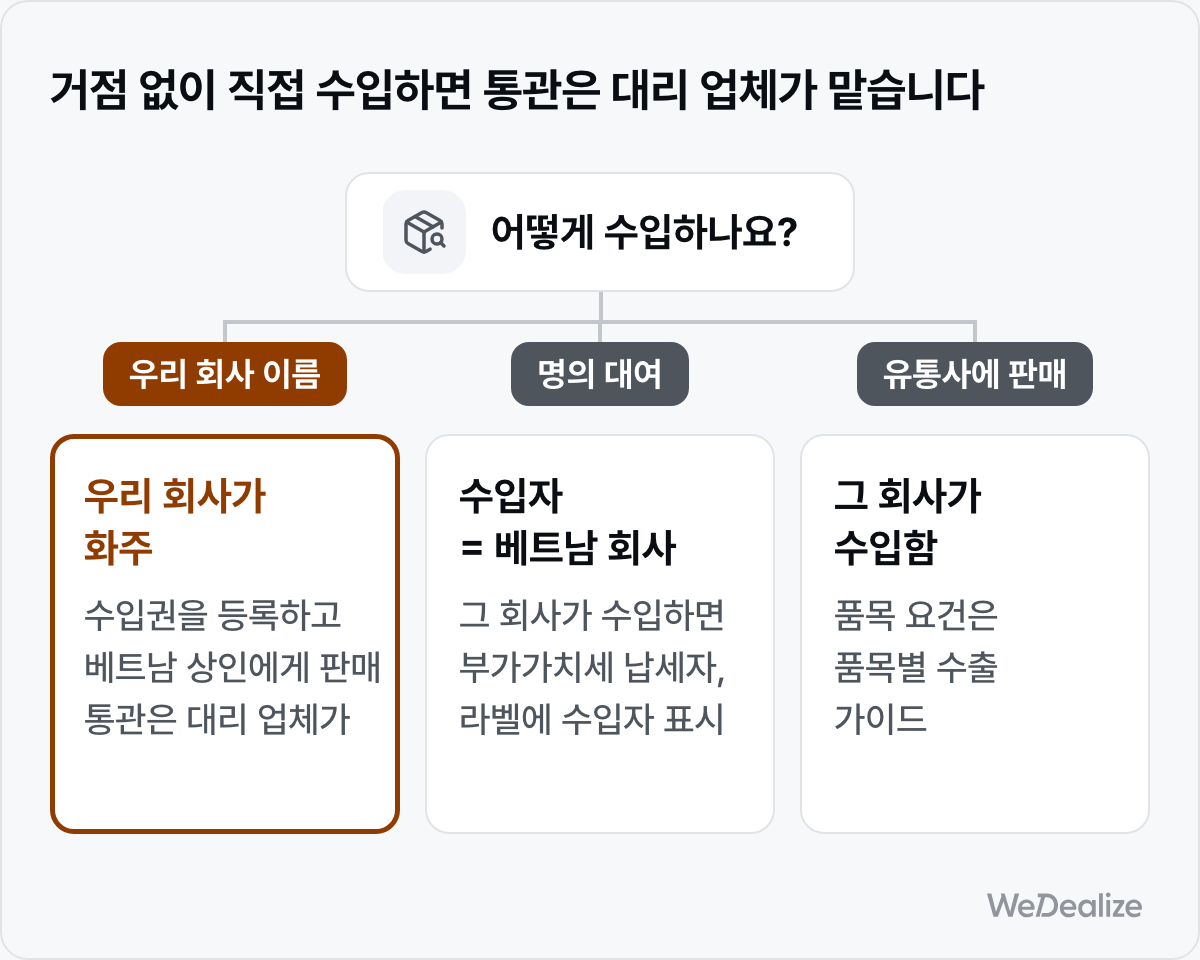
Who does what — The “using another company’s name” column is based on the method where a Vietnamese company declares itself as the importer. The details are provided in the sections in the right-hand column.
Task | Under our company’s name | Using another company’s name | Details |
|---|---|---|---|
Import declaration | Customs clearance agent | That company | Under our company’s name · Using another company’s name |
Payment of import VAT | Our company | That company | When importing |
Importer information on label·quality declaration | Our company | That company | Selling in Vietnam › Product obligations |
Importing under our company’s name — Our company, which has no establishment in Vietnam, registers its import rights and imports the goods as the cargo owner (chủ hàng hóa). See “Importing and selling under our company’s name.”
Using an importer’s name — A Vietnamese company becomes the importer and imports our company’s goods. See “Importing and selling using an importer’s name.”
Importing and selling under our company’s name
This applies when our company imports the goods as the cargo owner without an establishment in Vietnam and sells them to a Vietnamese trader.
Foreign trader without an establishment — Under Decree 90/2007 on import rights, this means a foreign trader with neither direct investment nor a representative office or branch in Vietnam. If it has even one representative office or branch, it is not subject to this decree.
Only within the scope of import rights — From September 5, 2026, Decree 292/2026 on foreign trade management applies. Under this decree, such a trader may trade goods in Vietnam only within the scope of export and import rights prescribed by the government.
Import-rights registration — Under Decree 90/2007 on import rights, obtaining an import-rights registration certificate allows the import of goods permitted under Vietnamese law and included in Vietnam’s market-opening commitment schedule. Imported goods may be sold to Vietnamese traders registered to do business in those goods.
Registration application — Application documents must be prepared in both English and Vietnamese and authenticated and consularly legalized by Vietnamese diplomatic missions abroad or other relevant authorities. Once the documents are complete, the registration certificate is issued within 30 business days and is valid for up to five years.
Publication of registration details — Within five business days from the date the registration certificate is received, publish its contents three consecutive times in mass media or a nationwide newspaper.
Tax identification number — After receiving the registration certificate, register a tax identification number with the tax department of the locality where the certificate was issued.
Customs clearance agent — Under Decree 08/2015 on customs procedures, if the cargo owner is a foreign trader without an establishment in Vietnam, customs clearance must be conducted through an agent. The agent is a Vietnamese customs clearance agent (đại lý làm thủ tục hải quan).
Sales VAT — The seller is the taxpayer. See “Sales tax — value-added tax” under “Selling in Vietnam” below.
Importing and selling using an importer’s name
This applies when a Vietnamese company becomes the importer and imports our company’s goods.
Assigning only customs clearance does not change the cargo owner — Under Decree 08/2015 on customs procedures, a customs clearance agent may also be the customs declarant. Under the Law on Customs, the agent performs the cargo owner’s declaration and tax payment obligations within the scope authorized by the cargo owner. Therefore, if we only assign customs clearance, our company remains the cargo owner and follows the procedures described above under “Importing and selling under our company’s name.”
Entrusted import arrangement — Customs document rules provide for entrusted import (ủy thác nhập khẩu), under which a Vietnamese company is entrusted with importing the goods. If the entrusted company imports goods subject to licensing or specialized inspection under the entrusting party’s license, it submits a copy of the entrustment agreement to customs.
Resale arrangement — If a Vietnamese company buys the goods from our company and imports them, this is a buyer sale → Product-Specific Export Guide
Import VAT — If the Vietnamese company imports the goods as the importer, that company is the taxpayer for import VAT. See “When importing” for the taxpayer rules and deduction requirements.
Labeling and quality obligations — Under Decree 37/2026 on the Law on Product and Goods Quality, compliance with labeling requirements for imported goods and quality-control requirements before distribution is the obligation of the organization or individual importing the goods. If that company is the importer, it performs these obligations.
What to stipulate in the contract — The contract should specify responsibility for additional customs duties, recall costs, and the transfer of remaining inventory when the contract ends.
Sales VAT — Even when another company’s name is used, the party selling to consumers is the taxpayer. See “Sales tax — value-added tax” under “Selling in Vietnam” below.
When importing
Customs value — Under the Ministry of Finance’s circular, the customs value is the price actually payable up to the first port or airport of import, and six methods, including the transaction value method, are applied in sequence. For imported goods without a sales contract or commercial invoice, the declared price is the customs value. If customs has grounds to believe that the declared price is incorrect, it redetermines the value using the prescribed methods (Customs valuation).
Import duty and FTA — Under the Ministry of Industry and Trade’s circular, the certificate of origin form issued by Korea under the Korea–Vietnam FTA is KV. VK is the form issued by Vietnam. Product-specific rates are not included in this guide.
Standard rate: 10% — Under the Law on Value-Added Tax (48/2024), the VAT rate for goods not subject to the 0% or 5% rates is 10%.
8% through the end of 2026 — Under National Assembly Resolution 204/2025, goods subject to the 10% rate are subject to an 8% rate from July 1, 2025, through December 31, 2026. Telecommunications, financial services, real estate, metal products, goods subject to special consumption tax, and other items are excluded from the reduction. The reduction applies equally at the import stage.
Tax base — The VAT tax base for imported goods is the customs value for import duty plus the import duty. Additional import duties, special consumption tax, and environmental protection tax are also added when applicable.
Taxpayer — Under the Law on Value-Added Tax, an organization or individual importing taxable goods is the “importer” and the VAT taxpayer.
Filing deadline — Under Vietnam’s Law on Customs, the customs declaration for imported cargo is filed before the cargo arrives or within 30 days from the date of arrival. The declaration is valid for 15 days from the date of registration.
Payment before customs clearance — Under the decree on import rights, a foreign trader without an establishment must pay taxes and fees or provide security before the goods are cleared through customs.
Requirements for deducting import VAT — Under the Law on Value-Added Tax, a business calculating VAT under the credit method may deduct the VAT on imported goods used to sell taxable goods. Proof of payment of VAT at the import stage is required, as is proof of non-cash payment except in certain cases prescribed by the government.
Selling in Vietnam
Sales tax — value-added tax
Sales VAT taxpayer — Under the Law on Value-Added Tax, an organization, household, or individual producing or trading taxable goods is a “business operator” and a VAT taxpayer.
Rate — The same rate table as at the import stage is used. See “When importing” above for the rates.
Tax identification number — A foreign trader without an establishment registers a tax identification number after registering its import rights. See “Importing and selling under our company’s name” above.
Product obligations
Required Vietnamese information — Under Decree 37/2026 on the Law on Product and Goods Quality, the required information on labels of goods distributed in Vietnam must be written in Vietnamese. The required information includes the product name, the name and address of the responsible organization or individual, the origin, and information prescribed for each product category.
Supplementary label — If an imported product’s label lacks or has insufficient required Vietnamese information, leave the original label intact and affix a Vietnamese supplementary label. The importing organization or individual must supplement the Vietnamese label before distribution.
Original label at customs clearance — Under Decree 37/2026 on the Law on Product and Goods Quality, the original label of imported goods must physically state the product name, origin, and the name and address of the overseas manufacturer or responsible party at the time of customs clearance. The information may be written in a foreign language. If the original label does not contain the manufacturer’s or overseas responsible party’s official name and address, both must be stated in accompanying or shipping documents.
Importer’s name — Labels on imported goods to be distributed in Vietnam must state the name and address of the manufacturer and importer.
Changed labeling rules — From January 23, 2026, labels must comply with Decree 37/2026 on the Law on Product and Goods Quality. Goods labeled and produced, imported, or distributed under the previous labeling decrees (43/2017·111/2021) before that date may continue to be distributed until the expiration date indicated on the label.
Quality control of imported goods — Under the amended Law on Product and Goods Quality, effective January 1, 2026, imported goods must have the applicable standard declared and must be labeled in accordance with the law before distribution. This obligation lies with the organization or individual importing the goods.
Medium- and high-risk products — For medium-risk products, conformity with technical regulations must be declared (công bố hợp quy). For high-risk products, registration for import quality inspection must be filed through the National Single Window portal.
Where to find the product lists — The Ministry of Industry and Trade determines the list of medium- and high-risk products under its authority and publishes it on the Ministry of Industry and Trade portal.
Recall of defective goods — Under the Law on Protection of Consumer Rights, a business must recall and handle defective goods when it discovers them and take measures to protect consumers during the recall.
Online sales pages — For quality and labeling information that sellers on their own websites or marketplaces must disclose, and for disclosure of defective goods, see “Certification and labeling” under Vietnam Sales Guide — Cross-Border E-Commerce.
Corporate income tax (permanent establishment)
Treaty standard — Under the Korea–Vietnam Tax Treaty, Vietnam may tax our company’s business profits only when our company conducts business through a permanent establishment in Vietnam. A branch or office is included as a permanent establishment.
Merely keeping inventory — Using facilities or keeping inventory solely to store or display goods does not constitute a permanent establishment. Because delivery is not included in the treaty’s list of exceptions, consult a tax professional if goods are dispatched from a warehouse in Vietnam.
Dependent agent — If a person other than an independent agent habitually exercises authority in Vietnam to conclude contracts in our company’s name, our company is deemed to have a permanent establishment. This deemed status does not apply if the person’s activities are limited to activities on the exceptions list, such as storage or display.
Independent agent — Conducting business through an independent agent, such as a broker or general commission agent, does not by itself constitute a permanent establishment. This applies only when the agent acts in the ordinary course of its business.
What to tell consumers and withdrawal·returns
Same as cross-border direct sales — Under the Consumer Protection Act, a distance transaction is a transaction conducted online or by other means without the consumer directly inspecting the goods. Online sales are distance transactions even when goods are shipped from a warehouse in Vietnam. For cancellation·returns and information displayed on the screen, see 「Withdrawal and Returns」 and 「Certification·Labeling」 in Vietnam Sales Guide — Cross-border Direct Sales.
When receiving returns back in Korea — See Overseas Returns Handling Guide for return pickup.
Requirements to continue observing after registration
Annual reports — Under the decree implementing import rights, a foreign trader without an establishment must report its import and export performance annually and must also report whenever requested. If it fails to submit an annual report or a requested report for two consecutive years, its registration certificate will be revoked.
Changes to the registration certificate — If the name·address, signing representative, or items change, apply in writing for an amendment. The application is processed within 15 business days, and the changed information must be publicly disclosed three consecutive times within 5 business days.
Renewal of the registration certificate — Renewal may be applied for 60 business days before the validity period expires, and the validity period of the renewed registration certificate is 5 years.
When ending operations — If operations are ended voluntarily or upon expiration of the term, notify the issuing authority and publicly disclose the notice three consecutive times no later than 60 days before the scheduled date. All debts and obligations to the state, organizations, and individuals in Vietnam must be settled.
Retention of customs documents — Under the Customs Law, the cargo owner must retain the customs documents for cleared cargo for 5 years from the date the declaration is registered. If the cargo owner is a foreign trader without an establishment, the customs brokerage company retains the customs documents.
Post-clearance audit — Under the Customs Law, customs authorities may conduct a post-clearance audit within 5 years from the date the declaration is registered.
If payment is late — Under the Tax Administration Law (108/2025, effective July 1, 2026), if taxes are paid after the deadline, late-payment interest of 0.03% per day is imposed on the overdue amount. The same applies to taxes collected by customs.
Connecting through WeDealize
Sales in which each order is express-shipped from a Korean center to Vietnam are covered in Vietnam Sales Guide — Cross-border Direct Sales and Overseas Direct Shipping Guide.
Common mistakes
Misconception: 「We can sell directly to Vietnamese consumers in our company’s name even without a legal entity in Vietnam」 — This is not necessarily true. A foreign trader without an establishment may conduct transactions only within the scope of its import rights, and imported goods may be sold to a Vietnamese trader registered to trade in those goods.
Misconception: 「Import-rights registration is unnecessary if a customs brokerage company files the declaration for us」 — No. Even if the brokerage company files the declaration, our company is the cargo owner. See 「Importing and selling by borrowing an importer’s name」 above.
Misconception: 「The FTA certificate of origin received from Korea uses the VK form」 — No. The form issued by Korea is KV, while VK is the form issued by Vietnam.
Items not confirmed
Taxpayer for entrusted imports — When entrusting a Vietnamese company with imports, confirm with Vietnamese customs which party—the entrusting party or the entrusted party—pays the import duty and import VAT.
Deduction of import VAT — Confirm with the Vietnamese tax authorities whether a foreign trader without an establishment can deduct import VAT and which party may deduct it in an entrusted import arrangement.
Seller of inventory imported under another party’s name — Confirm with Vietnam’s Ministry of Industry and Trade whether our company, which has no establishment, can directly sell inventory imported under a Vietnamese company’s name.
Retail and online sales by a trader registered for import rights — Confirm with the Ministry of Industry and Trade whether a foreign trader registered for import rights can sell directly to Vietnamese consumers or online marketplaces.
Scope of imports and sales by a representative office·branch — If there is a representative office or branch, confirm with Vietnam’s Ministry of Industry and Trade the scope within which goods may be imported and sold through that establishment.
Taxes on sales without an establishment — Confirm with the Vietnamese tax authorities the VAT and corporate income tax treatment of sales revenue from our company, which has no establishment, to Vietnamese traders.
VAT filing frequency — Confirm with the Vietnamese tax authorities whether VAT must be filed monthly or quarterly and the filing deadline.
Special consumption tax taxpayer — When importing goods subject to special consumption tax, confirm with the Vietnamese tax authorities who is responsible for filing and payment.
Import requirements for cosmetics·food — Confirm with Vietnam’s Ministry of Health and other competent authorities the cosmetic product declaration and local responsible-company requirements, as well as food self-declaration and import inspection requirements.
Amendments to the Korea–Vietnam FTA rules of origin form — Confirm with the Ministry of Industry and Trade whether the amendments to the rules of origin regulations (40/2015) (48/2015·09/2022) changed the KV form.
Risk level of electrical products — Check the lists of the Ministry of Industry and Trade and the Ministry of Science and Technology to determine whether the electrical products for sale are included among medium- or high-risk items.
Unsold inventory — Confirm with Vietnamese customs whether import duty and import VAT can be refunded when inventory is re-exported.
Related terms
IOR (Importer of Record) — The party that imports goods into the sales country and bears primary responsibility for paying customs duties.
Customs broker — A customs broker is a customs professional who, at the request of a cargo owner or other client, handles import and export declarations, calculates customs duties, and performs related tasks.
Certificate of Origin (C/O) — A Certificate of Origin (C/O) is a document certifying the origin of goods and is required to apply preferential tariff treatment under an FTA.