France Sales Guide — Local Sales
Automatically translated from Korean.
One-line summary — For local sales in France, even if customs clearance is handled by an indirect representative, our company selling in France automatically accounts for import VAT using its VAT number. A company outside the EU generally cannot be the declarant for imports, so a representative in the EU files the declaration, and our company obtains an EORI number and a French VAT number.
Scope of this article — When importing under our company’s name, without a French legal entity, or importing under the name of a French company and selling from French stock covered in other articles — Sending each order by express courier or post → France Sales Guide — Cross-Border Direct Sales · Korean export declaration when shipping out stock → Export Declaration · VAT on exported goods → Zero Rate · Producer registration by Member State → EPR · Product safety representative → EU Responsible Person (GPSR)
Check first
Is this the right article? — If you send each order from Korea, see France Sales Guide — Cross-Border Direct Sales. If you keep stock in France and ship from France, someone must file the import declaration, so this is the right article. If you sell to a French distributor or importer, that company imports the goods → Product-Specific Export Guide
What do you have in France? — If you sell to a French legal entity (subsidiary) and that entity imports the goods, see Product-Specific Export Guide. Under EU customs law, a legal entity whose registered office, headquarters, or permanent establishment is in the EU is a person established in the EU. A permanent establishment is a place of business where people and equipment are permanently present and customs-related activities are carried out. If you have a permanent establishment such as a branch, see the corporate tax sections under “Importing and selling under our company’s name” and “Selling in France” below. If you have none of these, read this entire article.
Who are you selling to? — Depending on whether you sell to French consumers, to a business with a French VAT number, or through a marketplace, the party responsible for reporting sales VAT differs. See “Selling in France” below.
Are these packaged goods, batteries, or electrical and electronic equipment? — Producers must obtain a unique identifier (IDU) for each product category. See “Product obligations” under “Selling in France” below.
Are they cosmetics or consumer products? — A responsible person in the EU is required before the products can be placed on the market. See “Product obligations” under “Selling in France” below.
Order of tasks
Decide whether our company can be the importer of record itself or whether to have an indirect representative in the EU file the declaration → Selling in France
Before the first import, obtain an EORI number and a French VAT number, and check whether a tax representative is required. The VAT number must be included in the import declaration for automatic accounting → Importing and selling under our company’s name
If you borrow another party’s importer name, specify the declaration representation method and allocation of costs in the contract → Importing and selling under a borrowed importer name
Prepare sales VAT filings → Selling in France › Sales tax
Obtain a producer unique identifier for each product category, and arrange an EU responsible person and French-language labeling → Selling in France › Product obligations
Determine the customs value, origin, and payment method, and file the import declaration → When importing
Include sales-page disclosures and withdrawal-right information on the product page → Information for consumers and withdrawal and returns
Continue VAT filings and document retention → Ongoing compliance after registration
Selling in France
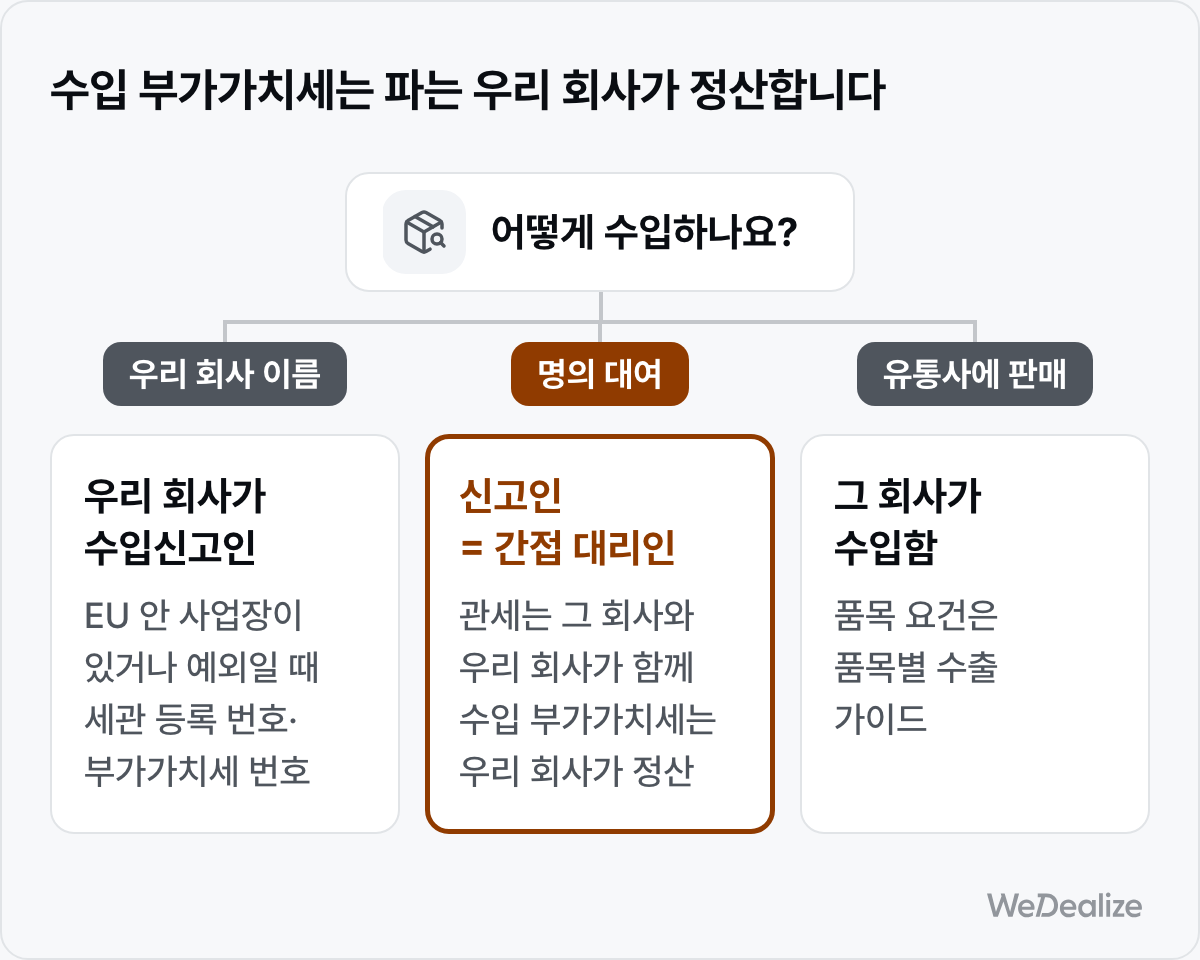
Who does what — The “borrowed name” column is based on indirect representation. The explanations are in the sections of the right-hand column.
Task | Under our company’s name | Using a borrowed name (indirect representation) | Details |
|---|---|---|---|
Submission of import declaration | Our company | That company | Under our company’s name · Using a borrowed name |
Payment of customs duties | Our company | That company · Our company | Using a borrowed name · When importing |
Payment and deduction of import VAT | Our company | Our company | Using a borrowed name · When importing |
Sales VAT filing | Our company | Our company | Selling in France › Sales tax |
Importing under our company’s name — Our company becomes the importer of record, imports the goods, and then sells them from a warehouse in France or elsewhere. If there is no permanent establishment in the EU, an exception must apply. See “Importing and selling under our company’s name.”
Borrowing an importer’s name — A French company files the import declaration in its own name as an indirect representative, and our company sells the goods in France. See “Importing and selling under a borrowed importer name.”
Importing and selling under our company’s name
This applies when our company imports the goods as the importer of record and then sells them from a warehouse in France or elsewhere.
Importer of record — Under EU customs law, the importer of record must be established in the EU customs territory. Exceptions include declarations for transit or temporary admission and occasional declarations that customs considers justified.
EORI number — According to French Customs guidance, a company outside the EU must obtain an EORI (customs registration number) to clear customs in France. Apply through SOPRANO EORI on the French Customs website before customs clearance; issuance is free. The number has the format “FR + country code + number assigned by customs.” If you have already obtained one in another EU Member State, you do not obtain another one in France.
Customs representative — Under EU customs law, anyone may appoint a customs representative. A direct representative files in the name of the person represented, while an indirect representative files in its own name on behalf of the person represented.
French VAT number — According to French Customs guidance, a company without a French VAT number must obtain one from the tax authorities to import into France, regardless of where it is established. Enter the number on every import declaration. However, as described below under “Selling only to businesses,” imports may be made without a number by appointing an international representative.
Tax representative — According to the French tax authority’s guidance, a company outside the EU must appoint a tax representative (représentant fiscal) if it must pay or report French VAT. The tax representative is a business established in France that files returns and pays VAT on the company’s behalf. If no representative is appointed, the counterparty must pay the VAT and penalties. A company from a country that has a mutual assistance agreement with France on tax collection and administrative cooperation does not need to appoint a tax representative. According to French tax authority guidance dated 2017-05-03, companies established in the Republic of Korea are subject to treatment similar to EU companies. Companies from such countries may appoint a permanent representative (mandataire permanent), as EU companies do.
Selling only to businesses — According to the French tax authority’s guidance, this is an option for a company that is not established in France and does not have a French VAT number. If you sell only to businesses with VAT numbers, you may appoint an international representative (mandataire à l'international). If you designate the French storage provider holding the goods or the customer as the international representative, that representative files the import VAT and sales returns on your behalf. This option cannot be used if you also sell to customers without VAT numbers, and it can no longer be used once you obtain a VAT number.
Sales VAT — The party selling in France registers and files the returns. See “Sales tax — VAT” under “Selling in France” below.
Importing and selling under a borrowed importer name
This applies when a French company files the import declaration in its own name as an indirect representative and our company sells our goods in France.
Current rules
Filing through indirect representation — Under EU customs law, if that company files as an indirect representative, that company, as the declarant, is the customs debtor, and our company, which entrusted it with the declaration, is also a debtor.
If the representative is not disclosed — Under EU customs law, if a person files without disclosing that it is acting as a representative, it is deemed to have filed in its own name and on its own account.
Importer and person liable for VAT on the declaration — According to French Customs Q&A, the importer on a standard import declaration is the person filing the declaration or the person who entrusted the filing to them. The importer and the person liable for import VAT are determined separately.
Our company selling the goods pays the import VAT — Even if an importer’s name is borrowed, if our company is the party selling to customers in France, our company pays the VAT. See “Person liable for tax” under “When importing” below.
Our company also claims the deduction — According to French Customs guidance, the person liable for import VAT accounts for both the payment and deduction on its VAT return. According to a French Customs notice, corrections to import VAT are also made by the business whose number is entered as the person liable for tax on the import declaration. A customs representative other than the person liable for tax cannot make the correction.
Inform the representative of the VAT number — According to French Customs Q&A, a customer required to have a French VAT number must provide it to the representative filing the declaration. If the representative improperly indicates that import VAT will be paid to customs without the number, the representative cannot recover from customs the tax paid. The customer may be subject to sanctions by the tax authority.
When the company’s joint and several liability is released — According to French Customs Q&A, an indirect representative is not jointly and severally liable for import VAT if it has fulfilled its declaration obligations and delivered the documents. The documents to be delivered are the information needed to determine the taxable base and the documents needed for deduction, and the deadline is no later than receipt of the goods.
Resale arrangement — If the French company buys the goods from our company, imports them, and sells them, that company is the importer and the buyer that sells the goods. In this case, see the Product-Specific Export Guide.
What to specify in the contract — Specify in the contract who bears any subsequent customs assessment, recall costs, transfer of remaining stock when the contract ends, and retention of declaration documents.
Sales VAT — If our company is the party selling in France, VAT registration and the tax representative are handled as described in “Sales tax — VAT” under “Selling in France” below.
Product responsibility — Under EU rules, responsibility for cosmetics and product labeling obligations lies with the importer. Specify in the contract whether the company lending its name or our company will take responsibility. See “Product obligations” under “Selling in France” below.
Effective date of changes — 2027-09-21
New EU Customs Code — The new EU Customs Code will generally apply from 2027-09-21. Under the new law, there is one importer at a time, and the importer must guarantee payment of customs duties and other charges.
The indirect representative assumes the importer’s obligations — Under the new law, the importer must be established in the EU customs territory. This requirement does not apply when an indirect representative in the EU acts as representative. In that case, an indirect representative representing an importer outside the EU is deemed to be the importer for importer obligations such as guaranteeing payment of customs duties.
When importing
Customs value — Under EU customs law, the primary method for determining customs value is the transaction value of goods sold for export to the EU. If the goods are sent as our company’s stock without being sold, this value cannot be used. In that case, the value is determined in the following order: the transaction value of identical goods, similar goods, the value calculated backward from the unit price at which the goods are sold in the EU, and the value calculated from the cost. At the declarant’s request, the order of the last two methods may be reversed.
Preferential origin (EU–Korea FTA) — For the requirements for making an origin declaration, see “Customs duties and taxes” in France Sales Guide — Cross-Border Direct Sales.
Taxable base — The taxable base for import VAT (the amount used to calculate the tax) is the same as in “Customs duties and taxes” in France Sales Guide — Cross-Border Direct Sales.
Person liable for tax — According to French Customs guidance, when imported goods are supplied in France, the person making that supply pays the import VAT. In other cases, the consignee listed on the import declaration—the person receiving the goods—pays it. A customs representative filing through indirect representation is also jointly liable for payment.
Automatic accounting — From January 1, 2022, businesses with a French VAT number do not pay import VAT to customs at the time of customs clearance. They report it together as VAT payable and VAT deductible on their VAT return (autoliquidation). The French VAT number must be entered on the import declaration.
The number comes first for deduction — According to the French customs Q&A, a foreign company must provide its French VAT number to customs at the time of customs clearance to use automatic accounting for import VAT. Therefore, obtain the number before the first import.
Deferred payment — Under the Union Customs Code, customs duty payment can be deferred for 30 days if security is provided and an application is submitted. The application can be made per shipment or for imports accumulated over a period of no more than 31 days. If applying for accumulated imports, the period is counted from the day after the end of that period and is reduced by half the number of days accumulated.
Declaration deadline — For the deadline for temporary storage (the status in which goods are held under customs supervision before customs clearance), see “Importer” in the France Sales Guide — Cross-Border Direct Sales.
Selling in France
Sales tax — VAT
Rates — Product-specific rates, including the standard rate of 20%, are the same as those in “Customs Duties and Taxes” in the France Sales Guide — Cross-Border Direct Sales.
Sales to consumers — According to French customs guidance, a company not established in France must pay VAT when it sells to a customer without a French VAT number. Therefore, French VAT registration is required.
Sales to businesses — According to French customs guidance, when selling to a customer with a French VAT number, the customer reports that VAT on its own VAT return.
Registration procedure — For the French VAT number and tax representative, see “Importing and Selling Under Our Company’s Name” above. Even if another party lends its name, the party selling to consumers must register.
Price display — For displaying tax-inclusive prices and sales terms, see “Sales Page” under “Certification and Labeling” in the France Sales Guide — Cross-Border Direct Sales.
Selling on marketplaces
Current rules — Under the EU VAT Directive, when a seller not established in the EU sells goods located in the EU to consumers through a marketplace, the marketplace is deemed to have received and directly supplied those goods.
From January 1, 2027 — Amendments to the EU VAT Directive expand the cases in which a marketplace is deemed to be the supplier to include certain sales to businesses. These businesses are those for which VAT is not charged on goods purchased in another Member State, such as businesses that conduct only exempt transactions for which input VAT cannot be deducted.
Product obligations
Unique Identifier (IDU) — According to guidance from the French Agency for Ecological Transition (ADEME), an importer that imports products and places them on the French market is also a producer. For obtaining and displaying the number, marketplace sales, and penalties, see “Before Sale” under “Certification and Labeling” in the France Sales Guide — Cross-Border Direct Sales.
When using a fulfillment provider — Under EU packaging regulations, a producer selling packaged products to consumers must provide registration information and a declaration of conformity when entering into a contract with a fulfillment provider. If the information is not corrected, the fulfillment provider suspends its services to that producer.
EU responsible person — Under the EU General Product Safety Regulation, a product cannot be placed on the market if it has no responsible economic operator within the EU. This operator is one of an EU-based manufacturer, importer, or authorized representative with a written mandate. If none of these exists, it is the EU-based fulfillment provider handling the product. The operator’s name and postal and electronic addresses must be displayed on one of the product, packaging, parcel, or accompanying documents.
Importer under EU regulations — Under the EU General Product Safety Regulation, an importer is a person established in the EU who places a product from outside the EU on the EU market. The importer must display its name and postal and electronic addresses on the product, or, if this is not possible, on the packaging or accompanying documents.
Cosmetics — Under the EU Cosmetics Regulation, only cosmetics for which a responsible person has been designated within the EU may be placed on the market. For imported cosmetics, the importer is the responsible person. The importer must be established in the EU and may designate another person established in the EU as the responsible person through a written mandate. Before placing the product on the market, the responsible person electronically notifies the European Commission of the product information.
Product liability — For products placed on the market after December 9, 2026 — Under the EU Product Liability Directive, the new directive applies to products placed on the market after December 9, 2026. For products from manufacturers outside the EU, the importer and the manufacturer’s authorized representative are liable for damages. If neither is located in the EU, the fulfillment provider is liable.
French-language labeling — For French-language versions of product descriptions, instructions for use, invoices, and other materials, see “Certification and Labeling” in the France Sales Guide — Cross-Border Direct Sales.
Corporate tax (permanent establishment)
Treaty standard — Under the Korea–France tax treaty, France may tax the profits attributable to our company’s permanent establishment only if our company conducts business through a permanent establishment in France.
Keeping only inventory — The use of facilities or the maintenance of inventory solely for the storage, display, or delivery of goods belonging to our company is not included as a permanent establishment.
Agent — If an agent in France habitually exercises the authority to conclude contracts in our company’s name, our company is deemed to have a permanent establishment. The use of an independent agent, such as a broker or general commission agent conducting business in the ordinary course, does not by itself create a permanent establishment. Even an agent with authority to conclude contracts is not deemed to create a permanent establishment if the agent’s activities are limited to the exception activities described in “Keeping only inventory” above.
Information for consumers and withdrawal and returns
Minimum 14-day withdrawal period — According to French government guidance, consumers who purchase online, by telephone, or by mail can change their mind without giving a reason for at least 14 days. For goods, the withdrawal period begins on the day after the goods are received.
Refunds, return shipping costs, and excluded goods — For the refund deadline, return shipping costs, and goods excluded from the right of withdrawal, see “Withdrawal and Returns” in the France Sales Guide — Cross-Border Direct Sales. For business information and tax-inclusive price displays, see “Sales Page” under “Certification and Labeling” in the same guide.
Ongoing obligations after registration
VAT returns — According to French customs guidance, businesses using automatic accounting for import VAT must submit their VAT returns by the 24th of each month.
Record retention — According to French administrative guidance, books and documents subject to tax audits must be retained for 6 years, accounting books and supporting documents for 10 years from the closing date, and import declarations for 3 years. Under the Union Customs Code, documents required for customs examinations must be retained for at least 3 years.
Annual producer declaration — For the declaration method, see “Before Sale” under “Certification and Labeling” in the France Sales Guide — Cross-Border Direct Sales.
Product incident notifications — For who must report incidents and how to report them, see “After Sale” under “Certification and Labeling” in the France Sales Guide — Cross-Border Direct Sales.
Unsold inventory — Under the Union Customs Code, customs duties can be refunded for goods that had defects at the time of customs clearance or that the importer rejected because they did not conform to the contractual terms, provided they are exported from the EU unused. Instead of exporting them, an application may be submitted for customs authorization to place them under a customs procedure for destruction or another purpose. To obtain a refund, apply within 1 year from the date on which the customs debt was notified.
Connecting through WeDealize
For sales in which each order is express-shipped from the Korea center to France, we have compiled the information in the France Sales Guide — Cross-Border Direct Sales and the Overseas Direct Shipping Guide.
Common mistakes
Misconception: “If I borrow someone else’s name, French VAT registration is unnecessary.” — This is not necessarily true. If our company is the party selling to French consumers, our company must pay VAT. See “Selling in France” above.
Misconception: “If the import declaration is filed in the customs broker’s name, that company pays the import VAT.” — No. Our company, which sells in France, is the person liable for the tax, and the accounting is also carried out using our company’s VAT number. See “Importing and Selling Under a Borrowed Importer Name” above.
Misconception: “Import VAT is paid to customs at the time of customs clearance.” — This is not necessarily true. Businesses with a French VAT number use automatic accounting on their VAT returns. See “When Importing” above.
Items not confirmed
Notice designating countries exempt from appointing a tax representative — Confirm with the French Tax Administration’s Tax Office for Foreign Companies (SIEE) whether the Republic of Korea is listed in the original ministerial notice designating countries exempt from appointing a tax representative.
Deduction of VAT on imports made before registration — Confirm with the Tax Office for Foreign Companies (SIEE) whether import VAT paid to customs before obtaining a French VAT number can be deducted after obtaining the number.
Late-filing surcharge for VAT returns — Confirm with the Tax Office for Foreign Companies (SIEE) the surcharge rate applicable when VAT filing or payment is late.
Domestic implementation of the expanded marketplace deemed-supplier rule — Confirm with the French Tax Administration whether the amendment to the EU directive, under which marketplaces are deemed suppliers for sales to certain businesses from 2027-01-01, has been incorporated into the French General Tax Code.
Importer and producer when borrowing a name — When importing under a borrowed name, confirm with a local expert who is considered the importer under EU regulations and the producer responsible under French producer-responsibility rules.
Deregistration — When ending sales in France, confirm the procedures for cancelling the VAT number and EORI with the Tax Office for Foreign Companies (SIEE) and French customs.
Re-exporting defect-free inventory — When exporting unsold inventory from the EU, confirm with French customs whether customs duties and import VAT can be refunded.
Domestic implementation of the Product Liability Directive — Confirm with the French Ministry of Justice or a local attorney the provisions of the French Civil Code implementing the EU Product Liability Directive applicable to products placed on the market after December 9, 2026.
Related terms
IOR (Importer of Record) — The party that imports goods into the country of sale and bears primary responsibility for payment of customs duties.
Customs broker — A customs professional who, at the request of a cargo owner or other client, handles import and export declarations, calculation of customs duties, and related matters.