France Sales Guide — Cross-Border Direct Sales
Automatically translated from Korean.
One-line summary — Cross-border direct-sales parcels to France are subject to value-added tax (standard rate: 20%) regardless of their value. From July 2026, a €3 customs duty will be charged for each tariff classification on distance-sale consignments of €150 or less, and from November, a €2 handling fee will also be charged. Consumers may withdraw without giving a reason for at least 14 days.
Scope of this guide — When Korean products are sent by international express or post to consumers in metropolitan France for each order (cross-border direct sales), see other guides for the EU common VAT special scheme → IOSS · producer registration by Member State → EPR · product safety responsible person → EU Responsible Person (GPSR) · Korean export declaration, simplified export declaration, and zero-rated VAT → Overseas Direct Shipping Guide · return collection → Overseas Returns Processing Guide
Things to check first
How are you selling? — This guide covers cross-border direct sales sent by international express or post for each order. If you sell to a French distributor or importer, that company imports the goods → Product-Specific Export Guides
Is the destination metropolitan France? — The EU VAT Directive does not apply to French overseas territories designated under EU treaties, so the VAT information in this guide does not apply. The €2 handling fee is charged even when goods are sent to an overseas territory.
Are cosmetics subject to a different rate in overseas territories? — The VAT rate for cosmetics in Martinique, Guadeloupe, and Réunion is 8.5%, which differs from metropolitan France.
What is the VAT rate for the product? — Rates differ by product: cosmetics and hygiene products are subject to 20%, while food is subject to 5.5%, for example. Check the rate first if you intend to display prices inclusive of tax.
Have you prepared the withdrawal notice? — If you do not provide the notice, the period during which consumers may withdraw becomes significantly longer. See “Withdrawal and Returns” below.
Order of tasks
Check the French VAT rate for the product → Customs Duties and Taxes
Check whether each parcel is worth €150 or less and decide whether to register for IOSS → Customs Duties and Taxes
Decide who will pay the customs duties and VAT → Importer
Appoint and register a packaging producer responsibility representative in France → Compliance and Labelling
If the product contains a battery, appoint and register a battery producer responsibility representative → Compliance and Labelling
For cosmetics, appoint an EU Responsible Person and submit the notification → Compliance and Labelling
State the withdrawal right, return shipping costs, and withdrawal exclusions on the product page and in the order confirmation email → Withdrawal and Returns
Ways to sell in France
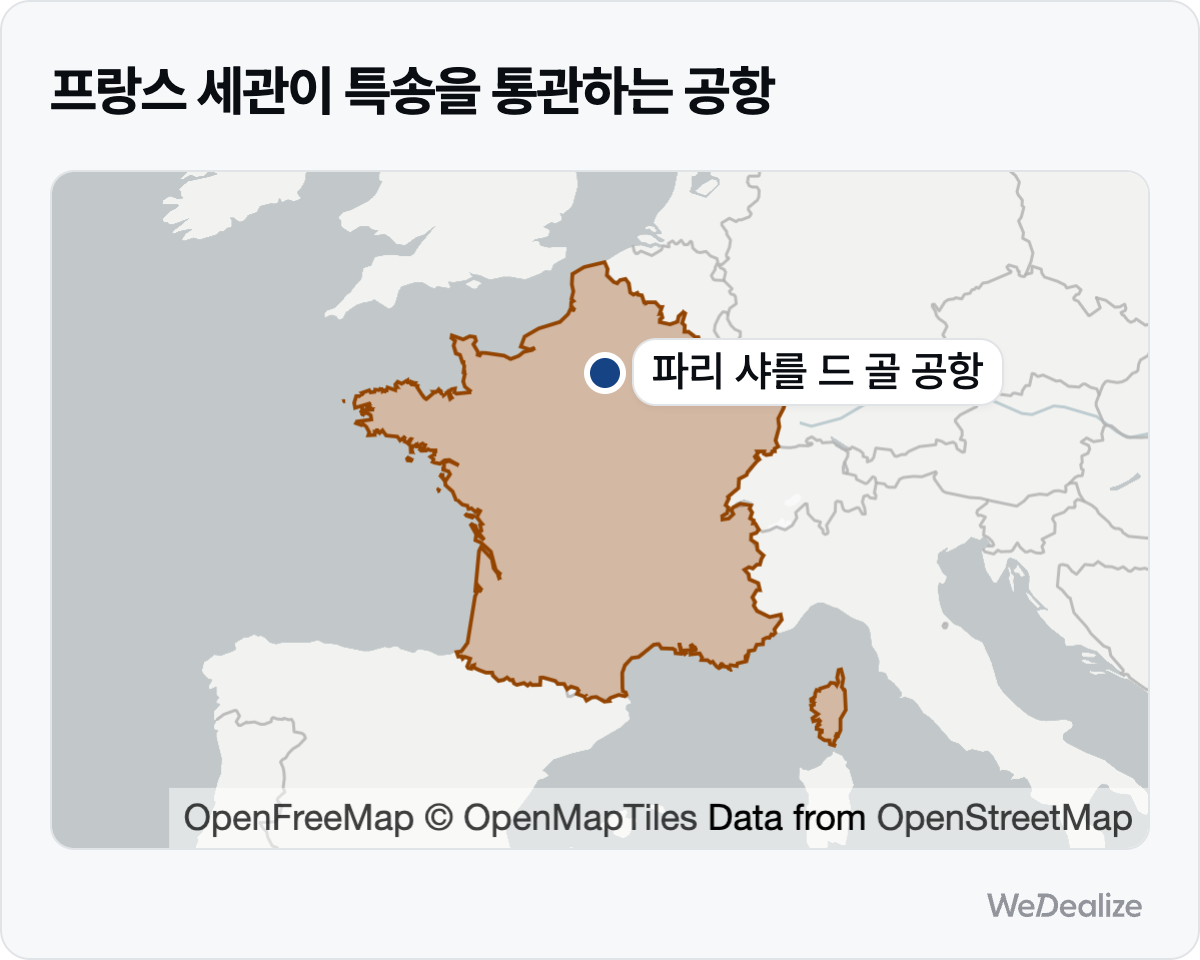
Express or post — Regardless of which method you use, distance-sale consignments are subject to the €3 customs duty and €2 handling fee described under “Customs Duties and Taxes” below.
Sales channels — Customs clearance standards are the same regardless of the marketplace used. When consignments of €150 or less are sold through an overseas marketplace, the marketplace is treated as the supplier under the EU VAT Directive and collects VAT (IOSS). The seller must inform French consumers of their withdrawal right and is responsible for registering as a packaging producer.
Customs Duties and Taxes
Consignments of €150 or less (one shipment sent at a time) — Sellers may register for IOSS, an EU scheme under which VAT on imported goods worth €150 or less is collected at checkout and reported. Once registered, they collect French VAT at checkout. See the IOSS guide for how consignments are handled when not registered. IOSS cannot be used for excise goods such as alcohol and tobacco.
€3 customs duty — From July 1, 2026 through July 1, 2028, consignments of €150 or less sold remotely to consumers will be subject to a €3 customs duty for each tariff classification, regardless of whether IOSS is used. The €3 charge applies regardless of origin. However, consignments not using IOSS may claim preferential tariff treatment under the Korea–EU FTA, in which case the preferential rate applies instead of the €3 charge. A formal import declaration must be filed, and the €2 handling fee remains payable. A statement on origin is required to receive preferential treatment. If a consignment is worth €6,000 or less, an approved exporter is not required: the exporter may write the origin statement prescribed by the agreement on a commercial document such as an invoice and sign it directly. Consignments for which VAT has been collected through IOSS cannot claim preferential treatment.
Tariff classification — The €3 charge applies once to each group of goods sharing the same tariff classification. If two T-shirts of different colors are sent, they may be treated as one classification and incur the €3 charge once. T-shirts and toys have two classifications and incur the charge twice.
€2 handling fee — From November 1, 2026, a €2 handling fee will be charged for each tariff classification on distance-sale goods regardless of value. For goods worth €150 or less, it is charged together with the €3 customs duty, and the marketplace, seller, or carrier pays it.
Product identification numbers — From November 1, 2026, import declarations for distance-sale consignments of €150 or less must include, for each item, the product number assigned by the seller (marketplace), the manufacturer's product number, and, if available, the manufacturer's number under international standards. Provide these numbers to the express carrier.
Abolition of France's parcel tax — The €2-per-parcel tax introduced by France in March 2026 was abolished on July 1, 2026.
Consignments over €150 — Pay customs duties and import VAT through standard import clearance. Check with a customs broker regarding application of preferential tariff rates.
Rates — France's Ministry for the Economy and Finance states that the standard rate is 20%, reduced rates are 10% (including non-reimbursable medicines) and 5.5% (including food), and the special rate is 2.1% (including medicines reimbursed by health insurance).
Cosmetics — The administrative information website identifies cosmetics (such as day creams and night creams) and hygiene products (such as soap and shampoo) as subject to the 20% rate in metropolitan France.
Importer
Decide whether the seller will collect the tax at checkout or whether the recipient will pay it. If the seller pays in advance, this is close to DDP; if the recipient pays upon delivery, this is close to DAP.
Under French customs decisions, the declarant pays the €3 customs duty and the handling fee. When IOSS is used, the declarant is the IOSS registrant or its indirect representative. When IOSS is not used, the declarant is the user of the simplified VAT procedure or its indirect representative; if neither applies, the declarant is the importer's indirect representative. These charges are not imposed on the consumer listed as the importer in the declaration.
If the recipient will become the importer, inform them in advance on the product page.
Compliance and Labelling
Packaging producer registration — Under EU packaging rules, a seller that directly makes packaged products available for the first time to end users in another Member State from outside the EU is also a producer. Producers register in the registry of each Member State where they first make products available, so a seller that sends products directly to French consumers must register separately in France. If it has no establishment in that Member State, it appoints a producer responsibility representative in writing for each Member State. See the EPR guide for the general structure.
Batteries — If you send batteries or battery-containing equipment directly to French consumers, you are a producer under the EU Batteries Regulation. Register in France and appoint a producer responsibility representative in France in writing.
Cosmetics — Under the EU Cosmetics Regulation, only cosmetics with a Responsible Person designated in the EU may be placed on the market. Before placing the product on the market, the Responsible Person electronically notifies the European Commission of the product information. Under the EU market surveillance rules, online sales targeting EU consumers are considered supply to the EU market, so this also applies to cross-border direct sales sent by parcel from Korea.
Product safety — Products from manufacturers outside the EU must have an EU Responsible Person, whose details must be displayed on the product page (EU Responsible Person (GPSR)).
French labelling — According to guidance from the French Ministry of Culture, the requirement to provide information in French applies to products sold in France, including imported products and products sold online.
Withdrawal and Returns
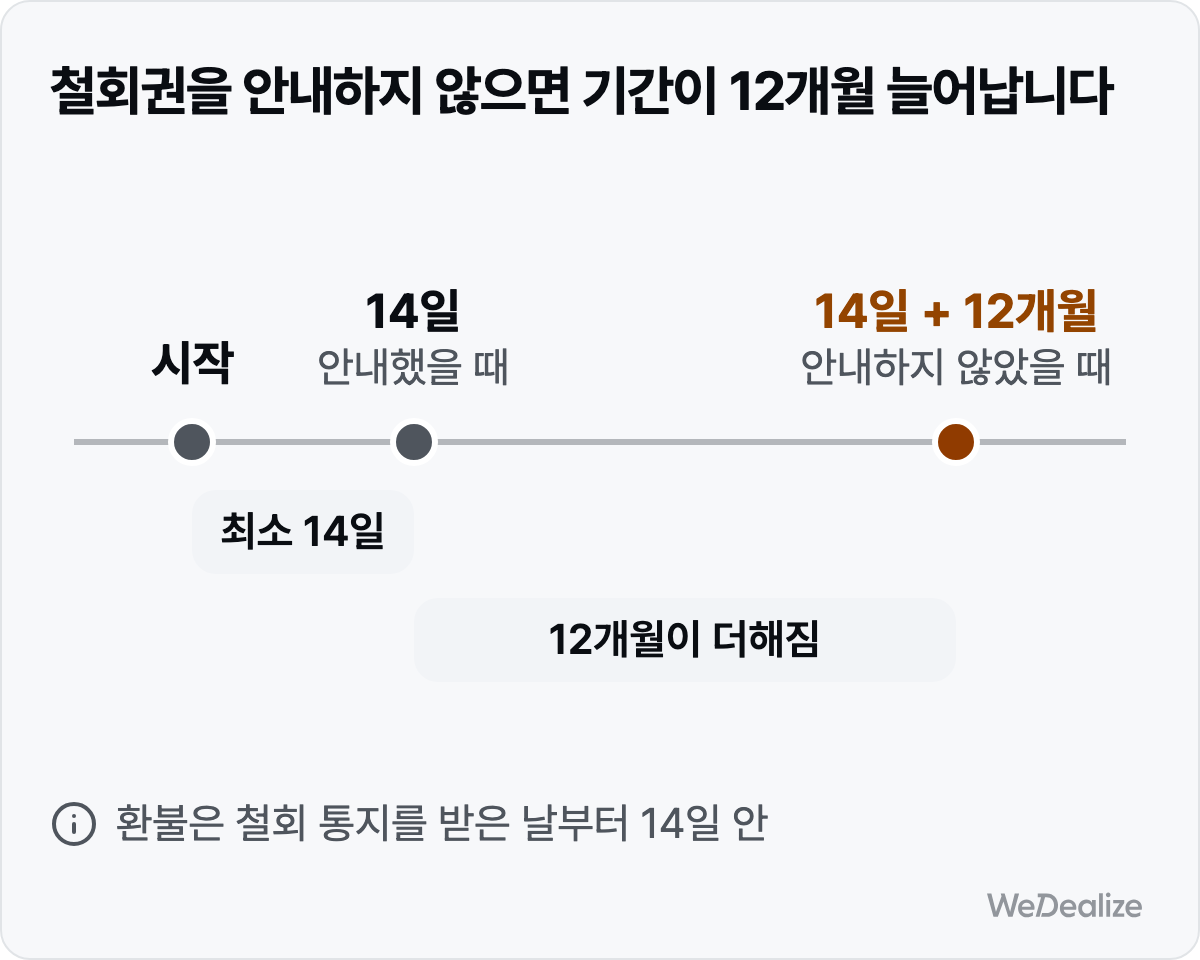
At least 14 days to withdraw — Consumers who buy online, by telephone, or by post may change their minds without giving a reason for at least 14 days. If the seller does not inform them of the withdrawal right, 12 months are added after the original period ends.
Split shipments — If one order is sent in separate shipments, the withdrawal period starts on the day after the consumer receives the last item.
Refund deadline — The seller refunds the consumer within 14 days from the day it receives the withdrawal notice. The seller may delay the refund until it receives the goods or proof of dispatch. The refund includes the original delivery charge, and if the refund is late, the refund amount is automatically increased.
Return shipping costs — As a rule, the consumer bears the direct cost of return shipping. However, the seller may not charge the consumer if it did not disclose this obligation in advance.
Exclusions from withdrawal — Made-to-order products are excluded. Products that cannot be returned for hygiene or health reasons after the consumer has opened them, such as sealed cosmetics, are also excluded. If you sell cosmetics, state this condition on the product page.
Withdrawal button — Under the EU Consumer Rights Directive, contracts concluded online must have a withdrawal button (such as “Withdraw from the contract here”) from June 19, 2026. French government guidance also requires a withdrawal function that remains visible throughout the withdrawal period (such as “renoncer au contrat ici”) and requires the seller to send confirmation of receipt by email or other means, stating the date and time, when the consumer withdraws.
Costs that remain even after a return — The €2 handling fee cannot be refunded once the import declaration has been accepted. For distance-sale goods worth €150 or less, the import declaration cannot be invalidated merely because the goods were returned.
When returned to Korea — Check with a customs broker regarding Korean customs clearance for returned goods.
Connect with WeDealize
The process for dispatching orders from an integrated overseas marketplace by express from the Korean center to France is summarized in the Overseas Direct Shipping Guide.
Transportation and Customs Tips
Enter tariff classifications accurately — Because the €3 customs duty and €2 handling fee are charged for each tariff classification, divide the items accurately on the invoice and provide the information to the express carrier.
Common Mistakes
Misconception: “Cosmetics are daily necessities, so they have a lower rate.” — No. In metropolitan France, cosmetics are subject to the standard 20% rate.
Misconception: “The withdrawal period is always 14 days.” — Not necessarily. If the seller does not provide information about the withdrawal right, 12 months are added.
Misconception: “The consumer always bears the return shipping cost.” — No. The consumer may be charged only if the seller informed them in advance.
Items Not Verified
French domestic provisions — Verify the French provisions on specific producer responsibility procedures, such as unique identification numbers, against the original text on Légifrance.
Related Terms
De minimis threshold in the country of sale — The threshold amount below which the country of sale exempts imported goods from customs duties and taxes.
Customs broker — A nationally qualified professional who files import and export declarations and calculates taxes on behalf of the shipper.
Export declaration — The procedure for declaring to customs the name, quantity, price, and other details of goods to be exported overseas.
Simplified export declaration (e-commerce) — A simplified declaration that reduces the number of fields required in a formal export declaration, mainly used for low-value e-commerce exports.
Zero-rated VAT — A system under which exported goods are subject to a 0% VAT rate and VAT paid on purchases is refunded.