Singapore Sales Guide — Cross-Border E-Commerce
Automatically translated from Korean.
In one line — Cross-border e-commerce products shipped to Singapore are not subject to customs duties unless they are liquor, tobacco, motor vehicles, or petroleum products, but 9% GST (Goods and Services Tax) applies. For items priced at no more than SGD 400 each, GST is collected at checkout by GST-registered sellers; otherwise, the recipient pays import GST when the CIF value (cost of goods, insurance, and freight) exceeds SGD 400.
Scope of this guide — This guide covers sending Korean products to Singapore consumers by international express or post for each order (cross-border e-commerce). Covered in another guide — Korean export declarations, simplified export declarations, and zero-rating → International Direct Shipping Guide · Return collection → International Returns Processing Guide
Check these first
How are you selling? — This guide covers cross-border e-commerce shipped by international express or post for each order. If you sell to a Singapore distributor or importer, that company imports the goods → Product-Specific Export Guide
Is the selling price of each item no more than SGD 400? — This determines whether GST is collected at checkout or upon import. Exclude freight and insurance from the selling price.
Are you required to register for GST? — Overseas sellers must register if their global turnover and supplies to Singapore consumers exceed the thresholds. See “Duties and Taxes” below first.
Is the item prohibited or subject to an import permit? — Chewing gum and e-cigarettes cannot be imported into Singapore. Controlled goods require an import permit even if their value is no more than SGD 400. For home appliances, telecommunications equipment, cosmetics, and food, see “Certifications and Labeling” below.
Steps to take
Check whether the item is prohibited or requires an import permit → Certifications and Labeling
Check whether you must register for GST, and collect GST at checkout for items priced at no more than SGD 400 → Duties and Taxes
Provide the express carrier with information on whether GST is payable and your registration number → Shipping and Customs Clearance Tips
Decide who to list as the consignee (the recipient named on the waybill) and who will pay the taxes → Importer
State your return and refund terms on the product page → Withdrawal and Returns
Ways to sell in Singapore
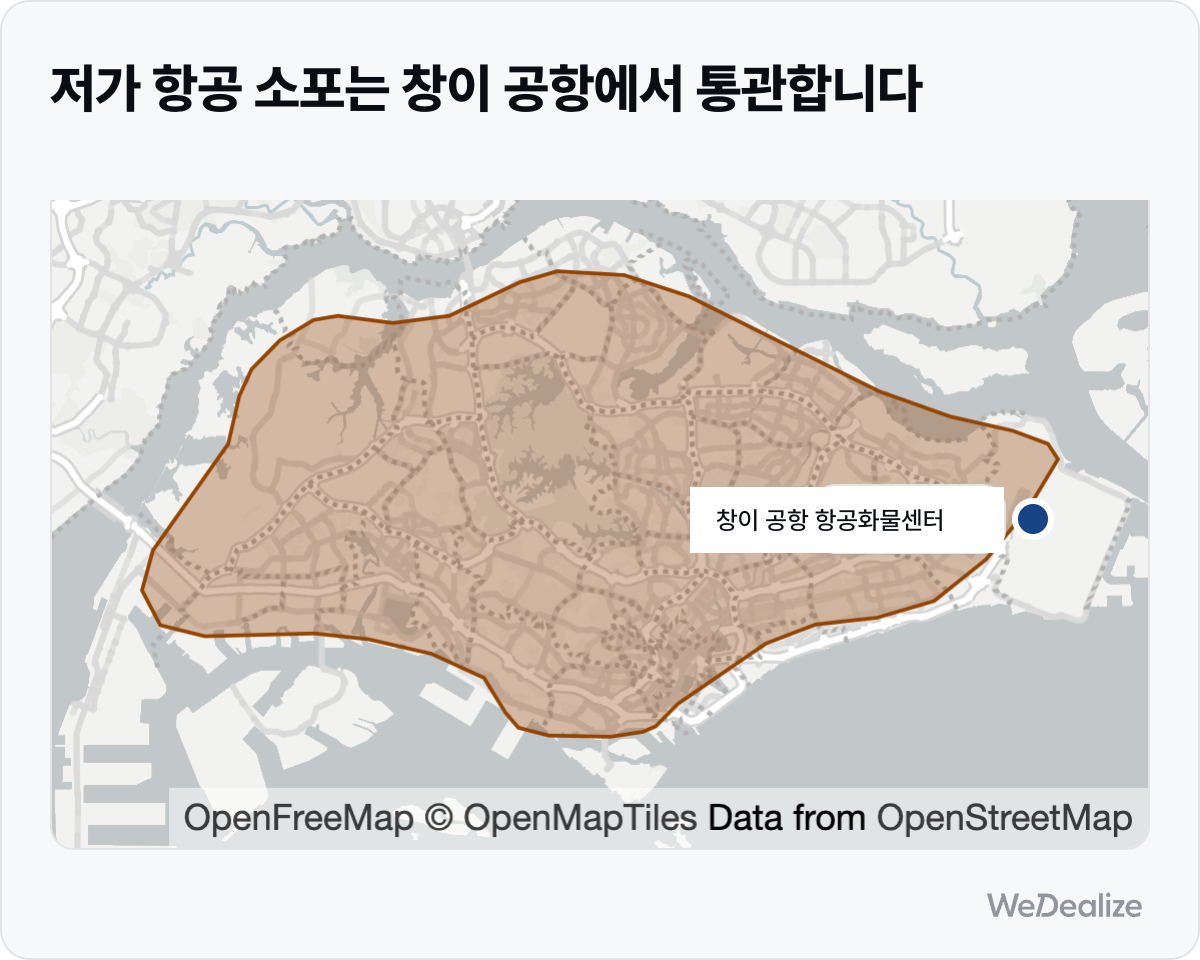
Express — The express carrier files the import declaration on behalf of the recipient. For tax payment, see “Importer” below.
Post — For parcels handled by Singapore Post (SingPost), Singapore Customs determines the CIF value and whether GST relief applies. If GST or customs duties are due, SingPost notifies the recipient, and the parcel is delivered after the recipient pays.
Sales channels — Regardless of the marketplace, customs clearance follows the above criteria based on whether the shipment is sent by express or post. If you sell through an overseas marketplace (electronic marketplace), the marketplace operator may collect GST depending on the circumstances. See “Duties and Taxes” below.
Duties and Taxes
Customs duty and import GST relief
Four types of goods are subject to customs duty and excise duty — According to Singapore Customs, goods subject to customs duty or excise duty fall into four categories: liquor, tobacco products, motor vehicles, and petroleum products and biodiesel blends. Other goods are not subject to customs duty or excise duty, and GST is charged unless relief applies.
Import GST relief (SGD 400) — The CIF value is the total of the cost of the goods, insurance, and freight. Goods brought in by air or post are exempt from GST upon import if their CIF value is no more than SGD 400 (low-value relief). Liquor and tobacco are excluded. This relief remains in place after the 2023 GST changes.
Consolidated as one shipment — Goods sent by the same consignor to the same importer on the same flight are treated as one shipment even if they have separate waybills. Splitting the goods into separate boxes does not help: if the combined CIF value exceeds SGD 400, GST is charged on the full amount.
GST — Overseas Vendor Registration (OVR)
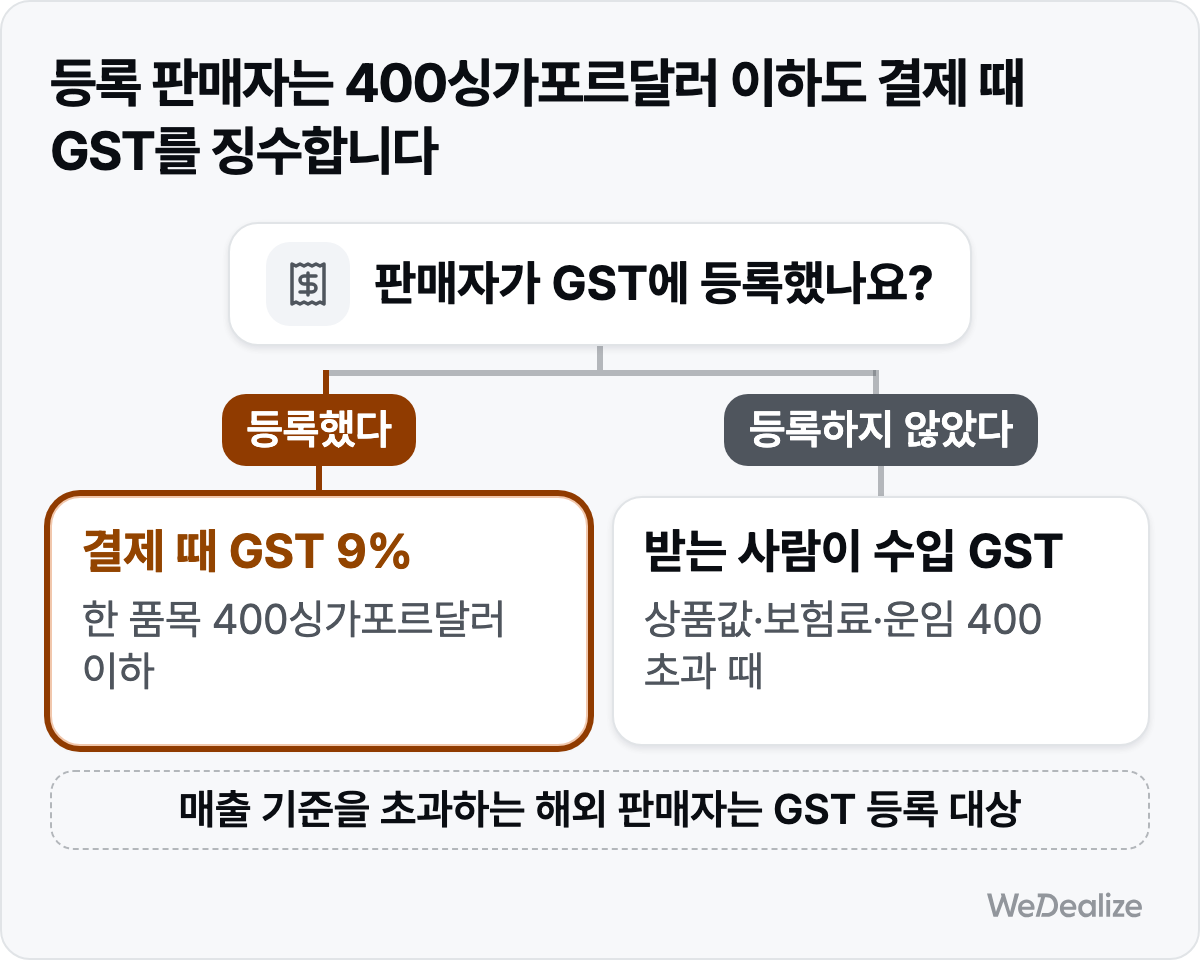
From January 1, 2023, Singapore has charged GST on low-value goods (LVG) worth no more than SGD 400 that are brought in by air or post. This GST is collected under the Overseas Vendor Registration (OVR) regime.
Rate — The GST rate is 9% from January 1, 2024.
Who must register? — Overseas suppliers whose global turnover exceeds SGD 1 million are subject to the rules. Their supplies of low-value goods and remote services to Singapore consumers must also exceed SGD 100,000. If they meet the thresholds, they must register for GST and file and pay the GST collected at checkout. If turnover exceeds both thresholds during a calendar year (January–December), the supplier must notify the Inland Revenue Authority of Singapore (IRAS) within 30 days after the end of that year. If it expects to exceed the thresholds in the next 12 months, it must notify IRAS within 30 days from the first day of that period.
How is the SGD 400 threshold measured? — It is measured using the selling price excluding freight and insurance, assessed separately for each item. Even if the total of an order exceeds SGD 400, each item is still an LVG if its individual price is no more than SGD 400.
When the marketplace collects GST — Depending on the circumstances, an electronic marketplace operator or redeliverer is treated as the supplier. In that case, the operator or redeliverer registers for, collects, and accounts for GST instead of the seller.
Items over SGD 400 — Even a registered seller does not collect GST at checkout if the selling price of an individual item exceeds SGD 400. IRAS cites charging GST on non-LVG items as an example of incorrect collection.
Unregistered sellers — They do not collect GST at checkout. If the CIF value including freight and insurance exceeds SGD 400, the recipient pays GST upon import.
Importer
The importer for express shipments is the consignee named on the waybill. If the final buyer is listed as the consignee on each waybill, each buyer may become the importer.
For items priced at no more than SGD 400, GST-registered sellers collect GST at checkout. Otherwise, the recipient pays import GST and customs duties to the express carrier before or upon delivery. If the recipient is responsible for payment, state this in advance on the product page.
Certifications and Labeling
Chewing gum and e-cigarettes — prohibited imports — According to Singapore Customs, chewing gum and e-cigarettes, vaporizers, and their components cannot be imported into Singapore. The only exception for chewing gum is dental or medicinal gum approved by the Health Sciences Authority (HSA).
Controlled goods — import permit — According to Singapore Customs, an import permit is required for air cargo with a CIF value of no more than SGD 400 if even one item is controlled by a relevant authority. Examples include telecommunications equipment, health products, and chemicals.
33 types of home appliances and gas appliances — SAFETY Mark — Singapore classifies 33 types of household electrical and gas products as controlled goods. Suppliers must register with the Consumer Product Safety Office (CPSO) as registered suppliers. Registration requires a business registration certificate issued by the Accounting and Corporate Regulatory Authority (ACRA). The products may be sold only after completing testing and conformity procedures and affixing the SAFETY Mark.
Telecommunications equipment — personal use is not subject to IMDA registration — According to the Infocomm Media Development Authority (IMDA), consumers do not need IMDA registration or approval when they purchase telecommunications equipment overseas for personal use. The equipment must comply with IMDA standards and must not interfere with public telecommunications networks. To sell it in Singapore, the supplier must declare that it complies with the standards and register it to obtain a registration number and approval for sale and use.
Cosmetics — HSA notification — Cosmetic manufacturers and importers must notify the HSA of their products before supplying them in Singapore. To use the notification system, they must register a local entity with ACRA. Labeling must include the name and address of the responsible company or person placing the product on the market. Labels must be in English.
Food — SFA licence or registration — A licence or registration with the Singapore Food Agency (SFA) is required to import food, and a Cargo Clearance Permit (CCP) is required for each shipment. Confirm with the SFA in advance whether food for sale may be sent by express.
Withdrawal and Returns
Consumer dispute channels — Singapore consumers’ first point of contact is the Consumers Association of Singapore (CASE). CASE helps consumers seek remedies such as refunds, repairs, and exchanges through negotiation and mediation. The Competition and Consumer Commission of Singapore (CCCS) takes action against suppliers that repeatedly engage in unfair practices.
State the return terms first — CASE and CCCS advise consumers to check the seller’s terms of transaction and return and refund policies before making an online purchase. Clearly state the return and refund terms on the product page.
When receiving the goods back in Korea — Goods re-imported within two years from the date the export declaration was accepted may qualify for re-import duty exemption — Consider re-import duty exemption for goods that were not manufactured, processed, repaired, or used overseas and are re-imported within two years from the date the export declaration was accepted. The exemption does not apply if customs duty was reduced or refunded for the goods or their raw materials. Confirm eligibility with a customs broker.
Connect through WeDealize
The process for shipping orders from an integrated overseas marketplace from our Korean center to Singapore by express is covered in the International Direct Shipping Guide.
Shipping and Customs Clearance Tips
Pass GST information to logistics providers — Registered sellers should provide information on whether GST is payable for each item and their GST registration number to the express carrier or other logistics providers.
Late GST information can result in paying twice — If the express carrier has not received the GST information by the time of import, Customs treats the shipment as an ordinary import and charges the recipient import GST. If the recipient pays GST twice, the seller must issue a refund.
Common Mistakes
Misconception: “There are no taxes if the value is no more than SGD 400.” — Incorrect. Import GST is exempted, but GST-registered sellers collect 9% GST at checkout.
Misconception: “If the order total exceeds SGD 400, it is not an LVG.” — Incorrect. LVG status is determined for each item based on its selling price. By contrast, import GST relief is determined based on the combined CIF value of one shipment on the same flight.
Misconception: “Splitting the goods into separate boxes allows the relief to apply.” — Incorrect. Goods sent by the same consignor to the same importer on the same flight are treated as one shipment even if they have separate waybills.
Items Not Yet Confirmed
Details of returns and labeling under consumer protection law — Check the Consumer Protection (Fair Trading) Act (CPFTA) and safety requirements in Singapore’s legislation database.
Remedy period for defective goods (the so-called lemon law) — Confirm the period and requirements with CCCS and CASE.
Information disclosure obligations for online sellers — Confirm with CCCS whether statutory disclosure obligations apply.
Home and gas appliances shipped directly from Korea — Confirm with CPSO whether CPSO registration and the SAFETY Mark are required even for controlled goods shipped directly to consumers.
Cosmetics shipped directly from Korea — Confirm with HSA whether cosmetics shipped directly to consumers are also subject to HSA notification and English labeling requirements.
Related Terms
Customs broker — A nationally licensed professional who files import and export declarations and calculates taxes on behalf of cargo owners.
Export declaration — The procedure for declaring to Customs the name, quantity, price, and other details of goods to be exported overseas.
Simplified export declaration (e-commerce) — A simplified form of formal export declaration with fewer declaration fields, mainly used for low-value e-commerce exports.
Zero-rating — A system under which a 0% VAT rate is applied to exported goods and the VAT paid on purchases is refunded.