Japan Sales Guide — Local Sales
Automatically translated from Korean.
In brief — If a Korean company becomes the direct importer without a Japanese entity, it files import declarations and pays customs duties and import consumption tax by appointing a customs procedure administrator when it has no office in Japan. If it sells goods located in Japan, the sale is a domestic transaction in Japan, so it must confirm its consumption tax filing and payment obligations and appoint a tax agent to handle national tax filings. Even if it borrows an importer of record through an IOR service, it must separately confirm the consumption tax obligations of the party selling in Japan and who is responsible for notifications concerning electrical appliances and cosmetics.
Scope of this article — When importing goods into Japan as the direct importer (IOR) and selling them without a Japanese entity; when importing and selling goods using an importer of record provided through an IOR service In other articles — Sending each order by express courier → Japan Sales Guide — Cross-Border E-Commerce · Cosmetic licenses and product notifications → Japan Cosmetics Export Guide
What to check first
How will the goods be imported? — Whether the Korean company becomes the direct importer or borrows an importer of record through an IOR service determines whose name appears on the import declaration and who pays import consumption tax. If you sell to a Japanese distributor or importer, that company imports the goods → Product-Specific Export Guides
Do you have an office in Japan? — If not, appoint a customs procedure administrator for customs procedures and a tax agent in Japan for national tax filings.
Are the goods electrical appliances, food, or cosmetics? — The party importing and selling them has notification or licensing obligations ("Certifications and Labeling").
Steps to take
Decide whether to become the direct importer or borrow an importer of record through an IOR service → How to sell in Japan
If you have no office in Japan, appoint a customs procedure administrator → When importing and selling as the direct importer (IOR)
If the goods are electrical appliances, food, or cosmetics, obtain the required notifications and licenses before importing them → Certifications and Labeling
Calculate customs duties and import consumption tax, and check whether you can claim an input tax credit → Customs Duties and Taxes
Confirm your consumption tax payment obligations for sales in Japan, your tax agent, and qualified invoice registration → Customs Duties and Taxes
How to sell in Japan
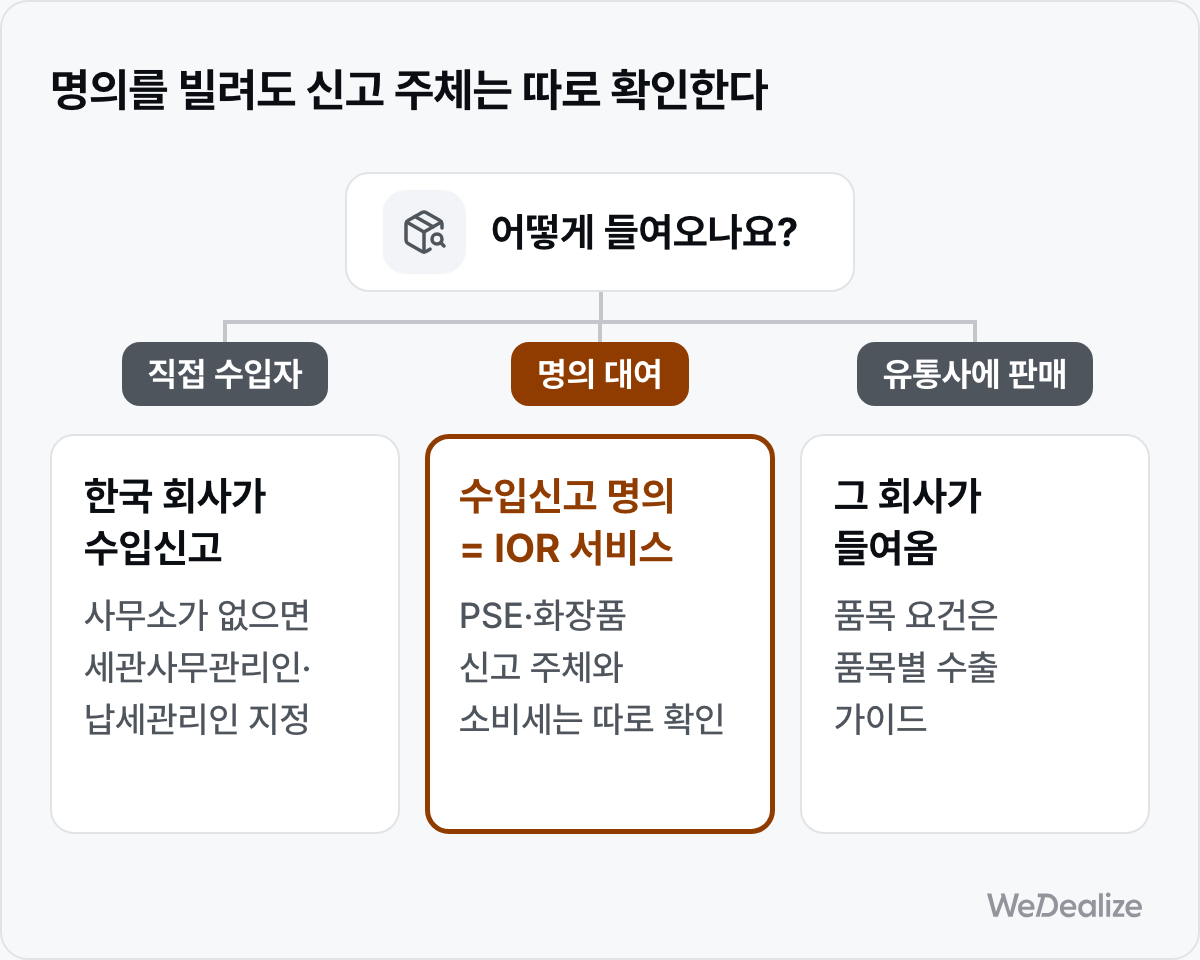
Direct importer (IOR) — Without a Japanese entity, the Korean company becomes the importer named on the import declaration, brings the goods into Japan, and then sells them from a warehouse in Japan or elsewhere. For the import procedures, see "When importing and selling as the direct importer (IOR)."
Borrowing an importer of record — An IOR service company becomes the importer named on the import declaration and brings the goods into Japan, while the Korean company sells them in Japan. For the import procedures, see "When importing and selling using a borrowed importer of record."
Customs Duties and Taxes
When importing
Customs duties and import consumption tax — When foreign goods are brought out of a bonded area, consumption tax is imposed together with customs duties, and the person importing the goods pays the consumption tax. Including local consumption tax, the standard rate is 10% and the reduced rate is 8%.
Taxable base for import consumption tax — The amount obtained by adding customs duties and other amounts to the customs value.
Input tax credit — A business that is not a consumption-tax-exempt business can deduct the consumption tax paid when bringing goods out of a bonded area from its output consumption tax.
When selling in Japan
Domestic transactions — Selling goods located in Japan is a domestic transaction in Japan and is subject to consumption tax; the seller files and pays the consumption tax.
Relationship with the April 2028 amendment — From April 2028, "transfers of specified low-value assets," which will become taxable, refers to mail-order sales of goods worth 10,000 yen or less that are located outside Japan and sent to Japan. Sales shipped from a warehouse in Japan are domestic transactions regardless of this amendment (for cross-border e-commerce, see Japan Sales Guide — Cross-Border E-Commerce).
Consumption-tax-exempt business — If taxable sales during the base period are 10 million yen or less, the obligation to pay consumption tax is exempted. Check with a tax accountant because there are exceptions separately provided by law. A consumption-tax-exempt business cannot claim a credit for consumption tax paid at import.
Tax agent — If a corporation with no office in Japan must file national tax returns, it appoints a tax agent from among persons residing in Japan and notifies the head of the tax office.
Registration as a qualified invoice-issuing business — Registration is optional. For a nonresident business with no office in Japan, registration will be refused if it has no consumption tax tax representative or has not reported a tax agent. A registered business does not become a consumption-tax-exempt business even if its sales are low.
When importing and selling as the direct importer (IOR)
This refers to cases where, without a Japanese entity, the Korean company is named on the import declaration, brings the goods into Japan, and then sells them from a warehouse in Japan or elsewhere.
Import declaration — The person intending to import the goods reports the product name, quantity, price, and other details to customs and obtains permission.
Customs procedure administrator — If a corporation with no office in Japan is to carry out customs procedures, it appoints a customs procedure administrator from among persons with an address in Japan.
Import consumption tax — The Korean company bringing in the goods pays it. If it is not a consumption-tax-exempt business, it can claim an input tax credit ("Customs Duties and Taxes").
Electrical appliances — An importing business located overseas must appoint a domestic administrator as a specified importing business and file the required notification ("Certifications and Labeling").
When importing and selling using a borrowed importer of record
This refers to cases where, without a Japanese entity, an IOR service company is named on the import declaration and brings the goods into Japan, while the Korean company sells them in Japan.
Import consumption tax — It is paid by the person bringing the goods out of the bonded area—in other words, the person named on the import declaration. The National Tax Agency's circular limits the exception under which the actual importer can claim the credit to cases involving customs quotas or reductions and exemptions (the so-called "limited declaration"). Consult a tax accountant about who can claim the credit when an importer of record is borrowed, based on the contract and the actual transaction.
Importer of electrical appliances — The Ministry of Economy, Trade and Industry explains that merely acting on behalf of someone in customs procedures is not importing, but a business that supplies imported goods in Japan, even as an agent, is an importing business. Decide by contract who will file as the importing business and confirm with the Ministry of Economy, Trade and Industry.
Cosmetics — Confirm whether the company lending its name holds a cosmetics manufacturing and marketing license. Only a licensed party may manufacture and market cosmetics as a business, and a license or other requirements are necessary for imports for commercial purposes.
Consumption tax on sales — If the party selling in Japan is the Korean company, confirm its consumption tax payment obligations and tax agent under the conditions in "When selling in Japan."
Certifications and Labeling
Electrical appliances (PSE) — A business importing electrical appliances must notify the Minister of Economy, Trade and Industry within 30 days of starting the business, comply with technical standards, conduct inspections, and affix the PSE mark. An overseas importing business (specified importing business) must appoint a domestic administrator in Japan and file the notification. Electrical appliances without the mark may not be sold or displayed for the purpose of sale.
Food and utensils for food — A person importing food, additives, utensils, containers, or packaging for sale or business use must notify the Minister of Health, Labour and Welfare each time. Notifications are accepted by quarantine stations. Quarantine stations state that nonresidents with no address or residence in Japan cannot file food import notifications. Therefore, when a Korean company with no office in Japan imports food for sale, an importer in Japan must file the notification.
Cosmetics — A cosmetics manufacturing and marketing license is required to manufacture and market cosmetics as a business in Japan. The license is issued by the governor of the prefecture where the office in which the general cosmetics manufacturing and marketing supervisor works is located. Therefore, a Korean company with no office in Japan appoints a Japanese cosmetics manufacturer and marketer that holds the license → Japan Cosmetics Export Guide
Mail-order sales disclosures — When selling online to Japanese consumers, display the sales price and shipping fees, the business name, address, telephone number, and other information under the Act on Specified Commercial Transactions. The required disclosures are the same as those in "Mail-Order Sales Disclosures" in Japan Sales Guide — Cross-Border E-Commerce.
When connected through WeDealize
Sales in which each order is shipped by express courier from a Korean fulfillment center to Japan are covered in Japan Sales Guide — Cross-Border E-Commerce and International Direct Shipping Guide.
Common mistakes
Misconception: "You cannot import into Japan without a Japanese entity." — Incorrect. If you have no office in Japan, appoint a customs procedure administrator to handle customs procedures.
Misconception: "If you borrow an importer of record, that company also files the PSE notification." — Not necessarily. The Ministry of Economy, Trade and Industry explains that merely acting on behalf of someone in customs procedures is not importing.
Misconception: "There is no consumption tax if goods shipped from a Japanese warehouse are worth 10,000 yen or less." — Incorrect. Selling goods located in Japan is a domestic transaction and is subject to consumption tax.
Related terms
IOR (importer of record) — The party that imports goods in the destination country and bears primary responsibility for paying customs duties.
Customs broker — A nationally certified professional who files export and import declarations and calculates taxes on behalf of the cargo owner.