U.S. Local Fulfillment Center Guide
Automatically translated from Korean.
One-line summary — Under the U.S. local fulfillment center model, goods are shipped to a U.S. center in advance and dispatched within the United States, and the importer of record (IOR) for U.S. customs is determined before importation. From January 5, 2027, if inventory is imported under the name of a Korean company, a CTPAT-certified customs broker must be designated.
Scope of this guide — Sellers who export Korean products from Korea (export) or send products manufactured in China, Vietnam, or other countries directly from the country of manufacture (triangular trade) to sell as inventory at a U.S. center See other guides — When shipping by express courier from Korea for each order → International Direct Shipping Guide · U.S. importer, customs clearance, certifications, and sales tax → U.S. Sales Guide — Local Sales · Returns collection → International Returns Processing Guide · Marketplace-operated warehouses → Marketplace-Operated Warehouse (Marketplace Fulfillment) Guide
Things to check first
Does the product receive a steady volume of U.S. orders? — Because inventory is shipped in advance, you need to be able to estimate to some extent how quickly it will sell. For the cost of inventory that remains unsold for a long time, see “Cost Structure” below.
Do you sell on a marketplace where U.S. delivery speed is important? — When goods are dispatched from a U.S. center, international transportation has already been completed before the order is placed.
Who will be the importer in the United States? — The Korean company may act as the importer itself, or you can designate a U.S. entity or a partner to act as the importer. See “Who Is the Importer?” below. For what to check when borrowing someone else’s name, see “Importing and Selling Under a Borrowed Importer Name” in U.S. Sales Guide — Local Sales.
Do the items to be imported require U.S. filings or certifications? — Depending on the item, it may be subject to U.S. filing or certification requirements. See “Requirements for Importation” below.
Which state is the U.S. center located in? — The obligation to register for sales tax may arise in the state where inventory is held. For state-specific standards, see “Selling Within the United States” under “Tariffs and Taxes” in U.S. Sales Guide — Local Sales.
Order of tasks
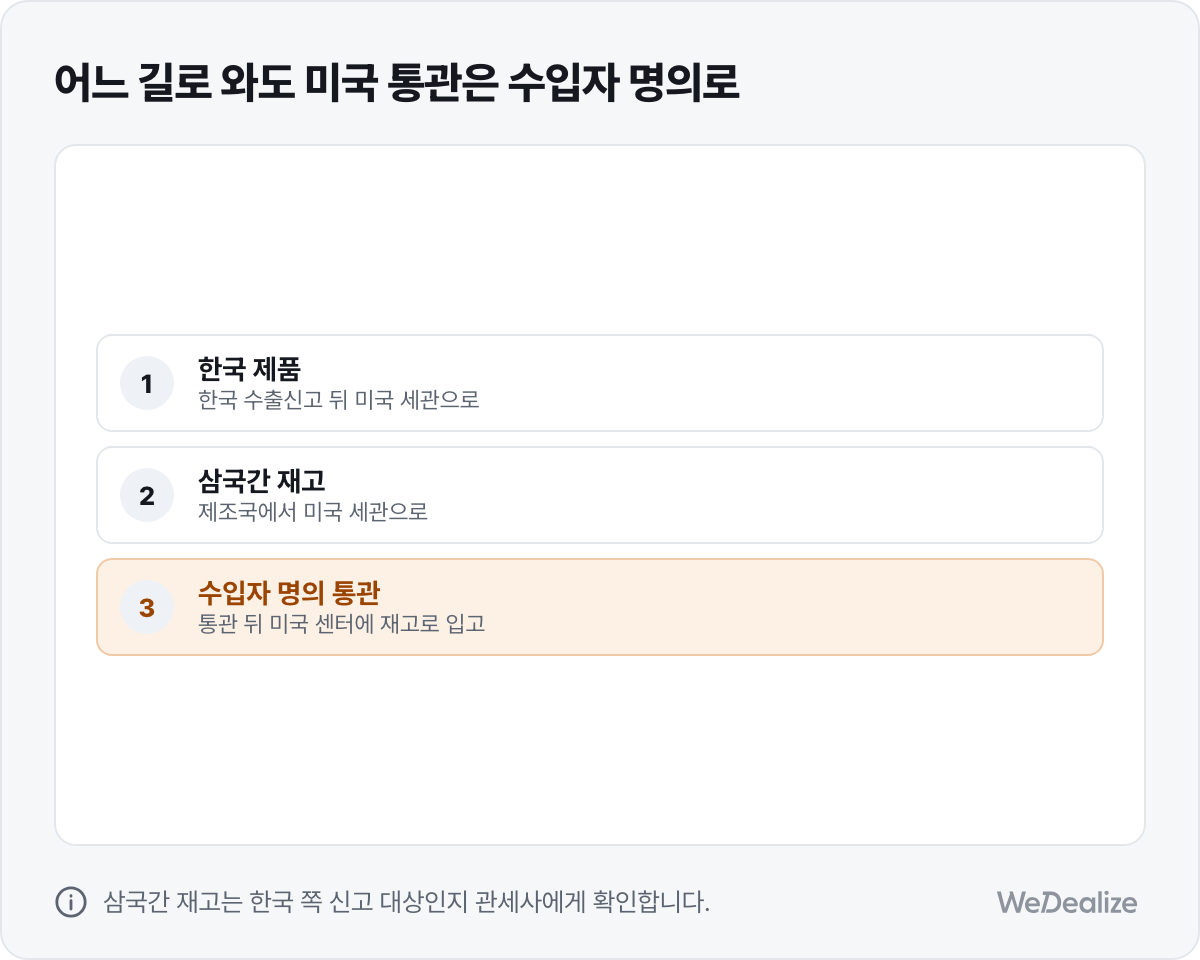
Determine the importer and the customs broker responsible for filings → Who Is the Importer?
Determine the items, quantities, and packaging units to be sent to the U.S. center, and check whether each item is subject to U.S. filing or certification requirements → Requirements for Importation
Decide whether to use international express courier for small quantities or a freight forwarder (ocean or air freight) for large quantities → Cost Structure
If shipping by vessel, submit the importer’s security filing (ISF, Importer Security Filing) by the deadline → U.S. Sales Guide — Local Sales “Transportation and Customs Clearance Tips”
File an export declaration in Korea or ship directly from the country of manufacture → Requirements for Importation
File the U.S. import declaration under the importer’s name and pay the duties → Who Is the Importer?
The center verifies the received quantity, adds the goods to inventory, and picks, packs, and dispatches each order → When Connected to WeDealize
Who Is the Importer?
Under the local fulfillment center model, the party importing the inventory, not the consumer, is the importer of record (IOR).
Responsibility for duties — Under federal regulations, the primary responsibility for paying duties lies with the importer.
From January 5, 2027 — CTPAT-certified customs broker — Under CBP (U.S. Customs and Border Protection)’s interim final rule, if a Korean company acts as the importer, it must designate a CTPAT-certified licensed customs broker to clear customs. For determining whether the importer is a foreign importer, as well as importer qualifications, agents, and bonds, see “Importing and Selling as the Direct Importer of Record (IOR)” in U.S. Sales Guide — Local Sales.
De minimis exemption — The United States has indefinitely suspended the de minimis exemption for both non-postal channels such as express couriers and international mail, so splitting shipments into smaller quantities does not qualify for duty-free treatment. For the background to the suspension and the date of any changes, see “Tariffs and Taxes” in U.S. Sales Guide — Cross-Border Direct Sales.
Requirements for Importation
Export — When shipping from Korea
Export declaration — To export goods, file an export declaration with the head of the customs office, stating the product name, specifications, quantity, price, and other details.
Declaration items — Check with a customs broker for the specific items required in an export declaration.
Triangular trade — When shipping directly from the country of manufacture
Export procedures in the country of manufacture — Confirm the export procedures of the country of manufacture with the local factory and freight forwarder.
Transaction structure — For triangular trade structures, see the articles on intermediary trade and export after delivery to a foreign country.
Product requirements — Complete before U.S. customs clearance
Check applicability — Some consumer products requiring certification are subject to electronic filing of CPSC (U.S. Consumer Product Safety Commission) certificates, and some food products are subject to FDA (U.S. Food and Drug Administration) prior notice requirements. Devices that emit radio waves may also be subject to FCC (U.S. Federal Communications Commission) certification. To determine whether an item is covered, see “Certifications and Labeling” in U.S. Sales Guide — Cross-Border Direct Sales.
Filing party — For information on who issues and files the certificate in each case, see “Certifications and Labeling” in U.S. Sales Guide — Local Sales.
Country-of-origin marking — For the country name of origin used for triangular-trade inventory and the additional duties payable when the marking is missing, see “Certifications and Labeling” in U.S. Sales Guide — Local Sales.
Cost Structure
Amounts vary depending on the product size, quantity, and period. When obtaining a quotation, compare it against the items below to confirm that all of them are included.
International transportation costs — International express, ocean, or air freight charges from Korea (or the country of manufacture) to the U.S. center.
Duties and customs clearance fees — Duties payable upon U.S. importation and customs brokerage fees. Check whether the quotation also includes CBP merchandise processing fees, harbor maintenance fees for ocean freight, and the cost of a bond required for formal customs clearance. For rates, bond requirements, and import declaration deadlines, see “Importing Inventory” in U.S. Sales Guide — Local Sales.
Receiving fee — The cost for the center to receive the goods, verify the quantity, and add them to inventory.
Storage fee — Charged according to the space occupied by the inventory. Confirm the measurement unit and billing cycle in the quotation.
Long-term storage fee — May be charged for inventory remaining longer than the period specified by the center, so confirm the applicable period in the quotation.
Outbound fee (picking, packing, and shipping) — The cost of picking, packing, and shipping each order.
Returns processing, removal, and disposal fees — Charged when customer returns are received and inspected, or when unsold inventory is removed or disposed of.
Marketplace-operated warehouse fees — For the fee structure of marketplace-operated warehouses such as Amazon FBA (Fulfillment by Amazon), see “Cost Structure” in Marketplace-Operated Warehouse (Marketplace Fulfillment) Guide.
Returns
Processing at the U.S. center — Returns are received and inspected at the U.S. center. If they can be resold, they are returned to inventory; otherwise, they are removed or disposed of.
Recovering duties paid in the United States — For the requirements and documents for a U.S. customs duty drawback on returned inventory, see “Customs Clearance in the Sales Country” in International Returns Processing Guide.
Unsold inventory — Under federal law, duties paid on imported goods may be refunded if the goods are not used in the United States and are exported within 5 years of importation before a refund claim is filed, or destroyed under customs supervision. Confirm the refundable items and claim procedures with a U.S. customs broker.
When bringing goods back to Korea — Triangular-trade inventory shipped directly from the country of manufacture is not eligible for re-import duty exemption because it was not exported from Korea. For the requirements and exclusions for re-import duty exemption on inventory exported from Korea, see “Korean Customs Clearance and Value-Added Tax” in International Returns Processing Guide.
When Connected to WeDealize
In the global multi-center service, you can select a U.S. center and check receiving, dispatch, and return histories, as well as remaining inventory. Orders from connected overseas marketplaces are dispatched from the logistics center in the country designated when the connection was made, and returns for orders sold through the U.S. center are received at the U.S. center. For the marketplace connection and invoice registration process, see “When Connected to WeDealize” in International Direct Shipping Guide.
Common Mistakes
Misconception: “If I send goods to the center, the center will handle customs clearance automatically.” — No. The importer and customs broker must be designated separately (see “Who Is the Importer?” above).
Misconception: “Establishing a U.S. corporation makes it the U.S. importer.” — Not necessarily. From January 5, 2027, a U.S. corporation is also considered a foreign importer if it does not meet the requirements for a U.S. importer. Check the requirements in “Importing and Selling as the Direct Importer of Record (IOR)” in U.S. Sales Guide — Local Sales.
Related Terms
3PL — A method in which a shipper entrusts some or all logistics activities, such as storage, transportation, and packing, to an unrelated external logistics company.
Fulfillment — An industry term referring to a method in which a seller entrusts logistics activities such as product storage and order processing to a fulfillment center.
Marketplace fulfillment — A service in which, when inventory is received at a marketplace-operated logistics center, the marketplace handles packing, shipping, and returns.
Reverse logistics — Logistics activities involving the collection of returned or exchanged goods from buyers, inspection, and processing through restocking or disposal.
Import declaration — The procedure for declaring to customs the product name, quantity, price, and other details of goods imported from abroad.