U.S. Sales Guide — Local Sales
Automatically translated from Korean.
In Brief — For local sales in the United States, the importer of record (IOR) that imports the inventory is responsible for customs duties, and cargo valued over $2,500 is formally entered with a bond. From January 5, 2027, if a Korean company imports directly, it must designate a CTPAT-certified customs broker (Customs-Trade Partnership Against Terrorism, a U.S. Customs program).
Scope of This Article — When you become the importer of record (IOR) or use an IOR service to borrow an importer’s name and import Korean products (exports) or products from the manufacturing country (triangular trade) into a U.S. warehouse, 3PL (third-party logistics provider), or marketplace warehouse such as Amazon FBA (Fulfillment by Amazon) for sale, see other articles — Sending each order by express courier or mail → U.S. Sales Guide — Cross-Border Direct Sales · Receiving inventory at a U.S. center and cost items → U.S. Local Center Guide · Receiving inventory at a marketplace warehouse → Marketplace Fulfillment Warehouse Guide
What to Check First
Who will be the importer? — Customs duty liability and the party responsible for filing differ depending on whether the Korean company becomes the importer of record (IOR) directly or borrows an importer’s name through an IOR service. If you sell to a U.S. distributor or importer, that company imports the goods → Product-Specific Export Guides
How much are you importing at one time? — Whether formal or informal entry applies is determined by the cargo value and the items involved (see “When Importing Inventory” under “Customs Duties and Taxes” below).
Which state will hold the inventory? — Check the sales tax registration requirements of the state where the inventory is stored (see “Selling Within the United States” under “Customs Duties and Taxes” below).
Is it a regulated product? — Check whether the product is subject to CPSC (U.S. Consumer Product Safety Commission), FDA (U.S. Food and Drug Administration), or FCC (U.S. Federal Communications Commission) requirements in “Certifications and Labeling” in U.S. Sales Guide — Cross-Border Direct Sales. See “Certifications and Labeling” below to determine who is responsible for filing.
Action Sequence
Decide whether to become the direct importer or borrow an importer’s name through an IOR service → Ways to Sell in the United States
If importing directly, prepare an agent, bond, and importer number → Importing and Selling as the Direct Importer of Record (IOR)
If importing directly, designate a CTPAT-certified customs broker from January 5, 2027 → Importing and Selling as the Direct Importer of Record (IOR)
If borrowing a name, verify the importer qualifications of the company lending its name → Importing and Selling by Borrowing an Importer’s Name
Decide who will handle CPSC certificate issuance and electronic filing, FDA prior notice, and the FSVP (Foreign Supplier Verification Program) importer for food → Certifications and Labeling
Check sales tax registration in the state where the inventory will be stored → Customs Duties and Taxes
For shipments by sea, submit the Importer Security Filing (ISF) by the deadline → Shipping and Customs Clearance Tips
Ways to Sell in the United States
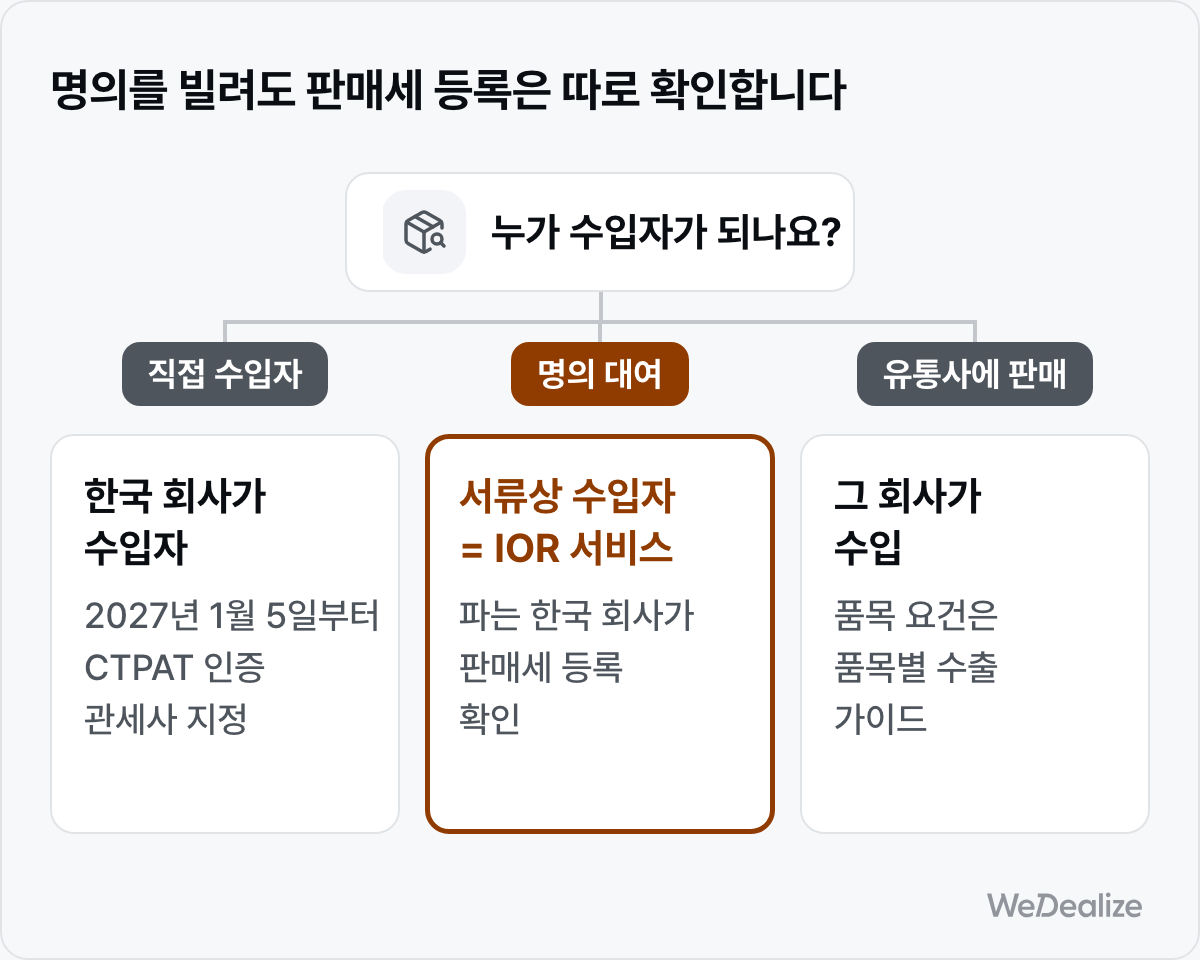
Direct Importer of Record (IOR) — The Korean company becomes the importer, without a U.S. entity, imports inventory into the United States, and then sells it. See “Importing and Selling as the Direct Importer of Record (IOR)” below for the required actions.
Borrowing an Importer’s Name — The IOR service company becomes the importer on the import declaration, imports the inventory, and the Korean company sells it in the United States. See “Importing and Selling by Borrowing an Importer’s Name” below for the required actions.
Where to Store Inventory — See U.S. Local Center Guide for receiving procedures and costs at U.S. local centers and 3PL warehouses. For marketplace warehouses (such as FBA), see Marketplace Fulfillment Warehouse Guide.
Exports and Triangular Trade — Sending goods from Korea to a U.S. warehouse is an export; see the Export Declaration article for procedures on the Korean side. Sending goods directly from the manufacturing country, such as China or Vietnam, is triangular trade; see the Intermediary Trade and Export Without Delivery to the Exporter articles for the transaction structure.
Customs Duties and Taxes
See U.S. Sales Guide — Cross-Border Direct Sales, “Customs Duties and Taxes,” for suspension of the low-value duty exemption and how to determine duty rates. This article covers only the points that differ when importing inventory in bulk and selling within the United States.
When Importing Inventory
Formal Entry — According to CBP (U.S. Customs and Border Protection) guidance, cargo valued over $2,500 must undergo formal entry. Certain goods, such as quota goods and goods subject to antidumping or countervailing duties, must also undergo formal entry. Cargo valued at $2,500 or less can generally use informal entry.
Bond — For formal entry, customs releases the goods only after a bond guaranteeing payment of customs duties is submitted. A bond may be a single-entry bond used for one transaction or a continuous bond used for multiple transactions. If the cargo is valued at $2,500 or less and conditions such as depositing the estimated duties before release are met, the port director may waive the requirement for a surety bond or cash deposit.
Filing Deadlines — Under federal regulations, the entry must be filed within 15 calendar days from the date the goods are unloaded from the vessel or aircraft. If the entry summary was not submitted together with the entry, it must be submitted within 10 working days after the entry, along with the estimated duties. If it is not submitted by the deadline, CBP claims the full bond amount as liquidated damages for a single-entry bond. For a continuous bond, CBP claims the same amount that would apply if the goods had been released under a single-entry bond. Goods for which the entry is not filed by the deadline are moved by CBP to a general order warehouse, and the consignee bears the risk and costs.
Customs Clearance Fees — For formal-entry goods, the importer pays CBP a merchandise processing fee of 0.3464% of the value of the goods. From October 1, 2026, the minimum fee is $34.58 and the maximum fee is $670.86. This fee is exempt for goods originating in Korea under the U.S.-Korea FTA.
Ocean Cargo — Commercial cargo unloaded from a vessel is subject to a harbor maintenance fee of 0.125% of the value. The fee does not apply to cargo eligible for informal entry.
Selling Within the United States
See U.S. Sales Guide — Cross-Border Direct Sales, “State Sales Tax Registration for Foreign Sellers,” for state sales and transaction thresholds and marketplace facilitator collection. If inventory is stored in a U.S. warehouse, also check the physical presence rules of that state.
Washington — The Washington Department of Revenue states that a marketplace seller has a physical presence in Washington if it stores inventory in the state. This includes inventory stored by a marketplace or third party. If there is a physical presence, the seller must register and collect and report sales tax from the date the presence is established, regardless of the $100,000 sales threshold. If the seller receives documentation that the marketplace collects and reports the tax on its behalf, it does not need to collect sales tax on marketplace sales. A marketplace seller subject to Washington requirements must file and pay business and occupation (B&O) tax even if it sells only through a marketplace.
California — Under California tax law, a retailer that uses a warehouse or storage location in the state, whether directly or indirectly, is a retailer engaged in business in California. A retailer engaged in business in the state collects use tax from the purchaser when selling goods to be used in California.
Importing and Selling as the Direct Importer of Record (IOR)
This applies when the Korean company becomes the importer, without a U.S. entity, imports inventory, and then sells it from a U.S. warehouse.
As of Now
Importer Qualifications — Under U.S. law, an entry may be filed by the owner or purchaser of the goods, or by a licensed customs broker designated by the owner, purchaser, or consignee. A Korean company that owns the goods may become the importer under this qualification.
Customs Duty Liability — Under federal regulations, customs duties are a personal debt owed by the importer to the U.S. government. Even if duties were sent to a customs broker, the importer remains liable if the broker fails to pay them. Submitting a bond with the entry does not eliminate the importer’s customs duty liability.
Foreign Corporation — A corporation not established in the customs territory of the United States or the U.S. Virgin Islands must meet two requirements to make a consumption entry (an entry for goods to be used or sold in the United States). First, it must have a resident agent in the state where the port of entry is located to receive service of process. For remote filing, it may have an agent in the state from which the filing was transmitted. Second, it must submit a bond through a U.S. corporate surety guaranteeing payment of any additional duties that may ultimately be determined.
Importer Number — When making the first formal entry, submit the importer information form (CBP Form 5106). If the importer does not have a U.S. Internal Revenue Service Employer Identification Number (EIN) or Social Security number, CBP assigns an importer number. From September 18, 2026, CBP will invalidate an importer number if the information on the form is inaccurate or incomplete. An entry cannot be filed using an invalidated number. Enter the company’s actual location in the actual address field. Do not use the address of a process agent, customs broker, freight forwarder, business support center, a post office box, or another person or company. Enter the importer’s own email address and telephone number; do not substitute those of a customs broker or another person.
Recordkeeping — Under federal regulations, the owner or importer who imports goods must retain import records for five years from the date of entry and submit them when CBP requests them.
From January 5, 2027
Presidential Executive Order — The June 2026 presidential Executive Order 14411 directed that informal entry by foreign importers be prohibited. For formal entry, it directed that foreign importers not be allowed to satisfy the bond requirement with a continuous bond. An exception applies if CBP permits it after the foreign importer demonstrates revenue protection and regulatory compliance. It also directed that foreign importers either obtain CTPAT certification or use a CTPAT-certified customs broker for formal entry.
CBP Regulations — CBP published an interim final rule on November 6, 2026, effective January 5, 2027. In this rule, CBP has not yet implemented the prohibition on informal entry.
Korean Companies Are Foreign Importers — A U.S. importer must be a corporation located in the United States and established under U.S. law. Therefore, if a Korean company becomes the importer without a U.S. corporation, it is a foreign importer. A U.S. corporation established by a Korean company is also a foreign importer if it is not controlled by U.S. citizens or lawful permanent residents owning at least 51% of the beneficial interest and does not meet the U.S. real property requirements.
Entry by Foreign Importers — A foreign importer may clear goods only if it has obtained CTPAT certification itself or designates a licensed customs broker that has obtained CTPAT certification. Among foreign importers, only Canadian importers can currently obtain CTPAT certification. Therefore, if a Korean company becomes the direct importer, it must designate a CTPAT-certified customs broker.
Scope of Application — These requirements apply to all formal entries and informal entry types 11, 12, and 13. CBP has stated that it may prohibit a foreign importer’s informal entries if it determines that the importer does not satisfy these requirements.
Importing and Selling by Borrowing an Importer’s Name
This applies when, without a U.S. entity, an IOR service company becomes the importer of record on the entry, imports inventory, and the Korean company sells it in the United States.
Companies That Can Lend Their Name — Under U.S. law, the importer of record must be a person qualified to make an entry under “Importer Qualifications” above. Before signing a contract, confirm whether the IOR service company will become the importer as the owner or purchaser, or as a designated customs broker.
Customs Duty Liability — Under federal regulations, the importer is the party primarily responsible for paying customs duties. When an importer’s name is borrowed, the IOR service company listed as the importer on the entry bears this responsibility.
From January 5, 2027 — A U.S. importer must declare its U.S. importer qualifications each time it files an entry. If a customs broker is to become the importer on behalf of a customer, it must first obtain a power of attorney from the customer. If that customer meets the foreign importer requirements, the customs broker must also obtain CTPAT certification. Therefore, confirm whether the company lending its name is the U.S. importer or a CTPAT-certified customs broker.
Sales Tax — If the Korean company is the party selling in the United States, it must determine sales tax registration under “Selling Within the United States” under “Customs Duties and Taxes” above.
Certifications and Labeling
Products subject to the requirements — See 「Certification and Labeling」 in U.S. Sales Guide — Cross-Border E-Commerce for products subject to CPSC certificate electronic filing, FDA prior notice, and FCC certification.
CPSC certificate issuance and electronic filing — If a finished product manufactured abroad requires certification under CPSC regulations, the importer issues the certificate and files it electronically with CBP. This importer is the importer of record (IOR) that can file the import entry. If the Korean company imports directly, it issues and files the certificate; if it borrows another party’s name, the IOR service company issues and files it.
FDA prior notice — Submitted by a person with the required information — Under FDA regulations, anyone who knows the required information may submit prior notice for food. The submitter may assign transmission to another person.
FDA food facility registration — Completed by the facility owner or operator — Under FDA regulations, facilities that manufacture, process, pack, or hold food intended for consumption in the United States must register. This applies to facilities both in the United States and abroad, and the facility’s owner, operator, or person in charge must complete the registration. Some facilities are exempt.
FDA FSVP importer — Handled by the owner or consignee in the United States — Under FDA regulations, the FSVP importer of food is the owner or consignee in the United States who owned or purchased the food at the time of entry. If there is no U.S. owner or consignee, the food may be imported only after a U.S. agent who has received consent is designated as the FSVP importer. Therefore, if the Korean company becomes the direct importer, it designates a U.S. agent as the FSVP importer.
FCC certification — The certified company or responsible party in the United States is responsible — Under FCC regulations, for devices subject to certification, the company that obtains certification is responsible for compliance with the technical standards. The responsible party for devices subject to a Supplier’s Declaration of Conformity must be located in the United States. If the device is imported, the importer is the responsible party.
Country-of-origin marking — Foreign-made goods imported into the United States must be marked in English with the name of the country of origin. For triangular-trade inventory shipped directly from the country of manufacture, use the name of the actual country of origin, which is the country of manufacture. If imported goods lack country-of-origin marking, an additional duty of 10% of the value must be paid unless the goods are marked, exported, or destroyed under customs supervision before liquidation.
Cancellations and Returns
Return conditions and shipping deadlines — See 「Cancellations and Returns」 in U.S. Sales Guide — Cross-Border E-Commerce for the U.S. Federal Trade Commission (FTC) shipping deadline rule and publication of return policies.
Returns received at a U.S. warehouse — See 「Returns」 in U.S. Local Fulfillment Center Guide for restocking, disposal, and refunds of duties paid in the United States.
When bringing goods back to Korea — See the International Returns Processing Guide for the procedures, and the Re-import Duty Exemption article for duty exemptions for inventory exported from Korea.
Connecting with WeDealize
The process of receiving inventory at a U.S. local fulfillment center and shipping each order from within the United States is summarized in the U.S. Local Fulfillment Center Guide.
Sales in which each order is express-shipped from a Korean center to the United States are covered in the U.S. Sales Guide — Cross-Border E-Commerce and the International Direct Shipping Guide.
Shipping and Customs Tips
Importer Security Filing (ISF) for ocean cargo — Under federal regulations, for cargo arriving by vessel, the ISF importer or its agent must submit the ISF electronically in English. Bulk cargo is excluded. The seller, buyer, importer number, and consignee number must be submitted 24 hours before the vessel is loaded at the foreign port. The manufacturer (or supplier), ship-to party, country of origin, and commodity number must also be submitted by the same deadline. The container stuffing location and the stuffer must be submitted 24 hours before arrival at the U.S. port. The ISF importer is the owner, buyer, or consignee of the goods, or an agent such as a customs broker. If the ISF obligation is violated under the import bond terms, the importer and the surety jointly bear liquidated damages of $5,000 for each violation.
Common Mistakes
Misconception: 「If you send goods to a U.S. warehouse or marketplace warehouse, the warehouse becomes the importer」 — No. The importer is the owner or buyer who can file the import entry, or a designated customs broker (see 「Importer Qualifications」 above).
Misconception: 「I sent the duties to the customs broker, so my responsibility for the duties is over」 — No. If the customs broker does not pay, the responsibility remains with the importer (see 「Duty Responsibility」 above).
Misconception: 「If you do not meet the sales threshold for sales tax, you do not need to register in a state where you keep inventory」 — Not necessarily. In Washington, a marketplace seller that keeps inventory must register regardless of the sales threshold (see 「Selling in the United States」 above).
Misconception: 「If I borrow another company’s name, that company also handles sales tax registration」 — Not necessarily. If the Korean company is the party selling in the United States, the Korean company must confirm its sales tax registration obligations (see 「Sales Tax」 under 「Importing and Selling Using Another Party’s Importer Name」 above).
Unconfirmed Items
Continuous bond limitations for foreign importers — Check CBP notices to determine when the limitations on formal-entry continuous bonds directed by the presidential executive order will be established by regulation.
Inventory nexus standards in other states — Confirm with the tax authorities of each state whether inventory at a marketplace warehouse or 3PL warehouse constitutes a physical nexus in states outside California and Washington.
Related Terms
IOR (Importer of Record) — The party that imports goods into the country of sale and bears primary responsibility for paying duties.
Customs broker — A customs professional who, at the request of a shipper or other party, handles import and export entries, calculates duties, and performs related tasks.
Economic nexus — A standard under which a business becomes obligated to collect sales and use tax when its sales or number of transactions in a U.S. state exceeds the applicable threshold, even if it has no place of business in that state.
Marketplace facilitator collection — A system under U.S. state law under which the marketplace collects sales tax on marketplace sales on behalf of sellers and remits it to the state.
Marketplace fulfillment — A service in which the marketplace handles packaging, shipping, and returns after inventory is received at a marketplace-operated fulfillment center.
3PL — A method in which a shipper entrusts some or all logistics operations, such as storage, transportation, and packaging, to an unrelated external logistics company.