Taiwan Sales Guide — Cross-Border Direct Sales
Automatically translated from Korean.
One-line summary — For cross-border direct-sales parcels to Taiwan, customs duty and business tax are exempt if the total dutiable value of goods sent together by the same sender to the same recipient is no more than 2,000 New Taiwan dollars. If the same recipient receives more than 6 tax-exempt shipments in a half-year, the exemption does not apply. Starting March 2026, for express shipments imported by an individual using a simplified declaration and authorized through an app, the recipient must confirm the authorization in advance before the shipment can be declared.
Scope of this guide — This guide covers sending Korean products to Taiwanese consumers by international express or post for each order (cross-border direct sales). See other guides for — Korean export declarations, simplified export declarations, and zero-rated VAT → Overseas Direct Shipping Guide · Return collection → Overseas Returns Processing Guide · Importing products into Taiwan for sale → Taiwan Sales Guide — Local Sales
Check first
How are you selling? — This guide covers cross-border direct sales, where goods are sent by international express or post for each order. If you import goods into Taiwan under your company’s name or use the name of a Taiwanese company as the importer and then sell them in Taiwan, see Taiwan Sales Guide — Local Sales. If you sell to a Taiwanese distributor or importer, that company imports the goods → Export Guide by Product Category
Is the total value of one shipment no more than 2,000 New Taiwan dollars? — This is the standard for low-value tax exemption. See “Customs Duty and Taxes” below for how values are combined and the recipient’s tax-exempt shipment limit.
Is the item subject to inspection or certification? — Designated electrical and household products, radio equipment, and cosmetics and food products announced by Taiwanese authorities are subject to inspection, approval, registration, or declaration before importation and sale. There may be exemptions when the recipient imports goods for personal use, so check “Certification and Labeling” below first.
Can the recipient confirm the customs-clearance authorization? — When an individual imports goods using a simplified declaration (an express-shipment declaration used instead of a standard import declaration) and authorizes the express carrier through a real-name authentication app, the recipient must confirm the authorization in the app in advance before the shipment can be declared. See “Importer” below.
Steps to take
Check whether the item is subject to inspection, approval, or registration → Certification and Labeling
Estimate the taxes based on the total value of one shipment and the recipient’s number of tax-exempt shipments → Customs Duty and Taxes
Decide whether the seller will collect the taxes at checkout or the recipient will pay them → Importer
Tell the recipient that they must confirm the customs-clearance authorization in advance in the real-name authentication app (EZ WAY) → Importer
Include the seller’s information and the 7-day cancellation method and exceptions on the product page → Cancellation and Returns
Ways to sell in Taiwan
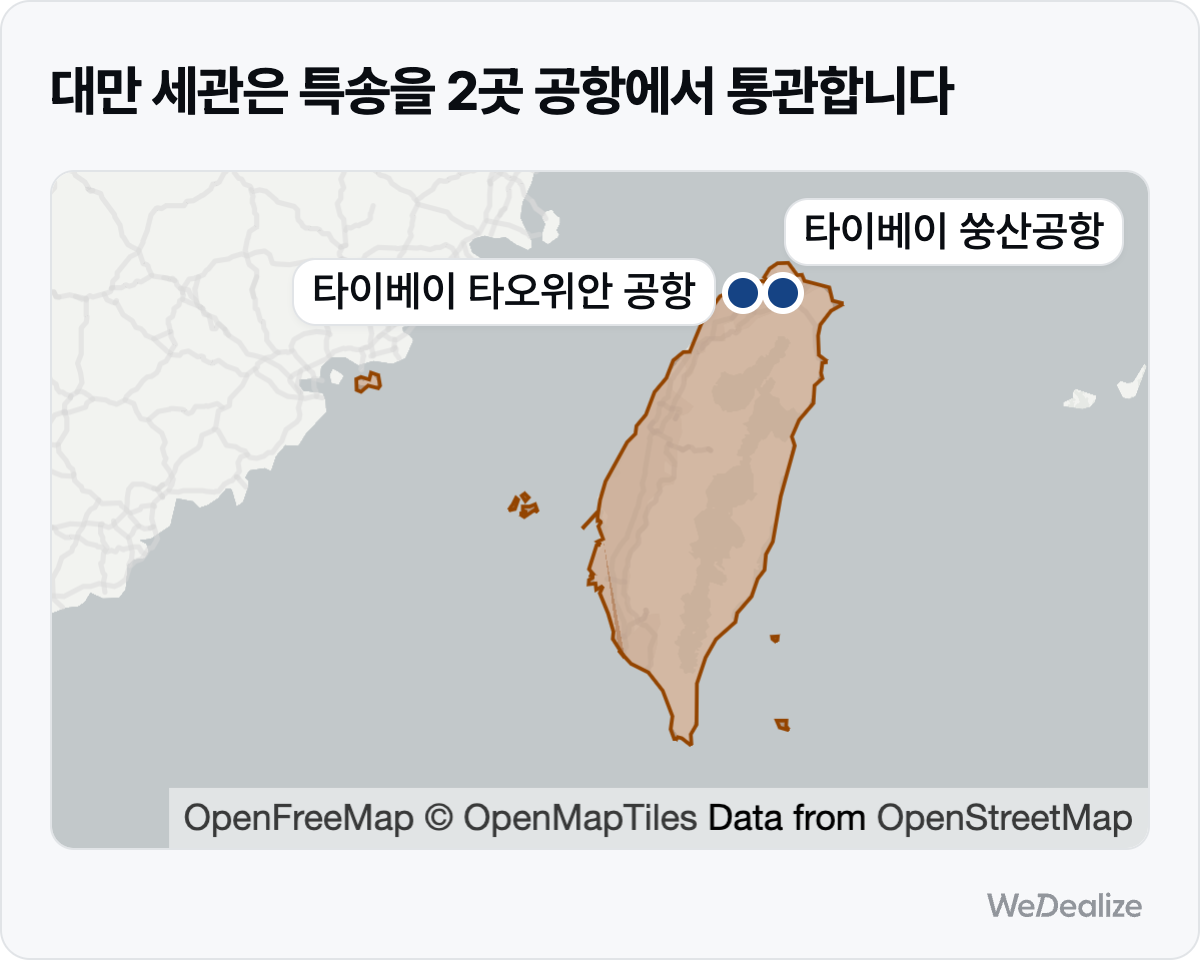
Express — Air express shipments cleared through an express cargo area or an air-cargo transshipment center follow the regulations for air express customs clearance. Express shipments with a dutiable value of no more than 50,000 New Taiwan dollars may be cleared using a simplified declaration. However, goods specified by the air express customs-clearance regulations must be declared using a standard import declaration regardless of their value. See “Certification and Labeling” below for the types of goods involved. Shipments exceeding 50,000 New Taiwan dollars must be cleared using a standard import declaration. Fresh agricultural, forestry, fishery, and livestock products, live animals and plants, and cargo with a total gross weight exceeding 70 kg per piece (bag) cannot be cleared through an express cargo area or an air-cargo transshipment center.
Post — International postal items are cleared under postal customs-clearance regulations that differ from those for express shipments. Each postal item (bag) must have a total gross weight of no more than 30 kg. For postal items with an FOB (Free On Board) value, excluding freight and insurance, exceeding 5,000 US dollars, the recipient must file a declaration with customs within 15 days from the day after the post office sends the notification. After the deadline, a late-declaration fee of 200 New Taiwan dollars per day is imposed; if no declaration is filed after 20 days, customs sells the cargo. See “Customs Duty and Taxes” below for the tax-exemption limit and rules on combining values.
Sales channels — Regardless of which marketplace you use, Taiwanese customs clearance and taxes follow the above standards based on whether the shipment is sent by express or post.
Own online store — Among overseas online-store platforms, Shopify says it can be used in almost every country. However, it explains that functions such as payments vary depending on the country where the business is located.
Customs Duty and Taxes
Tax exemption up to 2,000 New Taiwan dollars — Under Taiwan’s Customs Act, a single batch brought in together is exempt from tax if its total dutiable value is no more than the threshold announced by the Ministry of Finance. According to guidance from the Customs Administration, shipments valued at no more than 2,000 New Taiwan dollars are exempt from customs duty, business tax collected by customs on behalf of the tax authority (a tax similar to Taiwan’s VAT), and commodity tax. Tobacco, alcohol, and agricultural products subject to tariff quotas (a system applying a lower tariff rate up to a specified quantity) are excluded.
Dutiable value and business tax — According to the Customs Administration, the dutiable value includes freight and insurance. Even if the product price is no more than 2,000 New Taiwan dollars, the shipment is not tax-exempt if adding freight causes the value to exceed the threshold. Business tax is 5% of the amount obtained by adding customs duty and commodity tax to the dutiable value.
One express batch — Under the air express customs-clearance regulations, an express shipment is considered one batch when it is sent by the same sender on the same flight to the same recipient. Express operators and customs brokers may not split one batch into separate declarations. An exception applies when the total is within the tax-exemption limit or, even if it exceeds the limit, the importer voluntarily files a declaration and pays the taxes.
Combining postal items — Under the postal customs-clearance regulations, postal items sent by the same sender to the same recipient and arriving on the same day have their values combined. Postal items are also exempt from customs duty, commodity tax, and business tax if the combined value is no more than 2,000 New Taiwan dollars, excluding tobacco, alcohol, and agricultural products subject to tariff quotas. For postal items, if the dutiable value exceeds 2,000 New Taiwan dollars, taxes are imposed on the full amount.
Frequent imports are excluded — According to the Customs Administration, if the same taxpayer clears more than 6 tax-exempt shipments during a half-year period (January–June or July–December), the tax exemption does not apply. The same rule applies when the same recipient receives more than 6 tax-exempt postal shipments in a half-year.
Importer
Who pays the taxes — The persons liable for Taiwanese customs duties are the consignee (the person receiving the cargo), the holder of the delivery order (提貨單, the document presented to take delivery of the cargo), and the person holding the cargo. Import business tax is paid by the consignee or the person holding the cargo and is collected on their behalf by customs. Decide whether the seller will collect the taxes at checkout or the recipient will pay them. If the seller pays in advance, the arrangement is close to DDP (Delivered Duty Paid); if the recipient pays upon delivery, it is close to DAP (Delivered at Place). If the recipient will be the importer, notify them in advance on the product page.
Customs-clearance authorization by the recipient (EZ WAY) — The recipient must complete it
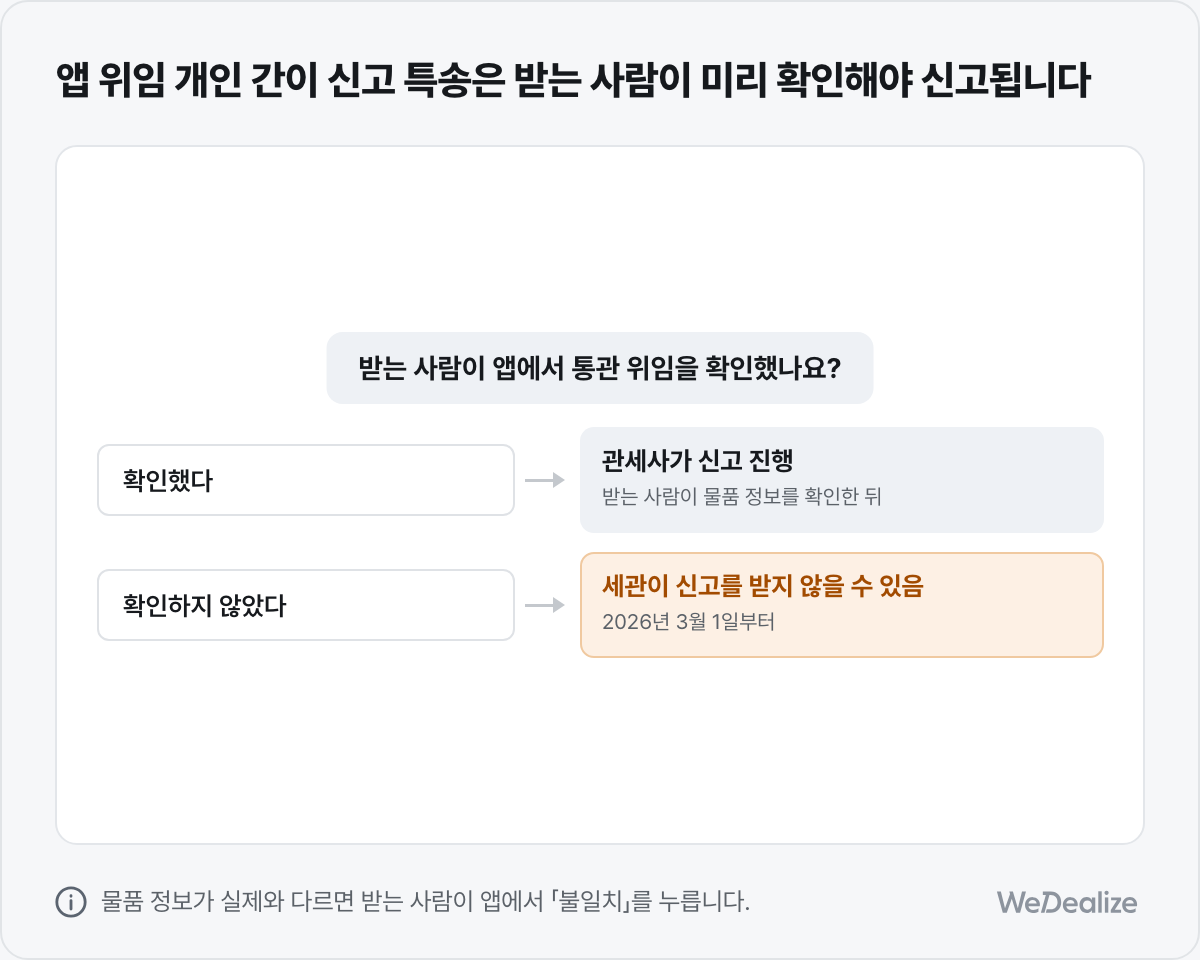
When a customs broker declares an express shipment using a simplified declaration, the recipient’s customs-clearance authorization (報關委任) is required. The authorization may be completed in writing, through the customs, port, and trade single window (關港貿單一窗口), or online through the real-name authentication platform.
From March 1, 2026, for express shipments imported by an individual using a simplified declaration and authorized through the real-name authentication app “EZ WAY 易利委,” the recipient must confirm the authorization in the app in advance. After the recipient confirms that the shipment information sent by the customs broker through the app matches the goods actually purchased, the declaration proceeds. If there is no record in the customs clearance information system showing that authorization was completed through one of the three methods, customs may refuse to accept the declaration. If it is confirmed that the recipient’s authorization cannot be obtained, the express operator may apply to change the person liable for the taxes to itself and return the shipment overseas before the cargo leaves the warehouse. The application deadline is 7 business days from the day after the cargo enters the warehouse or the declaration is filed. Cargo violating the Anti-Smuggling Act (海關緝私條例) cannot be returned. However, cargo exempt from penalties under the law may be returned. Cargo to be transferred for punishment for violating the laws of another agency also cannot be returned.
If the express operator files the declaration in the name of the person holding the cargo, it declares the recipient’s name and address. For an express shipment exceeding 2,000 New Taiwan dollars in dutiable value, if the recipient is an individual, it must also declare one of the recipient’s national ID number, Alien Resident Certificate number, or passport number. These three numbers do not need to be provided if the recipient’s real-name-authenticated mobile phone number is entered on the simplified declaration.
Certification and Labeling
Designated electrical and household products — BSMI inspection — Products designated for inspection by the Bureau of Standards, Metrology and Inspection (BSMI) may not be imported if they do not meet the inspection standards. Products recognized by the BSMI as low-risk may be imported, but they must meet the inspection standards before being distributed on the market. Sellers also may not display or sell products that do not meet the standards. Under the regulations on exemption from product inspection, goods imported by the recipient for personal use may be cleared without inspection by entering the exemption code if the combined value of the same declaration and same model is no more than 1,000 US dollars. This amount is calculated based on the CIF (Cost, Insurance and Freight) value, including freight and insurance. If the value exceeds 1,000 US dollars, up to two units may be exempted after review. Some items, such as toys, have separate quantity limits. The same person may receive an exemption for the same model once every six months.
Radio equipment — NCC approval — Radio-frequency equipment (射頻器材) announced by the National Communications Commission (NCC) requires approval before it can be manufactured or imported.
Cosmetics — Product registration — This applies to announced categories of cosmetics and cosmetic importers meeting a specified scale. These importers must complete product registration and create a product information file before supplying, selling, giving away, or displaying the products.
Food — When importing announced food products, food additives, food containers, and similar items, the importer must apply for import inspection with the competent authority and submit product information according to the customs tariff number. If the goods are not for sale and fall within the announced value and quantity limits, the import-inspection application is exempt. According to guidance from the Taiwan Food and Drug Administration (TFDA, the Food and Drug Administration of the Ministry of Health and Welfare), an import-inspection application is exempt for ordinary food imported for personal use if its value is no more than 1,000 US dollars and its weight is no more than 6 kg. The limits are calculated per item on the declaration. Foods in tablet or capsule form are limited to 12 bottles (boxes, containers, packs, or bags) per type and 36 bottles in total, and must be in their original packaging.
Animal and plant products — Quarantine — According to guidance from the Bureau of Animal and Plant Health Inspection and Quarantine, animals, plants, and their products purchased online and received by express must also pass quarantine before they can be imported. Animals and animal products subject to quarantine may not be sent by post; if sent by post, they will be returned, confiscated, or destroyed. Plant products subject to quarantine also generally may not be sent by post; if sent by post, they will be returned or destroyed. However, items that the Bureau of Animal and Plant Health Inspection and Quarantine has announced as exempt from submitting a quarantine certificate may be sent by post if the name of the contents is clearly marked on the packaging. They may also be sent by post when the recipient has obtained an import permit for postal shipment in advance. South Korea is a country affected by African swine fever as announced by Taiwan’s Ministry of Agriculture. If pork products are sent by post in violation of this announcement, an administrative fine of 200,000 New Taiwan dollars is imposed for the first violation and 1 million New Taiwan dollars from the second violation onward.
Goods declared using a standard import declaration — Under the air express customs-clearance regulations, express goods subject to import requirements, such as inspection or permits, must be declared using a standard import declaration. They may be cleared using a simplified declaration only in special cases announced by customs. Goods subject to commodity tax must also be declared using a standard import declaration. Goods subject to tariff quotas, special duties such as anti-dumping duties, or import-relief measures must likewise be declared using a standard import declaration.
Cancellation and Returns
Information disclosure — Under the Consumer Protection Act, distance-selling businesses must provide the business name, representative, business location, and contact information in clear language. They must also provide the product details, price, payment deadline and method, delivery deadline and method, cancellation period and method, and complaint-submission method. For online sales, this information must be provided electronically in a form that consumers can review and save in full.
Cancellation within 7 days (cooling-off right) — A consumer who purchases through distance selling may return the goods without giving a reason or cancel the contract in writing within 7 days after receiving the goods. The consumer does not bear the return shipping cost.
Exceptions to cancellation — If the seller has notified the consumer, cancellation is unavailable for goods that are perishable or have a short shelf life, made-to-order goods, and personal hygiene products whose packaging has been opened.
If cancellation information was not provided — The 7-day period begins on the day after the information is provided. The right to cancel expires four months after the day on which the original 7-day period would have begun.
Refund deadline — The seller refunds the amount paid by the consumer within 15 days from the day after receiving the returned goods. Any agreement requiring the consumer to bear return shipping costs for a 7-day cancellation is void.
When returning goods to Korea — Express shipments returned to Korea for repair or replacement due to specification or quality issues cannot use Taiwan’s simplified declaration and must be declared using a regular export declaration. Goods returned to Korea may qualify for re-import duty exemption if they are re-imported within 2 years from the date the export declaration is accepted, without being manufactured, processed, repaired, or used overseas. They are not exempt if the goods or their raw materials received a tariff reduction or exemption or a refund.
Duties on replacement goods — Under Taiwan’s Customs Act, when goods on which customs duties have been paid are replaced due to specification or quality issues, an application must be filed and verified within 1 month from the day after the original goods were imported for the replacement goods to be exempt from customs duties.
Connect through WeDealize
The process for express-shipping orders from an integrated overseas marketplace from the Korea center to Taiwan is summarized in the Overseas Direct Shipping Guide.
Shipping and customs clearance tips
Send the invoice along with the shipment — Under Taiwan’s express shipment customs clearance regulations, express carriers attach invoices to express shipments so that customs can inspect them. Provide the invoice when arranging the express shipment. Under postal customs clearance regulations, postal operators attach the invoice to the outside of the parcel or place it inside. If there is no invoice, the customs authorities will notify the post office to ask the recipient to submit it in writing when necessary.
Common mistakes
Misconception: “Items under 2,000 New Taiwan dollars are always duty-free.” — No. Recipients who have exceeded 6 duty-free shipments in a six-month period, as well as tobacco, alcohol, and other excluded items, do not qualify. The dutiable value also includes freight charges.
Misconception: “Splitting the goods into separate boxes means they will be duty-free.” — Not necessarily. Express shipments sent by the same sender to the same recipient on the same flight are combined and calculated as one batch.
Misconception: “If I authorize an agent through the app, the express shipment will clear customs without verification.” — No. From March 2026, express shipments imported by individuals using a simplified declaration and authorized through a real-name authentication app will be declared only after the recipient verifies them in advance.
Items not yet confirmed
Cross-border e-commerce cosmetics — Confirm with Taiwan’s Ministry of Food and Drug Administration whether cosmetics received for the consumer’s personal use are subject to product registration.
Applicability of Taiwan’s Consumer Protection Act — When a seller located in Korea sells directly to consumers in Taiwan, confirm with Taiwan’s Consumer Protection Committee, Executive Yuan, or a local attorney whether Taiwan’s Consumer Protection Act applies.
Related terms
Taiwan business tax — A value-added-tax-type tax imposed in Taiwan on the sale of goods and services and on imported goods.
Customs broker — A customs professional who, at the request of a cargo owner or other party, handles import and export declarations, customs duty calculations, and related matters.
Export declaration — The procedure for declaring to customs the names, quantities, prices, and other details of goods to be exported overseas.
Simplified export declaration (e-commerce) — A simplified declaration that reduces the number of declaration items required for a formal export declaration, primarily used for low-value e-commerce exports.
Zero-rated VAT — A system under which a 0% value-added tax rate is applied to exported goods. VAT paid on purchases (input tax) is deducted from output tax, and any remaining amount becomes a refundable tax credit.