Taiwan Sales Guide — Local Sales
Automatically translated from Korean.
One-line summary — When goods are imported into Taiwan for sale, the consignee (the person receiving the cargo) and other parties pay customs duties and import business tax, and Taiwan companies or business names registered as importers/exporters may conduct import and export operations. For an unregistered importer that does not engage in importing as a business, an import permit is exempted if the FOB (Free On Board) price of goods outside the import-restricted-items list, excluding freight and insurance, is USD 20,000 or less.
Scope of this article — When importing and selling under our company name without a Taiwan entity, and when importing and selling under the importer name of a Taiwan company covered in another article — Sending each order by express courier → Taiwan Sales Guide — Cross-Border Direct Sales
Things to check first
How will the goods be imported? — Depending on whether the goods are imported under our company name or under the importer name of a Taiwan company, the party responsible for paying customs duties and import business tax (a tax similar to Taiwan’s value-added tax), and the party required to apply for product inspection, will differ. If you sell to a Taiwan distributor or importer, that company imports the goods → Export Guide by Product Category
Do you have a branch or permanent establishment in Taiwan? — Importer/exporter registration is carried out by a Taiwan company or business name, and an overseas company must have a permanent establishment in Taiwan to become a business entity subject to business tax.
Are the goods subject to inspection or certification? — Designated electrical and household goods, wireless devices, and cosmetics and food products announced by the Taiwan authorities require inspection, approval, registration, or an application before importation and sale ("Certification and Labeling").
Order of tasks
Decide whether to import under our company name or borrow an importer’s name → How to sell in Taiwan
Check whether the goods can be imported without importer/exporter registration → Importing and selling under our company name
If the goods are subject to inspection or certification, decide who will apply and complete the requirements before importation → Certification and Labeling
Confirm who will pay customs duties and import business tax, and how business tax on sales in Taiwan will be handled → Customs Duties and Taxes
How to sell in Taiwan
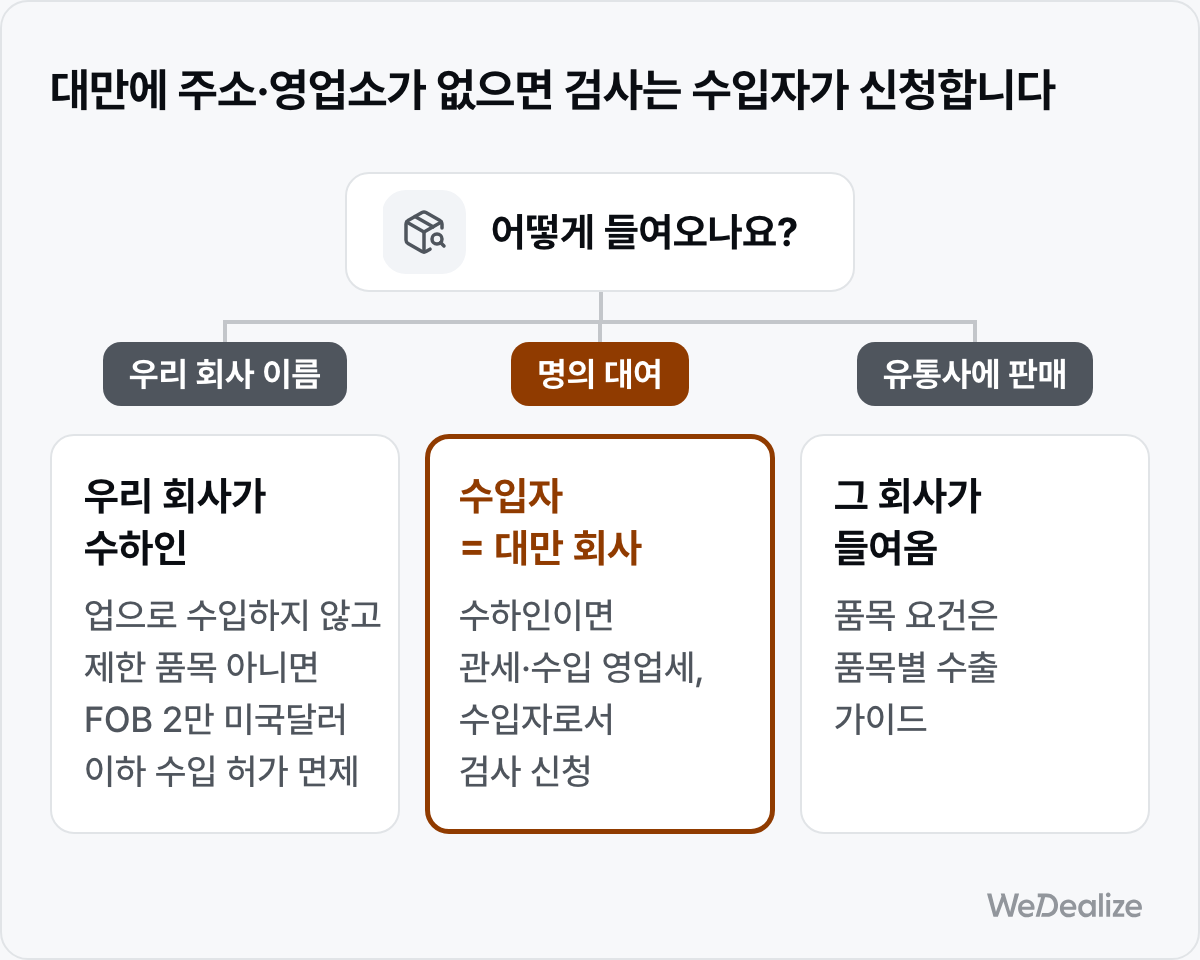
Importing under our company name — Without a Taiwan entity, our company becomes the consignee, imports the goods into Taiwan, and sells them from a warehouse or other location in Taiwan. See "Importing and selling under our company name."
Borrowing an importer’s name — A Taiwan company becomes the importer and imports the goods, while our company sells them in Taiwan. See "Importing and selling under a borrowed importer name."
Customs Duties and Taxes
When importing
Customs duties — The persons liable for customs duties are the consignee, the holder of the delivery order (提貨單, a document presented when taking delivery of cargo), and the holder of the cargo.
Import business tax — Import business tax is paid by the consignee or cargo holder and collected on their behalf by customs.
Business tax calculation — According to guidance from the Customs Administration, the dutiable value (the amount used as the basis for calculating customs duties) includes freight and insurance. Import business tax is 5% of the total of the dutiable value, customs duties, and commodity tax (貨物稅).
When selling in Taiwan
Domestic sales — A sale is considered to take place in Taiwan if, when the goods are transported and delivered, the place of departure is in Taiwan, or if the goods are in Taiwan when delivered without transportation.
Who is a business entity? — Business entities subject to business tax include an overseas business’s permanent establishment in Taiwan. An overseas business without a permanent establishment becomes a business entity when it provides electronic services online to individuals in Taiwan.
Tax registration and filing — Before commencing business, a business entity registers its tax account (稅籍) with the tax authorities. Even if there are no sales, it files sales and business tax for each two-month period within 15 days after the start of the following period.
Importing and selling under our company name
This refers to cases where our company becomes the consignee, imports the goods without a Taiwan entity, and sells them from a warehouse or other location in Taiwan.
Importer/exporter registration — A company or business name engaged in import/export operations may register as an importer/exporter (出進口廠商) with the Bureau of Foreign Trade of the Ministry of Economic Affairs unless otherwise prohibited or restricted by law. Under the Foreign Trade Act, a company or business name registered as an importer/exporter may conduct import/export operations.
Branch registration — Under Taiwan’s Company Act, a foreign company may not conduct business in Taiwan under its own name unless it registers a branch (a Taiwan branch). Violators may be subject to imprisonment for up to one year or detention, and a fine of up to NTD 150,000, either cumulatively or separately, and also bear direct civil liability. The competent authority may prohibit the use of the foreign company’s name.
Importing without registration — In principle, an importer that is not an importer/exporter, government agency, or other qualifying entity and that does not engage in importing as a business must obtain an import permit (簽證). However, a permit is exempted when goods outside the import-restricted-items list are imported by sea, air, or post and the FOB price is USD 20,000 or less. For goods imported under a permit, the importer may import only goods for its own use unless the Bureau of Foreign Trade separately approves otherwise.
Import declaration — Submit an import declaration with the invoice, packing list, and other documents attached. Customs brokers (報關業者) may be engaged to handle the declaration and tax payment procedures.
Declaration deadline — Under the Customs Act, the person liable for customs duties must file a declaration within 15 days from the day after the means of transport carrying the cargo arrives in Taiwan. If late, a late declaration fee (滯報費) of NTD 200 per day is charged; if no declaration is filed after 20 days, customs will sell the cargo.
Product inspection application — The importer is responsible for applying for inspection of goods manufactured outside Taiwan ("Certification and Labeling").
Importing and selling under a borrowed importer name
This refers to cases where a Taiwan company becomes the importer and imports the goods, while our company sells them in Taiwan.
Customs duties and import business tax — If the company lending its name is the consignee, that company is liable for customs duties and import business tax ("Customs Duties and Taxes").
Product inspection application — Even when importation is entrusted to another party, the entrusting party is responsible for applying for inspection only when the goods are sold in Taiwan under the name of an entrusting party that has an address or business premises in Taiwan. If our company, which has no address or business premises in Taiwan, entrusts the importation, the importer—in other words, the company lending its name—is responsible.
Cosmetics and food — See "Certification and Labeling" below for the products subject to product registration or import inspection and the parties responsible. Determine by contract who will register or apply.
Sales business tax — If our company is the party selling in Taiwan, check the requirements as described in "When selling in Taiwan."
Certification and Labeling
Designated electrical and household goods — BSMI inspection — Goods designated for inspection by the Bureau of Standards, Metrology and Inspection (BSMI) may not be imported if they do not meet the inspection standards. Goods recognized by BSMI as low-risk may be imported, but must meet the inspection standards before being distributed in the market. Sellers may not display or sell goods that do not meet the standards. The importer is responsible for applying for inspection of goods manufactured outside Taiwan.
Wireless devices — NCC approval — Radio-frequency equipment (射頻器材) announced by the National Communications Commission (NCC) may be manufactured or imported only after obtaining approval. Unless separately approved by the NCC, such equipment may be sold only after passing an examination (審驗) confirming compliance with the technical regulations.
Cosmetics — Product registration — Manufacturers and importers of announced types of cosmetics and those meeting certain size thresholds must complete product registration and prepare a product information file before supplying, selling, giving away, displaying, or allowing consumers to try the products.
Food — The party importing announced food products, food additives, food containers, and similar goods must apply for import inspection with the competent authority according to the customs tariff number and report product information.
Chinese labeling — Under the Commodity Labeling Act, when imported goods enter the market, the importer must indicate the product name, the name, address, and telephone number of the importer in Taiwan, and the country of origin. Major ingredients or materials, weight, volume or quantity, and the manufacturing year and month must also be indicated. For goods with an expiration period, the expiration date or validity period must be indicated together with the manufacturing year and month. Imported goods must also indicate the foreign-language name of the foreign manufacturer. Labels must be primarily in Chinese. Sellers may not sell or display for sale goods that are not labeled in accordance with the Commodity Labeling Act.
Distance-selling information and 7-day cancellation right — Under Taiwan’s Consumer Protection Act, distance-selling businesses must inform consumers of business information and the cancellation procedure. Consumers may cancel within 7 days after receiving the goods, although exceptions apply to certain goods for which cancellation is unavailable. For details, see "Withdrawal and Returns" in Taiwan Sales Guide — Cross-Border Direct Sales.
Connect through WeDealize
Sales in which each order is dispatched by express courier from a Korean center to Taiwan are covered in Taiwan Sales Guide — Cross-Border Direct Sales and Overseas Direct Shipping Guide.
Common mistakes
Misconception: “If the FOB price is USD 20,000 or less, I can keep importing and selling without registration.” — Not necessarily. Import-permit exemption without registration applies to importers that do not engage in importing as a business.
Misconception: “Even when borrowing an importer’s name, our company applies for product inspection.” — Not necessarily. If the entrusting party has no address or business premises in Taiwan, the importer is responsible for applying for inspection.
Items not yet confirmed
Sales in Taiwan by an overseas company without a permanent establishment — Confirm with Taiwan’s National Taxation Bureau or a tax accountant how the overseas company should register and file business tax when selling inventory stored in a Taiwan warehouse.
Import declarations under an overseas company’s name — Confirm with a customs broker the identification number and documents required when an overseas company without Taiwan registration declares itself as the consignee.
Repeated imports by an unregistered overseas company — Confirm with the Bureau of Foreign Trade of the Ministry of Economic Affairs whether an overseas company that repeatedly imports and sells inventory qualifies as an importer that does not engage in importing as a business.
Warehouse sales without a branch — Confirm with the Department of Commerce of the Ministry of Economic Affairs or a local attorney whether selling inventory from a Taiwan warehouse under our company name without branch registration constitutes conducting business in Taiwan.
Related terms
Taiwan business tax — A tax similar to value-added tax imposed on the sale of goods and services in Taiwan and on imported cargo.
IOR (Importer of Record) — The party that imports goods in the country of sale and bears primary responsibility for paying customs duties.
Customs broker — A customs professional who, at the request of a cargo owner or other party, handles import/export declarations, calculates customs duty amounts, and performs related tasks.