Australia Sales Guide — Cross-Border Direct Sales
Automatically translated from Korean.
One-line summary — For goods valued at AUD 1,000 or less, customs duty and GST (goods and services tax, Australia’s value-added tax) are generally not collected at the border, while sellers registered for GST charge 10% GST at the time of sale. If Australia-related turnover is AUD 75,000 or more, overseas sellers are also required to register.
Scope of this article — This article covers cross-border direct sales where Korean products are sent to Australian consumers by international courier or post for each order. Covered in other articles — Korean export declarations, simplified export declarations and zero-rated VAT → Overseas Direct Shipping Guide · Return collection → Overseas Returns Processing Guide
What to check first
How are you selling? — This article covers cross-border direct sales sent by international courier or post for each order. If you sell to an Australian distributor or importer, that company imports the goods → Product-Specific Export Guide
Are the value of each item and the total value of one consignment AUD 1,000 or less? — GST at the time of sale is determined by the value of each individual item, while formal import declarations at the border are determined by the total value of one consignment. See “Customs Duty and Taxes” below.
Are you required to register for GST? — Overseas sellers must also register if Australia-related turnover is AUD 75,000 or more. See “Customs Duty and Taxes” below for the period over which turnover is calculated.
Is the product subject to mandatory safety standards or import prohibitions? — Check “Certification and Labeling” first for products subject to mandatory standards, such as toys and infant products, and for e-cigarettes and nicotine products.
Are you planning to sell on a no-refund basis? — Consumer guarantees under Australian Consumer Law cannot be excluded by terms and conditions. See “Cooling-Off and Returns” below.
Order of tasks
Check whether the product is subject to mandatory safety standards or import prohibitions or permit requirements → Certification and Labeling
Determine whether you are required to register for GST, and include 10% GST when selling goods valued at AUD 1,000 or less → Customs Duty and Taxes
Display one total price including GST on the product page, and inform the customer of the GST amount when the order is confirmed → Customs Duty and Taxes
Decide whether the seller will collect the tax at checkout or the recipient will pay it → Importer
Include the GST registration number and whether GST was collected in the customs documents → Shipping and Customs Clearance Tips
State the consumer guarantee and change-of-mind return policies on the product page → Cooling-Off and Returns
Ways to sell in Australia
Courier — Goods valued at AUD 1,000 or less entering by air or sea freight are declared using Self-Assessed Clearance (SAC).
Post — SAC cannot be used for international post. Postal items valued at AUD 1,000 or less are generally not subject to customs duty or tax at the border, but alcohol is an exception. If the value exceeds AUD 1,000, the recipient files an import declaration and pays the taxes before delivery. If the shipment is not processed within 30 days after receiving the arrival notice, it may be returned.
Sales channels — Regardless of which marketplace you sell through, customs clearance follows the criteria above depending on whether the shipment is sent by courier or post. For low-value goods sold through an electronic distribution platform, such as an online marketplace, the platform operator is treated as the supplier and is responsible for GST.
Customs Duty and Taxes
At the border
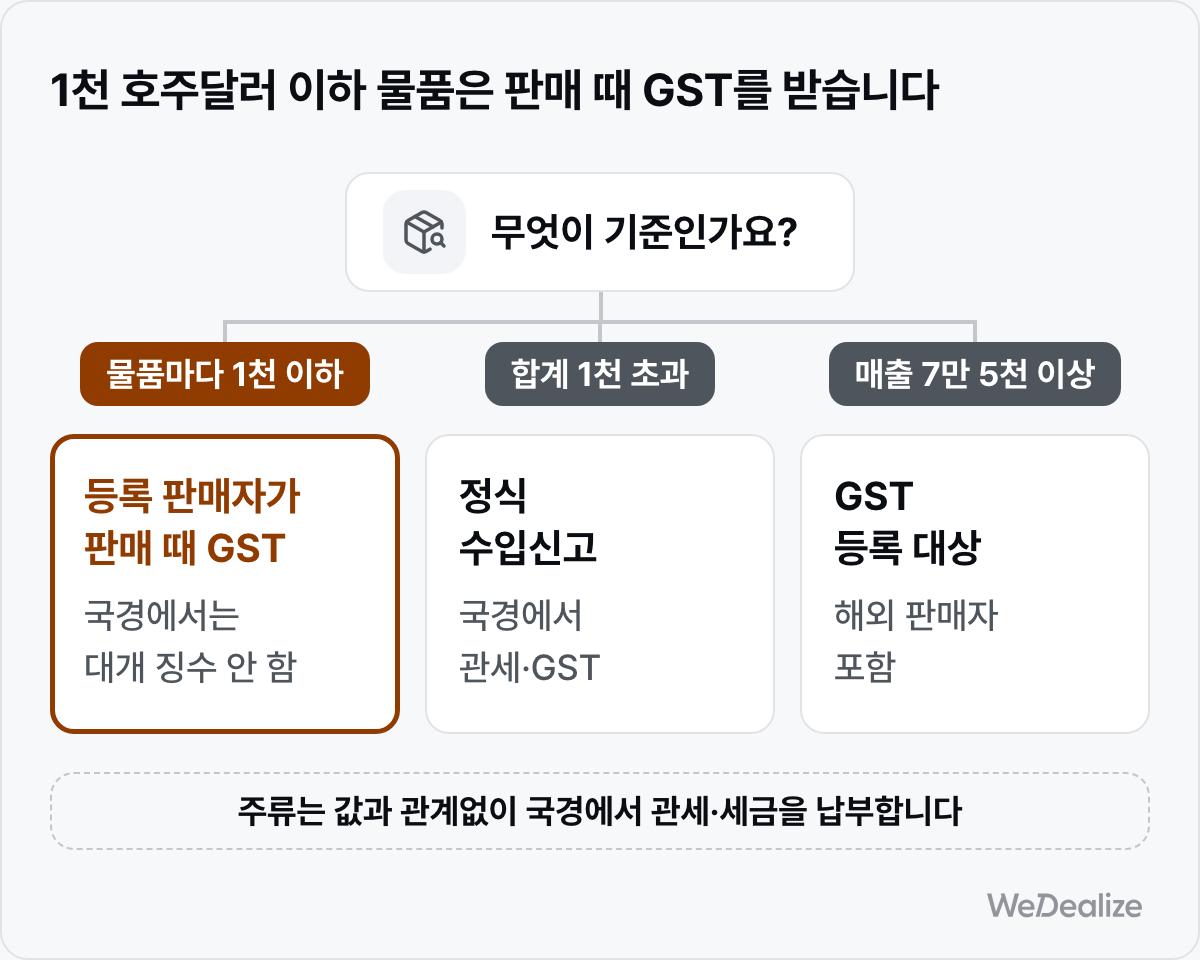
AUD 1,000 or less — Most goods are free of customs duty, tax and fees (low-value duty-free treatment). Alcohol is subject to customs duty and tax regardless of its value. Tobacco and tobacco products require an import permit, and most cannot be sent by post.
Over AUD 1,000 — If the total value of one consignment exceeds AUD 1,000, a formal import declaration is required. The goods are released only after all customs duty, taxes and import processing fees have been paid.
Orders shipped in separate packages — Boxes known to be part of the same order are treated as one consignment even if they arrive separately. If the total exceeds AUD 1,000, a formal import declaration is required. Goods ordered together and shipped in two or more separate consignments are excluded from the AUD 1,000 customs duty exemption.
Customs value — Customs duty is determined using the customs value, and the AUD 1,000 threshold for GST at the time of sale is also based on the customs value. When the customs value is determined using the actual transaction price, international freight and insurance costs from Korea to Australia are excluded. GST payable at the border is 10% of the customs value plus international freight and insurance costs and customs duty.
GST — Low-Value Imported Goods of AUD 1,000 or Less
GST at the time of sale — When goods with a customs value of AUD 1,000 or less are sold to an Australian consumer, an overseas seller registered for GST collects GST included in the sale price. The AUD 1,000 threshold applies to the value of each individual item, not the total order value. Tobacco, tobacco products and alcohol are excluded. The sale is not covered if the recipient is a business registered for GST and purchases the goods for business purposes. Goods for which the seller collected GST become “non-taxable importations,” meaning GST is not collected again at the border.
Rate — Australia’s GST rate is 10%. One-eleventh of the amount collected is GST.
Who must register — An overseas seller must also register if Australia-related turnover is AUD 75,000 or more during the 12 months up to the current month or during the 12 months beginning in the current month.
Orders taxable at the border — If there are grounds to determine that GST will be paid at the border, such as when the total value of one consignment exceeds AUD 1,000, GST is not collected at the time of sale. If GST was collected twice, the seller refunds the GST collected at the time of sale to the consumer.
Price display — When displaying prices to consumers, prominently show one total price that includes the GST collected by the seller. If GST is collected at the time of sale, inform the consumer of the GST amount when the order is confirmed.
Importer
Who files the declaration? — The importer (owner of the goods) or their agent, a customs broker, files the import declaration. For postal shipments, the recipient is the importer.
Who bears the cost? — For orders over AUD 1,000, decide whether the seller will collect customs duty and GST at checkout or the recipient will pay them. If the seller pays in advance, this is similar to DDP; if the recipient pays at delivery, it is similar to DAP. If the recipient is responsible for payment, notify them in advance on the product page.
Certification and Labeling
Mandatory safety standards — Australia has mandatory standards that require safety and information labeling for specific products, including toys and infant products. Supplying goods that do not comply with these standards is unlawful. Check the Product Safety Australia standards list to determine whether your product is covered.
E-cigarettes and nicotine — import prohibition — E-cigarette devices and liquids, all liquid nicotine, and heated tobacco products cannot be imported without prior authorization. From July 24, 2026, nicotine pouches may not be imported or sold unless permitted by law, such as when the product is listed on the Australian Register of Therapeutic Goods (ARTG).
Cooling-Off and Returns
Consumer guarantees — Consumer guarantees under Australian Consumer Law cannot be excluded regardless of what the seller says or does. A “no refunds” notice or time limit cannot restrict these rights.
Change of mind — Sellers are not required to provide a refund when a consumer changes their mind or finds a cheaper seller. Whether to accept change-of-mind returns is determined by the seller’s policy and should be stated on the product page.
When returning goods to Korea — Consider re-import duty-free treatment if the goods were not manufactured, processed, repaired or used overseas and are re-imported within two years from the date the export declaration was accepted (the date customs accepted the declaration). The exemption does not apply if customs duty was reduced or refunded on the goods or raw materials. Confirm applicability with a customs broker.
Connecting through WeDealize
The process for shipping orders from an integrated overseas marketplace from a Korean center to Australia by courier is summarized in the Overseas Direct Shipping Guide.
Shipping and Customs Clearance Tips
Information to include in customs documents — Sellers registered or required to register for GST must include the GST registration number, the business number (ABN) provided by the consumer, and whether GST was collected in the import declaration or simplified declaration (SAC). If you cannot enter the information yourself, ask the courier company or customs broker to enter it.
Common mistakes
Misconception: “There is no tax if the value is AUD 1,000 or less.” — Incorrect. It simply is not collected at the border. Registered sellers collect and remit 10% GST at the time of sale.
Misconception: “Australian Consumer Law does not apply because I am an overseas seller.” — Incorrect. Overseas businesses that sell directly to Australian consumers must comply with Australian Consumer Law, including consumer guarantees.
Misconception: “If I sell through a marketplace, the marketplace handles safety standards.” — Incorrect. Supplying goods that do not meet the standards is itself unlawful, so the seller must check first.
Items not yet confirmed
Electrical product safety (EESS and RCM marking) — Confirm with the electrical safety authority in each state whether the Electrical Equipment Safety System (EESS) and RCM marking apply to electrical products sent directly from Korea to consumers.
Cosmetics — AICIS registration — Confirm with AICIS whether business registration under the Australian Industrial Chemicals Introduction Scheme (AICIS) is required for cosmetics sent directly from Korea to consumers.
Food — Australian food standards and biosecurity — Confirm with the Department of Agriculture, Fisheries and Forestry (DAFF) how Australian food standards and imported food inspections apply to food sent directly from Korea to consumers, and what the biosecurity import conditions are.
Related terms
Customs broker — A nationally qualified professional who files import and export declarations and calculates tax amounts on behalf of the cargo owner.
Export declaration — The procedure for declaring to customs the product name, quantity, price and other details of goods to be exported overseas.
Simplified export declaration (e-commerce) — A simplified declaration that reduces the number of required fields in a formal export declaration and is mainly used for small-value e-commerce exports.
Zero-rated VAT — A system under which a 0% VAT rate is applied to exported goods and the VAT paid on purchases is refunded.
International courier — International shipping in which a courier company handles everything from pickup and air transport to customs clearance and delivery to the door.