Germany Sales Guide — Local Sales
Automatically translated from Korean.
One-line summary — If you import without a German entity, an indirect representative in the EU or a German company lending its name files the import declaration, and our company, which has the power of disposal over the inventory, deducts the import VAT. Businesses outside the EU cannot use the small-business VAT exemption and report VAT on domestic German sales to the Berlin International Tax Office.
Scope of this article — When importing in our company’s name without a German entity, or importing under the name of a German company and selling the goods as German inventory In other articles — Sending each order by express courier or post → Germany Sales Guide — Cross-Border Direct Sales · Korean export declaration when shipping out inventory → Export Declaration · VAT on exported goods → Zero Rate · Producer registration → EPR · Product safety representative → EU Responsible Person (GPSR)
Things to check first
Does this article apply? — If you ship from Korea for each order, see Germany Sales Guide — Cross-Border Direct Sales. If you keep inventory in Germany and dispatch it from Germany, someone must file an import declaration, so this is the applicable article. If you sell to a German distributor or importer, that company imports the goods → Product-Specific Export Guide
What do you have in the EU? — Under EU customs law, a legal person is established in the EU if it has its registered office, head office, or a permanent establishment in the EU. A permanent establishment is a fixed place of business where personnel and equipment are always available and customs-related activities are carried out. If you have a German entity (subsidiary), that entity imports the goods, so see Product-Specific Export Guide. If you have a permanent establishment such as a branch, our company may be the declarant in the EU, so check the corporate income tax sections under “Importing and selling in our company’s name” and “Selling in Germany” below. If you have none of these, see “Importing and selling in our company’s name” below.
Are you selling to consumers through a marketplace? — If you sell German inventory through a marketplace to customers who are not businesses, the VAT treatment differs. See “Selling in Germany” below.
Are these packaging materials, electrical and electronic equipment, batteries, or cosmetics? — Check under “Selling in Germany” below whether our company is the producer and whether there is a responsible person in the EU.
Order of tasks
Decide whether to import in our company’s name or under the name of a German company → Selling in Germany
If importing in our company’s name, appoint an indirect representative in the EU. If our company acts as the declarant, obtain an EORI number (EU customs registration number) → Importing and selling in our company’s name
If borrowing another company’s name, specify in the contract the documents and cost allocation for deducting import VAT → Importing and selling under a borrowed importer name
Prepare the customs value and proof of origin, file the import declaration, and pay the taxes → When importing
Report VAT on domestic German sales to the Berlin International Tax Office, and complete producer registration and appoint an EU responsible person before selling → Selling in Germany
Display business information, prices, and withdrawal terms on the sales page → Information for consumers and withdrawal and returns
Continue filing VAT returns and retaining documents → Ongoing compliance after registration
Selling in Germany
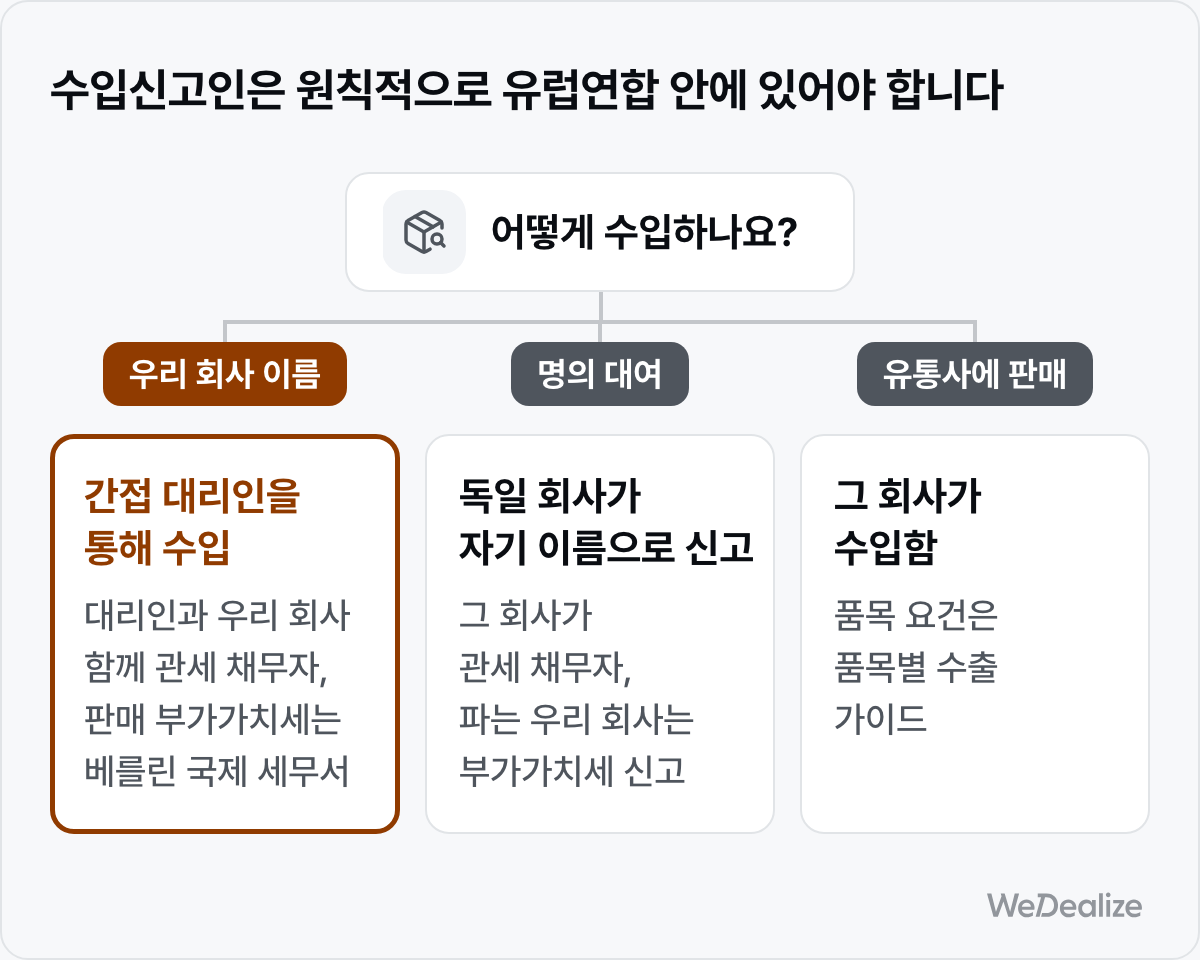
Who does what — The “borrowing a name” column is based on the arrangement in which the German company files in its own name without identifying itself as a representative. The explanations are in the sections in the right-hand column.
Task | In our company’s name | Borrowing a name | Details |
|---|---|---|---|
Import declaration | Indirect representative | That company | In our company’s name · Borrowing a name |
Customs duty and import VAT liability | Indirect representative and our company | That company | In our company’s name · Borrowing a name |
Deduction of import VAT | Our company | Our company | When importing · Borrowing a name |
VAT reporting on sales | Our company | Our company | Selling in Germany › Sales tax |
Importing in our company’s name — Without a German entity, an indirect representative in the EU files the declaration for our company’s goods, which are imported and then sold from a German warehouse or elsewhere. See “Importing and selling in our company’s name.”
Borrowing an importer’s name — A German company files the import declaration in its own name, and our company sells the goods in Germany. See “Importing and selling under a borrowed importer name.”
Importing and selling in our company’s name
This applies when our company’s goods are imported through a representative in the EU without a German entity and then sold from a German warehouse or elsewhere.
Current rules
Declarant — Under EU customs law, the declarant filing an import declaration must be established within the EU customs territory. An occasional declarant is an exception if the customs authorities consider it justified.
Indirect representative — Anyone may appoint a customs representative. A direct representative files in the name of the person who appointed them, while an indirect representative files in their own name on behalf of that person. A customs representative must also, in principle, be established in the EU.
Customs debtor — Under EU customs law, the declarant who filed the import declaration is the customs debtor. If an indirect representative files the declaration, our company, which commissioned the declaration, is also a debtor.
Document retention by the representative — According to German Customs guidance, an indirect representative must retain documents such as the import declaration, sales contract, and product description for at least three years and submit them during a customs audit. If the representative cannot submit them, the representative bears the import duty and other charges as the declarant.
EORI number — According to German Customs guidance, a business outside the EU needs an EORI number only when acting as a declarant or in similar cases. Registration is completed only once in the EU country where the first import declaration is filed, so if the first declaration is filed in Germany, apply to German Customs. In Germany, applications for an EORI number will be made through the Zoll-Portal from 2026-10-01.
Business notification and branch registration — Under German trade law, starting a permanent business or a branch or dependent establishment requires simultaneous notification to the competent authority. A commercial-register filing for a German branch of a foreign company is made with the court where the branch is located.
VAT on sales — Our company, as the seller, files the return. See “Sales tax — VAT” under “Selling in Germany” below.
Change date — 2027-09-21
New EU Customs Code — The new EU Customs Code will generally apply from 2027-09-21. Under the new law, there is one importer per transaction, who must guarantee payment of customs duties and other charges.
Importer must also be in the EU — Under the new law, the importer must be established within the EU customs territory. This requirement does not apply when an indirect representative in the EU acts on the importer’s behalf. In that case, the indirect representative acting for an importer outside the EU is treated as the importer for obligations such as guaranteeing payment of customs duties.
Importing and selling under a borrowed importer name
This applies when a German company files the import declaration in its own name and our company sells the goods in Germany.
Filing in its own name — Under EU customs law, a person who files without identifying themselves as a representative is deemed to have filed in their own name and on their own account. In this case, the company lending its name is the declarant, and the declarant is the customs debtor.
When appointed as an indirect representative — According to German Customs guidance, when a representative files in its own name but on behalf of another person, this is indirect representation. In that case, the arrangement is the same as “Importing and selling in our company’s name,” so our company is also a customs debtor.
Direct representation limited to customs clearance — A direct representative files in our company’s name, so our company, not the representative, is the declarant. Under EU customs law, the declarant must be established in the EU. Therefore, our company, which has no establishment in the EU, cannot import through direct representation except when filing occasionally.
Resale arrangement — If the German company buys the goods from our company and imports them, it is selling its own inventory, so this is a buyer sale → Product-Specific Export Guide
Deduction of import VAT — Under the German Federal Ministry of Finance’s VAT guidelines, import VAT is deductible by the business that had the power of disposal over the goods (the authority to decide whether to sell or use them) at the time of import customs clearance. It does not matter who paid the tax. Freight forwarders, carriers, and others involved in the import without the power of disposal cannot deduct it.
When our company makes the deduction — Under the same guidelines, even if the company acting as representative is liable for import VAT, our company, which has the power of disposal, deducts it. In this case, our company must obtain from that company the customs documents needed for the deduction. See “When importing” for the types of documents and deduction requirements.
VAT on sales — If our company is the party selling in Germany, it files according to “Sales tax — VAT” under “Selling in Germany.”
What to specify in the contract — The contract should specify settlement of the import VAT paid by that company, allocation of liability if additional customs duties are assessed, recall costs, and transfer of remaining inventory when the contract ends.
Producer registration and responsible person — Even if another company’s name is borrowed, if our company directly supplies or distance-sells to end users in Germany, check the “Product obligations” section under “Selling in Germany” in full.
When importing
Customs value — Under EU customs law, the primary basis for customs value is the transaction value of goods sold for export to the EU. If goods are imported without a sale, such as our company’s inventory, there is no transaction value. In that case, use, in order, the transaction value of identical goods, the transaction value of similar goods, the value calculated from the unit price of sales in the EU, and the computed value. If the declarant requests it, the order of the last two methods may be reversed.
Korea–EU FTA — To receive preferential tariff treatment for Korean-origin goods, the exporter must make an origin declaration on a commercial document such as an invoice. If a single consignment exceeds EUR 6,000, only an approved exporter may make the origin declaration.
Import VAT — Under German VAT law, customs rules apply correspondingly to import VAT. German Customs generally collects import VAT together with customs duties. For the rates and tax base, see “Customs duties and taxes” under Germany Sales Guide — Cross-Border Direct Sales.
Declaration deadline — Under EU customs law, non-EU goods in temporary storage must undergo a customs procedure such as import within 90 days or be re-exported.
Deferral of customs duty payment — Under EU customs law, customs duty payment may be deferred if security is provided and an application is filed. Duties for a period of up to 31 days may also be deferred in a single amount.
Deferral of import VAT payment — Under German VAT law, import VAT that is fully deductible may be deferred without providing security. Import VAT deferred in a single amount is payable on the 26th day of the second month following the relevant month.
Deduction requirements — Under German VAT law, a business may deduct as input tax the import VAT on goods imported for its business. According to German Customs guidance, the deduction is evidenced by the customs tax assessment notice or an alternative document certified by Customs.
Selling in Germany
Sales tax — VAT
Domestic German supply — Under German VAT law, when goods are transported and delivered, the supply is deemed to take place where transport begins. A sale shipped from a German warehouse to a customer in Germany is a domestic German supply, and the seller pays the VAT. If goods are sent from a German warehouse to a customer who is not a business in another EU country, the supply is deemed to take place where transport ends.
EU special taxation procedure — Under German VAT law, distance sales to customers in other EU countries may be reported under the EU special taxation procedure (OSS). If participating, it applies collectively to the relevant sales in all EU countries, and in Germany it is administered by the Federal Central Tax Office. A business outside the EU with no establishment in the EU reports participation to Germany if transport begins in Germany.
No small-business VAT exemption — Under German VAT law, the small-business VAT exemption applies only to businesses established in Germany and businesses in other EU countries that meet the requirements.
Competent tax office — The competent VAT office for a business whose head office or place of management is outside Germany is determined by country. For businesses from countries not on the list, such as Korea, the responsible office is the Berlin International Tax Office (Finanzamt Berlin International).
Tax Rates and Price Display — For tax rates, see “Customs Duties and Taxes” in Germany Sales Guide — Cross-Border Direct Sales; for displaying tax-inclusive prices, see “Sales Page” in the same guide under “Certifications and Labeling.”
When Selling on a Marketplace
Marketplace Deemed the Supplier — Under the German VAT Act, if a business established outside the EU sells goods through a marketplace to customers who are not businesses, the marketplace is deemed to have received and directly sold those goods. This applies to sales where transport starts and ends within the EU. Supplies by our company to the marketplace are exempt from VAT.
Marketplace Tax Liability — Except in the above case, the marketplace is liable for VAT that the seller has failed to pay. If the seller has a valid VAT identification number issued by the German Federal Central Tax Office, the marketplace is generally not liable.
Marketplace Records and Service Agent — The marketplace must record and retain for 10 years the seller’s name and address, VAT identification number, place of dispatch and destination, sales, and other information. Sellers outside the EU and European Economic Area (EEA) must designate a service agent in Germany (Empfangsbevollmächtigter) when applying for tax registration.
Product Obligations
This applies to our company when selling directly to German consumers, whether we import under our company’s name or use another party’s name. See “Certifications and Labeling” in Germany Sales Guide — Cross-Border Direct Sales for German registration authorities, agent authorization procedures, and periodic reporting.
Packaging — Under EU packaging regulations, a manufacturer, importer, or distributor located outside the EU is a producer if it directly makes packaged products available for the first time to end users in another Member State.
Electrical and Electronic Equipment — Under the German Electrical and Electronic Equipment Act, the person who first places equipment originating outside the EU on the German market is the manufacturer. A person located abroad who sells remotely to German end users is also a manufacturer.
Batteries — Under the EU Batteries Regulation, a person located outside the EU who sells remotely to end users in a Member State is a producer. This includes batteries incorporated into equipment.
Product Safety Responsible Person — Under the EU General Product Safety Regulation, a product cannot be placed on the market if there is no responsible economic operator in the EU. Under the EU Market Surveillance Regulation, if the manufacturer is outside the EU, the importer in the EU or an authorized representative appointed in writing is the responsible economic operator. If neither exists, the EU fulfillment service provider handling the product is the responsible economic operator. The responsible economic operator’s name and postal and electronic addresses must be displayed on one of the product, packaging, parcel, or accompanying documents. For online sales, the responsible economic operator’s name and postal and electronic addresses must also be displayed prominently on the sales page.
Cosmetics — Under the EU Cosmetics Regulation, for imported cosmetics, the importer established in the EU is the responsible person for the product. The importer may designate another person established in the EU as the responsible person by written mandate, and that person must accept the mandate in writing.
Product Liability — Current Rules — Under the German Product Liability Act, a person who imports a product into the EEA for business purposes, including sale, is also deemed to be a manufacturer.
From 2026-12-09 — Under the new EU Product Liability Directive, for products placed on the market after 2026-12-09, if the manufacturer is outside the EU, the importer and the manufacturer’s authorized representative are also liable. If neither is located in the EU, the fulfillment service provider is liable.
Corporate Income Tax (Permanent Establishment)
Treaty Rules — Under the Korea-Germany Tax Treaty, Germany may tax our company only when it carries on business in Germany through a permanent establishment, and only on profits attributable to that permanent establishment. A branch and an office are included as permanent establishments.
Keeping Only Inventory — Using a facility or keeping inventory solely for the storage, display, or delivery of our company’s goods does not constitute a permanent establishment.
Agent — If an agent in Germany habitually exercises authority to conclude contracts in our company’s name, our company is deemed to have a permanent establishment. The use of an independent agent acting in the ordinary course of business alone does not constitute a permanent establishment.
Information to Provide Consumers and Withdrawal and Returns
Same as the Cross-Border Direct Sales Section — Even when selling German inventory online, the sales-page display requirements and withdrawal and refund standards are the same. See “Sales Page” and “Withdrawal and Returns” under “Certifications and Labeling” in Germany Sales Guide — Cross-Border Direct Sales.
Ongoing Compliance After Registration
Advance VAT Return — Under the German VAT Act, a business must electronically submit an advance VAT return (Voranmeldung) within 10 days after the end of the filing period.
Payment — The VAT reported in the advance return must be paid on the same day, namely by the tenth day after the end of the filing period.
Filing Period — The filing period is generally quarterly, and monthly if the previous year’s tax exceeded 9,000 euros. Through the 2026 tax period, for the year in which a business starts, the 9,000-euro threshold is determined based on the estimated tax for that year. Through the 2026 tax period, if the business operated for only part of the previous year, the previous year’s tax is annualized for this determination. From the 2027 tax period, monthly returns must be filed in the year the business starts and the following year.
Annual Return — A business must electronically submit an annual VAT return every year.
Record Retention — Under the German Fiscal Code, books and records and customs documents prescribed by EU customs law must be retained for 10 years, accounting supporting documents for 8 years, and business correspondence received or sent for 6 years. The period is counted from the end of the year in which the document was created or received.
Late Filing — Under the German Fiscal Code, a late-filing surcharge may be imposed if a return is not filed or is filed late. If an annual VAT return is late, 0.25% of the amount of tax less the advance payments determined through advance returns is imposed for each late month, subject to a minimum of 25 euros per month. This calculation does not apply to quarterly or monthly advance returns.
Changes to Business Registration — Under the German Trade Regulation Act, if the establishment for which the business was registered is moved, or the business activity or name is changed, or the business is closed, the change must also be reported to the competent authority.
Changes to EORI Information — Changes to EORI number information or termination of the number must also be applied for through the Zoll-Portal.
Producer and Accident Reporting — See “After Sales” under “Certifications and Labeling” in Germany Sales Guide — Cross-Border Direct Sales for quantity reporting for electrical and electronic equipment, packaging data reporting, and product accident reporting.
Connecting Through WeDealize
Sales in which each order is shipped by express from the Korea center to Germany are covered in Germany Sales Guide — Cross-Border Direct Sales and International Direct Shipping Guide.
Common Mistakes
Misconception: “We cannot import our company’s goods without a German legal entity.” — Not necessarily. The goods can be imported if an indirect representative in the EU files the declaration. See “When Importing and Selling Under Our Company’s Name” above.
Misconception: “The company handling customs paid the tax, so that company claims the deduction.” — No. Import VAT is deductible by the party with the right of disposal. See “When Importing and Selling Using Another Party’s Name” above.
Misconception: “If sales are low, we do not have to pay German VAT.” — No. The small-business exemption applies only to businesses in Germany and other EU countries. See “When Selling in Germany” above.
Misconception: “If we use another party’s name, that company will also handle packaging and electrical and electronic equipment registrations.” — Not necessarily. If our company directly supplies or sells remotely to German end users, our company is the producer. See “When Selling in Germany” above.
Items Not Confirmed
VAT Registration Procedure — Confirm with the Berlin International Tax Office how to notify it of the start of business and which documents are required.
Deduction of Import VAT on Imports Made Before Registration — Confirm with the Berlin International Tax Office whether import VAT on goods imported before tax-office registration can be deducted after registration.
Business Registration When Keeping Only Warehouse Inventory — Confirm with the competent authority whether a business registration or branch registration is required when selling with inventory kept only at a fulfillment warehouse in Germany and no office in Germany.
Responsible Person for Cosmetics Imported Directly by a Non-EU Company — Confirm with the German cosmetics supervisory authority whom to designate as the responsible person when there is no importer in the EU.
Electrical and Electronic Equipment Manufacturer When Selling to a Distributor — Confirm with the Federal Environment Agency (UBA) or the registration authority whether our company is the manufacturer under the Electrical and Electronic Equipment Act when selling to a German distributor rather than through distance selling.
Importer Under the Product Liability Act When Using Another Party’s Name — Confirm with a German lawyer who is considered the importer under the Product Liability Act when a German company files the declaration in its own name.
German Law Implementing the New Product Liability Directive — Confirm through notices from the German Federal Ministry of Justice the amendments to the German Product Liability Act that will apply from 2026-12-09.
Use of Another Party’s Name After 2027-09-21 — Confirm with German Customs which of the company lending its name and our company is the importer under the new EU Customs Code.
Related Terms
IOR (Importer of Record) — The party that imports goods into the country of sale and bears primary responsibility for payment of customs duties.
Customs Broker — A customs professional who, at the request of a shipper or other client, handles import and export declarations, calculation of customs duties, and related matters.
Certified Exporter of Origin — An exporter certified as capable of proving origin and able to self-certify the origin within the scope permitted by an agreement.
Customs Value — The amount used as the basis for calculating customs duties: the transaction value adjusted by adding specified amounts, such as freight and insurance, to the price of the goods actually paid or payable by the buyer.