Indonesia Sales Guide — Cross-Border Direct Sales
Automatically translated from Korean.
In One Line — For cross-border direct-sales parcels to Indonesia, customs duty is exempt only when the FOB value is USD 3 or less; up to USD 1,500, customs duty is 7.5% (15% for cosmetics, 25% for clothing, etc.). VAT is collected even on shipments valued at USD 3 or less, and direct sales of finished foreign products through cross-border e-commerce platforms must have a FOB value of at least USD 100 per item (Ministry of Trade regulation, June 2026).
Scope of This Article — When sending Korean products to Indonesian consumers by international express delivery or postal service for each order (cross-border direct sales) Covered in another article — Korean export declarations, simplified export declarations, and zero-rated VAT → Overseas Direct Shipping Guide · Return collection → Overseas Returns Processing Guide
What to Check First
Which product category is it? — Customs duty on express shipments is divided into rates of 7.5%, 15%, and 25% depending on the product. Cosmetics are subject to 15%, while clothing, bags, and footwear are subject to 25%; products subject to 15% or 25% also incur 5% income tax.
Will you sell through a cross-border marketplace? — To sell finished foreign products directly to Indonesian consumers through a cross-border platform, the FOB value must be at least USD 100 per item. FOB (Free On Board) is the price excluding international freight and insurance. Items below that value may be sold only if permitted by the minister.
Will you list products on an Indonesian marketplace? — Foreign sellers must submit their domestic business license certificate, proof of compliance with standards, and other documents to the marketplace, and display the product description in Indonesian and the country of dispatch.
Action Sequence
Check the minimum price on the cross-border platform and the local representative requirements → Selling in Indonesia
Set the price including product-category customs duty, income tax, and VAT → Customs Duties and Taxes
Determine who the importer is and who will pay the taxes → Importer
If listing on a marketplace, submit documents and proof of compliance with standards and write the description in Indonesian → Certification and Labeling
It is safer to state the return terms in Indonesian, just like the product description → Withdrawal and Returns
Selling in Indonesia
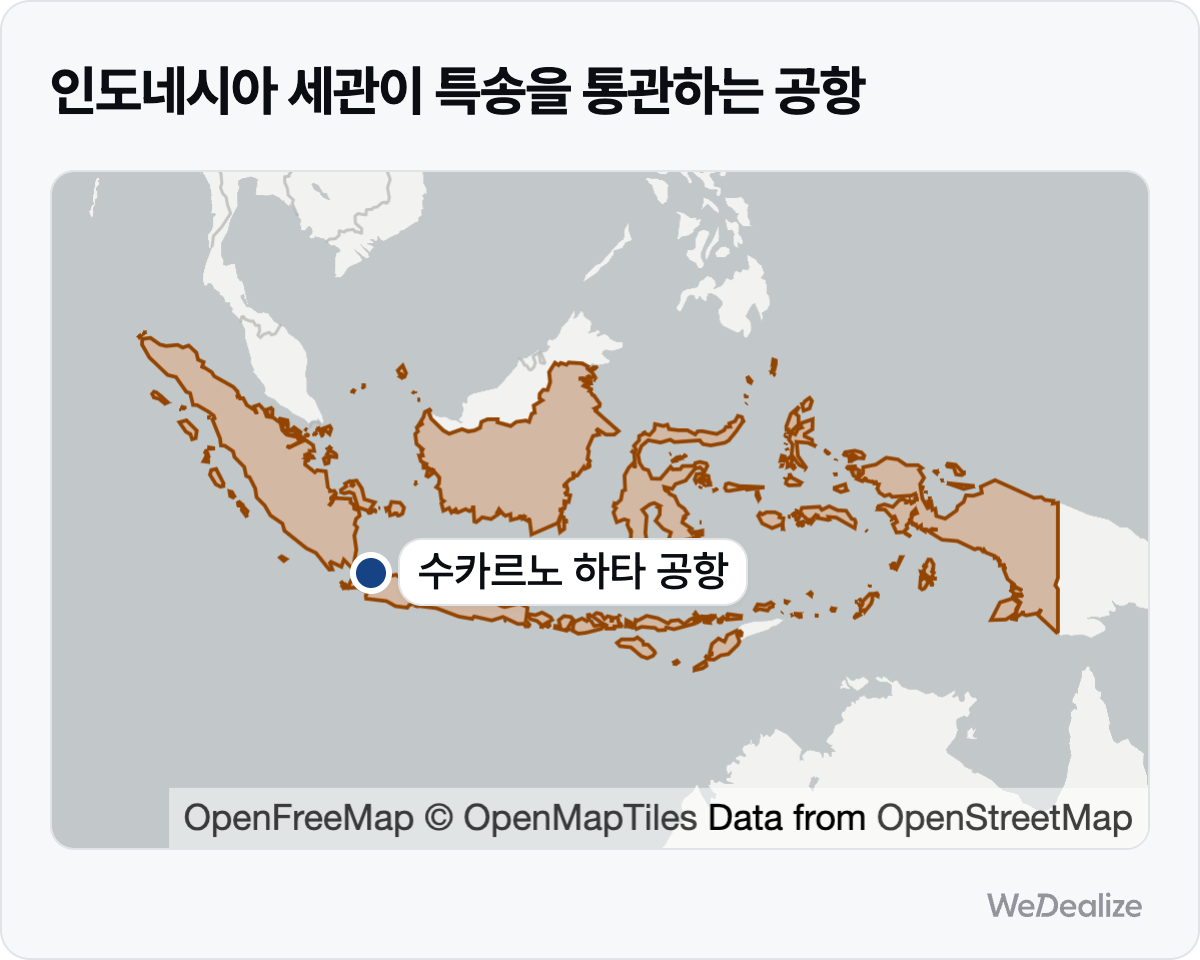
Express and Postal Shipments (Barang Kiriman) — The customs duty rate brackets are the same regardless of the sales channel. The importer varies depending on the channel (international express delivery, express customs clearance).
Selling through Your Own Store or a Marketplace — Ministry of Trade Regulation (Permendag 19/2026)
Ministry of Trade Regulation 19/2026, enacted on June 4, 2026, repealed the previous regulation (Permendag 31/2023) and took effect on the date of promulgation.
Cross-Border Platform Minimum FOB Price of USD 100 — Platforms engaged in cross-border e-commerce apply a minimum FOB price of USD 100 per item to sellers that directly sell finished foreign products into Indonesia. Prices in other currencies are converted using the exchange rate announced by the Ministry of Finance.
Products Below the Minimum Price — Only products designated by the minister in consultation with relevant ministries may be sold directly.
Local Representative of an Overseas Platform — This applies to overseas platforms that have transacted with at least 1,000 consumers or made at least 1,000 deliveries in a year. They are also covered if at least 1% of domestic internet users access the platform. A team formed by the Ministry of Trade evaluates whether a platform is covered, and covered platforms must appoint a representative in Indonesia. Check whether the scale of your own store meets these criteria.
Customs Duties and Taxes
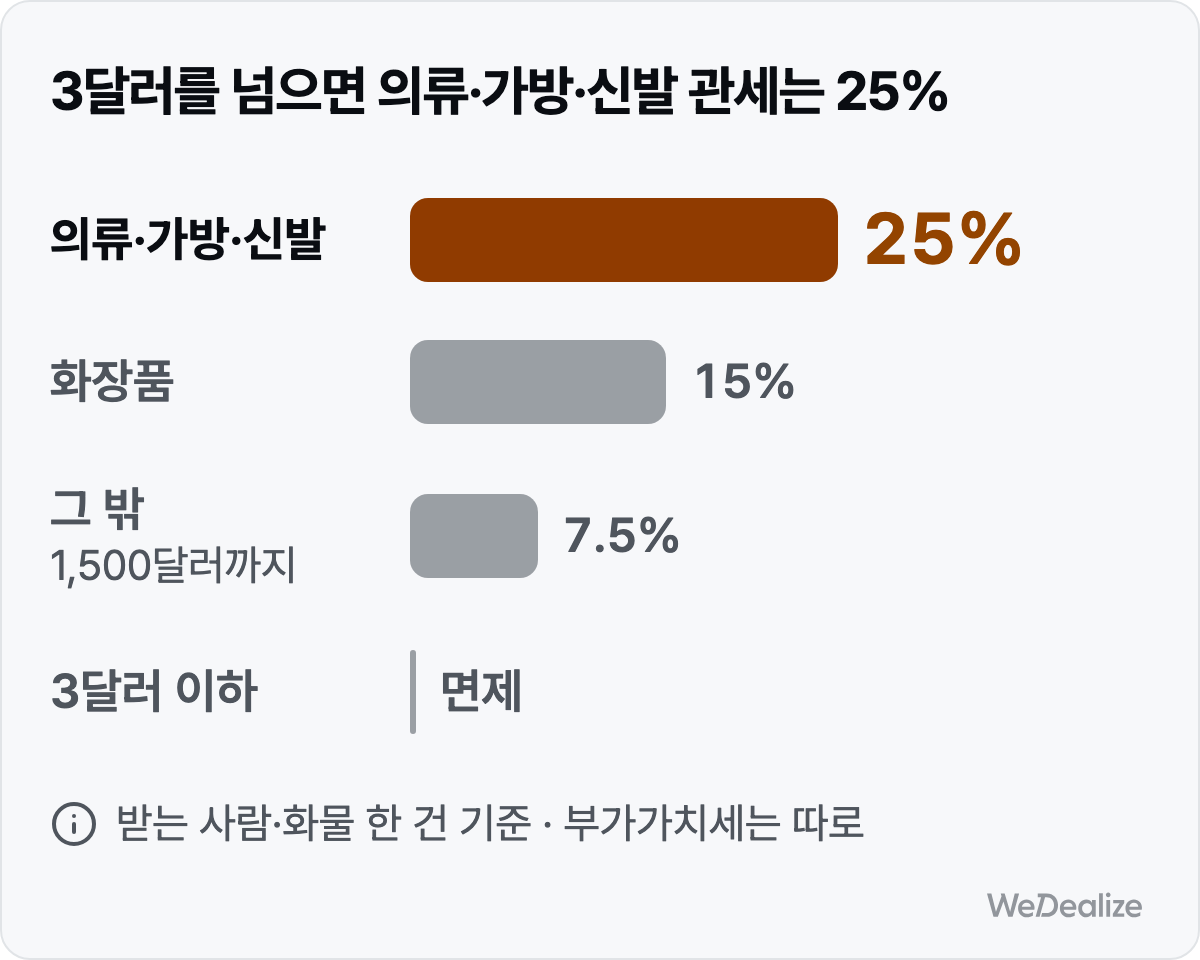
Ministry of Finance Regulation (PMK 4/2025) divides the customs duties and taxes on shipments brought in by express or postal service into value brackets. The value is the customs value (FOB) of one shipment for one recipient.
FOB USD 3 or Less — Customs duty is exempt (low-value exemption). VAT is collected, while income tax is not. Luxury goods sales tax is also collected if the goods are subject to it.
FOB Over USD 3 and Up to USD 1,500 — The standard customs duty is 7.5%, but different rates apply to certain products. Anti-dumping duties, safeguard duties, and similar duties are excluded. VAT is collected, while income tax is generally not collected.
Products Subject to 15% — These include cosmetics and beauty products (HS 33.03–33.07), iron and steel products (HS Chapter 73), and wristwatches (HS 91.01 and 91.02). Books (HS 49.01–49.04) are subject to 0%.
Products Subject to 25% — These include bags and travel bags (HS 42.02), textiles and clothing (HS Chapters 61–63), footwear (HS Chapter 64), and certain electric bicycles and scooters and ordinary bicycles (HS 87.12). Products subject to 15% or 25% also incur 5% income tax.
FOB Over USD 1,500 — If the recipient is an individual, file a regular import declaration (PIBK); if the recipient is a legal entity, file a PIB. Shipments declared under PIBK are subject to the general tariff rate (the most-favored-nation rate commonly applied to WTO member countries).
Importer
General Rule: The Recipient — The importer of an express shipment is the recipient.
E-Commerce Transaction Shipments — Under Ministry of Finance regulations, both retail online sales through one’s own website or app and marketplace sales are considered transactions by an “Electronic Commerce Operator (PPMSE).” For PPMSE transaction shipments, the Indonesian PPMSE or the local representative entity designated by an overseas PPMSE is treated as the importer. If the overseas PPMSE has not appointed a local representative, the recipient is the importer.
Who Pays the Taxes? — Decide whether the seller will collect the taxes at checkout or the recipient will pay them. If the seller pays in advance, it is similar to DDP; if the recipient pays upon delivery, it is similar to DAP. State which arrangement applies on the product page.
Certification and Labeling
Foreign Sellers Listing on an Indonesian Marketplace — Submit proof of a domestic business license, seller identity, compliance with standards, and a transaction account to the marketplace. Authenticate the domestic business license through an apostille (a certification that enables foreign public documents to be recognized), or an equivalent process. For identity and business-license documents, also attach a certificate or inspection report confirming that the information has been verified by an independent investigation agency in the home country. The marketplace will reject registration if the requirements are not met.
Language and Country of Dispatch — Write the product description in clear Indonesian and display the country of dispatch.
Proof of Compliance with Standards — For products subject to mandatory Indonesian National Standards (SNI) or technical requirements, provide proof of compliance. For products not subject to mandatory requirements, provide proof of compliance with the standards of the home country. Products subject to mandatory halal certification require a halal certificate.
Withdrawal and Returns
Return Terms in the Same Language — Sellers listing on a marketplace must write product descriptions in Indonesian. It is safer to state the return terms in the same language.
When Returned to Korea — Goods that have not been manufactured, processed, repaired, or used overseas may qualify for re-import duty exemption if re-imported within two years from the date the export declaration is accepted. There are exceptions, including cases where a refund was received, so confirm with a customs broker.
Connect Through WeDealize
The process for shipping orders from an integrated overseas marketplace by express delivery from a Korean center to Indonesia is summarized in the Overseas Direct Shipping Guide.
Transportation and Customs Clearance Tips
Collect the Recipient’s Identification Number — Express shipments must include an invoice or proof of payment, a clear description of the goods, and valid identification information for the recipient (national identity card KTP or taxpayer identification number NPWP).
Send Only New Products as Express Shipments — Goods sent through the express shipment procedure must be new; used goods are not allowed.
The Payment Deadline After Tax Notification Is Short — When customs issues a tax assessment notice (SPPBMCP), the express carrier (PJT) has three days to pay, while the designated postal operator has 60 days. If the recipient is responsible for payment, inform them of this schedule.
Recipients Can Track Parcels on the Customs Website — Customs provides a service for tracking overseas parcels by tracking number at beacukai.go.id/barangkiriman.
Common Mistakes
Misconception: “There are no taxes on shipments of USD 3 or less.” — Incorrect. Only customs duty is exempt. VAT is collected.
Misconception: “The customs duty rate is always 7.5%.” — Incorrect. Cosmetics are subject to 15%, while clothing, bags, and footwear are subject to 25%; these products also incur an additional 5% income tax.
Misconception: “An overseas platform does not need a representative in Indonesia.” — Incorrect. A platform may be covered if it meets any one of the following: 1,000 consumers, 1,000 deliveries, or 1% of users. A team formed by the Ministry of Trade evaluates whether the platform is covered.
Items Not Confirmed
Import VAT Rate — Confirm it through announcements from Indonesian customs and the Ministry of Finance.
Exact Effective Date of PMK 4/2025 — Confirm the date of promulgation in the Indonesian State Gazette.
Whether the USD 100 FOB Minimum Price Applies to Direct Shipping from an Own Store — Confirm with Indonesia’s Ministry of Trade.
Consumer Protection and Return Period — Confirm the rules on returns for distance sales in the original text of the Consumer Protection Law.
Distribution Licenses for Food and Cosmetics — Confirm with Indonesia’s food and drug authority whether food and cosmetics registration requirements apply to express shipments for personal orders.
Related Terms
Customs Broker — A nationally certified professional who files import and export declarations and calculates tax amounts on behalf of the cargo owner.
Export Declaration — The procedure for declaring to customs the product name, quantity, price, and other details of goods to be exported overseas.
Simplified Export Declaration (E-Commerce) — A simplified declaration that reduces the number of fields in a formal export declaration and is mainly used for low-value e-commerce exports.
Zero-Rated VAT — A system under which a 0% VAT rate is applied to exported goods and the VAT paid on purchases is refunded.
International Express Delivery — International shipping in which an express carrier handles everything from pickup and air transportation to customs clearance and door-to-door delivery.