Canada Sales Guide — Cross-Border Direct-to-Consumer Sales
Automatically translated from Korean.
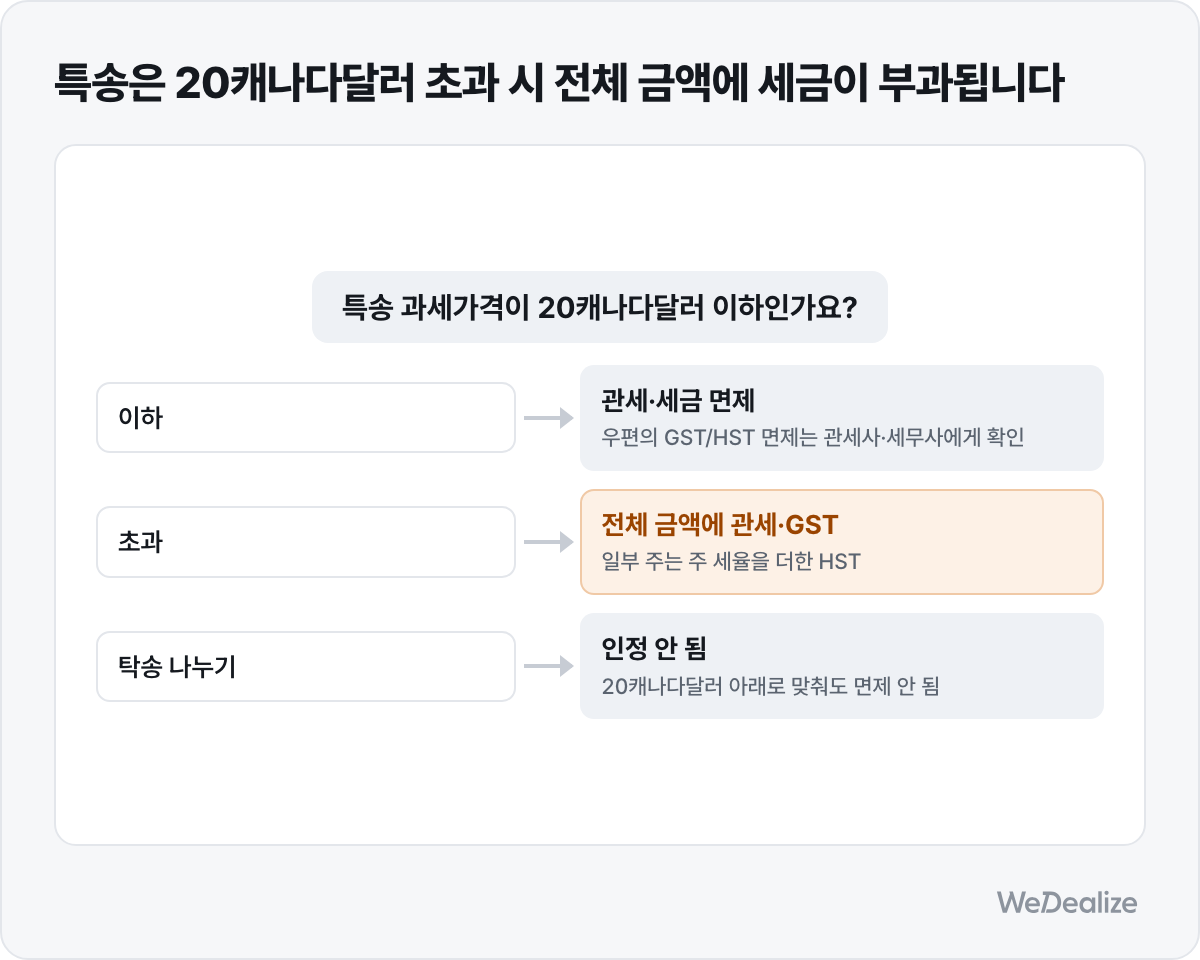
In one line — For express courier parcels sent to Canada through cross-border direct-to-consumer sales, customs duties and taxes are exempt only when the value for duty is CAD 20 or less. If it exceeds that amount, customs duties and 5% GST (or HST) are charged on the entire amount. The CAD 150 and CAD 40 thresholds apply only to goods from the United States and Mexico, and splitting one shipment to keep it below CAD 20 is not accepted.
Scope of this guide — Sending Korean products to Canadian consumers by international courier or mail for each order (cross-border direct-to-consumer sales) See other guides — Korean export declaration, simplified export declaration, and zero-rating → International Direct Shipping Guide · Return collection → International Returns Processing Guide · Importing into Canada for sale → Canada Sales Guide — Local Sales
Check these first
How are you selling? — This guide covers cross-border direct-to-consumer sales shipped by courier or mail for each order. If you become the importer of record (IOR) yourself without a corporation, or import into Canada under an IOR service and sell there, see Canada Sales Guide — Local Sales. If you sell to a Canadian distributor or importer, that company imports the goods → Export Guide by Product Category
Is the value for duty CAD 20 or less? — This is the customs-duty exemption threshold for goods sent from Korea by courier or mail. If it exceeds this amount, customs duties and GST/HST apply. Confirm with a customs broker or tax accountant whether GST/HST is exempt for mail shipments.
Is the recipient the person who placed the order? — If someone other than the person who placed the order imports the goods in Canada, the low-value exemption does not apply.
Which province is the recipient in? — The federal GST (goods and services tax) is 5%. In provinces that use HST (harmonized sales tax, combining federal GST with the provincial rate), the provincial rate is added. Quebec, British Columbia, Manitoba, and Saskatchewan impose separate provincial sales taxes (see “Provincial Sales Taxes”).
Steps to take
Confirm that the sales structure is not excluded from the low-value exemption → Importer
Calculate customs duties and GST/HST based on the CAD 20 value-for-duty threshold → Customs duties and taxes
Decide whether the seller will collect customs duties and taxes at checkout or the recipient will pay them → Importer
Provide the courier with the price, origin, and detailed product description → Shipping and customs clearance tips
Ways to sell in Canada
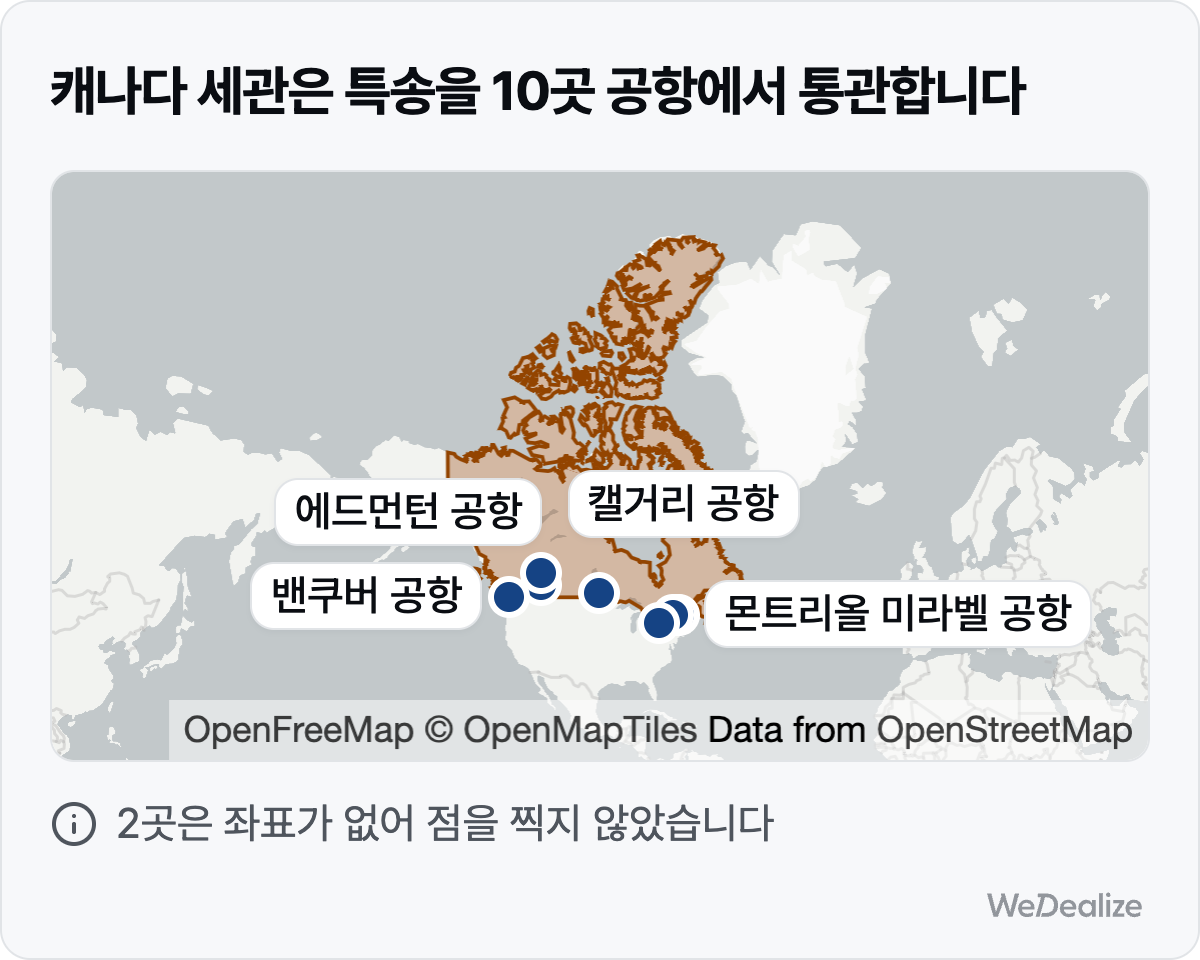
Courier and mail — The same criteria apply regardless of the sales channel. Courier shipments are governed by the Courier Imports Remission Order, and mail shipments by the Postal Imports Remission Order. For mail shipments too, customs duties and excise taxes are exempt when the value for duty is CAD 20 or less. Confirm with a customs broker or tax accountant whether GST/HST is exempt. Cases excluded from the exemption, such as goods purchased from a Canadian retailer or imports by someone other than the person who placed the order, are also treated the same for courier shipments (International Courier, Courier Customs Clearance).
Own online store and overseas marketplaces — Even if you sell through a marketplace, when the goods are sent from Korea by courier, the low-value exemption and tax thresholds below apply as usual. If the transaction is treated as a purchase from a Canadian retailer, the low-value exemption is unavailable. Confirm the sales structure first.
Customs duties and taxes
Comparison with Korean VAT
Canadian GST works in many ways like Korean VAT, but the rate is not a single nationwide rate and varies by province.
Item | Korean VAT | Canada |
|---|---|---|
Rate | One nationwide rate of 10% | Federal GST of 5% plus provincial taxes, which vary by province (see “Provincial Sales Taxes”) |
At importation | The importer declares and pays customs duties and tax to Customs | GST is charged on imported goods |
Tax calculation basis | Value for duty plus customs duties and other amounts | Value for duty plus customs duties and other amounts |
Tax paid by a business | VAT on business-use imported goods is credited as input tax | GST/HST-registered importers receive an input tax credit (ITC) |
Exports | Exported goods are zero-rated (0%) | Goods exported from Canada are zero-rated (0%) if the conditions are met |
HST — Ontario, Nova Scotia, New Brunswick, Newfoundland and Labrador, and Prince Edward Island collect GST and the provincial portion together as one tax. As with Korean VAT, registered businesses collect GST/HST when selling to businesses, and GST/HST paid on purchases or imports for business use is recovered as an input tax credit (ITC).
Quebec QST — This is the tax collected separately by Quebec. Registered businesses may receive a refund of QST paid (input tax refund, ITR).
PST and RST — PST in British Columbia and Saskatchewan and RST in Manitoba work differently. The person who buys and uses the goods pays the tax, and goods purchased for resale are not taxed at the outset.
Low-value exemption
CAD 20 threshold — This is the low-value tax exemption threshold established by the Courier Imports Remission Order. For goods entering by courier from outside the United States and Mexico, customs duties and taxes are exempt when the value for duty is CAD 20 or less.
The United States and Mexico have different thresholds — Only goods from the United States and Mexico are exempt from customs duties up to CAD 150 and taxes up to CAD 40. Even if Korean goods pass through the United States or Mexico, the CAD 20 threshold applies if they were not circulated in those countries.
If the threshold is exceeded, the entire amount is subject — If the value for duty exceeds the threshold, customs duties apply to the entire shipment (one shipment sent at one time), not just the excess. Splitting one shipment into several boxes to keep it below the threshold is not accepted.
GST/HST
Federal GST 5% — Under the Excise Tax Act, 5% GST is charged on imported goods based on the value of the goods. The value of the goods is the value for duty plus customs duties and other amounts.
HST — For goods imported by a person living in a participating province, the person pays the federal 5% plus that province’s rate. For goods imported for commercial purposes, see Canada Sales Guide — Local Sales.
Provincial Sales Taxes
The provincial tax added to the federal GST of 5% depends on the province where the recipient lives. The table below shows the taxes collected at the border on goods imported for personal use (cross-border direct-to-consumer parcels).
Province or territory | Tax payable at the border |
|---|---|
Ontario | HST 13% |
Nova Scotia | HST 14% |
New Brunswick · Newfoundland and Labrador · Prince Edward Island | HST 15% |
Quebec | GST 5% + QST 9.975% |
British Columbia | GST 5% + PST 7% |
Manitoba | GST 5% + RST 7% |
Saskatchewan | GST 5% + PST 6% |
Alberta · Yukon · Northwest Territories · Nunavut | GST 5% only |
Who collects it — Under agreements between the Canada Border Services Agency and the provinces, provincial taxes are collected as well. They are collected only on goods subject to GST.
HST provinces — Residents of those provinces pay HST when they import goods, regardless of where the goods enter Canada.
If the province of customs clearance is different — Provincial tax is calculated based on the province where the goods are delivered. For example, if a parcel destined for Quebec is cleared through customs in Ontario, only GST is paid at the border, and the recipient reports the Quebec tax directly to Quebec.
Tax-exempt goods — The goods exempt from provincial sales tax differ by province. Goods exempt from GST are also exempt from provincial tax.
Provincial sales tax registration for overseas sellers
The requirements for an out-of-province seller to register for provincial sales tax differ by province.
British Columbia — A seller outside Canada must register for PST before selling if it keeps inventory in a warehouse in BC, such as a fulfillment warehouse, and sells to BC customers. If the seller has a place of business, agent, or employee in Canada, it is treated as a seller in Canada. It must also register if it ships BC customer orders to BC by courier or similar means while advertising to BC customers, or if its BC sales exceed CAD 10,000 in 12 months.
Saskatchewan — An out-of-province business must obtain a PST licence if it makes retail sales by accepting orders from Saskatchewan and shipping the goods to Saskatchewan. There is no wording excluding sellers outside Canada.
Manitoba — An out-of-province business must register as an RST vendor if it ships goods to Manitoba consumers in Manitoba, solicits orders in Manitoba through advertising or similar means, and accepts orders from Manitoba. It must also register if it keeps inventory in Manitoba for sale. Registration is not required if it sells only to people who will resell the goods.
Quebec — General system — An out-of-Quebec seller must register for QST if, over 12 months, sales exceeding CAD 30,000 are made to unregistered QST persons of goods located in Quebec or goods delivered to Quebec by a method other than mail or courier. Sales shipped from Korea by mail or courier are not included in this amount.
Quebec — Simplified system — A seller outside Quebec that is registered for GST/HST must register under Quebec’s simplified QST system and collect QST at 9.975% if sales to Quebec consumers exceed CAD 30,000 over 12 months. A seller outside Canada that is not registered for GST/HST may collect under the simplified system only on digital products and services.
Importer
Exclusions from the low-value exemption — Goods purchased from a Canadian retailer and shipped directly from abroad are not eligible for the exemption. The same applies when the order is placed using an address, post office box, or telephone number in Canada, or when someone other than the person who placed the order imports the goods.
Who pays the tax? — If the seller pays in advance, it is similar to DDP; if the recipient pays upon delivery, it is similar to DAP. If the recipient will be the importer under the applicable conditions, state this in advance on the product page.
Withdrawal and returns
When receiving returned goods in Korea — See the International Returns Processing Guide for responsibility for international return shipping costs and reimportation duty and tax relief.
Connect through WeDealize
The process for shipping orders from an integrated overseas marketplace from a Korean center to Canada by courier is outlined in the International Direct Shipping Guide.
Shipping and customs clearance tips
Information to provide to the courier — The courier reports the shipment to the Canada Border Services Agency. The exporter provides the courier with the price, origin, and detailed product description.
Common mistakes
Misconception: “Canada is duty-free up to CAD 150” — No. This applies only to goods from the United States and Mexico. Goods sent from Korea are subject to the CAD 20 threshold.
Misconception: “Splitting the boxes makes them exempt” — No. Splitting one transaction’s shipment to keep it below the threshold is not accepted.
Misconception: “GST is 5% everywhere” — Not necessarily. Provinces that use HST add the provincial rate.
Not confirmed
Consumer withdrawal and return rules — Confirm the distance-selling rules of the province where you sell with the Canadian consumer authorities.
Product safety and labelling (including bilingual labelling) — Confirm the requirements under the Canada Consumer Product Safety Act and packaging and labelling regulations with the Canadian product safety authorities.
Related terms
Customs broker — A nationally licensed professional who handles import and export declarations and tax calculations on behalf of the cargo owner.
Export declaration — The procedure of declaring to Customs the product name, quantity, price, and other details of goods to be exported overseas.
Simplified export declaration (e-commerce) — A simplified declaration with fewer declaration items than a formal export declaration, mainly used for low-value e-commerce exports.
Zero-rating — A system under which exported goods are subject to a 0% VAT rate and VAT paid on purchases is refunded.
International courier — International delivery in which a courier company handles everything from pickup and air transport to customs clearance and delivery to the door.