Canada Sales Guide — Local Sales
Automatically translated from Korean.
In one line — If a Korean company imports and sells goods directly as the importer of record (IOR) without a Canadian corporation, it pays GST at the border and checks the requirements for GST/HST registration and provincial sales tax registration. Even if it imports under the name of an IOR service, it must likewise check the registration requirements applicable to the party selling in Canada. For commercial goods, only GST is collected at the border; provincial taxes are reported separately.
Scope of this guide — This guide covers importing and selling in Canada without a corporation by becoming the direct importer of record (IOR), or importing and selling by using an IOR service's importer-of-record designation In another guide — Sending each order by express courier or mail → Canada Sales Guide — Cross-Border Direct Sales · Who files cosmetic notifications → Canada Cosmetics Export Guide
What to check first
How will you import the goods? — Whether the Korean company becomes the direct importer of record (IOR) or borrows an importer-of-record designation from an IOR service determines who is listed as the importer during customs clearance and who pays the import taxes. If you sell to a Canadian distributor or importer, that company imports the goods → Export Guides by Product
Are you required to register for GST/HST? — If you carry on business in Canada, make taxable sales, and are not a small supplier, you must register (see “Importing and selling as a direct importer (IOR)”).
In which province will you keep inventory and in which province will you sell? — Provincial sales tax registration requirements vary depending on the province where you keep inventory (see “Provincial sales tax registration” in “Importing and selling as a direct importer (IOR)”).
Order of tasks
Decide whether to become the direct importer or borrow an importer-of-record designation through an IOR service → Ways to sell in Canada
If you import as the direct importer (IOR) without a corporation, check your import account, GST/HST registration, and provincial sales tax registration → Importing and selling as a direct importer (IOR)
If you import using an IOR service's importer-of-record designation, check who pays and claims a credit for import GST, as well as sales tax registration → Importing and selling using an importer-of-record designation
Report the provincial taxes on the imported goods directly → Customs duties and taxes
Ways to sell in Canada
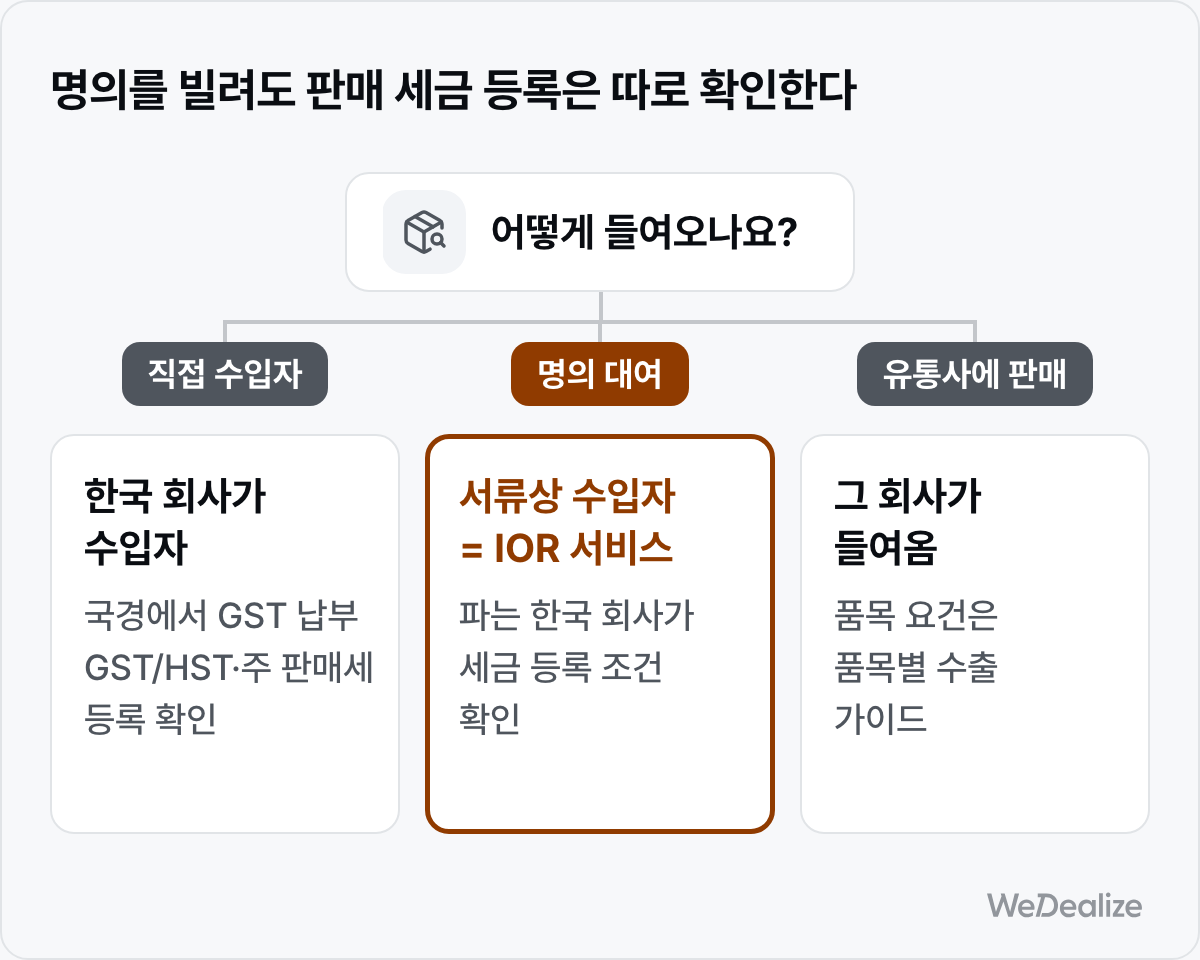
Direct importer (IOR) — The Korean company becomes the importer, without a Canadian corporation, imports the goods into Canada, and then sells them. For taxes and registration at the time of import, see “Importing and selling as a direct importer (IOR).”
Borrowing an importer-of-record designation — An IOR service company becomes the importer of record on paper, imports the goods, and the Korean company sells them in Canada. For taxes and registration at the time of import, see “Importing and selling using an importer-of-record designation.”
Customs duties and taxes
For an explanation of GST, HST, QST, and PST and how they differ from Korean VAT, see “Customs duties and taxes” in Canada Sales Guide — Cross-Border Direct Sales. This guide only covers what differs when goods are imported for commercial purposes.
When importing for commercial purposes
Only GST at the border — The Canada Border Services Agency does not collect provincial taxes on commercial goods at the border.
HST provinces — A GST/HST-registered business reports the provincial portion directly on line 405 of its next return; if it is not registered, it reports it using Form GST489.
British Columbia — PST must be self-assessed on goods imported for use in the business. Goods imported for resale are exempt.
Manitoba — If the importer is a business, the Canada Border Services Agency does not collect RST, so it must be self-assessed. Goods purchased for resale are not taxable.
Saskatchewan — If you purchase and use goods from an out-of-province supplier that did not collect tax, you must self-assess the tax. If you hold a vendor’s licence, you may purchase goods for resale without tax.
Quebec — A QST-registered business does not pay QST when it imports goods from outside Canada solely for commercial activities and is eligible to claim an input tax refund (ITR) for that QST. If these conditions are not met, it reports and pays the QST on its return. If a person that is not registered for QST must pay QST after importing goods, it reports it using Forms FP-505-V and FP-505.D.D-V.
Importing and selling as a direct importer (IOR)
This refers to a Korean company that becomes a non-resident importer (NRI), without a Canadian corporation, imports goods, and then sells them from a Canadian warehouse or similar location.
Import preparation — A non-resident importer has the same obligations as a Canadian importer. Obtain a 9-digit business number (BN9) from the Canada Revenue Agency (CRA), and create an import-export account (RM) through the Canada Border Services Agency’s CARM portal. Since 2024-05-13, the account cannot be issued until an agreement to keep records outside the business premises (BSF900) has been approved. Keep the records for 6 years after importing. A customs broker usually handles document preparation, payment of customs duties, and release of the goods on your behalf.
At import — Pay GST at the border. Because the goods are commercial, the Canada Border Services Agency does not collect provincial taxes; handle provincial taxes as described under “When importing for commercial purposes.” If you post security, you can use the Release Prior to Payment (RPP) privilege and pay later; without security, pay using a Type C declaration when the goods are released.
GST/HST registration — If you carry on business in Canada, make taxable sales, and are not a small supplier (gross revenue of CAD 30,000 or less in a single quarter or over the last four consecutive quarters), you must register. Whether you carry on business in Canada is determined by considering factors such as where your agents or employees are located, delivery destinations, inventory locations, and where contracts are made. Register using the non-resident online form or Form RC1.
If you register — If the requirements are met, you may claim the GST paid at import as an input tax credit (ITC), and you collect GST/HST on taxable goods sold to customers.
If you do not register — You cannot claim a credit for the GST paid at import. If the purchaser is a GST/HST-registered business, it may be able to claim the credit using evidence such as the import declaration (B3-3).
Provincial sales tax registration — If you keep inventory in a Canadian warehouse and sell it, register in British Columbia before making sales, and in Manitoba when you keep inventory for sale within the province. In Quebec, register when sales of goods kept in Quebec exceed CAD 30,000 over 12 months. For province-specific requirements for sales shipped from outside the province without inventory there, see “Provincial sales tax registration for overseas sellers” under Canada Sales Guide — Cross-Border Direct Sales.
Importing and selling using an importer-of-record designation
This refers to a Korean company that, without a Canadian corporation, has an IOR service company act as the importer of record on paper, imports the goods, and sells them in Canada.
Import GST — GST/HST on imported goods is paid by the owner or the importer of record. Because the goods are commercial, the Canada Border Services Agency does not collect provincial taxes; handle provincial taxes as described under “When importing for commercial purposes.”
Input tax credit (ITC) — The CRA describes the importer entitled to claim the GST paid at import as the person who caused the goods to be brought into Canada. The importer must be registered for GST/HST and meet the credit requirements. Confirm with a tax professional which of the company lending its name and the Korean company may claim the credit, based on the contract and the actual transaction.
Sales tax registration — If the Korean company is the party selling in Canada, check GST/HST registration and provincial sales tax registration under the same requirements as “GST/HST registration” and “Provincial sales tax registration” in “Importing and selling as a direct importer (IOR).”
Importer under product regulations — Product regulations may not treat the importer of record on paper as the importer. Health Canada explains that, under consumer product and cosmetics regulations, the importer of record on paper may not be considered the importer, and who qualifies as the importer is determined case by case. See the Canada Cosmetics Export Guide for who files a cosmetic notification.
Connect through WeDealize
Sales involving express shipments from a Korean fulfillment center to Canada for each order are covered in Canada Sales Guide — Cross-Border Direct Sales and International Direct Shipping Guide.
Common mistakes
Misconception: “You cannot import into Canada without a corporation.” — Incorrect. A non-resident importer can obtain a business number (BN9), create a CARM import-export account, and import goods.
Misconception: “You pay all provincial taxes at the border.” — Incorrect. The Canada Border Services Agency does not collect provincial taxes on commercial goods, so the provincial taxes must be self-assessed.
Misconception: “If you borrow someone’s importer-of-record designation, that company also handles tax registration and reporting.” — Incorrect. If the Korean company is the party selling in Canada, it must directly check the GST/HST and provincial sales tax registration requirements. Health Canada does not consider the importer of record on paper to be the importer under consumer product and cosmetics regulations.
Not covered here
Product safety and labelling (including bilingual labelling) — Confirm the requirements under the Canada Consumer Product Safety Act and packaging and labelling regulations with the Canadian product safety authorities.
Related terms
IOR (importer of record) — The party that imports goods into the country of sale and bears primary responsibility for paying customs duties.
Customs broker — A nationally certified professional who handles import and export declarations and calculates duties and taxes on behalf of the shipper.