Australia Sales Guide — Local Sales
Automatically translated from Korean.
One-line summary — For local sales in Australia, our company, using an ABN (Australian Business Number) or CCID (Customs Client Identifier), or the company lending us its name, lodges the import declaration. Import GST (Australia’s value-added tax) is paid by the party that lodges the import declaration and can be claimed as a credit if it is GST-registered. If Australia-related sales are AUD 75,000 or more, the seller must register for GST.
Scope of this guide — When importing into Australia in our company’s name without an Australian entity, or importing under the name of an Australian company and selling the goods as Australian inventory In other guides — Sending each order by express courier or post → Australia Sales Guide — Cross-border Direct Sales · Korean-side declaration when shipping out inventory → Export Declaration · VAT on exported goods → Zero-rating
What to check first
Is this the right guide? — If you send each order from Korea, see Australia Sales Guide — Cross-border Direct Sales. If you keep inventory in Australia and dispatch it from Australia, someone must be the importer, so this is the right guide. If you sell to an Australian distributor or importer, that company imports the goods → Product-specific Export Guide
What do you have in Australia? — If you sell goods to an Australian subsidiary and the subsidiary lodges the import declaration, see Product-specific Export Guide. If you have a branch or office, see foreign company registration under “Importing and selling in our company’s name” below and corporate income tax under “Selling in Australia.” If you have nothing there, read this entire guide.
Do you have an ABN (Australian Business Number)? — You can lodge an import declaration using a CCID even without an ABN. An ABN is required for deferred payment of import GST and registration as the responsible supplier for electrical equipment. See “Importing and selling in our company’s name” and “When importing” below.
Are Australia-related sales AUD 75,000 or more? — If so, you must register for GST. See sales tax under “Selling in Australia” below.
Are they electrical equipment, cosmetics, or food? — For electrical equipment, an Australian or New Zealand business must register as the responsible supplier, and if a cosmetic ingredient is an industrial chemical, the importer must register it. See product obligations under “Selling in Australia” below. For food and biosecurity requirements, see “When importing.”
Order of tasks
Decide whether to import in our company’s name or borrow an importer’s name → How to sell in Australia
If importing in our company’s name, obtain an ABN or CCID, appoint a customs broker, and check whether foreign company registration applies → Importing and selling in our company’s name
If borrowing a name, check whether that company will declare itself as the importer and claim the import GST credit, and agree on cost sharing → Importing and selling by borrowing an importer’s name
Determine whether GST registration is required. Only a registered or required-to-be-registered business can claim import GST as a credit, so check this before importing → Selling in Australia, When importing
Check responsible-supplier registration for electrical equipment, registration of cosmetic ingredients, mandatory safety standards, and post-sale accident reporting obligations → Selling in Australia
Determine the customs value, certificate of origin, and payment method, and check food and biosecurity requirements before lodging the import declaration → When importing
Continue with GST filing and payment, document retention, and annual foreign company filings → Ongoing obligations after registration
How to sell in Australia
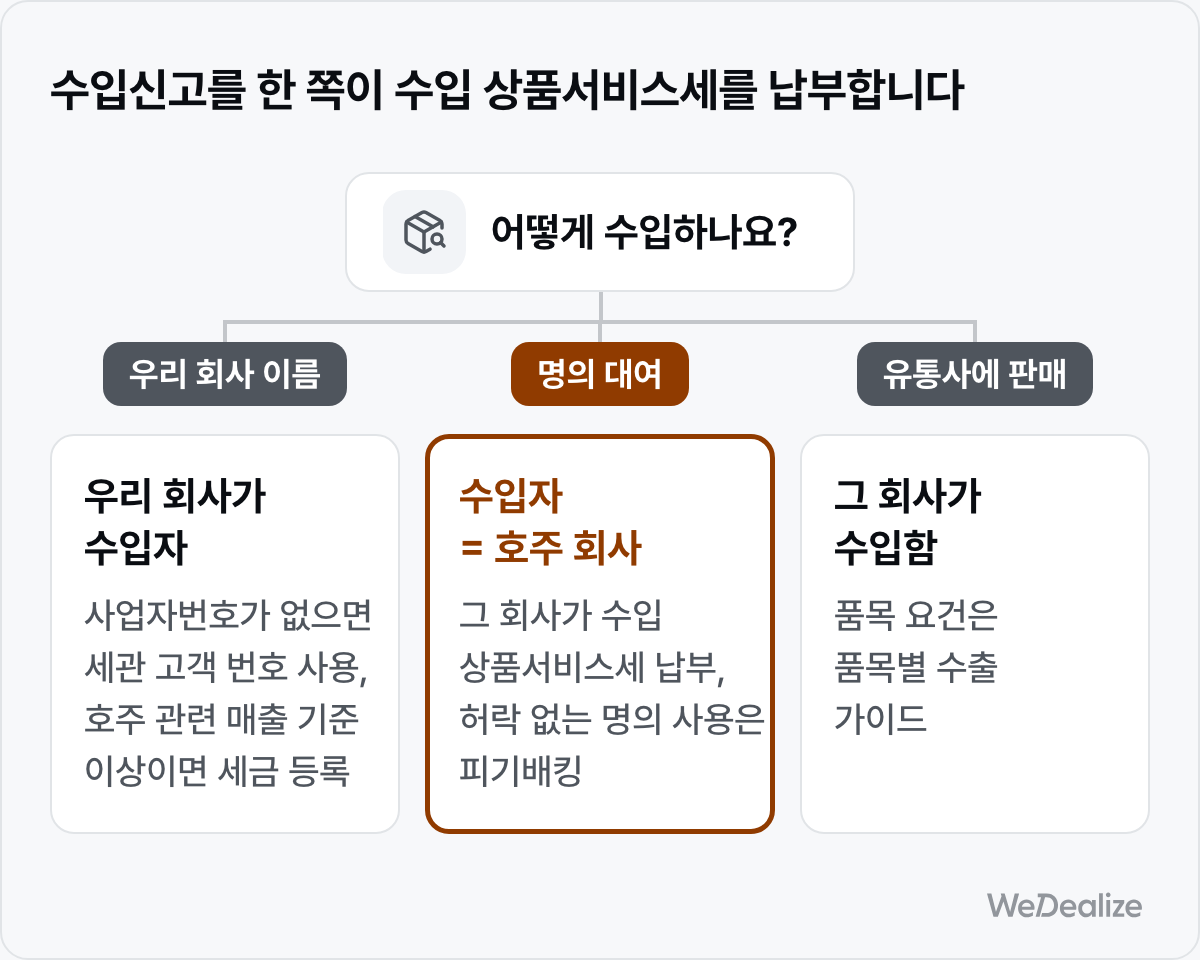
Who does what — The “Borrowing a name” column is based on the Australian company being listed as the importer on the declaration. The explanation is in the sections in the right-hand column.
Task | In our company’s name | Borrowing a name | Details |
|---|---|---|---|
Import declaration | Our company | That company | In our company’s name · Borrowing a name |
Claim for unpaid customs duty | Our company | That company · Owner | Borrowing a name |
Payment of import GST | Our company | That company | When importing · Borrowing a name |
Import GST credit | Our company | That company | When importing · Borrowing a name |
GST registration | Our company | Our company | Selling in Australia › Sales tax |
Importing in our company’s name — Our company becomes the importer, without an Australian entity, imports the goods into Australia, and then sells them from an Australian warehouse or similar location. See “Importing and selling in our company’s name.”
Borrowing an importer’s name — An Australian company declares itself as the importer, imports the goods, and our company sells them in Australia. See “Importing and selling by borrowing an importer’s name.”
Importing and selling in our company’s name
This applies when our company becomes the importer, without an Australian entity, imports the goods, and then sells them from an Australian warehouse or similar location.
Who is the importer? — Under Australian customs law, the owner of goods includes the owner, importer, consignee (the person receiving the cargo), agent, or anyone representing themselves as one of these. The owner of the goods must lodge an import declaration for home consumption or a declaration for entry into a customs-licensed warehouse. According to Australian Border Force guidance, an import declaration is lodged by the importer or its customs broker as agent.
CCID if there is no ABN — According to Australian Border Force guidance, a CCID is used to declare imported cargo for a person or company that does not have an ABN or does not use an ABN for that transaction.
Obtaining an ABN — You may obtain an ABN if you carry on an enterprise in Australia or make supplies connected with Australia while carrying on an enterprise. An entity with simplified registration (limited registration) cannot obtain an ABN.
Using a customs broker — Under Australian customs law, the owner of goods may appoint an agent in writing to handle customs procedures. A person who is an agent or acts as an agent is treated as the owner for purposes of applying customs law, including penalties. Australian Border Force guidance recommends using a customs broker for first-time or occasional importers.
Foreign company registration — Under Australian corporations law, a foreign company may carry on business in Australia only after registering, or applying to register, with ASIC (Australian Securities and Investments Commission). Having a place of business in Australia is regarded as carrying on business in Australia. Selling through an independent contractor or merely taking orders where the contract must be accepted outside Australia does not constitute carrying on business. Registration requires appointing at least one local agent.
Electrical equipment — An overseas company cannot register as the responsible supplier for electrical equipment. See product obligations under “Selling in Australia” below.
Sales tax registration — The seller registers. See sales tax under “Selling in Australia” below.
Importing and selling by borrowing an importer’s name
This applies when, without an Australian entity, an Australian company declares itself as the importer, imports the goods, and our company sells them in Australia.
How borrowing a name works — Under Australian customs law, the owner of goods includes the importer, consignee, or anyone representing themselves as one of these. If the Australian company is listed as the importer on the declaration, that company is also the owner under customs law.
This is different from merely having a customs broker lodge the declaration — If a customs broker lodges the declaration as an agent, see the customs broker section under “Importing and selling in our company’s name” above.
Resale arrangement — If the Australian company buys the goods from our company and imports them, this is a buyer sale in which that company is the importer. In this case, see Product-specific Export Guide.
Import GST and processing charges — If the company lending its name lodges the import declaration, that company pays the import GST. For the payer of processing charges, see “When importing” below.
Import GST credit — See “When importing” below for the credit requirements. If the company lending its name lodges the declaration, the credit requirements are assessed based on that company as well. If that company is not GST-registered and is not required to register, the import is not eligible for a credit.
Resident agent — Under Australia’s GST law, if an overseas business imports through an Australian resident agent, the agent pays the import GST and receives the credit. Whether the company lending its name is our company’s agent should be confirmed with a tax adviser based on the contract and actual transactions.
Unpaid customs duty — Under Australian customs law, unpaid customs duty must be paid by the owner of the goods. Even if a name is borrowed, our company may be liable if it qualifies as the owner.
Unauthorized use of a name — According to Australian Border Force guidance, importing by using another company’s information, such as its ABN, without permission is piggybacking. A customs broker must investigate further if it suspects that the importer on the declaration is not an actual party to the transaction. If the concern is not resolved after verification, the broker must not lodge the declaration.
Power of attorney and CCID — According to Australian Border Force guidance, a customs broker must check that the power of attorney proving its authority to act for the importer matches the importer’s information. A CCID must not be used to stand in for the actual importer’s information.
Matters to agree with that company — The contract should specify who bears the burden if customs duty is assessed later, recall costs, provision of copies of import documents, and transfer of remaining inventory when the contract ends.
Manufacturer liability and electrical equipment — When borrowing a name, see product obligations under “Selling in Australia” below for who bears manufacturer liability and who is the responsible supplier for electrical equipment.
Sales tax registration — Even when borrowing a name, the party selling to consumers registers. See sales tax under “Selling in Australia” below.
When importing
For formal import declarations for consignments exceeding AUD 1,000 and the calculation of GST payable at the border, see “Customs duties and taxes” and “At the border” in Australia Sales Guide — Cross-border Direct Sales. This section explains what differs when importing commercially.
Customs value — Under Australian customs law, the transaction value, the primary method for determining the customs value, is the price under the contract of sale for export to Australia. If our company imports its own inventory without such a contract, the value of identical or similar goods, a value calculated backward from the Australian selling price, and other methods are used in sequence.
Preferential origin (Korea-Australia FTA) — Under Australian customs law, FTA preferential tariff rates apply to goods originating in Korea. In addition to meeting the origin requirements, the importer must hold a certificate of origin or a copy when the tariff classification and rate are determined. An exception applies where Australia has waived the certificate-of-origin requirement.
Who pays? — Under Australia’s GST law, the person who imports the goods and lodges the import declaration pays the import GST. Under Australian customs law, once the import declaration is received, the owner of the goods must pay the import processing charge. If one of the owners pays, the obligation of the other owner is discharged.
When payment is due — Import GST is paid at the same time and in the same manner as customs duty. Customs may withhold release of the goods until the GST is paid.
Deferred GST — A business approved by the Commissioner of Taxation pays import GST to the ATO by the 21st day after the end of the month in which the liability to pay import GST arises. To obtain approval, the business must be GST-registered, have an ABN, and lodge returns monthly. Deferral applies when the approved business submits its GST return in the prescribed form and lodges the import declaration electronically.
Requirements for an import GST credit — A business that is GST-registered or required to be registered can claim the import GST it paid as a credit when it imports goods in the course of carrying on its business. For credit restrictions when simplified registration is chosen, see sales tax under “Selling in Australia” below.
Customs warehouse — According to Australian Border Force guidance, goods exceeding AUD 1,000 may be stored in a customs warehouse (customs-licensed warehouse) without paying customs duty or taxes after lodging a warehouse-entry declaration. They may be stored without a time limit until they are entered for home consumption or exported.
Food — Under Australia’s Imported Food Control Act, importing food that does not meet the applicable standards may result in imprisonment for up to 10 years. This provision excludes packaging and labeling standards.
Biosecurity — Under Australia’s Biosecurity Act, certain goods are designated as prohibited imports, while others may be imported only if conditions such as obtaining a permit are met. If a permit is required, the goods cannot be imported before the permit is obtained. A permit authorizes the applicant or a person acting on the applicant’s behalf to import the goods.
Prohibited Imports — See “Certification and Labeling” in Australia Sales Guide — Cross-Border Direct Sales for prohibited or restricted imports such as e-cigarettes and nicotine products.
When Selling in Australia
Sales Tax — GST
Domestic Sales in Australia — Sales of goods delivered to recipients in Australia are supplies connected with Australia. If a business registered, or required to be registered, for GST makes the sale in the course of its business, it is a taxable supply, and GST is 10% of the value of the supply.
Who Must Register — A person carrying on a business must register if their Australia-connected turnover is at least 75,000 Australian dollars over the 12 months ending this month or the 12 months beginning this month. This turnover does not include supplies that are not connected with Australia.
Simplified Registration — Overseas businesses that may choose simplified registration should see “Duties and Taxes” in Australia Sales Guide — Cross-Border Direct Sales. If simplified registration is chosen, import GST cannot be claimed as a credit.
Difference from the Low-Value Imported Goods Rules — See “Duties and Taxes” and “GST — Low-Value Imported Goods of 1,000 Australian Dollars or Less” in Australia Sales Guide — Cross-Border Direct Sales. For these sales, GST applies when the sale includes bringing the goods into Australia.
When Selling Through a Marketplace
Marketplace Operator’s GST — The rules treating an electronic distribution platform operator as the supplier apply to sales of imported low-value goods and intangible supplies from overseas.
Product Obligations
The Australian seller must comply with mandatory safety standards. Since the product requirements apply to the importer, confirm them with the company if you use its name.
Mandatory Safety Standards — Under Australian Consumer Law, consumer products of a kind subject to a safety standard in force cannot be supplied unless they comply with the standard. They also cannot be offered for sale or held for the purpose of supplying them. See “Certification and Labeling” in Australia Sales Guide — Cross-Border Direct Sales for the list of applicable standards.
Incident Reporting and Recalls — The supplier’s obligation to report an incident within two days and issue a recall notice applies even if the inventory is held in Australia. See “Certification and Labeling” in Australia Sales Guide — Cross-Border Direct Sales.
Electrical Products — Responsible Supplier — Under the Electrical Equipment Safety System (EESS) guidance, the responsible supplier for low-voltage electrical equipment for household use and similar purposes is an Australian or New Zealand business that manufactures or imports the product. A responsible supplier must have an ABN (or an IRD number in New Zealand) to register, and an overseas company cannot register. An overseas company must sell through an Australian or New Zealand responsible supplier or become an Australian or New Zealand legal entity and register.
Electrical Products — Unrelated to Customs Clearance — Under the EESS guidance, the importer is the first business responsible in the Australian supply chain, regardless of who signs the customs documents or pays the duties. The responsible supplier registers the product and displays the RCM (Regulatory Compliance Mark). Each state decides whether to adopt the EESS.
Cosmetics — Registration of Industrial Chemical Importers — Under Australia’s industrial chemicals legislation, cosmetic ingredients may be industrial chemicals. A person importing industrial chemicals must register with AICIS (the Australian Industrial Chemicals Introduction Scheme) in the year of importation. The registration year runs for 12 months from September 1.
Manufacturer Liability — Under Australian Consumer Law, if the manufacturer does not have a place of business in Australia, the person who imported the goods into Australia is also included as a manufacturer. Goods imported on behalf of another person are treated as having been imported by that person. If quality guarantees are not met, the affected person may claim compensation from the manufacturer.
Safety Defects — Under the same law, if goods supplied by a manufacturer have a safety defect and a person is injured, the injured person may claim the resulting loss from the manufacturer.
Corporate Income Tax (Permanent Establishment)
Treaty Standard — Under the Korea–Australia tax treaty, Australia may tax our company only when it carries on business in Australia through a permanent establishment, and only on profits attributable to that permanent establishment. A permanent establishment is a fixed place of business and includes a branch or office.
Holding Only Inventory — Using facilities or holding inventory solely to store, display, or deliver our company’s goods is not treated as a permanent establishment.
Agent — A permanent establishment is deemed to exist if a person in Australia habitually exercises authority to conclude contracts binding on our company. It is not deemed to exist if that person’s activities are limited to purchasing goods for our company. Using an independent agent acting in the ordinary course of business does not by itself create a permanent establishment.
Information for Consumers and Withdrawal and Returns
Same as the Cross-Border Direct Sales Section — Displaying one total price including GST and the rules on consumer guarantees and change-of-mind returns are the same even if inventory is held in Australia. See “Price Display” under “Duties and Taxes” and “Withdrawal and Returns” in Australia Sales Guide — Cross-Border Direct Sales.
Manufacturer Liability — For manufacturer liability borne by our company or the importer, see the product obligations under “When Selling in Australia” above.
Ongoing Compliance After Registration
GST Reporting Period — Under Australia’s goods and services tax law, the reporting period generally consists of three months ending at the end of March, June, September, or December. If GST turnover is at least 20 million Australian dollars, the Commissioner of Taxation determines that the reporting period will be monthly.
Filing Deadlines — Quarterly returns must be lodged by October 28 for July–September, February 28 for October–December, April 28 for January–March, and July 28 for April–June. Monthly returns must be lodged by the 21st day of the month following the end of the reporting period.
GST Payment — The net GST payable must also be paid by the same date as the return filing deadline.
Import Documents — Under Australia’s Customs Act, the owner of imported goods must retain the commercial documents necessary to verify the import declaration for five years after the goods are entered for home consumption.
Cancellation of Registration — Under Australia’s goods and services tax law, if a business that has been registered for at least 12 months applies in the prescribed form and is no longer required to be registered, the Commissioner of Taxation cancels its registration. The registration may also be cancelled without an application if the Commissioner determines that the business is not carrying on, and will not carry on, a business for at least the next 12 months.
Unsold Inventory — Under Australian customs regulations, when goods imported after payment of duties are exported, a duty drawback may be claimed. No drawback is available for goods used in Australia other than for inspection or display, or for goods whose FOB price at export is 25% or less of their customs value at import. Customs officers must be allowed to inspect the goods before export. The drawback must be at least 100 Australian dollars; if claimed on the same form together with drawbacks for other goods, the claims are counted in aggregate. The legal owner at the time of export must make the claim within four years from the date of export. For inventory stored in a bonded warehouse, see the bonded warehouse section under “At the Time of Import.”
Annual Lodgment by a Foreign Company — Under Australia’s Corporations Act, a registered foreign company must lodge copies of its balance sheet, cash flow statement, and income statement for the previous financial year with ASIC each year, at intervals of no more than 15 months.
Connect with WeDealize
Sales involving express shipments from the Korean center to Australia for each order are summarized in Australia Sales Guide — Cross-Border Direct Sales and International Direct Shipping Guide.
Common Mistakes
Misconception: “If we do not have an Australian legal entity, we cannot import under our company’s name.” — That is not necessarily true. Goods can be entered for import using a CCID even without an ABN. However, for electrical products, the responsible supplier must be an Australian or New Zealand business. See the product obligations under “When Selling in Australia” above.
Misconception: “If we borrow another company’s name, that company also assumes GST registration and safety obligations.” — No. If our company is the seller in Australia, our company must directly confirm the GST registration threshold and mandatory safety standards.
Misconception: “Even if we borrow another company’s name, our company can claim the import GST credit.” — Not necessarily. The credit is available when the party that made the import declaration meets the applicable conditions. See “Selling After Importing Under a Borrowed Importer’s Name” above.
Misconception: “Holding inventory in Australia immediately makes us subject to Australian corporate income tax.” — Not necessarily. Under the Korea–Australia tax treaty, holding inventory solely for storage or delivery is not treated as a permanent establishment. See the corporate income tax section under “When Selling in Australia” above.
Items Not Confirmed
Whether Foreign Company Registration Is Required — Confirm with ASIC or local counsel whether holding inventory in an Australian warehouse and selling it constitutes “carrying on business in Australia,” which requires foreign company registration.
How to Identify the Company Lending Its Name as the Importer — In light of the customs broker’s required verification of the actual importer, confirm with the Australian Border Force (ABF) whether declarations may be made in this manner.
Import GST Credit for Inventory Imported Before Registration — Confirm with the Australian Taxation Office (ATO) whether import GST on inventory imported before becoming required to register for GST can be claimed as a credit after registration.
CCID and GST Registration Procedures for Overseas Companies — Confirm with the Australian Border Force (ABF) the procedure for an overseas company with no place of business in Australia to obtain a CCID. Confirm the general GST registration and ABN application procedures with the Australian Taxation Office (ATO).
AICIS Registration Eligibility — Confirm with AICIS whether an overseas company with no place of business in Australia can register with AICIS and who must register when another company’s name is used.
Imported Food Inspection — Confirm with the Department of Agriculture, Fisheries and Forestry (DAFF) which imported food is subject to inspection, the costs, and the importer’s obligations.
Biosecurity Import Conditions — Check the Department of Agriculture, Fisheries and Forestry (DAFF)’s Biosecurity Import Conditions System (BICON) for product-specific biosecurity import conditions and permit requirements.
States That Have Adopted the EESS — Confirm with the electrical safety authority of each state which states have adopted the EESS and the registration requirements in those states.
Related Terms
IOR (Importer of Record) — The party that imports goods into the country of sale and bears primary responsibility for payment of customs duties.
Customs Broker — A customs professional who, at the request of a shipper or other party, handles import and export declarations, calculation of customs duty amounts, and related matters.
Customs Valuation — The process of determining the customs value of imported goods according to the methods and order prescribed by law.
Rules of Origin — Rules established for each agreement and product that determine which country a product originates from.