China Sales Guide — Cross-Border Direct Sales
Automatically translated from Korean.
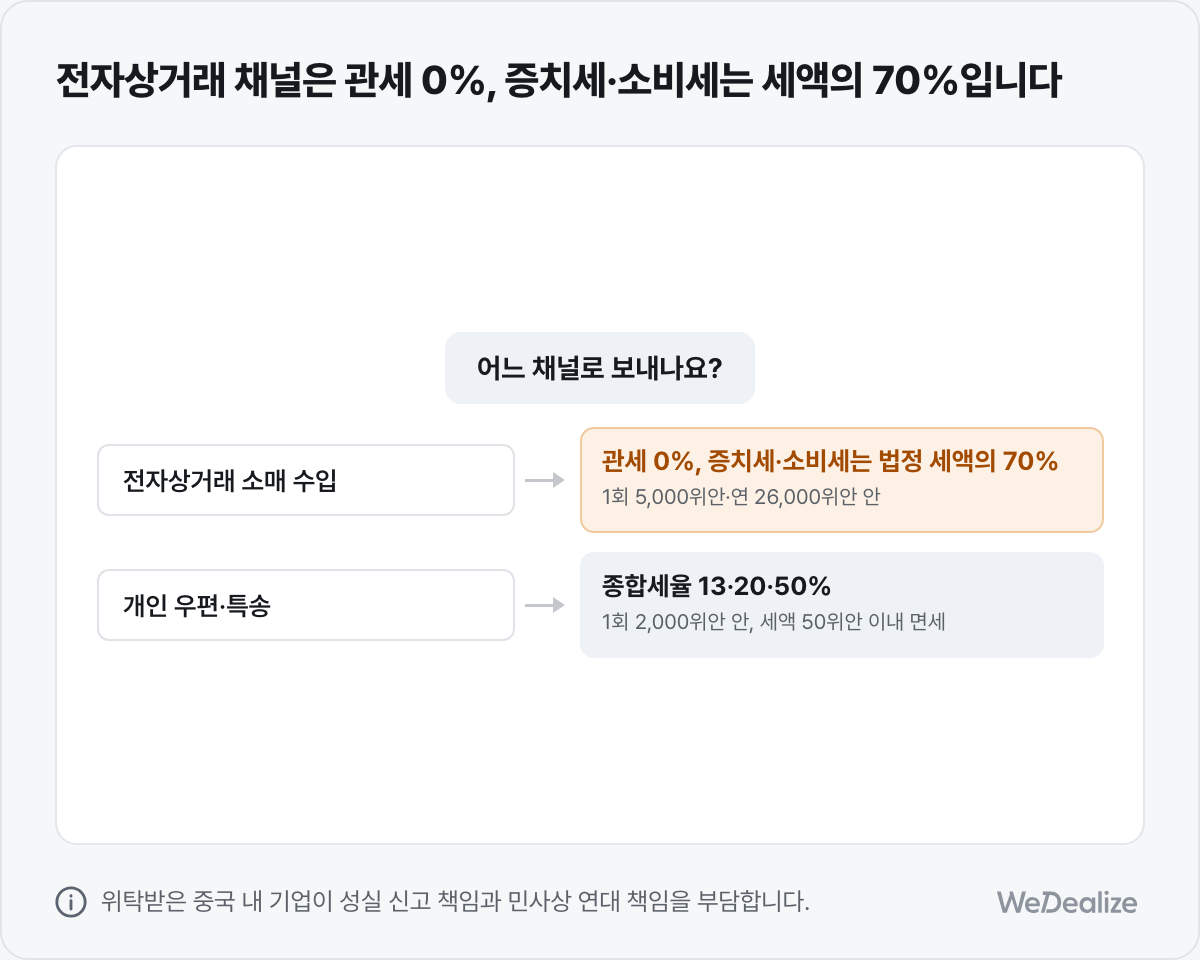
In one line — For China cross-border direct sales through the e-commerce channel (9610), customs duty is 0% up to CNY 5,000 per transaction and CNY 26,000 per year, while VAT and consumption tax are payable at 70% of the statutory tax amount. For personal postal or express items outside this channel, a comprehensive tax rate of 13%, 20%, or 50% applies to items up to CNY 2,000 per transaction, with tax waived when the tax amount is CNY 50 or less.
Scope of this article — This article covers sending Korean products to Chinese consumers by international express or postal service for each order (cross-border direct sales). See another article for — Korean export declarations, simplified export declarations, and zero-rated VAT → Overseas Direct Shipping Guide · Return collection → Overseas Return Handling Guide
Check first
How are you selling? — This article covers cross-border direct sales sent by international express or postal service for each order. If you borrow the name of a Chinese company as the importer or import and sell under the name of a company established in China, see China Sales Guide — Local Sales. If you sell to a Chinese distributor or importer, that company imports the goods → Export Guide by Product Category
Which channel are you using to ship? — To use the e-commerce channel, you must sell through a platform connected to customs, or the express or postal operator must submit transaction information to customs. See “Ways to Sell in China” below.
Do you have a contract company in China? — To use the e-commerce channel, an overseas seller must entrust declarations to one Chinese company. See “Importer” below.
Is the product included in the List of Cross-Border E-Commerce Retail Imported Goods? — The e-commerce channel tax treatment applies only to products on this list. The list currently in use is the 2019 version effective from 2020-01-01, which was adjusted once on 2022-03-01.
Is it a quarantine or prohibited item? — Goods in the e-commerce channel are also subject to quarantine, and prohibited or restricted goods cannot be shipped. See “Certification and Labeling” below.
Order of tasks
Decide whether to ship through the e-commerce channel or as a personal postal or express item → Ways to Sell in China
Calculate taxes using the limits and tax rates for each channel → Customs Duty and Taxes
For the e-commerce channel, select a contract company in China and confirm the platform, logistics provider, or declaration company that will collect taxes on behalf of the buyer → Importer
Display a risk notice on the order page and obtain the consumer’s consent → Certification and Labeling
State the terms for returns, exchanges, and recalls on the product page → Withdrawal and Returns
Ways to Sell in China
E-commerce retail imports (direct purchase 9610) — This refers to consumers in China purchasing overseas goods through a cross-border platform and bringing them into China through bonded warehouse release (1210) or overseas direct purchase (9610). Goods sent from Korea for each order may qualify for the direct purchase (9610) channel if they satisfy the requirements for platform transactions, the product list, and personal use.
Requirements for using this channel — A platform connected to customs must be able to cross-check the three types of information—transaction, payment, and logistics information (the “three orders”). If it is not an integrated platform, the express or postal operator must undertake to provide this electronic information in a consolidated form and accept legal responsibility. If the electronic information cannot be submitted, this channel’s tax treatment cannot be used, and the current regulations apply.
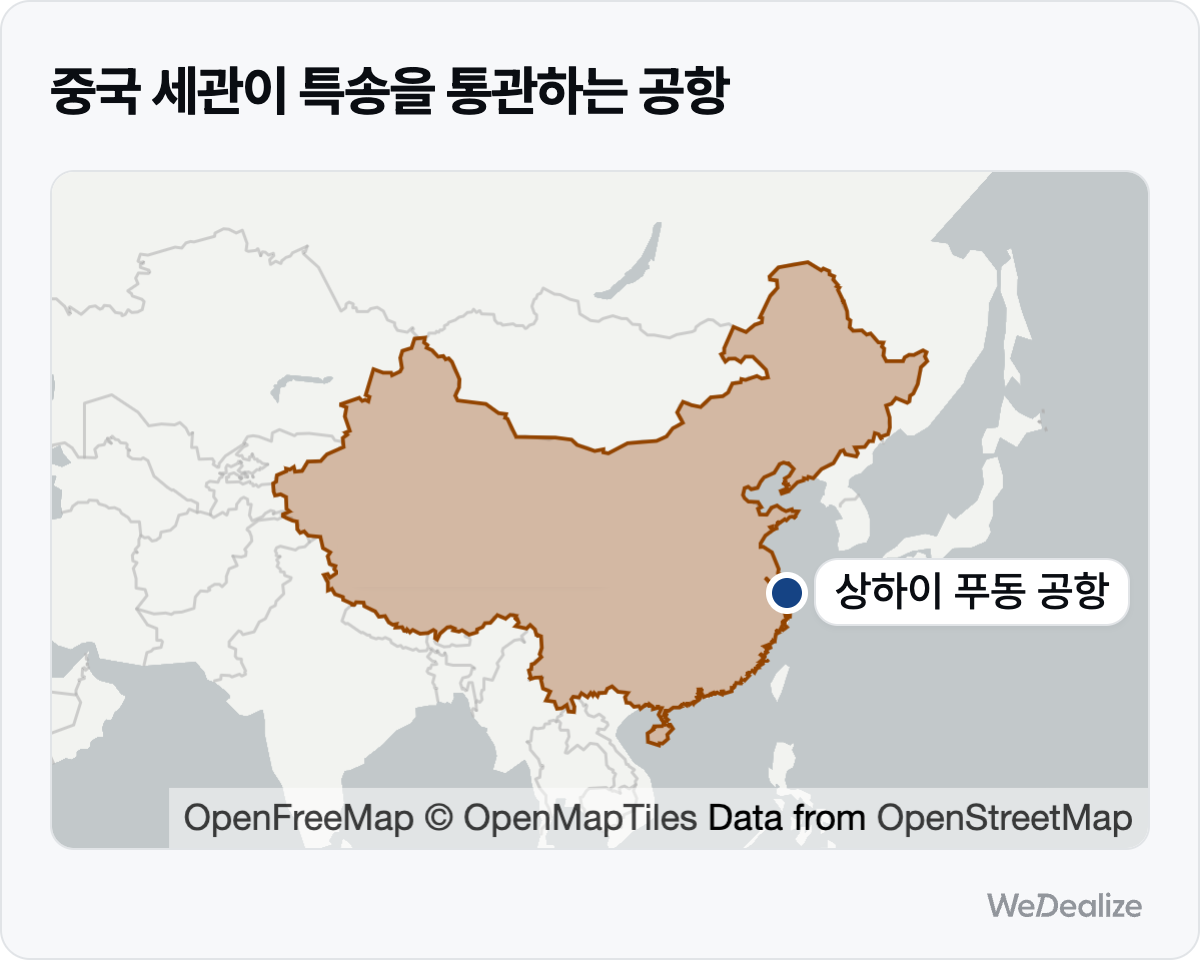
Carrier for the direct purchase channel — To ship through the direct purchase (9610) channel, the logistics provider must be a postal enterprise or an express company that has completed registration for filing declarations through an agent with customs.
Personal-use postal and express items (寄递物品) — The applicable standard is the “Measures for the Collection of Customs Duty, VAT, and Consumption Tax on Articles Entering China,” which took effect on December 1, 2024. Under these measures, postal and express items are personal-use goods, and cross-border e-commerce retail imported goods are excluded (International Express, Express Customs Clearance).
Customs Duty and Taxes
E-commerce retail import channel
Tax rates — Within the limit of CNY 5,000 per transaction and CNY 26,000 per individual per year, customs duty is 0%. Import VAT and consumption tax are payable at 70% of the statutory tax amount, with no tax-free threshold.
Taxable value — The actual transaction value, including the product sale price, freight, and insurance, is the taxable value.
A single item exceeding the per-transaction limit — Even if the taxable value exceeds CNY 5,000, the item may be imported through this channel if the order contains only one item and remains within the annual limit. However, customs duty, VAT, and consumption tax are payable in full at the product-specific rates.
An order exceeding the per-transaction limit — If a single transaction exceeds CNY 5,000, it is fully taxed under the general trade method. An order containing only one item is subject to the exception described immediately above.
If the annual limit is exceeded — If the annual total exceeds CNY 26,000, the goods are handled as general trade.
Personal-use postal and express items
Per-transaction limit — Under a General Administration of Customs announcement, the per-transaction limit for postal and express items sent by an individual from overseas into China is CNY 2,000.
Limit — If postal or express items totaling no more than CNY 2,000 are confirmed to be a reasonable quantity for personal use, customs duty, VAT, and consumption tax are collected together under simplified procedures. The same applies when the value exceeds CNY 2,000 if the item is a single indivisible article.
Comprehensive tax rates — Category 1 is 13% (books, IT products, food, beverages, furniture, toys, pharmaceuticals, etc.), and Category 2 is 20% (sports equipment, textile products, bicycles, and goods not included in Categories 1 or 3). Category 3 is 50% and covers tobacco, alcoholic beverages, precious-metal jewelry, golf equipment, luxury watches, luxury cosmetics, and batteries. The scope of Category 3 items is the same as the scope subject to China’s consumption tax.
Tax exemption up to CNY 50 — Postal and express items with a tax amount of no more than CNY 50 are cleared duty-free. Goods within the tax exemption limit are for personal use only and may not be used for commercial purposes.
If the reasonable quantity for personal use is exceeded — Goods exceeding a reasonable quantity for personal use are taxed as imported cargo. Selling or lending the goods is not considered personal use.
Importer
The buyer is the taxpayer — In the e-commerce channel, the individual who purchases the goods is the taxpayer. Therefore, the buyer is the party on the importer side.
Collection of taxes by an agent — One of the customs-registered platform, logistics, or declaration companies collects and pays the taxes on behalf of the buyer and submits a tax guarantee to customs.
The recipient is the taxpayer for personal postal and express items — For personal items outside the e-commerce channel, the recipient is the taxpayer, and the tax is paid before the goods clear customs and are released.
Contract company in China — Because an overseas seller (跨境电商企业) must entrust one enterprise registered for industry and commerce in China, first select the company that will handle customs registration and declarations.
Orderer and payer — If the orderer’s identity has not been authenticated by the authorities or an institution authorized by them, the orderer and payer must be the same person. The platform and the contract company in China verify the orderer’s identity.
Personal information — Even when handling the personal information of Chinese consumers in Korea for the purpose of selling to them, you must comply with China’s Personal Information Protection Law. In this case, establish a dedicated organization in China or appoint a representative, and notify the authorities of its name and contact details.
Certification and Labeling
Supervision as personal-use goods — E-commerce retail imported goods are supervised as goods brought in for personal use. Requirements for an initial import permit, registration, or filing (备案, a procedure for making a prior report to the authorities) do not apply. Exceptions are goods from regions affected by infectious diseases for which the relevant authorities have suspended imports, and goods for which emergency measures have been initiated due to serious quality or safety risks.
Quarantine and prohibited items remain subject to the rules — Customs conducts quarantine inspections of goods in this channel and their containers and packaging in accordance with the law. Goods that harm public health or biosafety, food or product safety, or intellectual property rights, as well as other prohibited or restricted goods, cannot be shipped.
Food that cannot be brought in by postal service, express, or direct purchase — Under the catalog issued by China’s Ministry of Agriculture and Rural Affairs and the General Administration of Customs, meat and meat products, dairy products, egg products, and fresh fruits and vegetables cannot be brought in by postal service, express, or direct purchase (9610). Dairy products include cheese, butter, and fermented milk, while egg products include mayonnaise. Aquatic products cannot be brought in, except for dried or cooked products and edible sauces made through fermentation. The catalog does not apply if approval is obtained from the authorities and a quarantine certificate issued by a government agency of the exporting country is provided.
Risk notice — The seller, together with the platform, must display a risk notice in a prominent place, such as the order screen. The consumer must be required to agree to the notice before placing an order.
What to include in the notice — State that the goods comply with the standards of their country of origin but may differ from Chinese standards, and that the consumer bears the resulting risks. Also state that a Chinese label may not be present, a Chinese electronic label may be available on the website, and the goods are for personal use only and may not be resold.
No resale — Goods purchased by consumers are final products for personal use and may not be resold in the Chinese market.
Withdrawal and Returns
Seller’s consumer rights responsibilities — The seller is responsible for disclosing product information, providing return and exchange services, operating a recall system for defective or faulty goods, and compensating for quality problems. If a risk is identified, the seller must stop sales, conduct a recall, and report it to customs and other relevant authorities.
When selling food through the e-commerce channel — The seller must entrust a food production or operation enterprise in China with the recall and report that enterprise’s information to the platform. If a risk is identified, the seller must stop sales and notify that enterprise of the recall.
Taxes on returns — The contract company in China or a declaration company appointed by it applies for the return within 30 days from the date the goods are released from customs supervision in China. If the returned goods arrive at the original customs-supervised facility within 45 days, the taxes are not collected and the buyer’s annual transaction amount is adjusted. State the return conditions on the product page.
When receiving the goods back in Korea — If the goods have not been manufactured, processed, repaired, or used overseas and are re-imported within 2 years from the date the export declaration was accepted, they may qualify for re-import duty exemption. The exemption does not apply if the goods or their raw materials received a customs duty reduction or exemption or a refund.
Connect through WeDealize
The process of shipping orders from an integrated overseas marketplace from the Korea center to China by express is outlined in the Overseas Direct Shipping Guide.
Shipping and Customs Clearance Tips
Enter the actual sale price on the invoice — For personal postal and express items, customs determines the taxable value based on the actual purchase price. Foreign-currency prices are converted into CNY using the exchange rate on the date the declaration is completed.
The tax rate is based on the date the declaration is completed — If the comprehensive tax rate changes during the relevant period, the rate on the date the declaration is completed, not the shipping date, applies.
Goods may be released first against an express company’s guarantee — A postal or express operator may provide a tax guarantee and apply for the goods to be released before the tax is paid.
Special rules for books, recordings, and video materials take priority — If separate rules apply to the taxation or exemption of printed matter, recordings, or video materials, those rules must be followed.
Common Mistakes
Misconception: “There are no taxes in the e-commerce channel.” — Incorrect. Only customs duty is 0%. VAT and consumption tax are payable at 70% of the statutory tax amount.
Misconception: “Postal shipments are tax-free up to CNY 50.” — Incorrect. CNY 50 refers to the tax amount, not the product price. For a product subject to the 13% rate, a taxable value of approximately CNY 384 or less results in a tax amount of no more than CNY 50.
Misconception: “Chinese certification and registration are all exempt in the e-commerce channel.” — Not necessarily. Initial import permits, registration, and filing do not apply. However, the seller still bears responsibility for quality and safety, recalls, and compensation, and must display a risk notice.
Items Not Confirmed
Scope of application of the E-Commerce Law to overseas sellers — Whether China’s E-Commerce Law also applies to overseas sellers is not clearly stated in the provisions, so confirm with a local Chinese legal professional.
Freight and insurance in the taxable value of postal and express items — Confirm in the General Administration of Customs announcement on calculation principles whether freight and insurance are included in the taxable value of personal postal and express items.
Consumers’ 7-day unconditional return right — Confirm in guidance from the State Administration for Market Regulation whether the 7-day unconditional return right under China’s Law on the Protection of Consumer Rights and Interests applies to cross-border direct sales by overseas sellers.
Related Terms
De minimis threshold in the country of sale — The threshold amount below which the country of sale exempts imported goods from customs duties and taxes.
DAP (Delivered at Place) — A term under which delivery takes place at the place of destination before unloading, and the seller does not unload the goods.
Customs broker — A customs professional who, at the request of cargo owners and others, handles export and import declarations and calculates customs duties and taxes.
Export declaration — The procedure of declaring to customs the name, quantity, price, and other details of goods to be exported overseas.
Simplified export declaration (e-commerce) — A simplified declaration that reduces the items required in a formal export declaration, mainly used for low-value e-commerce exports.
Zero-rated VAT — A system under which a 0% value-added tax rate is applied to exported goods. The value-added tax paid on purchases (input tax) is deducted from output tax, and any remaining amount becomes a tax refund.