China Sales Guide — Local Sales
Automatically translated from Korean.
In brief — The consignee on an import declaration in China must be a company or organization established in China and registered with customs. If you do not have a company in China, you can borrow the importer-of-record status of a Chinese company or sell to a Chinese distributor. When goods are imported, the consignee pays customs duties. Import VAT is 13% of the total of the customs value, customs duty, and consumption tax; goods specified by law, such as agricultural products and books, are subject to 9%.
Scope of this guide — Importing and selling by borrowing the importer-of-record status of a Chinese company; importing and selling under a company established in China See also — Sending each order by express courier or post (including cross-border e-commerce direct purchases under 9610) → China Sales Guide — Cross-Border Direct Sales · Cosmetic registration and filing → China Cosmetics Export Guide
First, check the following
How will you import? — The consignee (the party receiving the goods) and the party responsible for paying customs duties depend on whether you have a company registered in China or are borrowing the importer-of-record status of a Chinese company. If you sell to a Chinese distributor or importer, that company imports the goods → Export Guides by Product
Do you have a company registered in China? — Customs registration and designation as the consignee on an import declaration require the status of a market entity in China, such as a company registered to conduct business in China. See “Importing and selling under our company’s name” below.
Do you have only a representative office? — A representative office of a foreign company cannot sell in China. See “Importing and selling under our company’s name” below.
Is the product subject to certification or registration? — Products on the CCC (China Compulsory Certification) list, cosmetics, and food are subject to certification, registration, or filing (备案, a procedure for making a prior filing with the authorities). See “Certification and labeling” below.
Order of tasks
Decide whether to borrow a Chinese company’s importer-of-record status or establish a company in China → Ways to sell in China
Confirm the market-entity registration and customs registration of the company that will be the consignee → Importing and selling under our company’s name
If the product is subject to certification or registration, decide who will apply and complete the process before importing → Certification and labeling
Confirm who will pay customs duties and import VAT and how VAT on domestic sales in China will be handled → Customs duties and taxes
If selling online, prominently indicate products that cannot be returned and obtain the consumer’s confirmation at the time of purchase → Cancellation and returns
Ways to sell in China
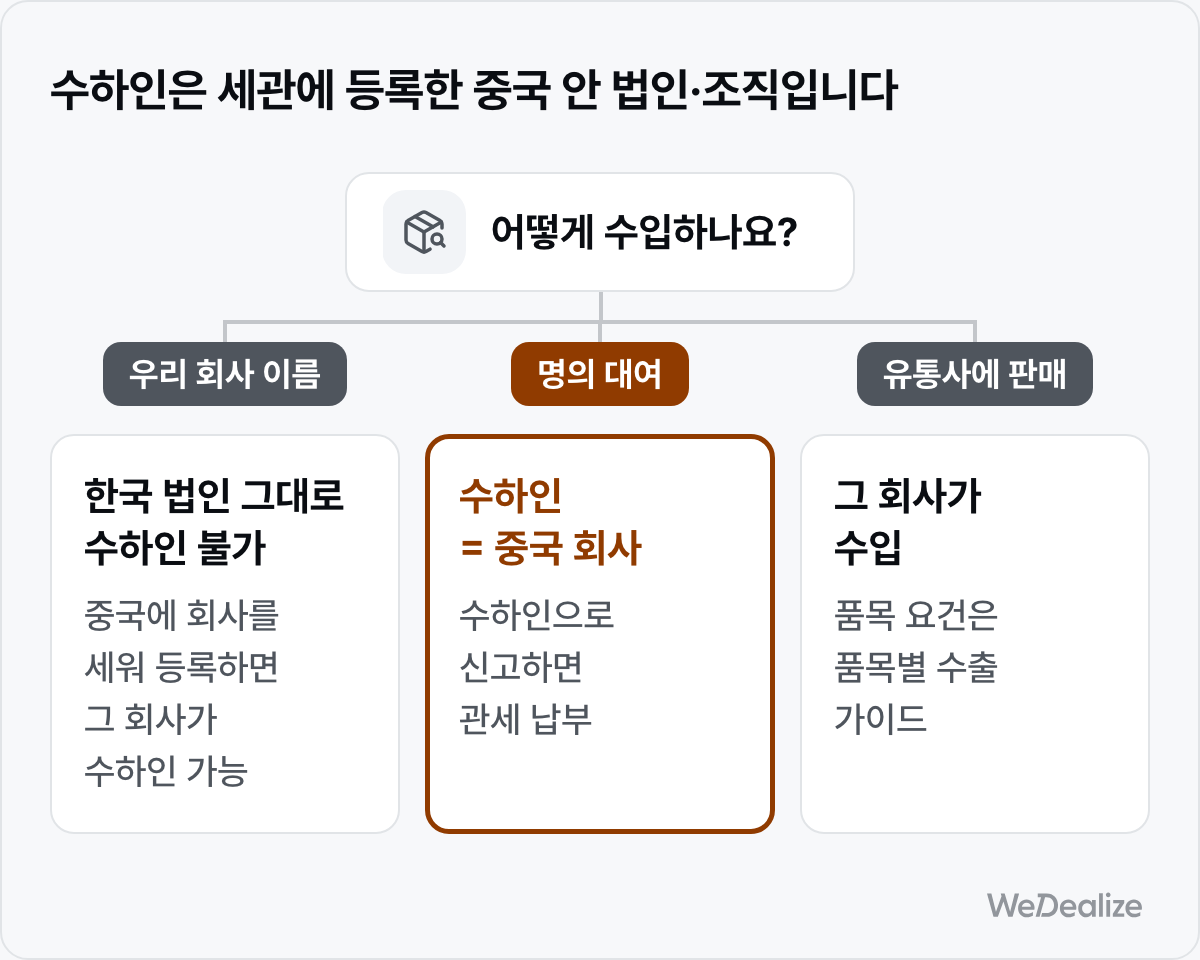
Importing under our company’s name — A Korean legal entity itself cannot be the consignee. If you establish and register a company in China, that company can be the consignee. See “Importing and selling under our company’s name.”
Borrowing an importer’s name — A Chinese foreign-trade operator accepts an entrustment and handles the import procedures, declaring its own company as the consignee. See “Importing and selling by borrowing an importer’s name.”
Customs duties and taxes
When importing
Customs duties — Under China’s Customs Law, the consignee of imported goods is the customs-duty taxpayer.
Customs value — The customs value (the amount used as the basis for calculating customs duty) is determined by adding freight, related costs, and insurance premiums incurred up to unloading at the place of importation in China to the transaction value.
Import VAT — Under China’s VAT Law, an organization or individual importing goods is the taxpayer, and customs collects the tax on its behalf. The tax rate is 13%.
Goods subject to 9% — Goods specified by law, including agricultural products, edible vegetable oil, edible salt, books, newspapers, magazines, audio recordings, video products, and electronic publications, are subject to 9%.
VAT calculation — Multiply the tax rate by the total of the customs value, customs duty, and consumption tax. If the State Council provides otherwise, those provisions apply.
Consumption tax — An organization or individual importing goods subject to consumption tax is the consumption-tax taxpayer, and customs collects the tax on its behalf.
Payment deadline — The taxpayer must pay the taxes within 15 days from the date the declaration is completed. If the conditions prescribed by customs are met and security is provided, taxes may be paid in a lump sum by the fifth working day of the following month. If payment is late, a surcharge for overdue payment of 0.05% of the unpaid tax amount per day (万分之五) is added. Import VAT and consumption tax collected by customs on behalf of the tax authority are subject to the same collection rules.
When selling in China
Domestic sales in China — When goods are sold, the transaction is taxable in China if the place where transportation of the goods begins or where the goods are located is in China. An organization or individual conducting taxable transactions in China is a VAT taxpayer.
When sold by a foreign company — If a foreign organization or individual conducts taxable transactions in China, the buyer withholds and pays the VAT on its behalf. An exception applies if, under State Council regulations, filing and payment are entrusted to an agent in China.
Importing and selling under our company’s name
This applies when a company is established in China, goods are imported under that company’s name, and then sold in China. This method cannot be used by the Korean legal entity itself.
Eligibility to be the consignee — Under the General Administration of Customs of China rules for completing import declarations, the consignee field must contain a company or organization established in China that is registered with customs and enters into and performs the import contract.
Customs registration — Under China’s Customs Law, a consignee must be registered with customs to submit an import declaration. Under the General Administration of Customs rules on registration of declaration entities, a consignee must have market-entity status to register with customs. When registering with customs, the consignee submits the Registration Information Form for Customs Declaration Entities (报关单位备案信息表). If the documents are complete and the registration requirements are met, customs completes the registration within three working days after review.
Market-entity registration — Market entities include companies and branches of foreign companies that conduct business for profit in China. A business cannot be operated under the name of a market entity unless it is registered. An exception applies when laws or administrative regulations provide that registration is not required. Upon registration, a business license (营业执照) is issued.
Abolition of foreign-trade operator registration — The registration of foreign-trade operators was abolished by the amendment to the Foreign Trade Law on 2022-12-30. From that date, the commerce authorities no longer accept this registration, and relevant authorities do not require registration documents.
Representative offices — A representative office of a foreign company (常驻代表机构) does not have legal-person status and may not conduct for-profit activities. Treaties or agreements concluded or joined by China may provide otherwise. If a representative office engages in imports or exports other than trade, it must register temporarily with customs, and that registration is valid for one year.
Declaration deadline — Under the Customs Law, the consignee must submit an import declaration within 14 days from the date on which the means of transport declares its entry into China. If the declaration is late, customs collects a late declaration fine. If no declaration is submitted even after three months, customs sells and disposes of the goods.
Late declaration fine — A fine of 0.05% of the customs value per day accrues from the 15th day after the date on which the means of transport declares entry until the date customs receives the declaration.
Using a customs broker — The consignee may entrust a 报关企业 (customs declaration enterprise, a company that handles customs clearance on its behalf) with the declaration and tax payment. The entrusting party must truthfully provide the customs declaration information to that company.
Liability of the customs declaration enterprise — If a customs declaration enterprise files a declaration in the taxpayer’s name and violates the rules, resulting in undercollection of taxes, it bears joint and several liability with the taxpayer for the taxes and late-payment surcharges. If the customs declaration enterprise files in its own name, it bears joint and several liability with the taxpayer for payment of the taxes.
Importing and selling by borrowing an importer’s name
This applies when no company is established in China and a Chinese company becomes the consignee and imports goods for our company.
Import agency — Under China’s Foreign Trade Law, a foreign-trade operator may, upon entrustment by another party, handle foreign-trade business on that party’s behalf within its business scope.
Customs-duty taxpayer — If the company lending its name declares itself as the consignee, that company is also the customs-duty taxpayer (“Customs duties and taxes”). The requirements for being a consignee are the same as those under “Importing and selling under our company’s name.”
Import VAT taxpayer — In an entrusted import, the company named as the taxpayer on the customs VAT payment certificate is the VAT taxpayer. If the payment certificate bears the agent company’s name, VAT is imposed on the agent company; if it bears the name of the entrusting company, VAT is not imposed on the agent company.
Certification and registration entity — CCC certification may be handled by the importer. For cosmetics, the Chinese enterprise legal person designated by the overseas registrant or filing applicant handles the registration or filing. Decide who will handle it in the contract (“Certification and labeling”).
VAT on sales — If our company is the party selling in China, check the requirements under “When selling in China.”
Certification and labeling
CCC certification — Products on the list designated by the state may be released, sold, or imported only after obtaining certification and displaying the certification mark. The manufacturer, seller, or importer entrusts certification to a designated certification body.
Cosmetics — Registration and filing — Special cosmetics for hair coloring, perming, whitening (including spot reduction), sun protection, or hair loss prevention, as well as cosmetics claiming new functions, may be imported only after registration with the National Medical Products Administration (NMPA). General cosmetics must be filed with the NMPA before importation.
Cosmetics — Designation of a Chinese enterprise legal person — An overseas registrant or filing applicant must designate an enterprise legal person in China to handle the registration or filing and assist with adverse-reaction monitoring and product recalls.
Cosmetics — Importer review and labeling — The importer must review whether registration or filing has been completed and whether the applicable standards are met. If they are not met, the cosmetics cannot be imported. Cosmetics must have a label on each minimum sales unit. Imported cosmetics may bear a Chinese label from the outset, or an additional Chinese label may be affixed. If an additional label is affixed, its contents must be identical to those of the original label.
Food — Registration and filing — Under China’s Food Safety Law, overseas food-producing enterprises exporting food to China must register with the authority responsible for entry-exit inspection and quarantine. Overseas exporters and agents, as well as Chinese importers, must file with the same authority.
Food — Chinese labels — Imported prepackaged food must have a Chinese label stating the country of origin and the name, address, and contact details of the agent in China. It cannot be imported if it lacks a Chinese label or if the label does not comply with the regulations.
Labeling of other products — Under China’s Product Quality Law, products or their packaging must display, in Chinese, the product name and the name and address of the production factory. The labeling of products sold by sellers must also comply with this standard.
Cancellation and returns
Seven-day no-reason returns — Under China’s Law on the Protection of Consumer Rights and Interests, when goods are sold online, through television, by telephone, by mail, or through similar means, consumers may return them without giving a reason within seven days from the date of receipt.
Exceptions — Exceptions include made-to-order goods; fresh or perishable goods; digital products downloaded online or opened by the consumer; and delivered newspapers and magazines. Goods that are unsuitable for return due to their nature and for which the consumer confirmed this at the time of purchase are also excluded.
Indicating exceptions — Under the Regulation on the Implementation of China’s Law on the Protection of Consumer Rights and Interests, sellers must prominently indicate goods that cannot be returned and require consumers to confirm this at the time of purchase. Sellers may not arbitrarily expand the scope of goods excluded from returns or make the exclusion a preselected consent option. If the consumer did not confirm it, the seller may not refuse a no-reason return. Even if the consumer opened the package to inspect it or reasonably tested it to check its quality or functions, the seller must accept the return if the original quality, functions, and appearance have not been affected.
Refunds and shipping costs — Returned goods must be intact. The seller refunds the payment within seven days from the date it receives the returned goods. The consumer bears the return shipping cost unless otherwise agreed, in which case the agreement applies.
Connect through WeDealize
Sales in which each order is dispatched by express courier from a Korean center to China are covered in China Sales Guide — Cross-Border Direct Sales and Overseas Direct Shipping Guide.
Common mistakes
Misconception: “Goods can be declared for import into China under the Korean company’s name.” — No. The consignee must be a company or organization established in China and registered with customs.
Misconception: “Establishing a representative office allows you to sell in China.” — No. A representative office may not conduct for-profit activities.
Misconception: “If you borrow a company’s name, that company automatically handles certification and registration as well.” — Not necessarily. For cosmetics registration and filing, the Chinese enterprise legal person designated by the overseas registrant or filing applicant handles the process. See “Certification and labeling” above.
Not yet confirmed
Entrusting party’s liability when borrowing a name — Confirm with a Chinese customs agency or local attorney what liability the Korean company entrusting imports to a Chinese company bears before customs and tax authorities.
Input VAT credit when borrowing a name — Confirm with the Chinese tax authorities or a tax accountant who may claim the import VAT paid through an import agent as an input VAT credit.
Sales in China by a Korean Company Without a Legal Entity — Confirm with the Chinese market regulation authorities or a local attorney whether the Korean company can sell inventory imported under another party’s name directly within China.
Related Terms
IOR (Importer of Record) — The party that imports goods into the country of sale and bears primary responsibility for paying customs duties.
Customs Broker — A customs professional who handles import and export declarations, customs duty calculations, and other related matters on behalf of cargo owners and others.
Customs Value — The customs value is the amount used as the basis for calculating customs duties. It is the transaction value adjusted by adding specified amounts, such as freight and insurance, to the price of the goods actually paid or payable by the buyer.